Beach Tourism Market Size
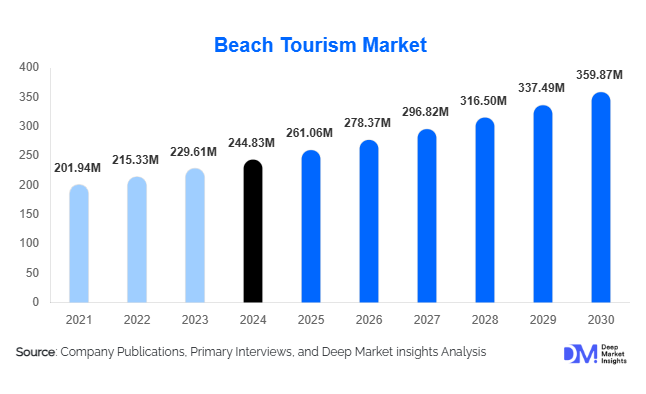
According to Deep Market Insights, the global beach tourism market size was valued at USD 244.83 billion in 2024 and is projected to grow from USD 261.06 billion in 2025 to reach USD 359.87 billion by 2030, expanding at a CAGR of 6.63% during the forecast period (2025–2030). The beach tourism market is thriving due to rising global disposable incomes, strong post-pandemic travel recovery, increasing adoption of experiential and wellness beach travel, and continuous investments in coastal infrastructure and premium beachfront accommodations. Growing interest in sustainable coastal destinations and eco-certified beaches is further driving traveler demand and global competitiveness among beach destinations.
Key Market Insights
- Premium beachfront accommodations such as integrated resort complexes and luxury villas are driving high-value spending, supported by rising demand from affluent travelers.
- Eco-conscious travel is reshaping beach tourism, with more tourists preferring Blue Flag–certified beaches, marine conservation programs, and low-impact coastal activities.
- Asia-Pacific leads global growth, driven by expanding middle-class wealth in China, India, Southeast Asia, and booming domestic coastal travel.
- Europe remains the largest traditional hub, led by Spain, Italy, Greece, and Portugal, with mature infrastructure and high repeat tourism rates.
- North America demonstrates strong outbound demand toward Caribbean, Mexican, and Mediterranean destinations.
- Technology adoption, including AI-driven trip planning, mobile in-destination booking, and digital experience marketplaces, is transforming beach holiday planning and experiential engagement.
What are the latest trends in the beach tourism market?
Premiumization and Experience-Led Beach Travel
Beach travel is shifting from generic sun-and-sand holidays toward curated, experience-driven itineraries. Luxury travelers increasingly opt for upscale beachfront stays featuring private villas, signature dining, yacht excursions, and tailored wellness therapies. Experiences such as coral-reef restoration, private surf coaching, and curated cultural immersion programs are gaining traction. Many destinations are developing multi-experience packages combining adventure, gastronomy, and wellness to maximize visitor spending and differentiate from traditional beach offerings.
Sustainable and Eco-Certified Beach Tourism
Growing environmental awareness is driving demand for sustainable and certified beach destinations. Blue Flag beaches, plastic-free zones, marine-protected areas, and carbon-neutral accommodations are becoming competitive differentiators. Operators are adopting eco-friendly waste management, renewable energy, and environmentally sensitive construction. Travelers, especially from Europe and APAC, increasingly factor sustainability ratings into destination selection, and many are willing to pay premiums for eco-certified beachfront experiences. Collaborative conservation tourism models, such as turtle-protection programs and coral nurseries, are becoming mainstream.
What are the key drivers in the beach tourism market?
Rising Disposable Incomes and International Travel Recovery
The expansion of the global middle class, combined with strong post-pandemic travel recovery, is fueling demand for domestic and international beach holidays. Increasing affordability of air travel and the rise of low-cost carriers are enabling new traveler segments to access coastal destinations. Popular beach hubs across Europe, APAC, the Caribbean, and the Mediterranean are reporting record-breaking visitor volumes driven by pent-up travel demand and enhanced connectivity.
Growing Demand for Wellness, Adventure, and Niche Coastal Experiences
Tourists are increasingly seeking purpose-driven travel that integrates wellness, adventure, and cultural enrichment. Demand is rising for wellness retreats, beachfront yoga resorts, surf camps, scuba diving tours, and eco-adventure packages. Experiential segments such as culinary beach tours, island-hopping, marine wildlife encounters, and heritage-focused coastal circuits are expanding rapidly. Operators are responding with personalized itineraries that combine relaxation, exploration, and immersive coastal culture.
Digital Transformation and Seamless Travel Experience
Online booking platforms, AI-based itinerary planners, virtual beach previews, and mobile-first in-destination services are accelerating beach tourism adoption. Travelers now use apps to reserve beach cabanas, book excursions, arrange private transfers, and explore restaurant recommendations. Real-time capacity management for beaches, dynamic pricing for hotels, and digital concierge services are enhancing convenience and driving higher spend per visitor.
What are the restraints for the global market?
Climate Vulnerability and Coastal Erosion
Beach destinations face significant risks from climate change, including sea-level rise, coral bleaching, extreme weather events, and coastal erosion. These factors can lead to beach degradation, infrastructure damage, reduced attractiveness, and rising insurance and operational costs. Destinations lacking robust coastal management and resilience planning face reduced long-term viability and competitiveness.
Seasonality and Infrastructure Constraints
Many beach tourism hubs experience strong seasonality, leading to overcrowding during peak months and limited demand in off-peak periods. Insufficient airport capacity, inadequate wastewater treatment, congestion in coastal towns, and limited accommodation supply restrict potential growth. Developing and emerging beach destinations particularly face infrastructure gaps that raise operational costs and limit scalability.
What are the key opportunities in the beach tourism industry?
High-Value Experience Packaging & Luxury Upscaling
There is a strong opportunity in designing integrated high-value beach experiences combining luxury stays, fine dining, adventure water sports, wellness programs, and exclusive cultural activities. Upscale beach tourism continues to outperform, with travelers willing to spend on personalized services, private transfers, boutique resorts, and curated itineraries. Destinations investing in premium infrastructure, marinas, spas, boardwalks, and yacht tourism can capture greater value per visitor.
Sustainable Destination Development & Blue Economy Growth
Eco-tourism presents an immense opportunity as destinations adopt conservation-driven models. Investments in coral restoration, marine protected areas, clean energy resorts, and sustainable waste management enhance long-term competitiveness. Community-led beach tourism initiatives, such as local craft markets, homestays, and certified eco-guides, support inclusive growth while strengthening cultural authenticity. Governments focusing on blue economy strategies can leverage tourism to finance marine conservation and sustainable coastal development.
Product Type Insights
Luxury beach tourism dominates the market, driven by high-value travelers seeking private beachfront villas, premium resort experiences, curated excursions, and wellness retreats. Mid-range beach tourism appeals to large family and couple segments with standardized offerings, reliable amenities, and affordable packages. Budget beach tourism continues expanding among youth and backpackers, supported by hostels, shared accommodations, and low-cost transport. The rise of self-guided coastal exploration, including road trips and self-booked island-hopping, is also contributing to growth across budget and mid-tier categories.
Application Insights
Leisure and relaxation travel remains the primary application, accounting for the majority of beach tourism demand. Adventure applications such as surfing, scuba diving, and parasailing are expanding rapidly, driven by interest in specialized skill-based travel. Wellness applications, including yoga retreats, spa therapies, and detox programs, are experiencing strong growth due to rising global wellness awareness. Cultural and eco-volunteering applications are emerging as niche categories where tourists engage in conservation, community work, and marine restoration initiatives.
Distribution Channel Insights
Online travel agencies (OTAs) and direct digital booking channels dominate beach tourism, offering transparent pricing, diverse accommodations, and easy comparison tools. Specialist coastal travel agencies continue to serve luxury and customized tour segments. Direct hotel and resort websites are gaining traction as brands offer loyalty programs, exclusive offers, and immersive virtual tours. Social media, influencers, and travel content creators play a pivotal role in shaping beach destination choices among younger demographics.
Traveler Type Insights
Couples and families represent the largest traveler group in beach tourism, drawn by guaranteed relaxation, family-friendly resorts, and convenience. Group travelers, including friends, corporate retreats, and student groups, prefer packaged experiences with cost efficiencies. Solo travelers are a rising segment seeking adventure, wellness, and self-discovery via coastal retreats. High-net-worth individuals continue to drive premium and ultra-luxury coastal travel demand.
Age Group Insights
Travelers aged 31–50 dominate demand due to high purchasing power and preference for mid-range and luxury beach experiences. Travelers aged 18–30 drive budget and adventure segments, leveraging digital platforms for deals and group travel. Older travelers (51–65 and above) contribute significantly to premium beach tourism, valuing wellness, comfort, and guided experiences with high safety standards.
| By Product Type | By Application | By Distribution Channel |
|---|---|---|
|
|
|
Regional Insights
North America
North America is among the largest outbound markets for beach tourism, with strong demand for the Caribbean, Mexico, Hawaii, and Mediterranean destinations. High disposable incomes, preference for luxury resorts, and interest in wellness and adventure packages support market expansion. Digital-first planning and loyalty-driven hotel bookings are particularly strong among U.S. travelers.
Europe
Europe remains one of the most mature and high-value beach tourism regions, led by Spain, Greece, Italy, Portugal, and Turkey. Strong intra-EU travel, extensive coastal infrastructure, and high repeat visitation contribute to stable growth. European travelers also lead demand for eco-certified destinations, sustainable accommodations, and low-impact coastal tourism experiences.
Asia-Pacific
Asia-Pacific is the fastest-growing region, with rising demand from China, India, Southeast Asia, Japan, and Australia. Expanding middle-class wealth, affordable air travel, and booming domestic tourism are driving coastal travel. APAC hosts many of the world’s fastest-growing beach destinations, including Thailand, Indonesia, Vietnam, and the Philippines.
Latin America
Beach tourism is expanding in Brazil, Colombia, Costa Rica, and Chile. Adventure-focused travel, surf tourism, and ecotourism are key drivers. Mexico, serving both Latin American and North American visitors, remains one of the region’s most dominant players with globally recognized beach resorts.
Middle East & Africa
The Middle East is investing heavily in luxury coastal tourism, particularly in the UAE, Saudi Arabia, and Qatar, creating new premium beachfront destinations. Africa remains home to iconic beach destinations such as Mauritius, Seychelles, Zanzibar, and Egypt’s Red Sea coast, supported by strong interest from European and Asian travelers.
| North America | Europe | APAC | Middle East and Africa | LATAM |
|---|---|---|---|---|
|
|
|
|
|
Key Players in the Beach Tourism Market
- Marriott International
- Hilton Worldwide
- Accor Group
- Hyatt Hotels Corporation
- InterContinental Hotels Group (IHG)
- Wyndham Hotels & Resorts
- Melia Hotels International
- Barceló Hotel Group
- Iberostar Group
- Minor Hotels
- Four Seasons Hotels and Resorts
- Kerzner International
- Airbnb (for beachfront rental inventory)
- Mandarin Oriental Hotel Group
- Sandals Resorts International
Recent Developments
- In March 2025, Marriott International announced the expansion of its luxury beachfront resort pipeline across Southeast Asia, with a focus on eco-integrated properties.
- In January 2025, Accor launched a new series of wellness-focused beachfront retreats across Europe and the Mediterranean aimed at premium travelers seeking rejuvenation.
- In February 2025, IHG unveiled its coastal sustainability roadmap, introducing solar-powered resort wings and plastic-free campus initiatives across Asia-Pacific.
- In April 2025, Hilton partnered with marine conservation NGOs to integrate coral restoration programs into guest activities in the Maldives and Seychelles.