Bath Toy Market Size
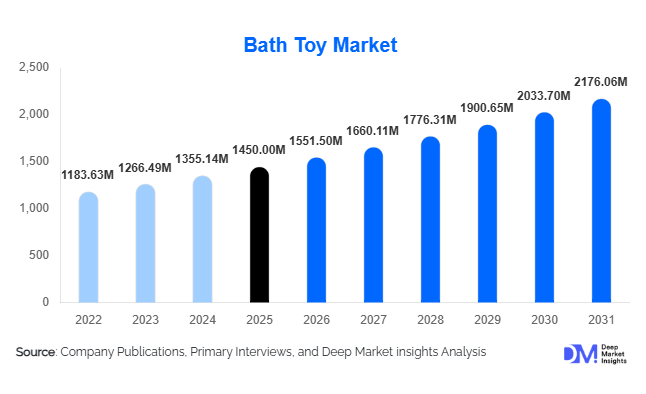
According to Deep Market Insights, the global bath toy market size was valued at USD 1,450 million in 2025 and is projected to grow from USD 1,551.50 million in 2026 to reach USD 2,176.06 million by 2031, expanding at a CAGR of 7.0% during the forecast period (2026–2031). The bath toy market growth is primarily driven by increasing parental focus on early childhood development, rising demand for safe and hygienic play products, and growing penetration of premium and eco-friendly toys across global markets.
Key Market Insights
- Demand for non-toxic, BPA-free, and mold-resistant bath toys is increasing, driven by heightened safety awareness among parents.
- Educational and developmental bath toys are gaining popularity, as parents seek products that combine play with learning outcomes.
- North America dominates the global market, supported by high consumer spending and strong brand penetration.
- Asia-Pacific is the fastest-growing region, fueled by rising middle-class income and expanding e-commerce access.
- Online retail channels are rapidly expanding, enabling direct-to-consumer sales and broader product accessibility.
- Sustainable and eco-friendly materials, including silicone and bioplastics, are reshaping product innovation trends.
What are the latest trends in the bath toy market?
Shift Toward Sustainable and Hygienic Products
One of the most prominent trends in the bath toy market is the transition toward sustainable and hygienic product designs. Consumers are increasingly concerned about mold accumulation and chemical exposure in traditional plastic toys. This has driven manufacturers to develop sealed, mold-resistant designs and use materials such as food-grade silicone and biodegradable plastics. Brands are also adopting eco-friendly packaging and pursuing certifications to align with global sustainability standards. This trend is particularly strong in Europe and North America, where regulatory pressures and consumer awareness are high, encouraging innovation in safe and environmentally responsible bath toys.
Integration of Interactive and Smart Features
The incorporation of interactive and technology-enabled features is transforming bath toys from simple play items into engaging developmental tools. Products with sound, light, and motion sensors are becoming increasingly popular, enhancing sensory stimulation and cognitive development. Some advanced bath toys now integrate app-based connectivity and STEM-focused learning elements, appealing to tech-savvy parents. These innovations are expanding the premium segment and enabling manufacturers to differentiate their offerings in a competitive market. The trend is expected to gain further traction as digital parenting tools become more mainstream globally.
What are the key drivers in the bath toy market?
Rising Focus on Early Childhood Development
Parents are increasingly prioritizing toys that contribute to cognitive, motor, and sensory development. Bath toys that incorporate educational elements such as numbers, letters, and problem-solving activities are gaining widespread adoption. This shift is particularly evident in developed markets, where early learning is a key purchasing factor. As a result, manufacturers are investing in research and development to create multifunctional toys that combine entertainment with developmental benefits.
Growing Awareness of Hygiene and Safety
Heightened awareness of hygiene risks associated with traditional bath toys has significantly influenced purchasing behavior. Concerns over mold growth and harmful chemicals have led to increased demand for sealed, easy-to-clean, and antimicrobial products. Regulatory standards related to child safety are also becoming stricter, prompting manufacturers to improve product quality and safety features. This driver has accelerated product replacement cycles and boosted demand for premium offerings.
What are the restraints for the global market?
Price Sensitivity in Emerging Markets
Despite growing demand, price sensitivity remains a key challenge in developing regions. A significant portion of consumers prioritizes affordability over advanced features, limiting the adoption of premium and eco-friendly bath toys. Manufacturers must balance cost efficiency with product quality to penetrate these markets effectively.
Stringent Safety Regulations
Compliance with global safety standards related to materials, design, and choking hazards increases production costs and complexity. Smaller manufacturers often face challenges in meeting these requirements, which can restrict market entry and innovation. Regulatory inconsistencies across regions further complicate global expansion strategies.
What are the key opportunities in the bath toy industry?
Expansion in Emerging Markets
Rapid urbanization and rising disposable incomes in countries such as India, China, and Brazil present significant growth opportunities. Increasing awareness of early childhood development and the expansion of e-commerce platforms are driving demand in these regions. Companies can capitalize on this opportunity by offering affordable, localized product lines tailored to regional preferences.
Growth of Eco-Friendly Product Segments
The demand for sustainable bath toys is creating new opportunities for innovation and premiumization. Products made from biodegradable materials and recyclable components are gaining traction among environmentally conscious consumers. Companies that invest in sustainable manufacturing processes and certifications can differentiate themselves and capture higher-margin segments.
Product Type Insights
Floating toys continue to dominate the global bath toy market, accounting for approximately 28% of total revenue in 2025. Their leadership is primarily driven by affordability, simplicity, and universal appeal across all age groups, making them a staple choice for households worldwide. Water-squirting toys hold a significant market share as well, fueled by their interactive nature, which enhances engagement during bath time and provides sensory stimulation for toddlers. Educational bath toys are among the fastest-growing segments, with growth driven by increasing parental focus on early childhood development and learning through play. Interactive and electronic bath toys are gaining traction in the premium category, leveraging technology to provide sound, light, and motion features that stimulate sensory development, support cognitive skills, and align with the growing demand for high-value, multifunctional toys.
Report Scope
| Report Metric | Details |
|---|---|
| Market Size in 2025 | USD 1450 Million |
| Market Size in 2026 | USD 1551.50 Million |
| Market Size in 2031 | USD 2176.06 Million |
| CAGR | 7.0% (2026-2031) |
| Base Year for Estimation | 2025 |
| Historical Data | 2022-2024 |
| Forecast Period | 2026-2031 |
| Report Coverage | Revenue Forecast, Competitive Landscape, Supply Chain Disruption, Growth Factors, Environment & Regulatory Landscape and Trends |
| Geographies Covered | North America, Europe, APAC, Middle East and Africa, LATAM |
| Countries Covered | U.S., Canada, U.K., Germany, France, Spain, Italy, Russia, Nordic, Benelux, Rest of Europe, China, Korea, Japan, India, Australia, Singapore, Taiwan, South East Asia, Rest of Asia-Pacific, UAE, Turky, Saudi Arabia, South Africa, Egypt, Nigeria, Rest of MEA, Brazil, Mexico, Argentina, Chile, Colombia, Rest of LATAM |
Explore more data points, trends and opportunities Download Free Sample Report
Material Type Insights
Plastic remains the leading material, contributing around 52% of the global market share in 2025. Its cost-effectiveness, ease of manufacturing, and scalability make it a preferred choice for mass-market products. However, silicone-based bath toys are rapidly gaining popularity, particularly in premium segments, due to superior hygiene, durability, and safety features. Foam-based toys maintain relevance in educational and developmental categories, offering tactile and lightweight solutions for young children. Meanwhile, sustainable materials such as bioplastics and organic rubber are emerging as key growth areas, driven by consumer awareness of environmental sustainability and stringent regulations in developed markets that favor eco-friendly product offerings.
Distribution Channel Insights
Offline retail channels, including supermarkets, specialty toy stores, and baby product outlets, account for approximately 55% of market share, benefiting from direct product visibility, immediate availability, and the ability to leverage in-store promotions. Despite this, online retail is the fastest-growing channel, propelled by convenience, wider product selection, competitive pricing, and increased penetration of e-commerce platforms in both developed and emerging regions. Direct-to-consumer (D2C) platforms are also gaining traction, enabling manufacturers to strengthen brand engagement, gather consumer insights, and improve profit margins by bypassing traditional intermediaries. The growth of online platforms is further supported by digital marketing, social media influence, and customer preference for home delivery of premium bath toys.
Age Group Insights
Toddlers aged 1–3 years represent the largest consumer segment, accounting for approximately 38% of market demand in 2025. This segment is highly engaged with bath toys due to their developmental stage, which emphasizes sensory exploration, motor skill development, and interactive play. Infants and preschool children also contribute substantially to demand, particularly for safety-focused and educational toys. Older children increasingly prefer bath toys that combine interactive learning with entertainment, which supports growth in educational and electronic toy categories.
End-Use Insights
Household consumption remains the dominant end-use segment, driven by rising birth rates, increased spending on child care products, and parental emphasis on hygiene and developmental toys. The institutional segment, including daycare centers, nurseries, and pediatric healthcare facilities, is growing at a faster pace, with a CAGR of approximately 8–9%, due to demand for durable, safe, and educational bath toys. Additionally, the hospitality industry, particularly family-oriented hotels and resorts, is emerging as a niche growth segment, offering bath toys to enhance guest experience and customer satisfaction. Export-driven demand is strong, with Asia serving as a major manufacturing hub supplying global markets, further boosting production volume and enabling competitive pricing strategies.
Explore more data points, trends and opportunities Download Free Sample Report
Bath Toy Market Segmentations
By Product Type
- Floating Toys
- Water-Squirting Toys
- Educational Bath Toys
- Interactive/Electronic Bath Toys
- Bath Activity Kits
- Mold-Resistant & Hygienic Toys
By Material Type
- Plastic
- Rubber
- Foam-Based
- Silicone
- Sustainable Materials
By Distribution Channel
- Offline Retail
- Online Retail
- Institutional Sales
By Age Group
- Infants
- Toddlers
- Preschool
- Early Childhood
By End-Use
- Household Consumption
- Institutional
- Hospitality
Regional Insights
North America
North America holds approximately 32% of the global bath toy market share in 2025, with the United States being the largest contributor. Market growth in the region is driven by high consumer spending, strong brand loyalty, and heightened awareness of product safety, hygiene, and developmental value. Premium and eco-friendly bath toys are particularly popular, fueled by parental preference for BPA-free, mold-resistant, and sustainable options. E-commerce expansion and omnichannel retailing further support accessibility, while regulatory enforcement on safety and materials encourages manufacturers to innovate and differentiate products.
Europe
Europe accounts for around 27% of the global market, with Germany, the United Kingdom, and France being the key contributors. The market is propelled by stringent safety regulations, environmental awareness, and rising consumer preference for certified, sustainable products. Growth is further supported by high urbanization, high disposable incomes, and a focus on early childhood education, driving demand for educational and premium bath toys. Online retail and D2C platforms are increasingly influencing purchasing decisions, particularly among younger, tech-savvy parents seeking convenience and product variety.
Asia-Pacific
Asia-Pacific is the fastest-growing region, largely driven by China and India, with an expected CAGR exceeding 8% over the forecast period. Rapid urbanization, rising disposable incomes, and expanding e-commerce penetration are the primary growth drivers. China dominates manufacturing and exports, while India is emerging as a high-growth consumption market due to increasing awareness of child development and organized retail penetration. Rising middle-class populations, growing parental focus on educational and safe toys, and favorable government initiatives promoting domestic manufacturing (e.g., “Make in India”) are accelerating regional demand. The proliferation of online marketplaces further enhances product availability and accessibility, supporting sustained growth.
Latin America
Latin America holds approximately 6–7% of the global market, with Brazil and Mexico being the leading countries. Regional growth is driven by expanding retail infrastructure, rising awareness of child development products, and increasing household disposable incomes. Adoption of mid-range and educational bath toys is particularly strong, supported by parents seeking affordable but safe and interactive play options. Urbanization, expanding e-commerce platforms, and marketing campaigns by global brands are further contributing to market expansion.
Middle East & Africa
The Middle East & Africa region accounts for around 5% of the global market, with the UAE and Saudi Arabia as key contributors. Market growth is fueled by increasing urbanization, high disposable incomes, and rising expatriate populations with strong purchasing power. Premium and eco-friendly bath toys are increasingly preferred, driven by consumer awareness of hygiene and safety standards. Growth is further supported by expanding retail networks, international brand presence, and government initiatives promoting early childhood development and quality standards in toys.
Key Players in the Bath Toy Market
- Mattel Inc.
- Hasbro Inc.
- Spin Master Corp.
- TOMY Company Ltd.
- VTech Holdings Ltd.
- Munchkin Inc.
- Infantino LLC
- Skip Hop Inc.
- Nuby (Luv n’ Care Ltd.)
- Boon Inc.
- Green Toys Inc.
- Chicco (Artsana Group)
- Hape International
- Yookidoo Ltd.
- Playgro Pty Ltd.