Bar Tools Market Size
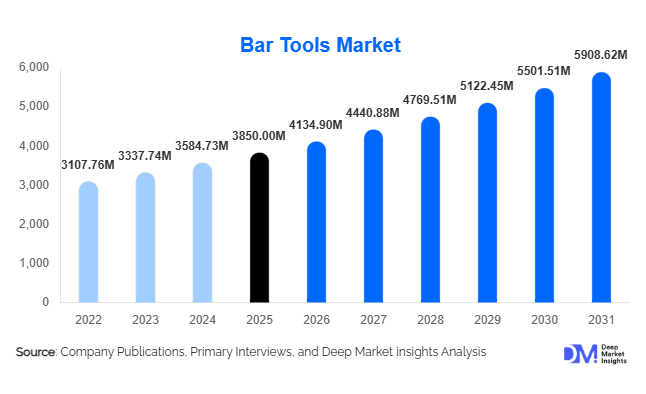
According to Deep Market Insights, the global bar tools market size was valued at USD 3,850 million in 2025 and is projected to grow from USD 4,134.90 million in 2026 to reach USD 5,908.62 million by 2031, expanding at a CAGR of 7.4% during the forecast period (2026–2031). The bar tools market growth is primarily driven by the expansion of the global hospitality industry, increasing popularity of cocktail culture, and rising demand for premium home bartending experiences. The growing number of bars, pubs, and restaurants across urban centers, combined with the surge in at-home mixology trends, has significantly boosted demand for both professional-grade and consumer-oriented bar tools globally.
Key Market Insights
- Rising cocktail culture globally is driving demand for specialized and premium bar tools across both commercial and residential segments.
- Commercial establishments dominate demand, accounting for nearly 60% of total market consumption due to bulk procurement by bars, hotels, and restaurants.
- Stainless steel tools lead the market, contributing around 45% share owing to durability, hygiene, and professional appeal.
- Online retail channels are expanding rapidly, capturing approximately 35% of global sales driven by e-commerce penetration.
- Asia-Pacific is the fastest-growing region, supported by urbanization, rising disposable incomes, and expanding nightlife culture.
- Product innovation and premiumization trends, including multi-functional tools and aesthetic designs, are reshaping market competition.
What are the latest trends in the bar tools market?
Premiumization and Aesthetic Product Design
The bar tools market is witnessing a strong shift toward premiumization, with consumers and professional bartenders increasingly opting for high-quality, visually appealing tools. Manufacturers are focusing on sleek finishes, ergonomic designs, and luxury packaging to enhance user experience. Premium kits that combine functionality with aesthetics are gaining popularity, especially among home bartenders who value presentation as much as performance. This trend is also supported by the rise of social media, where visually appealing cocktail preparation setups drive consumer purchasing decisions. Limited-edition collaborations and branded toolkits are further strengthening premium positioning.
Growth of Home Bartending and DIY Mixology
The surge in home entertainment culture has significantly boosted demand for bar tools. Consumers are increasingly investing in cocktail kits, shakers, and measuring tools to recreate professional experiences at home. This trend has been amplified by online tutorials, mixology content, and influencer marketing, making cocktail preparation more accessible. Entry-level and mid-range kits are particularly benefiting from this trend, while premium tools are gaining traction among enthusiasts. Subscription-based cocktail kits and bundled tool offerings are also emerging as new retail formats, further expanding consumer engagement.
What are the key drivers in the bar tools market?
Expansion of Global Hospitality Industry
The rapid growth of the global hospitality sector is a major driver of the bar tools market. Increasing tourism, urbanization, and lifestyle changes have led to a proliferation of bars, pubs, and restaurants worldwide. These establishments require high-quality bar tools for daily operations, driving consistent demand. Large hospitality chains are also standardizing equipment across locations, further boosting bulk procurement of tools.
Increasing Popularity of Cocktail Culture
The growing interest in cocktails, fueled by mixology trends, bartender competitions, and social media influence, is significantly driving demand for specialized bar tools. Consumers are becoming more knowledgeable about drink preparation, leading to increased adoption of tools such as shakers, strainers, and jiggers. This cultural shift is evident across both developed and emerging markets.
What are the restraints for the global market?
Price Competition from Unorganized Players
The availability of low-cost, unbranded products in developing markets poses a significant challenge for established manufacturers. These products often undercut premium offerings, leading to pricing pressure and reduced margins. The lack of standardization and quality differentiation further intensifies competition in the market.
Product Commoditization
Basic bar tools such as bottle openers and jiggers face commoditization, limiting opportunities for differentiation. This makes it difficult for companies to maintain premium pricing unless they invest in branding, innovation, or value-added features. As a result, companies must continuously innovate to remain competitive.
What are the key opportunities in the bar tools industry?
Expansion in Emerging Markets
Emerging economies in Asia-Pacific and Latin America present significant growth opportunities for bar tools manufacturers. Rapid urbanization, increasing disposable incomes, and a growing hospitality sector are driving demand in countries such as India, China, and Brazil. The expansion of nightlife culture and tourism infrastructure further supports market growth in these regions.
Technological Integration and Smart Tools
The integration of technology into bar tools, such as automated cocktail makers and smart dispensers, is creating new opportunities. These innovations enhance efficiency and user experience, particularly in commercial settings. Smart tools also appeal to tech-savvy consumers, opening new avenues for product differentiation and premium pricing.
Report Scope
| Report Metric | Details |
|---|---|
| Market Size in 2025 | USD 3850 Million |
| Market Size in 2026 | USD 4134.90 Million |
| Market Size in 2031 | USD 5908.62 Million |
| CAGR | 7.4% (2026-2031) |
| Base Year for Estimation | 2025 |
| Historical Data | 2022-2024 |
| Forecast Period | 2026-2031 |
| Report Coverage | Revenue Forecast, Competitive Landscape, Supply Chain Disruption, Growth Factors, Environment & Regulatory Landscape and Trends |
| Geographies Covered | North America, Europe, APAC, Middle East and Africa, LATAM |
| Countries Covered | U.S., Canada, U.K., Germany, France, Spain, Italy, Russia, Nordic, Benelux, Rest of Europe, China, Korea, Japan, India, Australia, Singapore, Taiwan, South East Asia, Rest of Asia-Pacific, UAE, Turky, Saudi Arabia, South Africa, Egypt, Nigeria, Rest of MEA, Brazil, Mexico, Argentina, Chile, Colombia, Rest of LATAM |
Explore more data points, trends and opportunities Download Free Sample Report
Product Type Insights
Shakers dominate the bar tools market, accounting for approximately 28% of the total market share in 2025. Their leadership is primarily driven by their indispensable role in cocktail preparation across both commercial and residential settings. Every cocktail-centric establishment, from high-volume bars to fine-dining restaurants, relies heavily on shakers, particularly Boston and cobbler variants, due to their efficiency, durability, and versatility. The increasing global adoption of mixology as both a profession and hobby has further reinforced demand for shakers, especially as cocktail menus become more complex and presentation-driven.
Additionally, the rise of experiential drinking and premium cocktail culture has increased the frequency of use of shakers, making them a recurring replacement purchase in commercial environments. Other product categories such as strainers, jiggers, and mixing tools are also witnessing steady demand, supported by the growing sophistication of drink preparation techniques. Meanwhile, specialty tools such as cocktail smokers, infusion kits, and garnishing tools are emerging as high-growth niche segments, driven by premiumization, social media influence, and the desire for visually appealing cocktails. These segments, although smaller in share, are expanding at a faster pace due to innovation and higher margins.
Material Insights
Stainless steel leads the material segment with approximately 45% market share, driven by its superior durability, corrosion resistance, and compliance with food safety standards. It is the preferred material among professional bartenders and commercial establishments due to its ability to withstand heavy usage, temperature fluctuations, and frequent cleaning. The material’s premium aesthetic and long lifecycle also make it a cost-effective choice over time, further strengthening its dominance.
Plastic and acrylic materials hold a significant share in the economy and mid-range segments, primarily due to their affordability and lightweight nature. These materials are widely used in residential applications and entry-level bar tool kits. Glass and wood materials cater to premium and aesthetic-focused segments, particularly in luxury bars and home décor-oriented setups. A notable trend shaping this segment is the increasing demand for sustainable and eco-friendly materials, including recycled metals, bamboo, and biodegradable composites. Manufacturers are actively incorporating these materials to align with evolving environmental regulations and consumer preferences, especially in developed markets.
Distribution Channel Insights
Online retail channels account for approximately 35% of the global market, making them one of the fastest-growing distribution segments. The rapid expansion of e-commerce platforms, coupled with the rise of direct-to-consumer (D2C) brands, has significantly transformed purchasing behavior. Consumers benefit from wider product availability, transparent pricing, customer reviews, and convenient delivery options. Online platforms also enable niche and premium brands to reach a global audience without heavy investment in physical infrastructure.
Offline channels continue to play a critical role, particularly in the commercial segment. Specialty stores, hospitality suppliers, and wholesalers remain the preferred sourcing channels for bars, hotels, and restaurants due to bulk purchasing capabilities, product reliability, and after-sales support. Additionally, in-store experiences allow buyers to assess product quality and ergonomics before purchase. The integration of omnichannel strategies, where brands combine online presence with physical retail partnerships, is becoming increasingly important to maximize market reach and customer engagement.
End-Use Insights
The commercial segment dominates the bar tools market, accounting for approximately 60% of total demand in 2025. This dominance is driven by the continuous expansion of the global hospitality industry, including bars, pubs, restaurants, and hotels. High consumption rates, frequent replacement cycles, and the need for standardized, high-quality tools contribute to sustained demand in this segment. Large hospitality chains and franchise models further amplify bulk procurement, reinforcing commercial segment leadership.
The residential segment is the fastest-growing, expanding at a CAGR of over 9%, fueled by the rising popularity of home bartending and DIY mixology. Consumers are increasingly investing in premium bar tool kits to replicate professional experiences at home, driven by social media trends, online tutorials, and changing lifestyle preferences. Institutional users, including event management companies, cruise lines, and airlines, represent a smaller but steadily growing segment. These users demand high-quality, portable, and durable tools to support large-scale service operations, contributing to incremental market growth.
Explore more data points, trends and opportunities Download Free Sample Report
Bar Tools Market Segmentations
By Product Type
- Shakers
- Strainers
- Measuring Tools
- Mixing Tools
- Pouring & Dispensing Tools
- Cutting & Preparation Tools
- Ice Handling Tools
- Bottle Opening Tools
- Specialty Bar Tools
By Material
- Stainless Steel
- Plastic & Acrylic
- Glass
- Aluminum
- Wood
- Silicone & Composite Materials
By Distribution Channel
- Online Retail
- Specialty Stores
- Supermarkets & Hypermarkets
- Hospitality Supply Stores
By End-Use
- Commercial
- Residential
- Institutional
Regional Insights
North America
North America holds approximately 32% of the global market share, with the United States accounting for over 25% of total demand. The region’s dominance is driven by a well-established hospitality industry, high consumer spending, and a deeply rooted cocktail culture. The presence of a large number of bars, lounges, and premium restaurants creates consistent demand for professional-grade bar tools. Additionally, the growing trend of home bartending, supported by high disposable incomes and e-commerce penetration, further accelerates market growth. Canada contributes significantly through the rising adoption of premium and aesthetically designed tools, particularly in urban centers.
Europe
Europe accounts for approximately 28% of the global market, led by countries such as the UK, Germany, France, and Italy. The region benefits from a strong cultural affinity for social drinking and a long-standing tradition of bars and pubs. Demand is further supported by the rapid growth of premium cocktail bars and mixology-focused establishments. Sustainability is a key growth driver in Europe, with consumers and businesses increasingly favoring eco-friendly materials and ethically sourced products. Government regulations promoting food safety and sustainability standards are also influencing product innovation and adoption.
Asia-Pacific
Asia-Pacific is the fastest-growing region, expanding at a CAGR exceeding 9%. China contributes nearly 15% of global demand, driven by large-scale manufacturing capabilities and increasing domestic consumption. India is emerging as a high-growth market due to rapid urbanization, rising disposable incomes, and a booming nightlife and hospitality sector. Countries such as Japan and Australia represent mature markets with stable demand, particularly for premium and specialized tools. The region’s growth is further fueled by increasing westernization of drinking habits, expansion of international hotel chains, and strong growth in the tourism and entertainment industries.
Latin America
Latin America, led by Brazil and Mexico, is experiencing moderate growth in the bar tools market. The expansion of the hospitality sector, coupled with rising middle-class incomes, is driving demand for both commercial and residential bar tools. Increasing tourism and the growing popularity of cocktail culture are further contributing to market expansion. Additionally, the adoption of premium tools is rising as consumers become more exposed to global trends through digital platforms and international travel. However, price sensitivity remains a key factor influencing purchasing decisions in the region.
Middle East & Africa
The Middle East and Africa region is witnessing steady growth, supported by increasing investments in tourism and hospitality infrastructure. Key markets such as the UAE and South Africa are leading demand due to their well-developed tourism sectors and high concentration of luxury hotels and bars. The Middle East, in particular, is benefiting from government initiatives aimed at diversifying economies through tourism, such as large-scale hospitality projects and international events. In Africa, the growth of urban centers and rising international tourism are driving demand for bar tools. The increasing presence of global hotel chains and premium establishments is further supporting market expansion across the region.
Key Players in the Bar Tools Market
- OXO International
- Cocktail Kingdom
- Barfly Mixology Gear
- Winco
- Carlisle FoodService Products
- Tablecraft Products Company
- Vacu Vin
- Norpro
- Rabbit (Metrokane)
- Final Touch
- True Brands
- Viski
- Zoku
- Cilio
- Leopold Vienna