Banana Fiber Sanitary Pads Market Size
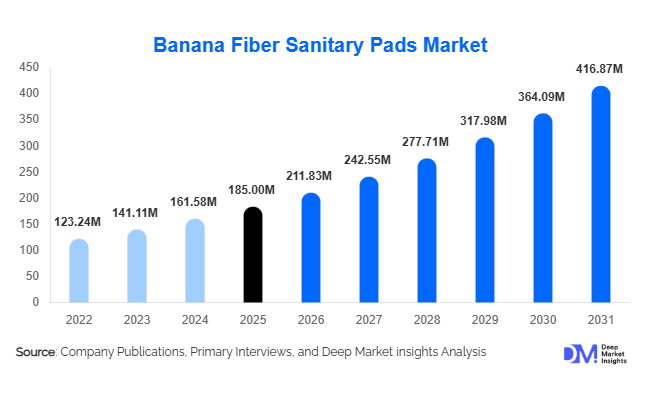
According to Deep Market Insights, the global banana fiber sanitary pads market size was valued at USD 185 million in 2025 and is projected to grow from USD 211.83 million in 2026 to reach USD 416.87 million by 2031, expanding at a CAGR of 14.5% during the forecast period (2026–2031). The banana fiber sanitary pads market growth is primarily driven by rising environmental awareness, increasing restrictions on plastic-based hygiene products, and growing demand for biodegradable and chemical-free menstrual care solutions across both developed and emerging economies.
Key Market Insights
- Eco-friendly menstrual hygiene products are rapidly replacing conventional plastic-based sanitary pads, especially in environmentally conscious urban populations and institutional programs.
- Asia-Pacific dominates global demand, led by India and Southeast Asia due to strong raw material availability, government initiatives, and NGO-led distribution programs.
- Institutional procurement is a major demand driver, with governments and NGOs distributing biodegradable pads in rural and underserved regions.
- Europe and North America are emerging premium markets, driven by demand for organic, chemical-free, and sustainable personal care products.
- Rural adoption is accelerating faster than urban adoption in developing economies, supported by awareness campaigns and subsidized menstrual hygiene schemes.
- E-commerce and D2C channels are transforming distribution, improving accessibility and awareness of banana fiber-based hygiene products globally.
What are the latest trends in the banana fiber sanitary pads market?
Shift Toward Sustainable and Plastic-Free Feminine Hygiene
The market is witnessing a strong transition toward biodegradable sanitary products as consumers become increasingly aware of the environmental impact of conventional pads, which contain significant plastic content. Banana fiber sanitary pads are gaining popularity due to their compostable nature and lower environmental footprint. This trend is particularly strong in urban centers of India, Europe, and North America, where eco-conscious purchasing behavior is rising. Governments are also supporting this shift through bans and restrictions on single-use plastics, indirectly boosting demand for natural fiber-based hygiene products. Brands are increasingly positioning banana fiber pads as part of the circular economy, emphasizing waste reduction and sustainability certifications to attract environmentally responsible consumers.
Rise of Decentralized and Social Enterprise Manufacturing Models
A key trend shaping the market is the emergence of decentralized production units, especially in banana-producing regions. Banana fiber extraction from agricultural waste allows local manufacturing, reducing supply chain costs and generating rural employment. Social enterprises and women-led startups are increasingly adopting this model to produce affordable sanitary pads while empowering local communities. This trend is particularly visible in India and parts of Africa, where micro-manufacturing units are supported by NGOs and government programs. The model also enhances scalability and improves penetration in rural markets by reducing logistics dependency and enabling localized distribution networks.
What are the key drivers in the banana fiber sanitary pads market?
Rising Environmental Awareness and Sustainable Consumption
The increasing global concern over plastic pollution is a major growth driver for the banana fiber sanitary pads market. Consumers are actively shifting toward biodegradable personal care products that minimize environmental harm. Banana fiber pads, derived from agricultural waste, align strongly with sustainability goals and appeal to eco-conscious millennials and Gen Z consumers. This behavioral shift is especially strong in urban markets where environmental activism and sustainable lifestyle choices are influencing purchasing decisions. Brands promoting plastic-free packaging and natural materials are gaining strong traction in both retail and online channels.
Government and NGO-Led Menstrual Hygiene Initiatives
Government programs and NGO initiatives are significantly accelerating market penetration, particularly in developing regions. Subsidized distribution of sanitary products in rural areas is expanding access to menstrual hygiene solutions. Banana fiber pads are increasingly being adopted in these programs due to their low cost, local availability of raw materials, and biodegradability. Countries such as India and Kenya are actively integrating eco-friendly sanitary products into public health schemes, improving awareness and adoption rates across low-income populations.
Growth of Affordable and Locally Produced Hygiene Solutions
The availability of banana fiber as a low-cost raw material is encouraging localized production, making sanitary pads more affordable and accessible. This is especially important in price-sensitive markets where affordability remains a key purchasing factor. Small-scale manufacturers are leveraging local supply chains to reduce production costs and improve distribution efficiency, further driving market expansion.
What are the restraints for the global market?
Limited Consumer Awareness and Product Trust
Despite growing adoption, many consumers remain unfamiliar with banana fiber sanitary pads, leading to hesitation in switching from conventional products. Concerns about comfort, absorbency, and hygiene performance continue to limit widespread acceptance, particularly in rural and semi-urban areas. Market education and awareness campaigns are required to overcome these barriers.
Supply Chain and Processing Infrastructure Limitations
The market faces challenges related to the lack of advanced processing infrastructure for banana fiber extraction and pad manufacturing. While raw material availability is abundant, converting banana pseudostems into high-quality absorbent fibers requires specialized technology. Limited scalability and fragmented supply chains can increase production costs and restrict mass-market expansion.
What are the key opportunities in the banana fiber sanitary pads industry?
Expansion of Institutional and Government Procurement Programs
Institutional demand presents a major growth opportunity, with governments, schools, and NGOs increasingly procuring biodegradable sanitary pads for public distribution programs. These initiatives aim to improve menstrual hygiene awareness while reducing environmental impact. Large-scale procurement contracts offer manufacturers stable demand and opportunities for rapid scaling in developing economies.
Premium Eco-Product Positioning in Developed Markets
In North America and Europe, banana fiber sanitary pads are increasingly being positioned as premium, eco-friendly personal care products. Consumers in these regions are willing to pay higher prices for organic, chemical-free, and sustainable alternatives. This opens opportunities for brand differentiation, subscription-based models, and direct-to-consumer sales channels.
Technological Innovation in Fiber Processing and Product Design
Advancements in fiber processing technology are improving the absorbency, comfort, and durability of banana fiber pads. Innovation in multi-layer design, biodegradable adhesives, and hybrid fiber blending is making these products more competitive with synthetic alternatives, unlocking new consumer segments globally.
Report Scope
| Report Metric | Details |
|---|---|
| Market Size in 2025 | USD 185 Million |
| Market Size in 2026 | USD 211.83 Million |
| Market Size in 2031 | USD 416.87 Million |
| CAGR | 14.5% (2026-2031) |
| Base Year for Estimation | 2025 |
| Historical Data | 2022-2024 |
| Forecast Period | 2026-2031 |
| Report Coverage | Revenue Forecast, Competitive Landscape, Supply Chain Disruption, Growth Factors, Environment & Regulatory Landscape and Trends |
| Geographies Covered | North America, Europe, APAC, Middle East and Africa, LATAM |
| Countries Covered | U.S., Canada, U.K., Germany, France, Spain, Italy, Russia, Nordic, Benelux, Rest of Europe, China, Korea, Japan, India, Australia, Singapore, Taiwan, South East Asia, Rest of Asia-Pacific, UAE, Turky, Saudi Arabia, South Africa, Egypt, Nigeria, Rest of MEA, Brazil, Mexico, Argentina, Chile, Colombia, Rest of LATAM |
Explore more data points, trends and opportunities Download Free Sample Report
Product Type Insights
Regular (day-use) sanitary pads dominate the banana fiber sanitary pads market, accounting for approximately 38% of the total market share in 2025. This leadership position is primarily driven by their high usage frequency, as they cater to everyday menstrual needs across both urban and rural populations. Their affordability and compatibility with existing consumption patterns make them the most scalable product category globally. Additionally, large-scale government procurement programs and NGO distribution models favor regular pads due to their cost efficiency and ease of distribution. From an absorbency standpoint, moderate absorbency pads hold around 34% share, as they address the needs of the majority of users during standard menstrual flow cycles. This segment benefits from a balance between performance and cost, making it widely acceptable across income groups. In terms of packaging, multi-pack formats lead with approximately 55% share, driven by institutional bulk purchases and consumer preference for cost savings through larger pack sizes.
By price segmentation, economy products account for nearly 46% of the market, reflecting the dominance of price-sensitive consumers in developing economies. The affordability of banana fiber as a raw material further strengthens this segment. Additionally, institutional sales contribute around 30% of total distribution, supported by government health programs and NGO-led initiatives aimed at improving menstrual hygiene access. The combination of affordability, scalability, and policy support continues to reinforce the leadership of these segments globally.
Application Insights
The primary application of banana fiber sanitary pads remains menstrual hygiene management, which constitutes the core demand across all geographies. Rural populations represent the largest application base, driven by affordability, increased awareness campaigns, and government-supported distribution programs. The use of banana fiber pads in rural areas is particularly significant due to their biodegradability, which addresses waste disposal challenges in regions lacking proper sanitation infrastructure.
Urban applications are witnessing steady growth, supported by rising consumer awareness regarding sustainability and health. Eco-conscious consumers in metropolitan areas are increasingly opting for biodegradable and chemical-free hygiene products, contributing to premium segment expansion. In addition, emerging applications are gaining traction in disaster relief operations, refugee camps, and humanitarian aid programs, where low-cost, biodegradable, and easily disposable hygiene solutions are critical. Export-oriented demand is also expanding, particularly toward Europe and North America, where regulatory frameworks and consumer preferences strongly favor sustainable products. This has opened new avenues for manufacturers in developing countries to tap into international markets, further diversifying application segments and strengthening global demand.
Distribution Channel Insights
Institutional distribution channels dominate the banana fiber sanitary pads market, accounting for approximately 30% of total sales. This dominance is driven by large-scale procurement by governments, NGOs, and international organizations focused on menstrual hygiene initiatives. These channels provide consistent demand and enable large-volume distribution, particularly in rural and underserved regions. Online retail is emerging as the fastest-growing distribution channel, supported by increasing digital penetration, growing awareness of sustainable products, and the rise of direct-to-consumer (D2C) brands. E-commerce platforms and brand-owned websites are enabling wider accessibility, product education, and subscription-based purchasing models, particularly among urban consumers.
Traditional retail channels, including pharmacies, supermarkets, and hypermarkets, continue to play a vital role in urban markets by offering product visibility and consumer trust. Specialty organic and eco-product stores are gaining importance in premium segments, catering to environmentally conscious consumers. Additionally, subscription-based delivery models are gaining traction, improving customer retention and ensuring consistent usage patterns.
End User Insights
Rural consumers represent the largest end-user segment, accounting for approximately 42% of the global market. This dominance is driven by government schemes, NGO-led awareness programs, and the affordability of banana fiber sanitary pads. The ability to locally manufacture these products further strengthens rural accessibility and adoption. Urban consumers are the fastest-growing segment, supported by rising environmental awareness, increasing disposable incomes, and a shift toward premium, eco-friendly personal care products. This segment is also influenced by digital marketing, social media awareness, and the availability of subscription-based purchasing options. Institutional buyers, including schools, healthcare organizations, and NGOs, form a critical demand base due to bulk procurement for large-scale distribution programs. These buyers play a key role in expanding market penetration, particularly in developing regions. Furthermore, export-driven demand from developed markets is increasing steadily, contributing to revenue growth and encouraging manufacturers to scale production and improve product quality to meet international standards.
Explore more data points, trends and opportunities Download Free Sample Report
Banana Fiber Sanitary Pads Market Segmentations
By Product Type
- Regular (Day-use) Pads
- Overnight Pads
- Pantyliners
- Maternity Pads
- Reusable/Washable Banana Fiber Pads
By Application
- Menstrual Hygiene Management
- Institutional & Public Health Programs
- Disaster Relief & Humanitarian Aid
- Export-Oriented Sustainable Hygiene Products
By Distribution Channel
- Online Retail
- Pharmacies & Drug Stores
- Supermarkets & Hypermarkets
- Specialty Organic Stores
- Institutional Sales
By End User
- Rural Consumers
- Urban Consumers
- Institutional Buyers
By Price Segment
- Economy
- Mid-Range
- Premium
Regional Insights
North America
North America accounts for approximately 18% of the global banana fiber sanitary pads market, with the United States and Canada leading demand. Growth in this region is primarily driven by high consumer awareness regarding sustainable and chemical-free personal care products. Increasing adoption of eco-friendly lifestyles, coupled with strong purchasing power, is supporting premium product positioning. Additional growth drivers include the rapid expansion of e-commerce platforms, widespread adoption of subscription-based hygiene products, and strong regulatory emphasis on reducing plastic waste. The presence of well-established organic product retail networks further accelerates market penetration. Innovation in product design and branding also plays a significant role in attracting environmentally conscious consumers.
Europe
Europe holds around 20% market share, with key markets including Germany, the UK, and France. The region’s growth is strongly influenced by stringent environmental regulations aimed at reducing single-use plastics and promoting biodegradable alternatives. High consumer awareness regarding sustainability and ethical consumption further supports market expansion. Government policies encouraging circular economy practices, along with increasing demand for certified organic and compostable hygiene products, are key growth drivers. Additionally, strong retail infrastructure and the presence of eco-labeling standards enhance consumer trust and product adoption. The region is also witnessing growing demand for premium and subscription-based hygiene solutions.
Asia-Pacific
Asia-Pacific dominates the global market with approximately 48% share, led by India, China, and Indonesia. India alone contributes nearly 28% of global demand, driven by large-scale government initiatives, NGO involvement, and strong local manufacturing capabilities. Key growth drivers in this region include abundant availability of banana fiber as a raw material, cost-effective production, and extensive rural distribution networks. Government programs focused on menstrual hygiene awareness and subsidized product distribution are significantly boosting demand. Additionally, the presence of social enterprises and women-led manufacturing units is accelerating local production and market penetration.
Latin America
Latin America is an emerging market, with increasing adoption in Brazil, Mexico, and Argentina. Growth in this region is driven by rising awareness of menstrual hygiene, improving healthcare infrastructure, and gradual adoption of sustainable consumer products. Government-led health initiatives and collaborations with NGOs are supporting product distribution in underserved areas. Additionally, increasing urbanization and the expansion of retail and e-commerce channels are contributing to market growth. However, limited awareness and price sensitivity continue to pose challenges to widespread adoption.
Middle East & Africa
The Middle East & Africa region is experiencing strong growth, particularly in countries such as Kenya, Nigeria, and South Africa. Africa is the fastest-growing regional market, with a CAGR exceeding 17%, driven by extensive NGO-led initiatives and government-supported menstrual hygiene programs. Key growth drivers include increasing focus on improving women’s health, rising awareness about menstrual hygiene, and the need for affordable and biodegradable products in regions with limited waste management infrastructure. In Africa, localized production models and community-based manufacturing are significantly boosting adoption. In the Middle East, demand is driven by high-income consumers and growing awareness of sustainable personal care products. The region is emerging as a premium import market, supported by strong retail infrastructure and increasing preference for organic and eco-friendly hygiene solutions.
Key Players in the Banana Fiber Sanitary Pads Market
- Saathi Pads
- Eco Femme
- SHE (Sustainable Health Enterprises)
- Niine Sanitary Napkins
- Carmesi
- Aakar Innovations
- Sanfe
- Azah
- Heyday Care
- Green Whisper