Badminton Shuttlecock Market Size
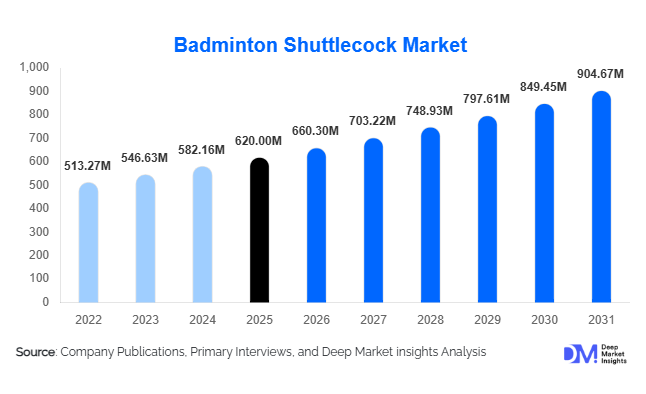
According to Deep Market Insights, the global badminton shuttlecock market size was valued at USD 620 million in 2025 and is projected to grow from USD 660.30 million in 2026 to reach USD 904.67 million by 2031, expanding at a CAGR of 6.5% during the forecast period (2026–2031). The badminton shuttlecock market growth is primarily driven by the rising global popularity of badminton across professional and recreational segments, increasing investments in indoor sports infrastructure, and the expansion of organized leagues and training academies. Additionally, growing accessibility through e-commerce channels and technological advancements in synthetic shuttlecock materials are further supporting sustained market expansion.
Key Market Insights
- Feather shuttlecocks continue to dominate the market, accounting for over 60% of demand due to their superior flight performance in professional play.
- Asia-Pacific leads global consumption, driven by strong participation in countries such as China, India, Indonesia, and Malaysia.
- Sports clubs and academies are the largest end-use segment, contributing nearly 40% of total demand due to high consumption frequency.
- Online distribution channels are rapidly expanding, supported by bulk purchasing and direct-to-consumer sales models.
- Synthetic shuttlecock innovation is gaining momentum, offering improved durability and cost efficiency for recreational users.
- Raw material price volatility, particularly feathers, continues to influence pricing and profit margins across manufacturers.
What are the latest trends in the badminton shuttlecock market?
Shift Toward Durable Synthetic Shuttlecocks
The market is witnessing a growing transition toward synthetic shuttlecocks, particularly nylon and composite variants, due to their durability and cost-effectiveness. While feather shuttlecocks remain the standard for professional tournaments, synthetic alternatives are gaining traction among recreational users, schools, and training academies. Technological advancements in material engineering are improving flight stability and consistency, reducing the performance gap between synthetic and feather shuttlecocks. This trend is especially prominent in price-sensitive markets, where long-lasting products reduce overall cost per play.
Digitalization of Sales Channels
E-commerce platforms and direct-to-consumer sales channels are transforming the distribution landscape. Online platforms allow bulk purchasing, subscription-based supply models, and easy access to a wide range of products. Sports brands are investing in digital marketing and personalized offerings to target clubs, academies, and individual consumers. The integration of user reviews, product comparisons, and pricing transparency is further enhancing consumer decision-making and driving online sales growth.
What are the key drivers in the badminton shuttlecock market?
Rising Global Participation in Badminton
The increasing popularity of badminton as both a professional and recreational sport is a major driver of market growth. International tournaments, Olympic visibility, and national leagues have boosted participation rates across regions. Countries in the Asia-Pacific and Europe are witnessing a surge in grassroots programs and school-level competitions, leading to consistent demand for shuttlecocks across all price segments.
Expansion of Sports Infrastructure and Training Facilities
Governments and private organizations are investing heavily in indoor sports facilities, including badminton courts and academies. These facilities require continuous replenishment of shuttlecocks due to their short lifespan, creating a recurring demand cycle. The growth of professional coaching centers and sports academies is further strengthening market demand, particularly for mid-range and premium shuttlecocks.
What are the restraints for the global market?
High Dependence on Natural Feather Supply
The production of premium shuttlecocks relies heavily on high-quality goose and duck feathers, which are subject to supply constraints and price fluctuations. Seasonal variations and limited sourcing regions can lead to volatility in raw material costs, impacting overall pricing and profitability for manufacturers.
Short Product Lifespan
Feather shuttlecocks, despite their superior performance, have a relatively short lifespan, especially in high-intensity play. This increases the cost burden for frequent users such as clubs and academies, potentially limiting adoption in cost-sensitive markets and encouraging the use of lower-quality alternatives.
What are the key opportunities in the badminton shuttlecock industry?
Growth of Organized Sports Programs
Government-led initiatives and private investments in sports development programs present significant opportunities for market expansion. School-level tournaments, national leagues, and grassroots training initiatives create consistent demand for shuttlecocks. These programs not only increase participation but also establish long-term consumption patterns, benefiting manufacturers and suppliers.
Innovation in Sustainable and Synthetic Materials
There is increasing scope for developing eco-friendly and sustainable shuttlecocks, including biodegradable synthetic variants and ethically sourced feathers. As environmental awareness grows, manufacturers investing in sustainable production practices can differentiate themselves and attract institutional buyers and environmentally conscious consumers.
Report Scope
| Report Metric | Details |
|---|---|
| Market Size in 2025 | USD 620 Million |
| Market Size in 2026 | USD 660.30 Million |
| Market Size in 2031 | USD 904.67 Million |
| CAGR | 6.5% (2026-2031) |
| Base Year for Estimation | 2025 |
| Historical Data | 2022-2024 |
| Forecast Period | 2026-2031 |
| Report Coverage | Revenue Forecast, Competitive Landscape, Supply Chain Disruption, Growth Factors, Environment & Regulatory Landscape and Trends |
| Geographies Covered | North America, Europe, APAC, Middle East and Africa, LATAM |
| Countries Covered | U.S., Canada, U.K., Germany, France, Spain, Italy, Russia, Nordic, Benelux, Rest of Europe, China, Korea, Japan, India, Australia, Singapore, Taiwan, South East Asia, Rest of Asia-Pacific, UAE, Turky, Saudi Arabia, South Africa, Egypt, Nigeria, Rest of MEA, Brazil, Mexico, Argentina, Chile, Colombia, Rest of LATAM |
Explore more data points, trends and opportunities Download Free Sample Report
Product Type Insights
Feather shuttlecocks continue to dominate the global badminton shuttlecock market, accounting for approximately 62% of total market share in 2025. This dominance is primarily driven by their mandatory usage in professional tournaments governed by international badminton standards, where precision, stability, and aerodynamic performance are critical. Feather shuttlecocks offer superior flight trajectory, speed control, and responsiveness, making them indispensable for competitive play. Additionally, premiumization trends in professional sports and rising investments in international tournaments further reinforce demand for high-quality feather shuttlecocks.
On the other hand, synthetic shuttlecocks, including nylon and plastic variants, are witnessing strong growth, particularly across recreational and institutional segments. Their key growth driver lies in their longer lifespan (2–3 times that of feather shuttlecocks) and lower cost per use, making them highly suitable for schools, academies, and amateur players. Technological advancements in polymer materials and design engineering are also improving their flight consistency, narrowing the performance gap with feather variants. As a result, synthetic shuttlecocks are expected to gain incremental share, especially in emerging markets and high-volume usage environments.
Application Insights
Sports clubs and academies lead the application segment, accounting for nearly 40% of total demand in 2025. This segment’s dominance is driven by high-frequency usage during daily training sessions, coaching programs, and local tournaments, which require continuous replenishment of shuttlecocks. The expansion of professional coaching infrastructure and grassroots training programs globally is a key factor supporting this segment’s growth. Professional tournaments represent a premium application segment, characterized by demand for top-grade feather shuttlecocks that meet stringent international standards. Growth in this segment is driven by increasing global tournaments, sponsorships, and media coverage, which elevate the need for high-performance equipment.
Educational institutions are emerging as a high-growth segment, supported by the integration of badminton into school and university sports curricula. Government initiatives promoting sports participation at an early age are further strengthening this trend. Meanwhile, recreational usage is expanding steadily, fueled by urbanization, rising disposable incomes, and growing health awareness, particularly among working professionals and youth populations seeking indoor fitness activities.
Distribution Channel Insights
Offline retail channels dominate the market, holding approximately 58% share in 2025. This leadership is driven by consumer preference for physically inspecting shuttlecock quality, including feather alignment, durability, and brand authenticity, before purchase. Specialty sports stores and authorized dealers play a crucial role in serving professional players and institutional buyers who prioritize quality assurance.
However, online distribution channels are the fastest-growing segment, supported by increasing digital penetration and evolving purchasing behavior. E-commerce platforms and brand-owned websites are enabling bulk procurement, subscription-based supply models, and competitive pricing. This channel is particularly gaining traction among sports academies and recreational users in urban areas. Additionally, online platforms are expanding access in emerging markets where physical retail infrastructure remains underdeveloped, thereby contributing significantly to overall market growth.
End-Use Insights
Sports clubs and academies remain the largest end-use segment, driven by their continuous need for shuttlecock replenishment due to intensive training activities. This segment benefits from structured demand cycles and bulk purchasing behavior, making it a key revenue contributor for manufacturers. Professional tournaments drive demand in the premium segment, where product quality and performance consistency are critical. The increasing number of international and regional competitions is reinforcing demand for high-end feather shuttlecocks.
Schools and colleges are emerging as one of the fastest-growing end-use segments, supported by government-backed sports programs and increasing emphasis on physical education. Recreational users represent a broad and expanding consumer base, driven by lifestyle changes, fitness trends, and accessibility of indoor sports facilities. Additionally, export-driven demand plays a significant role, with major manufacturing hubs such as China supplying large volumes to regions with limited domestic production capacity, thereby sustaining global market balance.
Explore more data points, trends and opportunities Download Free Sample Report
Badminton Shuttlecock Market Segmentations
By Product Type
- Feather Shuttlecocks
- Synthetic Shuttlecocks
By Application
- Professional Tournaments
- Sports Clubs & Academies
- Educational Institutions
- Recreational Use
By Distribution Channel
- Online Retail
- Offline Retail
By Price Tier
- Economy
- Mid-Range
- Premium
By Speed Category
- Slow Speed
- Medium Speed
- Fast Speed
Regional Insights
Asia-Pacific
Asia-Pacific dominates the badminton shuttlecock market with approximately 52% share in 2025, making it the largest and fastest-growing regional market. China leads both production and consumption, driven by its well-established manufacturing ecosystem, cost advantages, and strong domestic demand. The country also serves as the primary export hub globally. India is one of the fastest-growing markets, registering growth above 8% CAGR, supported by government initiatives such as grassroots sports development programs, an increasing number of badminton academies, and the rising popularity of professional leagues. Southeast Asian countries like Indonesia and Malaysia contribute significantly due to their deep-rooted badminton culture, strong international presence, and high participation rates. Key growth drivers for the region include a large player base, government funding, expanding sports infrastructure, and cultural affinity toward badminton.
Europe
Europe accounts for around 18% of the global market share, with key countries including Denmark, the United Kingdom, Germany, and France. Denmark stands out as a major contributor due to its strong badminton legacy and high per capita participation. Growth in Europe is driven by increasing interest in recreational sports, well-established indoor sports infrastructure, and rising demand for premium-quality shuttlecocks. Additionally, growing awareness around fitness and wellness, along with the presence of organized sports clubs, is supporting steady market expansion. The region also benefits from strong import channels, particularly from Asia, ensuring consistent product availability.
North America
North America holds approximately 15% market share, led by the United States and Canada. The region is witnessing steady growth driven by increasing adoption of badminton as a recreational and school-level sport. Expansion of indoor sports facilities, community sports programs, and multicultural influences—particularly from Asian populations—are key drivers. Additionally, the rise of amateur leagues and university-level competitions is contributing to demand. The growing popularity of fitness-oriented indoor activities is further supporting market growth in this region.
Latin America
Latin America represents around 7% of the global market, with Brazil and Mexico as primary contributors. The region is in a developing stage, with growth driven by increasing awareness of badminton as a competitive sport and gradual improvements in sports infrastructure. Government initiatives promoting sports participation and rising youth engagement are key growth drivers. While the market remains relatively small, increasing imports and expanding distribution networks are expected to support future growth.
Middle East & Africa
The Middle East & Africa region is an emerging market, with countries such as the UAE, Saudi Arabia, and South Africa leading demand. Growth in this region is driven by rising investments in sports infrastructure, increasing disposable incomes, and growing interest in indoor recreational activities. Government initiatives aimed at promoting sports participation and hosting international events are also contributing to market expansion. Additionally, the region’s reliance on imports from Asia creates opportunities for global manufacturers to expand their footprint. The market is expected to witness steady growth as awareness and participation levels continue to rise.
Key Players in the Badminton Shuttlecock Market
- Yonex Co., Ltd.
- Victor Rackets Industrial Corp.
- Li-Ning Company Limited
- RSL International
- Carlton Sports
- Babolat
- Kawasaki Sports
- Apacs Sports
- Ashaway Racket Strings
- Gosen Co., Ltd.
- Wilson Sporting Goods
- Fleet Shuttlecock
- Aeroplane Shuttlecock
- Kason Sports
- Silver Sports