Baby Stroller Market Size
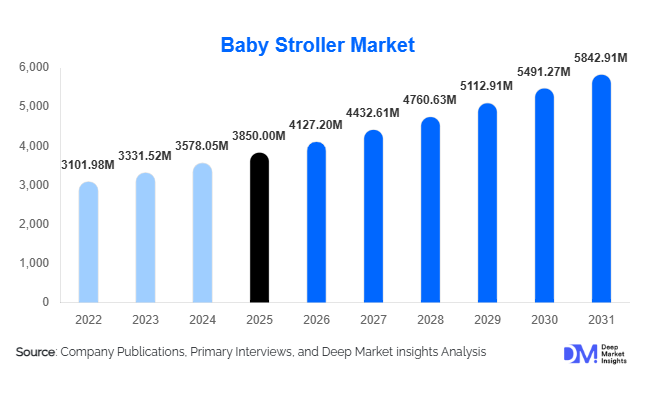
According to Deep Market Insights, the global baby stroller market size was valued at USD 3,850 million in 2025 and is projected to grow from USD 4,127.20 million in 2026 to reach USD 5,842.91 million by 2031, expanding at a CAGR of 7.4% during the forecast period (2026–2031). The baby stroller market growth is primarily driven by increasing urbanization, rising disposable incomes, growing participation of women in the workforce, and the rising preference for safe and convenient infant mobility solutions. Additionally, product innovation in lightweight, modular, and travel-friendly strollers is accelerating consumer adoption across both developed and emerging economies.
Key Market Insights
- Urban households dominate demand, accounting for nearly 60% of global stroller purchases due to lifestyle-driven mobility needs.
- Mid-range strollers lead the pricing segment, contributing around 45% of total market revenue by balancing affordability and functionality.
- North America holds the largest regional share, supported by high disposable income and strong brand penetration.
- Asia-Pacific is the fastest-growing region, driven by rising middle-class populations in China and India.
- Online retail channels contribute nearly half of global sales, reflecting strong e-commerce penetration and digital purchasing behavior.
- Product innovation, including smart and modular strollers, is transforming the competitive landscape and driving premiumization trends.
What are the latest trends in the baby stroller market?
Smart and Connected Strollers Gaining Adoption
The integration of technology into baby strollers is emerging as a key trend, with manufacturers introducing smart features such as GPS tracking, automatic braking systems, temperature sensors, and smartphone connectivity. These innovations are particularly appealing to tech-savvy urban parents who prioritize safety and convenience. Smart strollers also enable real-time monitoring of infant conditions, enhancing user confidence and product differentiation. As IoT adoption increases globally, this trend is expected to expand into mid-range segments, making advanced features more accessible.
Shift Toward Lightweight and Travel-Friendly Designs
Consumers are increasingly preferring lightweight, foldable, and compact strollers that are easy to transport and store. This trend is driven by urban living constraints, increased travel frequency, and the need for convenience among working parents. Travel system strollers and umbrella strollers are gaining traction, particularly in regions with high urban density. Manufacturers are focusing on ergonomic designs, quick-fold mechanisms, and durable yet lightweight materials such as aluminum to meet evolving consumer expectations.
What are the key drivers in the baby stroller market?
Rising Dual-Income Households
The increasing number of dual-income families is a major driver of stroller demand. Working parents require reliable and efficient mobility solutions for infants, boosting demand for versatile and easy-to-use strollers. This trend is particularly strong in urban areas across North America, Europe, and the Asia-Pacific region, where time constraints and lifestyle changes necessitate convenient childcare products.
Product Innovation and Premiumization
Continuous innovation in stroller design and functionality is driving market growth. Features such as modular configurations, adjustable seating, shock absorption systems, and enhanced safety mechanisms are attracting consumers. Premium strollers are increasingly viewed as lifestyle products, encouraging higher spending per unit and boosting overall market value.
What are the restraints for the global market?
High Cost of Premium Products
The relatively high cost of advanced and premium strollers limits adoption in price-sensitive markets. While demand exists, affordability remains a barrier, particularly in developing regions where consumers prioritize essential spending over premium baby products.
Stringent Safety Regulations and Product Recalls
Compliance with safety standards across different regions poses challenges for manufacturers. Product recalls due to safety concerns can negatively impact brand reputation and increase operational costs. Adhering to evolving regulatory requirements remains a critical restraint for market participants.
What are the key opportunities in the baby stroller industry?
Expansion in Emerging Markets
Emerging economies such as India, Brazil, and Indonesia present significant growth opportunities due to rising disposable incomes, increasing urbanization, and growing awareness of baby care products. Low penetration rates in these regions provide ample scope for market expansion through localized pricing and product offerings.
Eco-Friendly and Sustainable Products
Growing environmental awareness is driving demand for strollers made from sustainable materials and non-toxic components. Manufacturers adopting eco-friendly practices and transparent supply chains can attract environmentally conscious consumers and gain a competitive advantage.
Report Scope
| Report Metric | Details |
|---|---|
| Market Size in 2025 | USD 3850 Million |
| Market Size in 2026 | USD 4127.20 Million |
| Market Size in 2031 | USD 5842.91 Million |
| CAGR | 7.4% (2026-2031) |
| Base Year for Estimation | 2025 |
| Historical Data | 2022-2024 |
| Forecast Period | 2026-2031 |
| Report Coverage | Revenue Forecast, Competitive Landscape, Supply Chain Disruption, Growth Factors, Environment & Regulatory Landscape and Trends |
| Geographies Covered | North America, Europe, APAC, Middle East and Africa, LATAM |
| Countries Covered | U.S., Canada, U.K., Germany, France, Spain, Italy, Russia, Nordic, Benelux, Rest of Europe, China, Korea, Japan, India, Australia, Singapore, Taiwan, South East Asia, Rest of Asia-Pacific, UAE, Turky, Saudi Arabia, South Africa, Egypt, Nigeria, Rest of MEA, Brazil, Mexico, Argentina, Chile, Colombia, Rest of LATAM |
Explore more data points, trends and opportunities Download Free Sample Report
Product Type Insights
Full-size strollers dominate the global baby stroller market, accounting for approximately 32% of total revenue in 2025. Their leadership is primarily driven by their versatility, durability, and ability to support infants through multiple growth stages. These strollers typically offer enhanced storage capacity, adjustable seating positions, and superior safety features, making them highly suitable for everyday use. Parents, particularly first-time buyers, prefer full-size strollers as a long-term investment, which reinforces their dominance globally. Additionally, manufacturers continue to enhance these models with modular add-ons and ergonomic improvements, further sustaining demand.
Travel system strollers are gaining strong traction due to their multifunctionality, enabling seamless integration with infant car seats. This convenience-driven value proposition is particularly appealing in developed markets where car ownership is high. Meanwhile, lightweight and umbrella strollers are emerging as the fastest-growing sub-segment, driven by increasing urbanization and demand for compact, portable solutions. These strollers are especially popular among urban consumers and frequent travelers due to their easy foldability, lightweight aluminum frames, and space-saving designs. The shift toward mobility and convenience continues to accelerate growth across these segments.
Application Insights
Everyday-use strollers represent the largest application segment, contributing nearly 50% of total demand in 2025. Their dominance is attributed to their essential role in daily activities such as shopping, commuting, and outdoor walks. These strollers are designed for durability and comfort, making them indispensable for routine infant transportation. The consistent demand for daily mobility solutions ensures steady growth in this segment, particularly in urban environments where convenience is critical.
The travel and compact-use segment is the fastest-growing application category, driven by rising global travel trends, increased mobility among young families, and the need for lightweight, easy-to-carry products. Airline-friendly designs and compact folding mechanisms are key factors influencing purchasing decisions. Additionally, jogging strollers cater to a niche but growing segment of fitness-conscious parents. Equipped with advanced suspension systems, air-filled tires, and enhanced stability, these strollers are gaining popularity in developed regions where active lifestyles are prevalent. This diversification of applications highlights the market’s adaptability to evolving consumer lifestyles.
Distribution Channel Insights
Online retail channels lead the market, accounting for approximately 48% of total stroller sales in 2025. The dominance of e-commerce is driven by factors such as wider product availability, competitive pricing, convenience of home delivery, and access to customer reviews. Digital platforms also enable brands to directly engage with consumers, offering personalized recommendations and promotional discounts, which significantly influence purchasing behavior.
Offline channels, including specialty baby stores, hypermarkets, and department stores, continue to play a critical role, particularly for high-involvement purchases. Consumers often prefer to physically assess product features such as build quality, safety mechanisms, and comfort before making a purchase. Specialty stores, in particular, provide expert guidance and product demonstrations, which are crucial for first-time parents. The coexistence of online and offline channels reflects an omnichannel retail strategy that enhances overall market reach.
End-User Insights
Urban households dominate the baby stroller market, representing approximately 60% of global demand in 2025. This leadership is driven by higher disposable incomes, compact living environments, and a greater need for convenient mobility solutions. Urban parents are also more inclined toward premium and technologically advanced strollers, further boosting market value in this segment.
Semi-urban households are witnessing steady growth due to improving economic conditions, increasing awareness of baby care products, and expanding retail penetration. These regions are gradually transitioning toward organized retail and e-commerce platforms, which is enhancing product accessibility. Rural markets, although currently underpenetrated, present significant long-term growth potential. Increasing awareness, government initiatives supporting maternal and child health, and improving distribution networks are expected to drive adoption in these areas over the forecast period.
Explore more data points, trends and opportunities Download Free Sample Report
Baby Stroller Market Segmentations
By Product Type
- Full-Size Strollers
- Lightweight / Umbrella Strollers
- Jogging Strollers
- Travel System Strollers
- Double / Tandem Strollers
- Modular / Convertible Strollers
By Application
- Everyday Use
- Travel / Compact Use
- Sports / Jogging Use
By Distribution Channel
- Online Retail
- Specialty Baby Stores
- Hypermarkets / Supermarkets
- Department Stores
- Brand-Owned Stores
By End User
- Urban Households
- Semi-Urban Households
- Rural Households
Regional Insights
North America
North America holds approximately 30% of the global baby stroller market share in 2025, with the United States contributing nearly 75% of regional demand. The region’s growth is driven by high disposable incomes, strong consumer preference for premium and branded products, and widespread awareness of infant safety standards. Additionally, the presence of leading manufacturers and continuous product innovation, including smart strollers and ergonomic designs, supports sustained demand. High car ownership rates further boost the adoption of travel system strollers, while well-established e-commerce infrastructure enhances product accessibility.
Europe
Europe accounts for around 25% of the global market, led by Germany, the United Kingdom, and France. Growth in this region is primarily driven by stringent safety regulations, which encourage the adoption of high-quality and certified products. Increasing consumer preference for eco-friendly and sustainable strollers is another key driver, with manufacturers focusing on recyclable materials and non-toxic fabrics. Additionally, rising awareness of child comfort and safety, coupled with strong retail networks, supports consistent market expansion. Government policies promoting child welfare also indirectly contribute to a steady demand.
Asia-Pacific
Asia-Pacific represents approximately 28% of the global market and is the fastest-growing region, with a projected CAGR exceeding 9%. China dominates regional demand, followed by India and Japan. Growth in this region is driven by rapid urbanization, expanding middle-class populations, and increasing female workforce participation. Rising disposable incomes and growing awareness of baby care products are further accelerating adoption. The rapid expansion of e-commerce platforms and digital payment systems has significantly improved product accessibility, particularly in emerging economies. Additionally, government initiatives supporting domestic manufacturing and childcare products are strengthening regional market growth.
Latin America
Latin America holds about 10% of the global market, with Brazil and Mexico as key contributors. Market growth in this region is driven by improving economic conditions, rising urbanization, and increasing penetration of organized retail. Expanding middle-class populations and growing awareness of infant safety products are also contributing to demand. The gradual shift toward online retail channels is enhancing accessibility and affordability, enabling more consumers to purchase branded stroller products.
Middle East & Africa
The Middle East & Africa region accounts for approximately 7% of the global market. Growth is primarily driven by rapid urban development, increasing expatriate populations, and rising disposable incomes in key countries such as the UAE and South Africa. The demand for premium and imported stroller products is particularly strong in the Middle East due to high purchasing power. Additionally, increasing awareness of child safety and expanding retail infrastructure are supporting market growth. In Africa, improving economic conditions and rising birth rates are expected to create long-term opportunities for market expansion.
Key Players in the Baby Stroller Market
- Goodbaby International Holdings
- Newell Brands
- Artsana Group
- Dorel Industries
- Britax Group
- Peg Perego
- UPPAbaby
- Baby Jogger
- Combi Corporation
- Chicco
- Nuna International
- Evenflo Company
- Joovy
- Hauck Group
- Silver Cross