Baby Oral Care Market Size
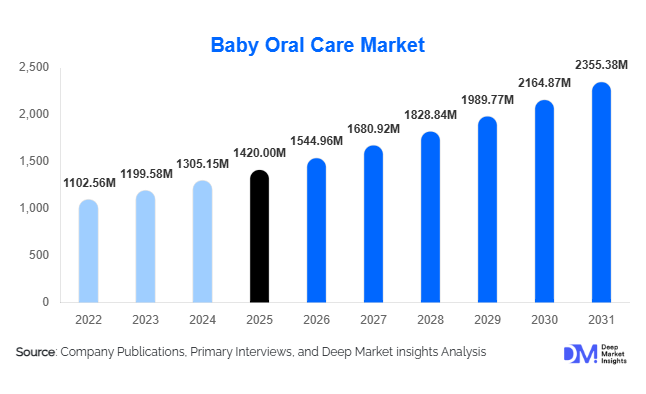
According to Deep Market Insights,the global baby oral care market size was valued at USD 1,420 million in 2025 and is projected to grow from USD 1,544.96 million in 2026 to reach USD 2,355.38 million by 2031, expanding at a CAGR of 8.8% during the forecast period (2026–2031). The baby oral care market growth is primarily driven by increasing awareness among parents regarding early childhood dental hygiene, rising demand for safe and organic baby care products, and the growing influence of pediatric dental recommendations encouraging oral care practices starting from infancy.
Key Market Insights
- Rising parental awareness of infant oral hygiene is driving the adoption of specialized products such as fluoride-free toothpaste, silicone toothbrushes, and gum cleansing wipes.
- Natural and organic baby oral care products are gaining popularity as parents increasingly avoid synthetic ingredients and artificial additives in infant care products.
- North America dominates the global market, supported by high consumer spending on baby care products and strong pediatric dental awareness programs.
- Asia-Pacific is the fastest-growing region, driven by rising birth rates, expanding middle-class populations, and increasing access to baby care retail networks.
- E-commerce channels are rapidly transforming distribution, allowing consumers to access niche and premium baby oral care brands globally.
- Product innovation, including BPA-free toothbrushes, probiotic toothpaste formulations, and educational oral care kits, is reshaping product development strategies.
What are the latest trends in the baby oral care market?
Growing Demand for Natural and Organic Baby Oral Care Products
The shift toward clean-label and natural baby care products is one of the most prominent trends shaping the baby oral care market. Parents are increasingly choosing toothpaste and oral hygiene products formulated with plant-based ingredients such as aloe vera, chamomile, coconut oil, and xylitol. These ingredients offer antibacterial properties while ensuring safety for infants who may accidentally swallow toothpaste. The demand for fluoride-free and preservative-free formulations has increased significantly in recent years. Manufacturers are responding by launching certified organic baby toothpaste and eco-friendly toothbrushes made from biodegradable materials. Packaging innovations such as recyclable tubes and sustainable toothbrush handles are also becoming more common, reflecting growing environmental consciousness among modern parents.
Technology-Enhanced Infant Oral Care Solutions
Technological integration is gradually entering the baby oral care space, with manufacturers introducing smart toothbrushes and interactive oral care tools designed specifically for toddlers. Some toothbrushes now feature built-in timers, music, and LED indicators that guide children to brush properly while encouraging healthy dental habits from an early age. Mobile applications connected to smart toothbrushes allow parents to monitor brushing routines and track oral hygiene habits. Educational dental kits designed with gamification elements are also gaining traction as they make oral hygiene engaging for toddlers. As digital health technologies continue to expand, smart oral care devices tailored for young children are expected to create new product innovation opportunities within the baby oral care market.
What are the key drivers in the baby oral care market?
Increasing Awareness of Early Childhood Dental Care
One of the primary drivers of the baby oral care market is the increasing emphasis on preventive dental care during infancy. Pediatric dentists recommend cleaning a baby’s gums even before teeth emerge and establishing brushing routines as soon as the first tooth appears. Governments, dental associations, and healthcare providers worldwide are promoting early oral hygiene awareness programs for parents. These initiatives have significantly increased the adoption of products such as gum wipes, finger toothbrushes, and infant toothpaste. As awareness spreads through healthcare institutions and parenting communities, the demand for specialized baby oral care products is expected to continue growing.
Growing Premiumization in the Baby Care Industry
The global baby care market has witnessed strong premiumization in recent years, with parents increasingly willing to invest in high-quality products that ensure safety and health benefits for their children. Premium baby oral care products featuring organic ingredients, BPA-free materials, and pediatric dentist endorsements are gaining widespread acceptance. These products are often marketed with safety certifications and dermatologically tested formulations, which strengthen consumer trust. The trend is particularly prominent in developed markets such as the United States, Canada, Germany, and Japan, where consumers are willing to pay higher prices for safer and more sustainable baby care products.
What are the restraints for the global market?
Strict Regulatory Requirements for Infant Products
Baby oral care products are subject to strict safety regulations because they are used by infants and toddlers. Regulatory authorities require extensive product testing to ensure that ingredients are non-toxic and safe for accidental ingestion. Compliance with these regulations increases manufacturing costs and can slow product development cycles. Smaller manufacturers often face challenges in meeting international safety standards, which may limit their ability to expand into global markets.
Limited Awareness in Emerging Rural Markets
Although awareness regarding infant oral hygiene is increasing globally, adoption remains limited in several developing regions due to lack of awareness and limited access to pediatric dental services. In many rural areas, parents are still unfamiliar with the importance of early oral care routines. Limited retail availability and lower purchasing power also restrict the penetration of baby oral care products in these regions. Expanding educational initiatives and improving product accessibility remain critical challenges for market growth.
What are the key opportunities in the baby oral care industry?
Expansion in Emerging Economies
Emerging economies such as India, China, Brazil, and Indonesia present strong growth opportunities for baby oral care manufacturers. Rapid urbanization, increasing disposable income, and expanding middle-class populations are encouraging parents to spend more on baby hygiene products. Retail expansion through supermarkets, pharmacies, and online marketplaces is improving product accessibility in these regions. As healthcare awareness improves and pediatric dental services expand, demand for baby oral care products is expected to rise significantly in emerging markets over the coming decade.
Smart and Educational Oral Care Products
The introduction of smart and educational oral care tools designed for toddlers represents another major opportunity for manufacturers. Products that incorporate music, visual cues, and brushing timers help children develop consistent oral hygiene habits while making brushing more engaging. These innovations appeal to modern parents who prioritize health education and early habit formation. Educational oral care kits distributed through hospitals and pediatric clinics are also gaining popularity, offering opportunities for manufacturers to collaborate with healthcare institutions and expand market reach.
Report Scope
| Report Metric | Details |
|---|---|
| Market Size in 2025 | USD 1420 Million |
| Market Size in 2026 | USD 1544.96 Million |
| Market Size in 2031 | USD 2355.38 Million |
| CAGR | 8.8% (2026-2031) |
| Base Year for Estimation | 2025 |
| Historical Data | 2022-2024 |
| Forecast Period | 2026-2031 |
| Report Coverage | Revenue Forecast, Competitive Landscape, Supply Chain Disruption, Growth Factors, Environment & Regulatory Landscape and Trends |
| Geographies Covered | North America, Europe, APAC, Middle East and Africa, LATAM |
| Countries Covered | U.S., Canada, U.K., Germany, France, Spain, Italy, Russia, Nordic, Benelux, Rest of Europe, China, Korea, Japan, India, Australia, Singapore, Taiwan, South East Asia, Rest of Asia-Pacific, UAE, Turky, Saudi Arabia, South Africa, Egypt, Nigeria, Rest of MEA, Brazil, Mexico, Argentina, Chile, Colombia, Rest of LATAM |
Explore more data points, trends and opportunities Download Free Sample Report
Product Type Insights
Baby toothpaste dominates the baby oral care market, accounting for nearly 38% of the global market share in 2025. Its strong position is driven by growing parental awareness about the importance of early oral hygiene, increasing recommendations from pediatric dentists, and the widespread availability of fluoride-free and organic formulations tailored for infants and toddlers. Baby toothbrushes, particularly silicone finger brushes and training toothbrushes, are another key segment, gaining popularity for their gentle cleaning and ease of use. Gum care products, including cleansing wipes and gum massage brushes, are witnessing steady growth, especially for pre-teething infants, due to their role in soothing discomfort and preventing oral infections. Dental starter kits, which bundle toothbrushes, toothpaste, and educational guides, are emerging as a preferred choice for first-time parents, combining convenience with guidance on proper oral hygiene routines.
Age Group Insights
The 1–2 years age group holds approximately 34% of the global baby oral care market, making it the largest segment. This stage is critical as toddlers develop multiple teeth and transition to independent brushing routines. Pediatric dentists strongly recommend brushing twice daily during this phase, driving demand for toddler-specific toothbrushes and toothpaste. The 6–12 months age group also contributes significantly, as parents introduce oral care products during the teething period. Products for newborns, such as gum wipes and silicone finger brushes, are essential for maintaining hygiene before tooth eruption, ensuring early oral health and establishing long-term brushing habits.
Distribution Channel Insights
Offline retail channels dominate the market, accounting for nearly 57% of total sales in 2025. Pharmacies, supermarkets, and baby specialty stores are trusted sources, offering professional recommendations and pediatric dentist-approved brands. Conversely, online retail is the fastest-growing channel, fueled by the convenience of home delivery, access to niche and premium brands, detailed product information, and customer reviews. Subscription models for frequently used baby care products further accelerate online sales. This growth is also supported by the proliferation of e-commerce platforms in emerging markets, providing easy access to a wide range of baby oral care products.
End-Use Insights
Household consumption accounts for nearly 82% of the global baby oral care market, as parents integrate oral hygiene products into daily routines. Pediatric dental clinics and hospitals are emerging as secondary segments, recommending specific oral care products during early checkups and distributing dental starter kits to new parents. Daycare centers are increasingly adopting oral hygiene programs for toddlers, reflecting growing awareness of oral care in early childhood education settings. These developments collectively drive steady demand and create opportunities for product innovation and educational initiatives.
Explore more data points, trends and opportunities Download Free Sample Report
Baby Oral Care Market Segmentations
By Product Type
- Baby Toothpaste
- Baby Toothbrushes
- Gum Care Products
- Baby Oral Care Kits
- Teething & Gum Massage Products
- Training Toothbrushes & Finger Brushes
By Age Group
- 0–6 Months (Pre-Teething Oral Care)
- 6–12 Months (Teething Stage)
- 1–2 Years (Toddler Oral Care)
- 2–3 Years (Early Independent Brushing)
By Distribution Channel
- Online Retail
- Supermarkets & Hypermarkets
- Pharmacies & Drug Stores
- Baby Specialty Stores
- Hospital & Pediatric Clinic Distribution
By End Use
- Household / Parents
- Pediatric Dental Clinics
- Hospitals & Maternity Centers
- Daycare & Early Education Centers
Regional Insights
North America
North America holds nearly 32% of the global baby oral care market, making it the largest regional market. The United States drives demand through high consumer spending, awareness of preventive dental care, and strong influence of pediatric dental associations promoting early oral hygiene. Canada contributes through well-developed healthcare infrastructure and growing preference for organic baby care products. The regional market growth is supported by increasing parental willingness to invest in premium and specialized oral care solutions, coupled with educational campaigns emphasizing oral health from infancy.
Europe
Europe accounts for approximately 24% of the global market, led by Germany, the United Kingdom, and France. The region shows a strong preference for organic, natural, and eco-friendly baby oral care products, encouraging manufacturers to launch fluoride-free toothpastes, biodegradable toothbrushes, and chemical-free gum care solutions. Strict product safety and quality regulations enhance consumer trust, while growing health awareness among parents and educational campaigns by pediatric associations drive product adoption. Rising e-commerce penetration and innovative marketing strategies further contribute to market expansion.
Asia-Pacific
Asia-Pacific represents nearly 29% of the global market share and is projected to be the fastest-growing region. China and India lead due to large infant populations, increasing disposable incomes, and growing awareness of pediatric dental health. Expanding e-commerce platforms, aggressive marketing by global and regional brands, and the rise of organized retail are key growth drivers. Japan and South Korea, as mature markets, exhibit high demand for premium and technologically advanced oral care products. Regional growth is also fueled by government health initiatives, pediatric awareness campaigns, and rising urbanization that increases accessibility to specialized baby care products.
Latin America
Latin America holds around 7% of the global market, with Brazil and Mexico leading regional demand. Market growth is driven by rising birth rates, increasing parental awareness of infant oral health, and the expansion of modern retail and e-commerce channels. Government-led healthcare programs and promotional campaigns about infant oral hygiene are encouraging adoption of baby toothpaste, toothbrushes, and starter kits. Urbanization and growing middle-class populations also support higher spending on specialized baby oral care products.
Middle East & Africa
The Middle East & Africa region accounts for approximately 8% of the global baby oral care market. Countries such as the UAE, Saudi Arabia, and South Africa are witnessing rising demand due to improving healthcare awareness, increasing disposable incomes, and parental preference for premium and organic products. Expansion of modern retail chains, online marketplaces, and government healthcare initiatives are supporting market development. Additionally, targeted marketing campaigns and collaborations with pediatric dentists are helping educate parents on the importance of early oral care, driving adoption of toothpaste, toothbrushes, and dental starter kits.
Key Players in the Baby Oral Care Market
- Procter & Gamble
- Colgate-Palmolive Company
- Unilever
- Johnson & Johnson
- Church & Dwight Co., Inc.
- Lion Corporation
- Pigeon Corporation
- Chicco (Artsana Group)
- Dr. Brown’s
- Tom’s of Maine
- Jack N’ Jill Kids
- Brush Baby Ltd.
- Radius Corporation
- Mamaearth
- The Natural Dentist