Baby Oil Market Size
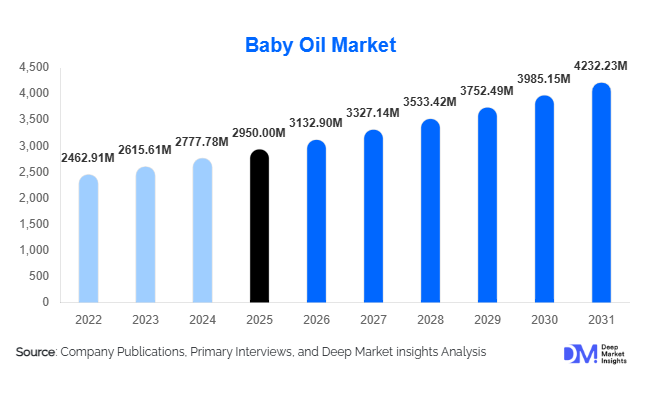
According to Deep Market Insights, the global baby oil market size was valued at USD 2,950 million in 2025 and is projected to grow from USD 3,132.90 million in 2026 to reach USD 4,232.23 million by 2031, expanding at a CAGR of 6.2% during the forecast period (2026–2031). The market growth is primarily driven by rising awareness of infant skincare, increasing disposable income among young parents, and growing demand for safe, dermatologically tested, and natural baby care products. Additionally, the expansion of e-commerce platforms and the rising adoption of baby oil in adult skincare routines are further supporting market expansion globally.
Key Market Insights
- Plant-based and organic baby oils are gaining strong traction, driven by increasing consumer preference for natural and chemical-free formulations.
- Asia-Pacific dominates the global market, supported by high birth rates and strong cultural practices such as infant massage.
- Online retail channels are the fastest-growing distribution segment, enabling wider product accessibility and direct-to-consumer engagement.
- Premiumization is reshaping the market, with higher demand for hypoallergenic and dermatologically tested products.
- Infant skincare remains the core application, accounting for the majority of product usage globally.
- Multifunctional usage of baby oil, including adult skincare and cosmetic applications, is expanding the market base.
What are the latest trends in the baby oil market?
Shift Toward Natural and Organic Formulations
Consumers are increasingly shifting away from traditional mineral-based oils toward plant-based and organic alternatives such as coconut, almond, and olive oil-based formulations. This trend is driven by heightened awareness regarding potential skin sensitivities and a growing preference for clean-label products. Manufacturers are responding by launching certified organic products, improving ingredient transparency, and investing in sustainable sourcing practices. The demand for fragrance-free and hypoallergenic variants is also rising, particularly in developed markets where safety standards and consumer expectations are higher.
Expansion of E-commerce and Direct-to-Consumer Channels
The rapid growth of e-commerce platforms has transformed the distribution landscape of the baby oil market. Online retail allows brands to reach a wider audience, offer personalized recommendations, and engage directly with consumers through digital marketing strategies. Subscription-based models, bundled baby care kits, and influencer-driven promotions are becoming increasingly common. This trend is particularly significant in emerging markets, where digital penetration is improving access to premium and niche baby care products.
What are the key drivers in the baby oil market?
Rising Awareness of Infant Skincare
Increasing awareness regarding infant hygiene and skincare is a major driver of the baby oil market. Parents are becoming more informed about the importance of maintaining skin hydration and preventing conditions such as dryness and rashes. Pediatric recommendations and healthcare campaigns are encouraging the use of specialized baby care products, including oils for daily massage and moisturization.
Growth in Disposable Income and Urbanization
The expansion of middle-class populations in emerging economies such as India, China, and Southeast Asia is significantly boosting demand for baby care products. Rising disposable incomes are enabling consumers to spend more on premium and branded baby oils, while urbanization is improving access to organized retail and healthcare services. This economic shift is a key contributor to sustained market growth.
What are the restraints for the global market?
Concerns Regarding Mineral Oil Safety
Despite regulatory approvals, concerns and misconceptions about the safety of mineral oil-based products persist among consumers. Negative perceptions related to petroleum-derived ingredients are influencing purchasing decisions, particularly in developed markets, where consumers are increasingly opting for natural alternatives.
Price Sensitivity in Developing Markets
While premium baby oils are gaining popularity, a large segment of consumers in developing regions remains price-sensitive. The higher cost of organic and plant-based products limits their adoption, especially in rural and semi-urban areas. This creates a challenge for manufacturers to balance affordability with innovation and quality.
What are the key opportunities in the baby oil industry?
Growth of Organic and Premium Product Segments
The increasing demand for organic and premium baby care products presents a significant opportunity for market players. Brands that invest in certified organic ingredients, sustainable packaging, and transparent labeling can capture higher margins and build strong consumer trust. This trend is particularly prominent in North America and Europe, where consumers are willing to pay a premium for safety and quality.
Product Diversification and Multifunctional Applications
Baby oil is increasingly being positioned as a multifunctional product suitable for both infants and adults. Applications such as makeup removal, skin hydration, and massage therapy are expanding the product’s usage beyond traditional baby care. This diversification is enabling companies to target a broader consumer base and increase product penetration across different demographics.
Report Scope
| Report Metric | Details |
|---|---|
| Market Size in 2025 | USD 2950 Million |
| Market Size in 2026 | USD 3132.90 Million |
| Market Size in 2031 | USD 4232.23 Million |
| CAGR | 6.2% (2026-2031) |
| Base Year for Estimation | 2025 |
| Historical Data | 2022-2024 |
| Forecast Period | 2026-2031 |
| Report Coverage | Revenue Forecast, Competitive Landscape, Supply Chain Disruption, Growth Factors, Environment & Regulatory Landscape and Trends |
| Geographies Covered | North America, Europe, APAC, Middle East and Africa, LATAM |
| Countries Covered | U.S., Canada, U.K., Germany, France, Spain, Italy, Russia, Nordic, Benelux, Rest of Europe, China, Korea, Japan, India, Australia, Singapore, Taiwan, South East Asia, Rest of Asia-Pacific, UAE, Turky, Saudi Arabia, South Africa, Egypt, Nigeria, Rest of MEA, Brazil, Mexico, Argentina, Chile, Colombia, Rest of LATAM |
Explore more data points, trends and opportunities Download Free Sample Report
Product Type Insights
Mineral-based baby oil continues to dominate the global market, accounting for approximately 48% of the total market share in 2025. The leadership of this segment is primarily driven by its cost-effectiveness, long shelf life, and widespread availability across both developed and developing markets. Mineral oils are highly refined, stable, and non-reactive, making them a preferred choice for mass-market consumers and large-scale manufacturers. Additionally, their strong presence in established brands and legacy formulations reinforces consumer trust, particularly in price-sensitive regions across Asia and Latin America.
However, the market is witnessing a notable shift toward plant-based baby oils, which represent the fastest-growing segment. This growth is fueled by increasing consumer awareness regarding ingredient safety, rising demand for natural, organic, and chemical-free formulations, and the growing influence of clean-label trends. Oils derived from coconut, almond, and olive sources are gaining popularity, particularly in North America and Europe, where premiumization is a key trend. Medicated and hypoallergenic baby oils are also expanding their market presence, especially in developed regions where dermatological safety, pediatric recommendations, and regulatory compliance play a critical role in purchase decisions. Furthermore, fragrance-free formulations are increasingly preferred by parents seeking minimalistic and sensitive-skin-friendly products, contributing to steady growth in niche but high-value segments.
Application Insights
Skin moisturization remains the leading application segment, contributing nearly 50% of the global market share in 2025. This dominance is driven by the essential role of baby oil in maintaining infant skin hydration, preventing dryness, and supporting overall skin health. Pediatric recommendations and daily skincare routines strongly reinforce the use of baby oil as a primary moisturizing solution across all regions. Massage therapy represents the second-largest application segment, with particularly strong demand in the Asia-Pacific. The growth of this segment is supported by deep-rooted cultural practices of infant massage in countries such as India and China, where baby oil is considered essential for improving blood circulation, bone strength, and overall well-being. This cultural factor provides a sustained and consistent demand base for the market.
Additional applications, including hair care and cosmetic usage, are expanding the market scope beyond infant care. Adult consumers increasingly use baby oil for makeup removal, skin hydration, and massage therapy, driven by its gentle and non-irritating properties. This diversification of applications is a key driver of incremental market growth and product innovation.
Distribution Channel Insights
Supermarkets and hypermarkets dominate the distribution landscape, accounting for approximately 38% of the global market share in 2025. The leadership of this segment is attributed to extensive retail networks, high product visibility, consumer trust, and the ability to offer a wide range of brands under one roof. These retail formats also benefit from strong supply chain integration and promotional activities that drive volume sales. Pharmacies and drugstores continue to play a crucial role, particularly for medicated and dermatologist-recommended baby oils. These channels are preferred by parents seeking medically endorsed and safe products, especially in developed markets.
Meanwhile, online retail is the fastest-growing distribution channel, driven by increasing digital penetration, convenience, and access to a broader product portfolio. E-commerce platforms enable consumers to compare products, read reviews, and access premium or niche brands that may not be available in physical stores. Additionally, the rise of direct-to-consumer (D2C) models, subscription services, and influencer-driven marketing is accelerating online sales growth globally. Specialty baby stores are also gaining traction by offering curated product selections, expert guidance, and personalized shopping experiences, particularly in urban centers.
End-User Insights
Infants aged 0–12 months represent the largest end-user segment, accounting for approximately 55% of the global market share in 2025. The dominance of this segment is driven by the critical importance of skincare during early infancy, where baby oil is widely used for daily massage, moisturization, and protection against skin dryness. High product dependency during this stage ensures consistent demand across all regions. Toddlers (1–3 years) form the second-largest segment, with continued usage of baby oil for skincare and massage, although at a relatively lower frequency compared to infants. This segment benefits from ongoing parental preference for gentle and safe skincare products.
The adult segment is emerging as a key growth area, driven by the multifunctional nature of baby oil. Increasing adoption for cosmetic purposes such as makeup removal, body moisturization, and massage therapy is expanding the consumer base beyond traditional infant care. This trend is particularly strong in urban markets and among younger demographics, contributing to overall market expansion.
Explore more data points, trends and opportunities Download Free Sample Report
Baby Oil Market Segmentations
By Product Type
- Mineral-Based Baby Oil
- Plant-Based Baby Oil
- Medicated/Hypoallergenic Baby Oil
- Fragrance-Free Baby Oil
- Fragrance-Added Baby Oil
By Application
- Skin Moisturization
- Massage Therapy
- Hair Care
- Cosmetic/Makeup Removal
By Distribution Channel
- Supermarkets/Hypermarkets
- Pharmacies/Drugstores
- Online Retail/E-commerce
- Specialty Baby Stores
- Convenience Stores
Regional Insights
Asia-Pacific
Asia-Pacific leads the global baby oil market, accounting for approximately 42% of the total market share in 2025. The region’s dominance is driven by high birth rates, a large population base, and deeply rooted cultural practices such as infant massage, particularly in countries like India and China. India stands out as one of the fastest-growing markets, supported by rising disposable income, increasing urbanization, and growing awareness of branded and packaged baby care products. Additionally, government initiatives focused on maternal and child healthcare, expanding retail infrastructure, and increasing penetration of e-commerce platforms are further accelerating regional growth.
North America
North America holds around 25% of the global market share, with the United States being the primary contributor. Growth in this region is driven by high consumer awareness, strong preference for premium and organic products, and stringent regulatory standards ensuring product safety. The increasing demand for hypoallergenic and fragrance-free formulations reflects a shift toward clean-label and dermatologically tested products. Furthermore, higher disposable income, well-established healthcare systems, and the strong presence of leading global brands continue to support steady market growth in the region.
Europe
Europe accounts for approximately 20% of the global market, with key markets including Germany, the United Kingdom, and France. The region’s growth is primarily driven by strong consumer preference for organic, sustainable, and environmentally friendly products. Regulatory frameworks emphasizing product safety and ingredient transparency play a crucial role in shaping purchasing decisions. Additionally, rising demand for vegan and cruelty-free formulations, coupled with increasing awareness of infant skincare, is supporting the expansion of plant-based baby oil products across Europe.
Latin America
Latin America contributes around 6% of the global market share, with Brazil and Mexico as major markets. The region is experiencing steady growth due to increasing urbanization, improving access to healthcare, and rising awareness of infant hygiene and skincare. However, price sensitivity remains a key factor, leading to strong demand for mid-range and affordable products. The expansion of modern retail formats and growing penetration of international brands are also contributing to market development in the region.
Middle East & Africa
The Middle East & Africa region accounts for approximately 7% of the global market. Growth in this region is supported by improving healthcare infrastructure, rising birth rates in certain countries, and increasing awareness of infant care practices. The UAE and South Africa are key markets, driven by higher disposable income and growing demand for premium baby care products. Additionally, government-led healthcare initiatives, expanding retail networks, and increasing availability of international brands are further supporting market growth across the region.
Key Players in the Baby Oil Market
- Johnson & Johnson
- Unilever
- Procter & Gamble
- Himalaya Wellness
- Dabur
- Chicco
- Pigeon Corporation
- Mustela
- Burt’s Bees
- Sebapharma
- Mothercare
- Beiersdorf
- Weleda
- Earth Mama Organics
- California Baby