Baby Nursery Furniture Market Size
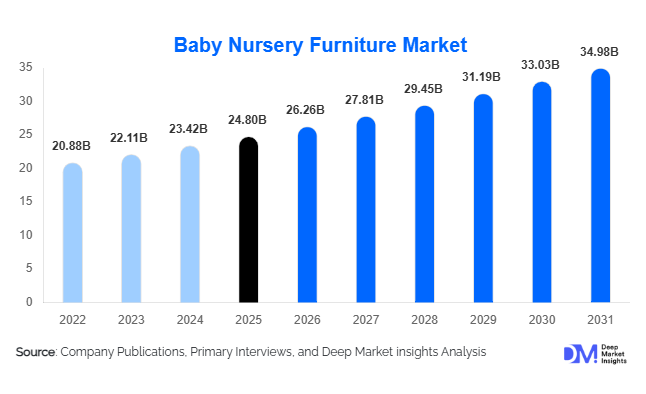
According to Deep Market Insights, the global baby nursery furniture market size was valued at USD 24.8 billion in 2025 and is projected to grow from USD 26.26 billion in 2026 to reach USD 34.98 billion by 2031, expanding at a CAGR of 5.9% during the forecast period (2026–2031). The market growth is driven by rising urbanization, increasing disposable incomes, growing demand for premium and safe infant furniture, and strong adoption of multifunctional and smart nursery solutions across developed and emerging economies.
Key Market Insights
- Convertible and multifunctional nursery furniture is gaining strong traction, driven by compact urban housing and long-term usability needs.
- Eco-friendly and non-toxic materials are becoming a global standard, with rising demand for FSC-certified wood and sustainable production.
- North America leads in premium and smart nursery furniture adoption, supported by high spending per child and strong safety regulations.
- Asia-Pacific is the fastest-growing region, driven by urbanization, an expanding middle-class population, and rising birth-related spending.
- E-commerce is transforming distribution channels, enabling global brands and D2C players to scale rapidly across markets.
- Smart nursery furniture integration is accelerating, including IoT-enabled cribs, monitoring systems, and automated comfort solutions.
What are the latest trends in the baby nursery furniture market?
Shift Toward Smart and Connected Nursery Ecosystems
The market is witnessing rapid adoption of smart nursery furniture, including sensor-based cribs, app-controlled bassinets, and automated rocking systems. Parents increasingly seek integrated monitoring features that track sleep patterns, temperature, and infant movement. This trend is particularly strong in urban households across North America, Europe, and parts of Asia, where smart home ecosystems are expanding. Manufacturers are integrating AI-based alerts, remote connectivity, and digital parenting support tools to enhance product differentiation and user convenience.
Premiumization and Interior-Driven Nursery Design
Nursery furniture is increasingly viewed as part of home aesthetics rather than purely functional equipment. Demand for designer cribs, coordinated nursery sets, and modular furniture systems is rising. Influenced by social media and parenting influencers, consumers are investing in visually cohesive nursery spaces. Premium materials, minimalist Scandinavian designs, and customizable furniture sets are gaining popularity, particularly among millennial parents.
What are the key drivers in the baby nursery furniture market?
Rising Disposable Income and Urban Parenting Trends
Increasing disposable incomes and the growth of nuclear families are significantly boosting demand for baby nursery furniture. Urban parents are spending more on high-quality, safe, and durable nursery products. The trend of “one-child premium parenting” in emerging economies such as China and India is further increasing per-child spending, supporting market expansion across mid-range and premium segments.
Growing Focus on Infant Safety and Product Standards
Strict global safety regulations and rising parental awareness regarding infant well-being are driving demand for certified nursery furniture. Anti-tip designs, non-toxic finishes, and compliance with international safety standards (ASTM, EN, ISO) are becoming essential. This regulatory environment is pushing manufacturers to innovate safer and more durable furniture solutions.
E-commerce Expansion and Direct-to-Consumer Growth
The rapid expansion of online retail platforms has transformed purchasing behavior in the nursery furniture market. Consumers benefit from wider product selection, price transparency, and easy customization. Direct-to-consumer models are also improving brand margins while enabling global reach, particularly for niche and premium furniture brands.
What are the restraints for the global market?
High Product Costs and Raw Material Volatility
Fluctuating prices of wood, steel, foam, and upholstery materials significantly impact manufacturing costs. Premium nursery furniture remains expensive due to quality material requirements and compliance with safety standards. This limits affordability in price-sensitive emerging markets and restricts mass adoption of premium products.
Declining Birth Rates in Developed Economies
Falling fertility rates in regions such as Europe, Japan, and parts of North America pose a structural challenge to long-term demand growth. While premiumization offsets some impact, declining newborn populations reduce overall volume demand for nursery furniture.
What are the key opportunities in the baby nursery furniture industry?
Growth of Eco-Friendly and Sustainable Furniture
Increasing environmental awareness is driving demand for sustainable nursery furniture made from certified wood, bamboo, and low-emission materials. Companies investing in green manufacturing, recyclable packaging, and non-toxic coatings are gaining a competitive advantage. This segment is expected to see strong premium pricing potential globally.
Expansion in Emerging Markets
Rapid urbanization and rising middle-class populations in India, Southeast Asia, and Latin America present significant growth opportunities. Increasing demand for affordable yet durable nursery furniture is encouraging global brands to expand manufacturing and distribution networks in these regions.
Smart Modular Furniture Systems
The shift toward compact living spaces is creating opportunities for modular, convertible, and space-saving nursery furniture. Products that adapt from the infant to the toddler stages are gaining popularity due to cost efficiency and long lifecycle value.
Report Scope
| Report Metric | Details |
|---|---|
| Market Size in 2025 | USD 24.8 Billion |
| Market Size in 2026 | USD 26.26 Billion |
| Market Size in 2031 | USD 34.98 Billion |
| CAGR | 5.9% (2026-2031) |
| Base Year for Estimation | 2025 |
| Historical Data | 2022-2024 |
| Forecast Period | 2026-2031 |
| Report Coverage | Revenue Forecast, Competitive Landscape, Supply Chain Disruption, Growth Factors, Environment & Regulatory Landscape and Trends |
| Geographies Covered | North America, Europe, APAC, Middle East and Africa, LATAM |
| Countries Covered | U.S., Canada, U.K., Germany, France, Spain, Italy, Russia, Nordic, Benelux, Rest of Europe, China, Korea, Japan, India, Australia, Singapore, Taiwan, South East Asia, Rest of Asia-Pacific, UAE, Turky, Saudi Arabia, South Africa, Egypt, Nigeria, Rest of MEA, Brazil, Mexico, Argentina, Chile, Colombia, Rest of LATAM |
Explore more data points, trends and opportunities Download Free Sample Report
Product Type Insights
Cribs and cots continue to dominate the global baby nursery furniture market, accounting for approximately 34% of total market revenue in 2025. The segment’s leadership is primarily driven by the essential role of cribs in infant safety, sleeping comfort, and early-stage childcare. Rising awareness regarding certified infant sleeping environments, combined with stricter government safety regulations related to crib spacing, anti-tip structures, and non-toxic finishes, continues to accelerate replacement demand globally. Convertible cribs are witnessing particularly strong adoption as consumers increasingly prefer long-term value products that can transition from infant to toddler stages. Premium smart cribs integrated with motion sensors, sleep-monitoring technologies, and automated rocking systems are also gaining traction among urban households in North America, Europe, Japan, and South Korea.
Storage furniture, including dressers, wardrobes, shelving units, and multifunctional organizers, represents another significant product category due to rising demand for efficient space utilization in compact urban apartments. Growing urbanization and shrinking residential living spaces are encouraging parents to invest in modular storage systems that combine aesthetics with functionality. Multifunctional nursery storage furniture with integrated changing stations and foldable designs is becoming increasingly popular among millennial parents seeking practical and visually coordinated nursery interiors.
Seating and comfort furniture, such as nursing chairs, gliders, recliners, and ottoman sets, is emerging as one of the fastest-growing segments within the market. Increasing awareness regarding maternal comfort during feeding and infant care routines is driving demand for ergonomic seating solutions. Premium upholstered nursing chairs with adjustable features and sustainable fabric materials are gaining strong popularity in developed markets, particularly in the United States, Canada, Germany, and the UK. Changing tables and multifunctional nursery units are also witnessing rising adoption globally, especially within mid-range and premium product categories. Parents increasingly prefer integrated nursery systems that combine changing stations, storage compartments, and mobility features to maximize convenience. In addition, the growth of compact urban housing is driving demand for foldable and space-saving nursery furniture products that support multifunctional living environments.
End-Use Insights
Residential households remain the dominant end-use segment within the global baby nursery furniture market, accounting for nearly 82% of total market demand in 2025. Rising parental expenditure on infant care products, growing awareness regarding child safety, and increasing preference for personalized nursery aesthetics continue to drive strong residential demand globally. The increasing influence of social media parenting trends, nursery décor inspiration platforms, and premium lifestyle positioning is encouraging parents to invest in coordinated nursery environments that combine comfort, safety, and interior design appeal.
The rapid expansion of nuclear families and dual-income urban households is further strengthening residential furniture purchases. First-time parents are increasingly prioritizing multifunctional and long-lasting nursery furniture products, particularly convertible cribs, modular storage systems, and eco-friendly furniture solutions. Premiumization trends are especially visible in North America, Europe, China, and parts of the Middle East, where consumers are willing to spend significantly more on certified, sustainable, and designer nursery furniture. Daycare centers and childcare institutions represent one of the fastest-growing commercial end-use categories. Rising female workforce participation rates globally, particularly in urban economies, are accelerating demand for organized childcare infrastructure. Childcare operators are increasingly investing in durable, safety-certified, and modular nursery furniture solutions that comply with institutional regulations while maximizing operational efficiency. Commercial demand for stackable cribs, space-saving furniture, and easy-to-maintain nursery systems is increasing significantly across developed economies.
Hospitals and maternity clinics continue to provide stable institutional demand for bassinets, infant care stations, feeding chairs, and changing furniture. Investments in maternal healthcare infrastructure across Asia-Pacific, the Middle East, and Latin America are supporting procurement growth in this segment. Additionally, pediatric clinics and neonatal care units increasingly require specialized infant furniture solutions designed for safety, hygiene, and medical compatibility. The hospitality industry is emerging as a growing niche application area within the market. Hotels, resorts, and serviced apartments are increasingly introducing family-friendly accommodations equipped with portable cribs, compact nursery furniture, and child-safe room features to attract traveling families. Furthermore, export-driven manufacturing demand from Asia-Pacific production hubs such as China, Vietnam, and Malaysia continues to strengthen global supply chains and support international distribution growth.
Explore more data points, trends and opportunities Download Free Sample Report
Baby Nursery Furniture Market Segmentations
By Product Type
- Cribs & Cots
- Baby Beds & Toddler Transition Furniture
- Storage Furniture
- Seating & Comfort Furniture
- Changing & Care Furniture
- Feeding Furniture
- Nursery Décor & Functional Accessories Furniture
By Material Type
- Solid Wood Furniture
- Engineered Wood/MDF Furniture
- Metal-Based Furniture
- Plastic/Polymer Furniture
- Hybrid & Mixed Material Furniture
- Sustainable/Bamboo Furniture
By Distribution Channel
- Online Retail
- Baby Specialty Stores
- Furniture Retailers
- Department Stores
- Hypermarkets & Supermarkets
- Direct-to-Consumer Platforms
By End Use
- Residential Households
- Daycare & Childcare Centers
- Hospitals & Maternity Clinics
- Hospitality Sector
- Institutional Childcare Facilities
By Technology Integration
- Conventional Nursery Furniture
- Smart Connected Nursery Furniture
- Safety-Certified Nursery Furniture
- Eco-Friendly & Non-Toxic Nursery Furniture
Regional Insights
North America
North America accounted for approximately 33% of the global baby nursery furniture market in 2025, making it the largest regional market worldwide. The United States dominates regional demand due to high consumer spending on infant care products, strong awareness regarding nursery safety standards, and widespread adoption of premium and smart nursery furniture. Rising disposable income levels, growing preference for designer nursery interiors, and increasing demand for multifunctional furniture continue to support regional growth.
Strict regulatory frameworks established by organizations such as the Consumer Product Safety Commission (CPSC) are driving continuous replacement demand for compliant cribs and infant furniture. Additionally, the strong penetration of e-commerce platforms and direct-to-consumer furniture brands has significantly expanded product accessibility across the region. Consumers increasingly prefer sustainable, non-toxic, and FSC-certified nursery products, further encouraging premiumization within the North American market. The rapid adoption of smart nursery technologies, including app-connected bassinets and AI-enabled sleep monitoring systems, is also positioning the region as a leader in innovation-driven demand.
Europe
Europe represents nearly 27% of the global market share, with Germany, the United Kingdom, France, Italy, and Nordic countries acting as major demand centers. The region’s growth is strongly driven by rising consumer preference for sustainable, eco-friendly, and ethically sourced nursery furniture products. European consumers prioritize high-quality craftsmanship, minimalist aesthetics, and environmentally compliant materials, making FSC-certified wooden nursery furniture particularly popular across the region.
Scandinavian design influence plays a significant role in shaping nursery furniture trends within Europe, emphasizing simplicity, modularity, and multifunctionality. Regulatory pressure regarding chemical emissions, toxic coatings, and furniture stability standards is encouraging manufacturers to invest heavily in sustainable production technologies. The increasing popularity of compact urban living is also driving demand for foldable and space-saving nursery furniture solutions in major metropolitan areas such as London, Paris, Berlin, and Amsterdam. Growing online furniture retail penetration, combined with rising consumer interest in personalized nursery décor, is further accelerating market expansion across Europe. Germany remains one of the largest importers and consumers of premium nursery furniture products within the region.
Asia-Pacific
Asia-Pacific is the fastest-growing regional market for baby nursery furniture and accounted for approximately 25% of global demand in 2025. China remains the largest regional market due to its extensive manufacturing ecosystem, rapidly expanding urban middle-class population, and increasing expenditure on premium infant products. Rising disposable incomes, urban housing development, and growing awareness regarding infant safety standards continue to support strong demand growth across the region. India is emerging as one of the fastest-growing national markets globally, driven by high birth volumes, rapid urbanization, increasing online retail penetration, and rising consumer aspiration toward premium childcare products. Government initiatives supporting domestic furniture manufacturing, including “Make in India,” are encouraging production capacity expansion and improving product affordability.
Japan and South Korea contribute significantly to the demand for compact, modular, and technologically advanced nursery furniture due to limited residential living space and high consumer preference for innovation-driven products. Increasing adoption of smart nursery systems and multifunctional furniture solutions is accelerating market growth across developed Asia-Pacific economies. Additionally, the region’s role as a major global manufacturing and export hub continues to strengthen its long-term strategic importance within the industry.
Latin America
Latin America accounted for nearly 8% of the global baby nursery furniture market in 2025, with Brazil and Mexico representing the largest regional demand centers. Rapid urban population growth, improving retail infrastructure, and increasing middle-class consumer spending are driving nursery furniture demand across the region. Mid-range furniture products remain the most popular category due to affordability considerations and growing demand for practical multifunctional solutions.
The expansion of organized retail channels and online marketplaces is improving product accessibility in major urban areas across Brazil, Mexico, Chile, and Colombia. Rising awareness regarding infant safety standards and increasing exposure to global nursery décor trends through digital platforms are also contributing to market expansion. However, economic volatility and currency fluctuations continue to create pricing sensitivity within the regional market.
Middle East & Africa
The Middle East & Africa region accounted for approximately 7% of global market demand in 2025. The UAE and Saudi Arabia lead regional demand for premium and luxury nursery furniture products, supported by high-income households, expanding luxury retail infrastructure, and strong consumer preference for imported designer furniture brands. Rapid residential construction activity, increasing expatriate populations, and rising expenditure on premium childcare products are major growth drivers across Gulf Cooperation Council (GCC) countries. Luxury nursery furniture collections, smart nursery systems, and customized interior-focused nursery solutions are gaining strong traction among affluent consumers in Dubai, Abu Dhabi, and Riyadh.
South Africa continues to serve as an important manufacturing and distribution hub within Africa, while improving urbanization and rising middle-class populations across parts of the continent are gradually supporting broader market development. Growing investments in hospitality infrastructure and family-oriented accommodation services are also contributing to regional nursery furniture demand growth.
Key Players in the Baby Nursery Furniture Market
- Delta Children
- Storkcraft
- Goodbaby International
- Million Dollar Baby Co.
- IKEA
- Natart Juvenile
- Silver Cross
- Babyletto
- Boori
- Sorelle Furniture
- Dream On Me
- Pali Design
- Mamas & Papas
- Romina Furniture
- Casa Kids