Baby Doll Market Size
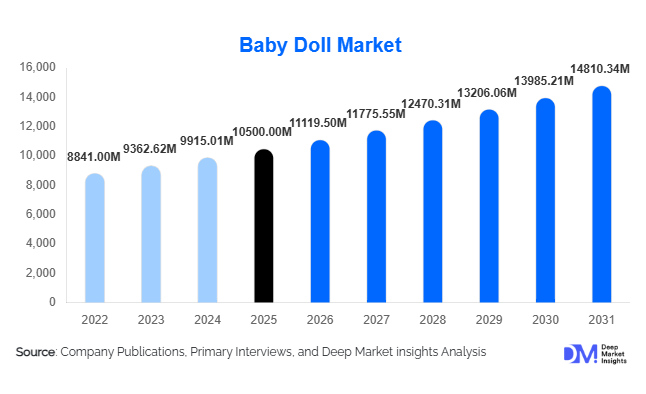
According to Deep Market Insights, the global baby doll market size was valued at USD 10,500 million in 2025 and is projected to grow from USD 11,119.50 million in 2026 to reach USD 14,810.34 million by 2031, expanding at a CAGR of 5.9% during the forecast period (2026–2031). The baby doll market growth is driven by increasing global toy consumption, rising demand for educational and developmental toys among children, and the expanding popularity of interactive dolls equipped with smart features such as voice recognition and motion sensors.
Baby dolls remain one of the most traditional and enduring categories within the global toy industry. These toys play a crucial role in imaginative play and early childhood development by encouraging nurturing behaviors, role-playing, and emotional intelligence among young children. Over the past decade, the market has evolved from simple plastic dolls toward technologically advanced and realistic dolls designed to replicate human interactions.
The increasing influence of e-commerce, social media marketing, and global retail expansion has significantly widened the reach of baby doll manufacturers. Emerging markets in Asia-Pacific and Latin America are witnessing strong demand due to rising middle-class populations and increased spending on children’s products. Additionally, the growing trend of collectible dolls and premium handcrafted dolls has introduced a high-value niche segment catering to adult hobbyists and collectors.
Key Market Insights
- Interactive and smart baby dolls are gaining popularity, incorporating AI-based responses, sensors, and mobile connectivity to enhance play experiences.
- Plastic and vinyl dolls dominate manufacturing due to their durability, cost-effectiveness, and mass production capability.
- North America remains the largest market, driven by high toy spending and the strong presence of global toy brands.
- Asia-Pacific is the fastest-growing region, supported by rising disposable income and expanding toy retail infrastructure.
- The collectible doll segment is expanding rapidly, fueled by adult hobbyists and nostalgia-driven toy purchases.
- E-commerce is reshaping distribution, enabling global consumers to access niche brands, premium dolls, and limited-edition products.
What are the latest trends in the baby doll market?
Rise of Interactive and Smart Dolls
Technological innovation is transforming the baby doll market with the introduction of interactive dolls capable of responding to voice commands, touch, and environmental stimuli. These dolls often include sensors, microchips, and AI-based programming that allow them to simulate realistic behaviors such as crying, laughing, or responding to nurturing actions. Parents increasingly prefer such toys because they combine entertainment with learning and emotional development. Smart dolls can also integrate with mobile applications that offer interactive storytelling, learning modules, and parental controls. As toy manufacturers continue investing in research and development, interactive dolls are becoming a key differentiator in the competitive toy industry.
Growth of Collectible and Realistic Dolls
The collectible doll segment has witnessed strong growth over the past decade, particularly among adult hobbyists and enthusiasts. Reborn dolls and artist-designed dolls are handcrafted to resemble real babies, often featuring intricate detailing, lifelike skin textures, and high-quality clothing accessories. These dolls are often sold as limited editions, increasing their value among collectors. Online communities and auction platforms have further accelerated the popularity of collectible dolls by connecting enthusiasts across the globe. The growing “kidult” trend, where adults purchase toys for nostalgia or stress relief, is also expanding demand for premium dolls.
What are the key drivers in the baby doll market?
Growing Demand for Developmental Toys
Parents worldwide increasingly prefer toys that contribute to their child’s cognitive, emotional, and social development. Baby dolls are widely recognized for promoting nurturing behavior and empathy in children, particularly during early childhood. Educational institutions and childcare centers also incorporate dolls into role-playing activities designed to improve communication and social skills. This focus on developmental play has significantly boosted the demand for baby dolls, especially among children aged two to five years. As educational toys gain greater attention among parents, baby dolls are increasingly marketed as tools for emotional learning and early childhood development.
Expansion of Global Toy Retail and E-Commerce
The rapid expansion of online retail channels has transformed the toy industry. E-commerce platforms allow consumers to access a wider variety of dolls, including niche and international brands that may not be available through traditional retail outlets. Digital marketing, influencer promotions, and online reviews also play a major role in shaping consumer purchasing decisions. For manufacturers, direct-to-consumer online sales channels provide opportunities to increase profit margins while reaching a broader global audience. The convenience of online shopping, combined with faster logistics networks, is expected to continue supporting the growth of the baby doll market.
What are the restraints for the global market?
Environmental Concerns Regarding Plastic Toys
One of the major restraints for the baby doll market is the growing environmental concern regarding plastic toys. Most dolls are manufactured using materials such as PVC, vinyl, and synthetic polymers, which are not biodegradable. Governments and environmental organizations are increasingly advocating for stricter regulations on plastic usage and waste management in the toy industry. As consumers become more environmentally conscious, manufacturers are under pressure to develop eco-friendly materials and sustainable packaging solutions. However, transitioning to sustainable materials often increases production costs and may affect pricing strategies.
Competition from Digital Entertainment
The rapid growth of digital entertainment platforms, including mobile games, video streaming, and augmented reality applications, has significantly changed children’s play habits. Many children now spend a substantial portion of their leisure time using smartphones, tablets, and gaming consoles. This shift in entertainment preferences poses a challenge for traditional toy categories such as baby dolls. Toy manufacturers must adapt by incorporating digital features and interactive capabilities into their products to remain relevant in an increasingly digital entertainment landscape.
What are the key opportunities in the baby doll industry?
Expansion in Emerging Markets
Emerging economies present significant growth opportunities for the baby doll market. Countries such as China, India, Brazil, and Indonesia are experiencing rapid urbanization, rising disposable incomes, and expanding middle-class populations. These demographic trends are increasing consumer spending on children’s products, including toys. The development of organized retail and e-commerce platforms in these markets is also improving product accessibility. Manufacturers that establish regional production facilities and local distribution networks can benefit from lower logistics costs and increased market penetration.
Integration of Educational Technology in Toys
The integration of educational technology in toys represents another major opportunity for the baby doll market. Smart dolls equipped with learning modules, storytelling capabilities, and interactive games can enhance children’s cognitive development while maintaining entertainment value. Educational dolls that teach languages, numbers, or emotional recognition are becoming increasingly popular among parents seeking toys that combine fun and learning. As educational technology continues to evolve, baby doll manufacturers have the opportunity to create innovative products that bridge the gap between traditional toys and digital learning tools.
Report Scope
| Report Metric | Details |
|---|---|
| Market Size in 2025 | USD 10500 Million |
| Market Size in 2026 | USD 11119.50 Million |
| Market Size in 2031 | USD 14810.34 Million |
| CAGR | 5.9% (2026-2031) |
| Base Year for Estimation | 2025 |
| Historical Data | 2022-2024 |
| Forecast Period | 2026-2031 |
| Report Coverage | Revenue Forecast, Competitive Landscape, Supply Chain Disruption, Growth Factors, Environment & Regulatory Landscape and Trends |
| Geographies Covered | North America, Europe, APAC, Middle East and Africa, LATAM |
| Countries Covered | U.S., Canada, U.K., Germany, France, Spain, Italy, Russia, Nordic, Benelux, Rest of Europe, China, Korea, Japan, India, Australia, Singapore, Taiwan, South East Asia, Rest of Asia-Pacific, UAE, Turky, Saudi Arabia, South Africa, Egypt, Nigeria, Rest of MEA, Brazil, Mexico, Argentina, Chile, Colombia, Rest of LATAM |
Explore more data points, trends and opportunities Download Free Sample Report
Product Type Insights
Traditional baby dolls continue to dominate the global baby doll market, accounting for approximately 34% of total market demand. The leading position of this segment is primarily driven by its affordability, widespread availability, and strong consumer familiarity across generations. Traditional dolls are typically manufactured using molded plastic or vinyl bodies with basic accessories such as feeding bottles, clothing, and cradles, making them accessible to a broad range of consumers, particularly in price-sensitive markets across Asia-Pacific and Latin America. Their durability and simple design also make them suitable for younger children and daycare environments. Another key driver supporting the dominance of traditional baby dolls is their strong presence in the mass retail segment, particularly in supermarkets, toy specialty stores, and discount retail chains. These dolls are frequently included in seasonal promotions and gift purchases during holidays such as Christmas, birthdays, and cultural festivals, further strengthening their global demand.
Meanwhile, interactive and smart baby dolls represent one of the fastest-growing product categories. These dolls incorporate sensors, voice recognition, and programmable responses that simulate real-life interactions such as crying, laughing, or responding to touch. The growing integration of educational technology in toys and increasing parental preference for developmental toys are accelerating the adoption of this segment. Reborn and realistic baby dolls cater primarily to collectors, hobbyists, and adult consumers who value high craftsmanship and authenticity. These dolls are often handmade with lifelike skin textures, rooted hair, and weighted bodies that mimic real infants. Although this segment represents a smaller share of the total market, it commands premium pricing and higher profit margins.
Application Insights
Children’s play and developmental learning remain the largest application segment in the baby doll market, accounting for the majority of global demand. Baby dolls play a crucial role in early childhood development by encouraging nurturing behavior, emotional bonding, empathy, and imaginative role-playing. Educational psychologists and child development specialists often emphasize the importance of pretend play, and baby dolls are widely used to simulate caregiving scenarios that help children develop social and emotional intelligence. The strong demand for developmental toys from parents and educational institutions is a key driver behind this segment’s leadership. Many preschools, daycare centers, and early learning institutions incorporate dolls into their teaching methodologies to help children practice communication, storytelling, and collaborative play.
The gift segment also represents a significant portion of baby doll sales. Dolls are among the most commonly purchased toys for birthdays, holiday celebrations, and festive occasions. Seasonal demand spikes are particularly strong during Christmas in North America and Europe, while festivals such as Diwali in India and Lunar New Year in parts of Asia also contribute to increased toy purchases. The collectible doll segment has been expanding rapidly, especially in developed markets such as the United States, Germany, and Japan. Adult collectors and hobbyists purchase limited-edition dolls, artist-designed dolls, and vintage-style products, often treating them as valuable collectibles. Online marketplaces and collector communities have significantly contributed to the growth of this niche segment.
Distribution Channel Insights
Toy specialty stores remain the leading distribution channel for baby dolls, accounting for approximately 38% of global market sales. The dominance of this channel is driven by its ability to offer a wide range of products, expert recommendations, and interactive shopping experiences. Consumers visiting toy specialty stores often benefit from product demonstrations, seasonal promotions, and in-store displays that encourage impulse purchases. These stores also maintain strong relationships with leading toy brands, allowing them to introduce new product launches and exclusive product lines. Another factor contributing to the leadership of toy specialty stores is their reputation for product quality and safety assurance, which is particularly important for parents purchasing toys for young children. Many specialty retailers also organize educational events and play demonstrations that further strengthen customer engagement.
Hypermarkets and supermarkets represent another important distribution channel, particularly in urban regions where consumers prefer one-stop shopping experiences. These retail outlets typically stock mass-market dolls at competitive price points and frequently include them in promotional campaigns during holiday seasons. Online retail platforms are the fastest-growing distribution channel in the baby doll market. E-commerce platforms allow consumers to access a broader product selection, compare prices, and read customer reviews before making purchasing decisions. The rapid growth of digital commerce, combined with improved logistics and global shipping networks, has significantly expanded the reach of international toy brands.
Age Group Insights
Children aged two to five years represent the largest consumer group in the baby doll market, accounting for approximately 36% of global demand. This age group is particularly receptive to imaginative and role-playing activities, making baby dolls one of the most preferred toys during early childhood. Developmental psychologists widely recognize the importance of pretend play at this stage, as it helps children develop empathy, communication skills, and social understanding. The leadership of this age segment is also supported by strong parental demand for toys that encourage nurturing behavior and emotional learning. Many parents view baby dolls as tools for teaching responsibility and caregiving skills, particularly among preschool-aged children.
Children aged five to eight years represent another important segment, often preferring dolls with enhanced features such as accessories, themed clothing, and interactive capabilities. These dolls allow for more complex storytelling and imaginative play. Pre-teen consumers frequently gravitate toward collectible dolls or character-themed dolls linked to popular entertainment franchises, including movies and television shows. These dolls often feature licensed designs and limited-edition releases that appeal to brand-conscious young consumers. The adult collector segment, while smaller in overall volume, represents a lucrative niche market characterized by premium handcrafted dolls, limited-edition releases, and artist-designed products. The rising “kidult” trend, where adults purchase toys for nostalgia or stress relief, has further expanded this segment’s influence within the global toy market.
Explore more data points, trends and opportunities Download Free Sample Report
Baby Doll Market Segmentations
By Product Type
- Traditional Baby Dolls
- Interactive & Smart Baby Dolls
- Reborn & Realistic Dolls
- Soft-Body / Plush Dolls
- Therapy Dolls
By Application
- Children’s Play & Development
- Gift & Seasonal Toy Market
- Collectibles & Hobby Market
- Educational & Therapy Applications
By Distribution Channel
- Toy Specialty Stores
- Hypermarkets & Supermarkets
- Online Retail
- Department Stores
- Brand-Owned Stores
By Age Group
- Infants & Toddlers (0–2 Years)
- Preschool Children (2–5 Years)
- Early Childhood (5–8 Years)
- Pre-Teens (8–12 Years)
- Adult Collectors
Regional Insights
North America
North America accounts for approximately 37% of the global baby doll market, making it the largest regional market. The United States dominates demand within the region due to its high consumer spending on toys, strong retail infrastructure, and the presence of several leading toy manufacturers. Seasonal purchasing patterns play a major role in market performance, with holiday periods such as Christmas generating significant sales volumes. One of the key drivers of regional growth is the strong culture of gift-giving and toy purchasing among families with young children. Additionally, North America has a highly developed toy retail ecosystem consisting of specialty toy stores, department stores, and online marketplaces that facilitate product accessibility. The region is also witnessing increasing demand for interactive dolls and collectible dolls, particularly among adult hobbyists and enthusiasts. Canada contributes to regional demand through growing online toy retail and increasing interest in educational toys that promote developmental learning.
Europe
Europe represents approximately 26% of the global baby doll market. Major markets include Germany, the United Kingdom, France, Italy, and Spain. Germany stands out as a key market due to its long-standing tradition of doll manufacturing and strong export capabilities. European consumers often prioritize product quality, craftsmanship, and safety standards when purchasing toys. One of the primary drivers of growth in the European market is the increasing preference for premium and eco-friendly toys. Consumers in the region are highly environmentally conscious, encouraging manufacturers to introduce sustainable materials, recyclable packaging, and ethically manufactured dolls. In addition, the region has a well-established network of specialty toy stores and boutique retailers that support premium and collectible doll sales.
Asia-Pacific
Asia-Pacific is the fastest-growing regional market for baby dolls, driven by strong demand from China, India, Japan, and South Korea. Rapid urbanization, rising disposable incomes, and expanding middle-class populations are key factors supporting toy market growth across the region. China plays a dual role as both the world’s largest toy manufacturing hub and a rapidly expanding consumer market. The country’s strong manufacturing infrastructure and export capabilities allow global toy brands to maintain cost-efficient production while supplying international markets. India and Southeast Asian countries are emerging as important growth markets due to rising birth rates, expanding retail networks, and increasing consumer spending on children’s products. Japan, on the other hand, represents a mature toy market with strong demand for collectible dolls, designer toys, and high-quality craftsmanship.
Latin America
Latin America accounts for approximately 6% of global baby doll market demand. Brazil and Mexico are the largest markets within the region due to their large populations and expanding middle-class consumer base. Growth in the region is primarily driven by increasing consumer spending on children’s products, rising urbanization, and the gradual expansion of organized retail networks. International toy brands are also increasing their presence in the region through partnerships with local distributors and online marketplaces. The rapid growth of mobile commerce and digital retail platforms is improving accessibility to global toy brands and supporting overall market expansion.
Middle East & Africa
The Middle East and Africa region represents approximately 4% of the global baby doll market. The United Arab Emirates and Saudi Arabia are key markets due to their high retail spending and strong presence of international toy brands in large shopping malls and entertainment centers. One of the key drivers of growth in the Middle East is the expansion of modern retail infrastructure, including large shopping malls and entertainment complexes that incorporate toy stores and family entertainment zones. Rising disposable incomes and a young population demographic are also contributing to increasing toy demand. In Africa, South Africa represents one of the most developed toy markets due to its established retail sector and expanding e-commerce platforms. Growing urban populations and rising consumer awareness of international toy brands are gradually supporting the growth of the baby doll market across the broader African region.
Key Players in the Baby Doll Market
- Mattel Inc.
- Hasbro Inc.
- MGA Entertainment
- Zapf Creation AG
- JC Toys Group
- Spin Master Corp.
- Jakks Pacific Inc.
- Adora Dolls
- Corolle
- Götz Puppenmanufaktur
- Bayer Design Fritz Bayer GmbH
- Toyland Company
- The New York Doll Collection
- Toymagic
- Paradise Galleries