Baby Diapers Market Size
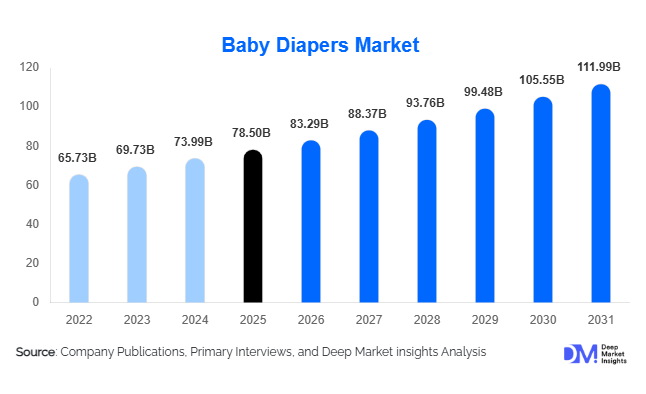
According to Deep Market Insights, the global baby diapers market size was valued at USD 78.5 billion in 2025 and is projected to grow from USD 83.29 billion in 2026 to reach USD 111.99 billion by 2031, expanding at a CAGR of 6.1% during the forecast period (2026–2031). The baby diapers market growth is primarily driven by rising urbanization, increasing participation of women in the workforce, growing awareness of infant hygiene, and the rapid expansion of organized retail and e-commerce distribution channels across emerging economies.
Key Market Insights
- Disposable diapers dominate global demand, accounting for nearly 72% of the total market share in 2025 due to convenience and high absorption efficiency.
- Asia-Pacific leads global consumption, supported by large infant populations, rising disposable incomes, and rapid urbanization.
- Premium and ultra-absorbent diapers are gaining traction, particularly in North America and Europe, where consumers prioritize performance and skin protection.
- E-commerce and subscription-based diaper models are expanding rapidly, reshaping traditional retail distribution channels.
- Sustainability trends are reshaping product innovation, with biodegradable and organic diapers gaining visibility in developed markets.
- Mid-range pricing dominates global demand, accounting for nearly 45% of total market consumption due to its balance of affordability and quality.
What are the latest trends in the baby diapers market?
Shift Toward Eco-Friendly and Biodegradable Diapers
The baby diapers market is witnessing a structural shift toward sustainability, with increasing demand for biodegradable, plant-based, and chemical-free diapers. Parents are becoming more environmentally conscious, especially in Europe and North America, where regulatory frameworks are encouraging reduced landfill waste. Manufacturers are investing in bamboo fibers, organic cotton, and compostable materials to reduce environmental impact. This trend is also influencing packaging innovations, with recyclable and plastic-free packaging becoming more common across premium diaper brands.
Digitalization and Subscription-Based Consumption Models
E-commerce platforms and subscription-based diaper delivery services are rapidly transforming purchasing behavior. Parents increasingly prefer automated monthly deliveries that ensure convenience and cost efficiency. Digital platforms also allow personalized recommendations based on the baby's age, weight, and skin sensitivity. AI-driven retail analytics, targeted promotions, and direct-to-consumer models are helping brands build stronger customer retention. This trend is particularly strong in urban markets where time efficiency is a key purchasing factor.
What are the key drivers in the baby diapers market?
Rising Female Workforce Participation and Urban Lifestyles
The increasing number of working women globally has significantly boosted demand for convenient childcare products. Disposable diapers save time and reduce dependency on traditional cloth alternatives, making them essential in dual-income households. Urbanization further amplifies this trend as nuclear families dominate household structures, increasing reliance on ready-to-use hygiene products.
Growing Awareness of Infant Health and Hygiene
Parents are increasingly prioritizing hygiene, skin protection, and comfort for infants. This has led to the rising adoption of premium diapers with features such as wetness indicators, hypoallergenic materials, and enhanced breathability. Hospitals and maternity clinics also play a crucial role in product awareness, often influencing brand selection during early childcare stages.
Expansion of Organized Retail and E-Commerce Channels
The rapid expansion of supermarkets, pharmacies, and online retail platforms has significantly improved product accessibility. E-commerce penetration in particular has transformed diaper distribution, especially in emerging economies where offline availability was previously limited. Subscription models and discount-driven online sales are accelerating repeat purchases and expanding market reach.
What are the restraints for the global market?
Environmental Concerns and Waste Management Issues
Disposable diapers contribute significantly to non-biodegradable waste, creating environmental challenges in landfill management. Regulatory pressure in developed regions is pushing manufacturers to adopt sustainable alternatives, increasing production costs and limiting the growth of conventional diaper formats.
Price Sensitivity in Emerging Economies
Despite strong demand growth, affordability remains a major barrier in low-income regions. Many consumers still rely on cloth-based alternatives due to the recurring cost of disposable diapers. This restricts deeper penetration in rural and price-sensitive markets across Asia, Africa, and Latin America.
What are the key opportunities in the baby diapers industry?
Expansion in Emerging Markets
Countries such as India, Indonesia, Nigeria, and Brazil present significant growth opportunities due to rising birth rates, urbanization, and increasing disposable incomes. These regions remain underpenetrated, allowing global and regional brands to expand through affordable product offerings and localized manufacturing strategies.
Innovation in Smart and Premium Diapers
The development of smart diapers equipped with moisture sensors and health monitoring systems presents a new frontier in product innovation. Premiumization is also driving demand for ultra-soft, high-performance diapers that enhance comfort and skin protection. These innovations are creating higher-margin opportunities for manufacturers targeting urban consumers.
Sustainability-Led Product Development
The shift toward eco-friendly diapers is creating strong opportunities for companies investing in biodegradable materials and circular manufacturing systems. Governments and consumers are increasingly supporting sustainable products, allowing early adopters to gain a long-term competitive advantage in developed markets.
Report Scope
| Report Metric | Details |
|---|---|
| Market Size in 2025 | USD 78.5 Billion |
| Market Size in 2026 | USD 83.29 Billion |
| Market Size in 2031 | USD 111.99 Billion |
| CAGR | 6.1% (2026-2031) |
| Base Year for Estimation | 2025 |
| Historical Data | 2022-2024 |
| Forecast Period | 2026-2031 |
| Report Coverage | Revenue Forecast, Competitive Landscape, Supply Chain Disruption, Growth Factors, Environment & Regulatory Landscape and Trends |
| Geographies Covered | North America, Europe, APAC, Middle East and Africa, LATAM |
| Countries Covered | U.S., Canada, U.K., Germany, France, Spain, Italy, Russia, Nordic, Benelux, Rest of Europe, China, Korea, Japan, India, Australia, Singapore, Taiwan, South East Asia, Rest of Asia-Pacific, UAE, Turky, Saudi Arabia, South Africa, Egypt, Nigeria, Rest of MEA, Brazil, Mexico, Argentina, Chile, Colombia, Rest of LATAM |
Explore more data points, trends and opportunities Download Free Sample Report
Product Type Insights
Disposable diapers continue to dominate the global baby diapers market, accounting for approximately 72% of total market share in 2025. This leadership is primarily driven by their superior convenience, high absorbency levels enabled by advanced superabsorbent polymers, and widespread availability across both offline and online retail channels. The increasing participation of working parents, particularly in urban areas, has significantly accelerated the shift toward disposable formats. Additionally, innovations such as ultra-thin cores, breathable back sheets, and wetness indicators have further strengthened consumer preference for disposable diapers, especially in developed markets.
Cloth diapers, while environmentally sustainable, remain a niche segment due to their relatively lower convenience and higher maintenance requirements. However, they are gaining selective traction among eco-conscious consumers in Europe and North America. Training pants (pull-up diapers) represent a fast-growing sub-segment, driven by increasing demand during toddler transition phases and rising awareness of potty training products. Swim pants, although a smaller segment, are witnessing steady growth due to increased travel, recreational activities, and infant participation in swimming programs. Notably, premium disposable diapers are outperforming economy variants, particularly in North America and Europe, as consumers increasingly prioritize comfort, dermatological safety, and long-duration protection.
End-Use Insights
Household consumers remain the dominant end-use segment, accounting for over 90% of total market demand in 2025. This dominance is driven by consistent daily usage, rising birth rates in emerging economies, and increasing awareness of infant hygiene among parents. The growing prevalence of nuclear families and dual-income households has further amplified demand for convenient diapering solutions, reinforcing household consumption as the primary growth driver.
Institutional demand, including hospitals, maternity clinics, and daycare centers, is expanding at a relatively faster pace compared to household consumption. Hospitals play a critical role in influencing early brand adoption, as new parents are often introduced to specific diaper brands during postnatal care. Additionally, the increasing number of institutional deliveries globally, particularly in developing countries, is boosting diaper usage within healthcare settings. Daycare centers are also emerging as important contributors to demand, driven by rising female workforce participation and the need for standardized hygiene practices. The institutional segment is further supported by bulk procurement models and partnerships between manufacturers and healthcare providers.
Distribution Channel Insights
Offline retail channels continue to lead the baby diapers market, accounting for approximately 65% of total sales in 2025. Supermarkets, hypermarkets, pharmacies, and convenience stores remain key distribution points due to their accessibility, immediate product availability, and strong consumer trust. In emerging markets, traditional retail outlets still play a crucial role in driving product penetration, particularly in semi-urban and rural areas.
However, online retail is the fastest-growing distribution channel, contributing nearly 35% of incremental market growth. The rapid expansion of e-commerce platforms, combined with increasing internet penetration and smartphone usage, is transforming purchasing behavior. Subscription-based diaper delivery models are gaining popularity, offering convenience, cost savings, and uninterrupted supply for parents. Additionally, online platforms provide benefits such as price comparison, bulk purchase discounts, and personalized product recommendations based on infant age and weight. Brand-owned websites and direct-to-consumer strategies are also gaining traction, enabling manufacturers to enhance customer engagement, collect consumer data, and improve profit margins.
Explore more data points, trends and opportunities Download Free Sample Report
Baby Diapers Market Segmentations
By Product Type
- Disposable Diapers
- Cloth Diapers
- Training Pants
- Swim Pants
By Material Type
- Synthetic
- Organic/Biodegradable
- Hybrid Materials
By Distribution Channel
- Online Retail
- Supermarkets & Hypermarkets
- Pharmacies & Drugstores
- Convenience Stores
- Direct-to-Consumer
Regional Insights
Asia-Pacific
Asia-Pacific dominates the global baby diapers market, holding approximately 38% market share in 2025, making it the largest and fastest-growing regional market. China remains the largest contributor, accounting for nearly 18% of global demand, driven by urbanization, increasing disposable incomes, and a strong shift toward premium diaper products. India represents the fastest-growing market in the region, with a CAGR exceeding 7.5%, supported by rising birth rates, an expanding middle-class population, and increasing penetration of organized retail and e-commerce platforms.
Key growth drivers in Asia-Pacific include rapid urbanization, improving healthcare infrastructure, rising awareness of infant hygiene, and government initiatives promoting maternal and child health. Additionally, the expansion of domestic manufacturing capabilities and cost-effective production is enabling wider product availability and affordability, further accelerating market growth.
North America
North America accounts for approximately 25% of the global baby diapers market, with the United States being the dominant contributor. The region is characterized by high per capita consumption, strong brand loyalty, and a well-established retail infrastructure. Premium and ultra-premium diapers represent a significant share of the market, driven by consumer preference for high-quality, skin-friendly, and technologically advanced products.
Key growth drivers include high disposable income, increasing demand for eco-friendly and biodegradable diapers, and strong innovation by leading manufacturers. Additionally, the widespread adoption of subscription-based purchasing models and advanced e-commerce ecosystems is further enhancing market growth. Regulatory emphasis on product safety and sustainability is also encouraging innovation in biodegradable materials.
Europe
Europe holds around 20% of the global market share, with key markets including Germany, the United Kingdom, and France. The region is highly mature, with stable demand driven by consistent birth rates and high product penetration. European consumers exhibit a strong preference for sustainable and environmentally friendly products, significantly influencing market trends. Growth in Europe is primarily driven by stringent environmental regulations, increasing adoption of biodegradable diapers, and rising consumer awareness regarding product safety and sustainability. Premiumization is also a key trend, supported by high purchasing power and demand for dermatologically tested and hypoallergenic products. Additionally, innovation in eco-friendly materials and circular economy initiatives is shaping long-term market development.
Latin America
Latin America represents approximately 9% of the global baby diapers market, with Brazil and Mexico being the largest contributors. The region is characterized by growing urban populations and improving economic conditions, which are driving increased adoption of disposable diapers. Key growth drivers include expanding retail infrastructure, rising disposable incomes, and increasing awareness of infant hygiene. Government programs supporting maternal and child health are also contributing to higher diaper usage. Additionally, the penetration of affordable mid-range diaper products is enabling manufacturers to capture demand in price-sensitive segments, further supporting regional growth.
Middle East & Africa
The Middle East & Africa region accounts for approximately 8% of the global market, with significant growth potential driven by demographic and economic factors. Africa, particularly countries such as Nigeria and South Africa, is witnessing rising demand due to high birth rates and improving access to hygiene products. In the Middle East, countries such as the UAE and Saudi Arabia are driving demand for premium imported diapers, supported by high disposable incomes and preference for international brands. Key growth drivers across the region include increasing urbanization, expanding healthcare infrastructure, and growing awareness of infant hygiene. Additionally, improving distribution networks and rising penetration of modern retail formats are enabling greater product accessibility, positioning the region as a high-growth market over the forecast period.
Key Players in the Baby Diapers Market
- Procter & Gamble
- Kimberly-Clark
- Unicharm Corporation
- Essity AB
- Kao Corporation
- Ontex Group
- Hengan International Group
- First Quality Enterprises
- Nobel Hygiene
- Drylock Technologies
- DSG International
- Fujian Shuangheng Group
- Chiaus (Fujian) Industrial Development
- Pigeon Corporation