Baby & Toddler Toys Market Size
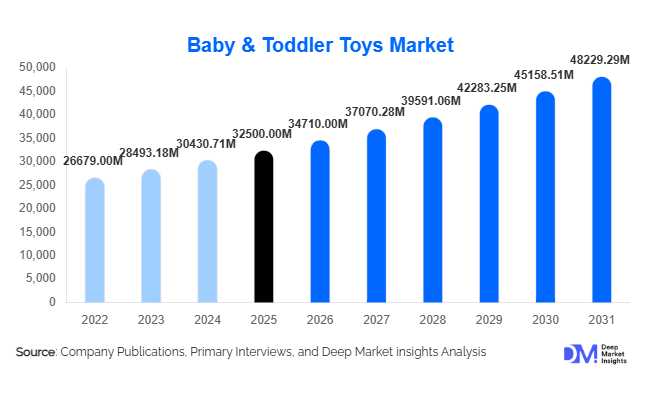
According to Deep Market Insights, the global baby & toddler toys market size was valued at USD 32,500 million in 2025 and is projected to grow from USD 34,710.00 million in 2026 to reach USD 48,229.29 million by 2031, expanding at a CAGR of 6.8% during the forecast period (2026–2031). The market growth is primarily driven by rising parental spending on early childhood development, increasing demand for educational and interactive toys, and the expansion of e-commerce channels that make products more accessible to urban and emerging markets worldwide.
Key Market Insights
- Educational and activity-based toys dominate demand, as parents increasingly seek products that enhance cognitive and motor skills for infants and toddlers.
- Smart and AI-integrated toys are rapidly growing, offering interactive learning experiences that combine entertainment with early childhood development benefits.
- North America holds the largest market share, supported by high disposable income and early adoption of premium and technologically advanced toys.
- Asia-Pacific is the fastest-growing region, driven by rising middle-class populations in China and India and increased awareness about early childhood education.
- Online retail channels are expanding rapidly, enabling consumers to access a wider product selection with convenient delivery, contributing to 28% of global sales in 2025.
- Sustainable and eco-friendly toys are increasingly preferred, creating new opportunities for product differentiation and premium pricing, particularly in Europe and North America.
What are the latest trends in the baby & toddler toys market?
Integration of Smart & Interactive Technology
Manufacturers are increasingly incorporating AI, augmented reality, and mobile connectivity into toys for infants and toddlers. These smart toys enhance cognitive and language development while engaging young users with interactive features. Products such as AI-enabled learning tablets, voice-activated dolls, and interactive robots are gaining traction, particularly in high-income regions. The trend appeals strongly to tech-savvy parents who prioritize educational play combined with entertainment, allowing manufacturers to charge premium prices for advanced functionalities.
Sustainability and Eco-Friendly Materials
Eco-conscious consumers are driving demand for toys made from non-toxic, recyclable, and biodegradable materials. Wooden blocks, silicone teethers, and fabric-based plush toys with safe dyes are increasingly preferred. Brands investing in sustainable production processes are gaining market share, particularly in Europe and North America. Sustainability trends also align with government regulations and safety standards, reinforcing brand credibility and enhancing consumer trust.
What are the key drivers in the baby & toddler toys market?
Increasing Parental Spending on Early Childhood Development
Globally, parents are prioritizing toys that promote learning and development. Activity and educational toys, which account for approximately 32% of the market share in 2025, are in high demand. Growing awareness of early cognitive and motor skill development has encouraged investment in multifunctional, developmental products, which positively impacts market growth.
Rapid Expansion of E-Commerce Channels
Online retail has transformed toy distribution, enabling easier access to a wide product range and competitive pricing. The online segment already contributes nearly 28% of total sales and continues to expand rapidly in APAC and Latin America, supported by increased digital adoption and convenient delivery options.
Technological Innovation in Toys
Interactive, AI-powered, and electronic learning toys are becoming increasingly popular. Products that combine learning and play not only drive premium sales but also create strong differentiation opportunities for brands. Continuous innovation in toy design, connectivity, and functionality is a major factor accelerating global market expansion.
What are the restraints for the global market?
High Cost of Premium Toys
Advanced electronic and smart toys carry high manufacturing and retail costs, limiting adoption in price-sensitive regions. Manufacturers face challenges in balancing affordability with advanced features to expand market penetration without compromising margins.
Stringent Safety and Regulatory Compliance
Compliance with global standards such as ASTM F963 and EN71 requires significant investment in testing, quality control, and certification. Smaller manufacturers and new entrants may face barriers to entry, which can slow market growth despite strong demand.
What are the key opportunities in the baby & toddler toys industry?
Expansion in Emerging Markets
Asia-Pacific and Latin America represent major growth opportunities, driven by rising urban middle-class populations and increasing awareness of early childhood development. Markets in India, China, and Brazil are seeing heightened demand for premium, branded toys. Localized product strategies, digital marketing, and regional distribution networks can help brands capture these emerging markets.
Integration of Technology in Educational Toys
Interactive, smart, and AI-enabled toys provide a new avenue for differentiation and higher revenue. Learning tablets, voice-activated dolls, and robotic toys are increasingly popular, especially in North America and Europe. Incorporating connectivity and augmented reality can boost engagement and create recurring revenue opportunities through content subscriptions or upgrades.
Adoption of Sustainable and Eco-Friendly Toys
Eco-conscious consumer behavior is prompting manufacturers to adopt safe, recyclable, and non-toxic materials. This opportunity is particularly strong in Europe and North America, where parents are willing to pay a premium for sustainable products. Brands integrating sustainability into design and manufacturing can improve brand loyalty and market share.
Report Scope
| Report Metric | Details |
|---|---|
| Market Size in 2025 | USD 32500 Million |
| Market Size in 2026 | USD 34710 Million |
| Market Size in 2031 | USD 48229.29 Million |
| CAGR | 6.8% (2026-2031) |
| Base Year for Estimation | 2025 |
| Historical Data | 2022-2024 |
| Forecast Period | 2026-2031 |
| Report Coverage | Revenue Forecast, Competitive Landscape, Supply Chain Disruption, Growth Factors, Environment & Regulatory Landscape and Trends |
| Geographies Covered | North America, Europe, APAC, Middle East and Africa, LATAM |
| Countries Covered | U.S., Canada, U.K., Germany, France, Spain, Italy, Russia, Nordic, Benelux, Rest of Europe, China, Korea, Japan, India, Australia, Singapore, Taiwan, South East Asia, Rest of Asia-Pacific, UAE, Turky, Saudi Arabia, South Africa, Egypt, Nigeria, Rest of MEA, Brazil, Mexico, Argentina, Chile, Colombia, Rest of LATAM |
Explore more data points, trends and opportunities Download Free Sample Report
Product Type Insights
Activity and educational toys represent the leading product category in the global baby & toddler toys market, accounting for approximately 32% of total market share in 2025. These toys, including building blocks, stacking rings, shape sorters, puzzles, musical learning toys, and interactive books, are widely adopted because they support early cognitive, sensory, and motor skill development. The strong performance of this segment is primarily driven by increasing parental awareness regarding early childhood education and developmental milestones during the first five years of life. Many parents actively seek toys that combine entertainment with learning outcomes such as problem-solving ability, language development, and hand-eye coordination. Educational toys are also widely used in preschool environments, further reinforcing their global demand.
Soft toys and plush toys represent the second-largest segment, supported by their high safety standards, emotional bonding value, and comfort-oriented design. Plush toys made from hypoallergenic fabrics and organic cotton are gaining traction among parents concerned about product safety and infant comfort. These toys often play a role in emotional development and sensory familiarity for toddlers, making them a staple purchase across households globally.
Electronic and smart toys are emerging as one of the fastest-growing product categories. These toys integrate technologies such as voice recognition, touch sensors, artificial intelligence, and mobile connectivity to create interactive learning experiences for toddlers. Smart toys such as talking dolls, learning tablets, robotic companions, and musical activity stations are gaining popularity, particularly in developed markets such as North America and Western Europe. The adoption of digital learning tools at younger ages and the growing comfort of parents with technology-enabled play are key factors accelerating this segment.
Application Insights
Household consumption dominates the baby & toddler toys market, accounting for approximately 85% of total global demand. Parents and family members represent the primary purchasing group, driven by increasing focus on early childhood learning, developmental play, and emotional engagement. Toys designed to stimulate creativity, language skills, and physical coordination are especially popular among parents with children aged 0–4 years. Rising disposable income levels and the growing culture of gifting toys for birthdays, holidays, and developmental milestones further strengthen household demand.
Institutional demand is also expanding steadily, particularly from daycare centers, preschools, early childhood education centers, and pediatric therapy facilities. Educational institutions increasingly incorporate structured play-based learning methods into their teaching frameworks, which drives demand for activity-based toys, developmental kits, and sensory learning products. Montessori and STEM-inspired learning toys are particularly popular in institutional environments, where educators emphasize experiential learning for young children.
Export-driven demand also plays a significant role in the global baby and toddler toys industry. Countries such as China, India, and Vietnam remain major manufacturing hubs and export toys to developed markets, including the United States, Germany, France, Japan, and the United Kingdom. Favorable manufacturing costs, well-developed supply chains, and large-scale production capabilities enable Asian manufacturers to meet global demand efficiently. In addition, the growing demand for branded and premium educational toys in developed markets continues to stimulate international trade flows. Looking ahead, the premium and educational toy segments are expected to grow at an estimated CAGR of approximately 7% during the forecast period. This growth reflects a broader shift in consumer behavior where parents increasingly prioritize developmental benefits, safety standards, and educational outcomes when selecting toys for infants and toddlers.
Explore more data points, trends and opportunities Download Free Sample Report
Baby & Toddler Toys Market Segmentations
By Product Type
- Activity & Educational Toys
- Soft & Plush Toys
- Electronic & Smart Toys
- Ride-On Toys
- Bath Toys
- Musical Toys
By Material
- Plastic
- Wood
- Textile & Fabric
- Silicone & Rubber
By Distribution Channel
- Online Retail
- Specialty Toy Stores
- Supermarkets & Hypermarkets
- Department Stores
- Direct-to-Consumer (Brand Websites)
By End Use
- Household Consumption
- Daycare & Preschool Institutions
- Pediatric Therapy & Development Centers
Regional Insights
North America
North America represents the largest regional market for baby and toddler toys, accounting for approximately 30% of the global market share in 2025. The United States dominates regional demand, followed by Canada. Strong purchasing power, high parental awareness regarding early childhood development, and a well-established toy retail ecosystem contribute to the region’s leadership position. Consumers in North America demonstrate strong preferences for premium, technologically advanced, and educational toys that promote cognitive development.
Several drivers continue to support regional growth. First, high disposable income allows parents to invest in premium toy brands and smart learning devices. Second, strong safety regulations such as ASTM toy safety standards ensure high product quality, increasing consumer trust. Third, the rapid expansion of e-commerce platforms, including direct-to-consumer toy brands and online marketplaces, has significantly increased product accessibility. Additionally, North American consumers are early adopters of AI-enabled and interactive toys, further driving innovation and market expansion within the region.
Europe
Europe accounts for approximately 25% of the global baby & toddler toys market, with Germany, the United Kingdom, France, Italy, and Spain representing the major consumer markets. European consumers demonstrate strong demand for educational toys, sustainable materials, and high safety standards. Toys designed according to Montessori learning principles and eco-friendly manufacturing practices are particularly popular across the region.
Regional growth is primarily driven by increasing consumer preference for environmentally sustainable products, strict regulatory frameworks such as EN71 toy safety standards, and a strong emphasis on early childhood education. European parents increasingly prefer toys made from natural materials such as wood, organic fabrics, and recyclable plastics. Additionally, government support for early childhood education programs across several European countries encourages the use of educational toys in daycare centers and preschools. The strong presence of premium toy manufacturers and a mature retail ecosystem also contributes to steady market growth in the region.
Asia-Pacific
Asia-Pacific is the fastest-growing regional market with an estimated CAGR of 8.2%, driven by expanding consumer markets in China, India, Japan, South Korea, and Southeast Asia. The region benefits from a rapidly growing middle-class population, increasing urbanization, and rising awareness of early childhood development.
China represents approximately 12% of global market demand, supported by strong domestic manufacturing capabilities and growing consumer spending on children’s products. India contributes roughly 10% of the market, with rising birth rates, increasing disposable incomes, and strong growth in online retail platforms driving toy sales. In addition, the expansion of organized retail chains, digital marketplaces, and international toy brands across Asian markets is improving accessibility and consumer choice. Educational toy adoption is particularly increasing in urban areas where parents prioritize cognitive development and skill-building activities for toddlers.
Latin America
The Latin American baby and toddler toys market is experiencing steady expansion with an estimated growth rate of around 6% CAGR. Brazil and Mexico represent the largest markets within the region due to their large populations and expanding middle-class consumer base. Urbanization and increasing consumer exposure to global toy brands are contributing to the growing demand for developmental toys.
Regional growth is driven by rising household spending on children's products, increased participation of women in the workforce, and expanding retail networks, including supermarkets, toy specialty stores, and online marketplaces. Additionally, imported premium toys from the United States, Europe, and Asia are gaining popularity among affluent consumers seeking high-quality educational products for young children.
Middle East & Africa
The Middle East & Africa region currently accounts for approximately 5% of global market share but is gradually emerging as a promising growth market. The United Arab Emirates, Saudi Arabia, and South Africa represent the primary demand centers within the region. Growth in the Middle East is largely supported by high-income households, strong demand for premium international toy brands, and the rapid expansion of modern retail infrastructure, including shopping malls and e-commerce platforms. Meanwhile, African markets such as South Africa and Nigeria are witnessing the gradual adoption of developmental toys as urban middle-class populations expand.
Additionally, increasing investments in early childhood education programs across several Middle Eastern countries are encouraging the use of educational toys in daycare and preschool environments. As retail infrastructure improves and consumer awareness continues to grow, the region is expected to witness steady expansion in the baby and toddler toys market over the coming years.
Key Players in the Baby & Toddler Toys Market
- Mattel Inc.
- Hasbro Inc.
- LEGO Group
- Fisher-Price Inc.
- VTech Holdings Ltd.
- Spin Master Corp.
- Ravensburger AG
- Bandai Namco Holdings Inc.
- TOMY Company Ltd.
- Chicco (Artsana S.p.A.)
- Melissa & Doug
- LeapFrog Enterprises
- Infantino LLC
- Hape International AG
- Bruder Spielwaren GmbH