Audio Systems Market Size
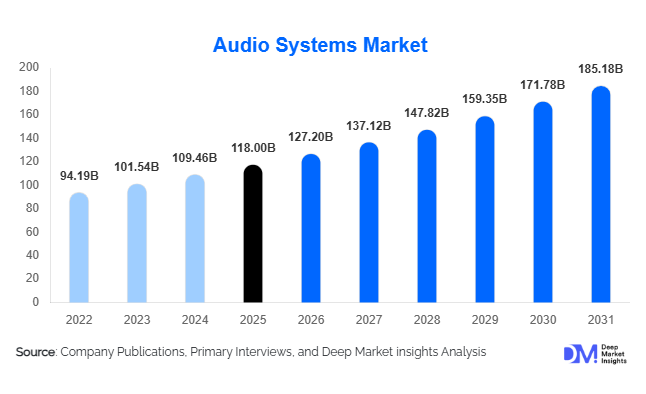
According to Deep Market Insights, the global audio systems market size was valued at USD 118 billion in 2025 and is projected to grow from USD 127.20 billion in 2026 to reach USD 185.18 billion by 2031, expanding at a CAGR of 7.8% during the forecast period (2026–2031). The market growth is primarily driven by rising adoption of wireless and AI-enabled audio devices, increasing consumer demand for immersive home entertainment, and growing integration of advanced audio systems in automotive and professional sectors worldwide.
Key Market Insights
- Wireless and smart audio systems are rapidly gaining traction, driven by consumer preference for portability, multi-room connectivity, and voice-controlled smart home integration.
- Home entertainment and immersive audio solutions dominate market adoption, reflecting the popularity of soundbars, Bluetooth speakers, and home theater systems across residential applications.
- North America leads the global market, with high disposable income and early adoption of smart home ecosystems driving audio system consumption.
- Asia-Pacific is the fastest-growing region, led by rising middle-class wealth, urbanization, and rapid digitalization in China, India, and Southeast Asia.
- Europe shows steady demand for high-end and professional audio systems, fueled by strong entertainment and music production industries in Germany, the UK, and France.
- Technological innovation, such as AI-assisted sound optimization, spatial audio, and noise-canceling solutions, is reshaping product design and consumer engagement.
What are the latest trends in the audio systems market?
Shift Toward Wireless and Smart Audio Devices
Consumers are increasingly favoring wireless audio systems over traditional wired devices due to ease of use, portability, and integration with smartphones and smart home ecosystems. Bluetooth and Wi-Fi-enabled speakers, headphones, and home theater systems dominate the market, while AI-powered smart speakers offer voice control, adaptive sound, and multi-room synchronization. Brands are leveraging IoT and cloud connectivity to provide seamless user experiences, enabling consumers to manage music, calls, and home automation through a single interface. The trend toward smart homes is further driving the adoption of audio devices as central hubs for residential entertainment and connectivity.
Immersive and Professional Audio Solutions
Demand for high-fidelity audio in home, automotive, and professional settings is growing. Spatial audio, Dolby Atmos-enabled sound systems, and professional studio monitors are gaining popularity among audiophiles, gamers, and content creators. In the media and entertainment sector, audio systems are crucial for music production, live events, broadcasting, and post-production. Professional-grade microphones, mixers, and PA systems are increasingly being integrated with digital platforms to enhance sound quality and workflow efficiency. Immersive audio solutions are also driving consumer upgrades in home theaters and gaming setups.
What are the key drivers in the audio systems market?
Increasing Adoption of Wireless and AI-Enabled Devices
Wireless connectivity, including Bluetooth and Wi-Fi, has become a major driver for audio systems. Consumers prefer compact, portable, and easily connectable devices for home, automotive, and professional use. AI-enabled devices further enhance this experience with smart sound calibration, adaptive noise cancellation, and personalized audio profiles. These features are particularly appealing to tech-savvy consumers, driving both replacement cycles and adoption of premium products.
Growth of Streaming Platforms and Digital Entertainment
The global expansion of music streaming, podcasting, and online video platforms has significantly increased the need for high-quality audio equipment. Consumers are upgrading to soundbars, wireless speakers, and premium headphones to experience superior sound quality while watching movies, playing video games, or streaming music. The growing popularity of e-sports, VR, and online content creation is further boosting demand for immersive audio solutions.
Expansion of Automotive and Professional Audio Applications
Automotive manufacturers are integrating advanced audio systems into electric and premium vehicles as a differentiating feature. Meanwhile, professional audio applications in media, events, and broadcasting continue to expand. Investments in stadiums, airports, and concert venues globally have created opportunities for high-performance PA systems and professional audio equipment, contributing to market growth.
What are the restraints for the global market?
Price Competition and Low-Cost Alternatives
Intense competition, particularly from low-cost manufacturers in Asia, has put pressure on pricing in entry-level and mid-range segments. While premium products maintain higher margins, lower-priced alternatives reduce overall profitability and challenge established brands to differentiate through technology and quality.
Rapid Technological Obsolescence
Frequent technological advancements lead to shorter product lifecycles. Consumers often upgrade to newer devices with enhanced features such as AI-based sound optimization, wireless connectivity, or immersive audio formats. This rapid obsolescence creates inventory and product development challenges for manufacturers, adding pressure to maintain innovation pipelines.
What are the key opportunities in the audio systems industry?
Integration with Smart Home Ecosystems
Smart homes provide a major growth avenue for audio systems. Devices that integrate with voice assistants, IoT platforms, and multi-room audio setups are increasingly in demand. Audio systems are becoming central hubs for home automation, allowing users to control lighting, security, and entertainment through AI-enabled devices, creating opportunities for innovative product offerings.
Expansion in Gaming and Immersive Entertainment
The rise of gaming, VR, and immersive media experiences is creating strong demand for premium audio equipment. Gaming headsets, surround-sound systems, and spatial audio solutions enhance user engagement and content immersion. Companies that invest in these high-performance segments can tap into a rapidly growing consumer and professional audience.
Emerging Market Penetration
Emerging economies, particularly in the Asia-Pacific and Latin America, are witnessing rising disposable incomes, increasing urbanization, and growing middle-class populations. Countries like India, China, Brazil, and Indonesia are seeing increased consumer demand for both entry-level and premium audio products. Additionally, expanding e-commerce platforms are facilitating access to global brands, presenting significant opportunities for both new entrants and established players.
Report Scope
| Report Metric | Details |
|---|---|
| Market Size in 2025 | USD 118 Billion |
| Market Size in 2026 | USD 127.20 Billion |
| Market Size in 2031 | USD 185.18 Billion |
| CAGR | 7.8% (2026-2031) |
| Base Year for Estimation | 2025 |
| Historical Data | 2022-2024 |
| Forecast Period | 2026-2031 |
| Report Coverage | Revenue Forecast, Competitive Landscape, Supply Chain Disruption, Growth Factors, Environment & Regulatory Landscape and Trends |
| Geographies Covered | North America, Europe, APAC, Middle East and Africa, LATAM |
| Countries Covered | U.S., Canada, U.K., Germany, France, Spain, Italy, Russia, Nordic, Benelux, Rest of Europe, China, Korea, Japan, India, Australia, Singapore, Taiwan, South East Asia, Rest of Asia-Pacific, UAE, Turky, Saudi Arabia, South Africa, Egypt, Nigeria, Rest of MEA, Brazil, Mexico, Argentina, Chile, Colombia, Rest of LATAM |
Explore more data points, trends and opportunities Download Free Sample Report
Product Type Insights
Speakers and loudspeaker systems represent the largest product category in the global audio systems market, accounting for approximately 34% of total revenue in 2025. The segment’s leadership is driven by increasing consumer demand for immersive home entertainment, portable listening solutions, and smart home integration. The rapid adoption of portable Bluetooth speakers, smart speakers, soundbars, and multi-room wireless audio systems has significantly expanded the consumer base across residential environments. Soundbars, in particular, are experiencing strong demand due to their ability to enhance television audio performance while maintaining compact form factors suitable for modern living spaces. Additionally, the proliferation of smart home ecosystems and voice assistants has accelerated the integration of speakers into connected home environments, further strengthening the segment’s market dominance.
Wireless headphones and earphones are another rapidly expanding category, supported by the growing popularity of true wireless stereo (TWS) earbuds, over-ear noise-canceling headphones, and gaming headsets. Increasing smartphone usage, mobile entertainment consumption, and demand for high-quality audio during commuting or remote work are major growth drivers for this segment. Features such as active noise cancellation, spatial audio capabilities, and AI-driven sound personalization are also enhancing consumer adoption. Amplifiers, receivers, and professional audio systems occupy specialized but stable segments within the market. These products are widely used in recording studios, broadcasting facilities, live events, cinema installations, and large-scale entertainment venues. While their overall volume is smaller compared with consumer audio products, their higher average selling prices and critical role in professional audio production ensure consistent revenue contribution to the global market.
Application Insights
The residential home entertainment segment remains the leading application area for audio systems globally, driven by increasing consumer spending on entertainment technologies and the rapid expansion of digital streaming services. The surge in subscription-based platforms for music, movies, podcasts, and gaming has encouraged consumers to upgrade their audio equipment to achieve higher sound fidelity. Devices such as soundbars, wireless speakers, and home theater systems are becoming standard components of modern living spaces, particularly as consumers seek cinema-like experiences within their homes. The automotive audio segment is emerging as one of the fastest-growing application areas. Automotive manufacturers increasingly integrate premium audio systems into vehicles as a key differentiation feature, particularly in electric vehicles and luxury car models. Partnerships between automotive OEMs and premium audio brands have resulted in advanced in-car audio solutions that include multi-speaker configurations, immersive surround sound technologies, and AI-based sound optimization.
Professional audio applications also play a critical role in market expansion. Industries such as media production, broadcasting, live entertainment, music recording, and event management rely heavily on high-performance audio systems, including studio monitors, microphones, mixers, and PA systems. As digital content creation, podcasting, and live streaming continue to grow worldwide, the demand for professional audio equipment is expected to increase steadily. Emerging applications include AI-enabled smart speakers, spatial audio systems for virtual reality environments, and integrated multi-room entertainment solutions that support connected home experiences.
Distribution Channel Insights
Online retail channels dominate global audio systems sales, accounting for nearly 46% of the market in 2025. The strong performance of e-commerce platforms is driven by factors such as convenience, broader product selection, competitive pricing, and the ability to compare technical specifications and customer reviews before purchasing. Leading e-commerce marketplaces and direct-to-consumer brand websites have become key sales channels for both entry-level and premium audio devices. Digital marketing strategies, influencer partnerships, and social media advertising have further strengthened online customer engagement and product visibility.
Despite the growth of online retail, offline distribution channels continue to play a critical role, particularly for premium and professional audio equipment. Specialty electronics stores and audio showrooms allow consumers to experience product performance before making purchasing decisions, which is especially important for high-end sound systems and studio equipment. In addition, B2B distribution channels remain essential for large-scale installations and professional audio applications. System integrators, audio installers, and commercial distributors supply audio systems to entertainment venues, hospitality properties, educational institutions, and corporate environments. These channels support customized installations for stadiums, conference centers, and public infrastructure projects, contributing significantly to overall market revenue.
End-Use Insights
The residential sector accounts for approximately 48% of global audio systems demand in 2025, making it the dominant end-use segment. The strong adoption of smart home technologies, coupled with increasing consumer interest in immersive entertainment experiences, has accelerated demand for wireless speakers, soundbars, and multi-room audio solutions. Consumers are increasingly investing in high-quality audio setups to enhance movie streaming, gaming, and music listening experiences within their homes. The automotive industry represents the fastest-growing end-use segment, driven by rising integration of advanced infotainment systems in modern vehicles. Premium audio systems are increasingly becoming standard features in luxury and electric vehicles, with automakers partnering with specialized audio brands to deliver superior in-car sound quality. The growing electric vehicle market is further accelerating this trend, as manufacturers aim to enhance passenger comfort and entertainment.
Professional and commercial sectors are also witnessing strong growth, particularly in media production, hospitality, retail, education, and public infrastructure projects. Investments in stadiums, airports, theaters, and entertainment complexes have created new demand for high-capacity sound reinforcement systems. In addition, export-driven demand from major electronics manufacturing hubs such as China, Japan, Germany, and South Korea continues to support global market expansion by supplying advanced audio technologies to international markets.
Explore more data points, trends and opportunities Download Free Sample Report
Audio Systems Market Segmentations
By Product Type
- Speakers & Loudspeaker Systems
- Headphones & Earphones
- Amplifiers & Receivers
- Professional Audio Systems
- Home Audio Systems
- Automotive Audio Systems
By Application
- Residential / Home Entertainment
- Automotive Audio Systems
- Professional Audio & Media Production
- Commercial & Corporate Spaces
- Hospitality & Retail Venues
- Public Infrastructure
By Distribution Channel
- Online Retail
- Consumer Electronics Stores
- Audio Specialty Stores
- Hypermarkets & Supermarkets
- Direct B2B Sales / System Integrators
Regional Insights
North America
North America holds approximately 38% of the global audio systems market, making it the largest regional market. The United States accounts for the majority of regional demand, followed by Canada. Growth in this region is driven by high consumer purchasing power, widespread adoption of smart home ecosystems, and strong demand for premium entertainment technologies. Consumers in North America are early adopters of advanced audio products such as AI-enabled speakers, immersive home theater systems, and wireless noise-canceling headphones.
The region also benefits from a highly developed entertainment industry, including film production, music recording, and live event infrastructure, which drives strong demand for professional audio equipment. Additionally, the presence of major technology companies and audio system manufacturers encourages innovation and product development. Increasing investments in gaming, streaming platforms, and smart home automation technologies continue to support long-term market growth in North America.
Europe
Europe accounts for approximately 27% of global audio systems demand, with Germany, the United Kingdom, and France emerging as the key regional markets. The region’s strong music production heritage, broadcasting industry, and professional audio equipment manufacturing base contribute significantly to market growth. Germany is particularly known for high-end audio engineering and premium sound systems, while the UK hosts a large number of music studios, concert venues, and media companies.
European consumers are also highly receptive to high-quality and sustainable electronics, encouraging manufacturers to develop energy-efficient and environmentally responsible audio devices. Additionally, the increasing popularity of streaming services and smart home technology adoption across Western Europe is supporting demand for wireless speakers and soundbars. Growth in cultural events, music festivals, and live entertainment further drives demand for professional sound systems across the region.
Asia-Pacific
Asia-Pacific represents around 24% of the global market and is the fastest-growing region. China, India, Japan, and South Korea are the major contributors to regional demand. Rapid urbanization, rising disposable incomes, and the expanding middle-class population are fueling strong consumer demand for electronics and entertainment technologies. China remains the largest production and consumption hub for audio equipment, supported by its extensive consumer electronics manufacturing ecosystem. Japan and South Korea are recognized for technological innovation and premium audio product development, while India is emerging as a high-growth market due to increasing smartphone penetration and digital media consumption. Additionally, the rapid expansion of e-commerce platforms across Asia-Pacific has significantly improved product accessibility and market penetration for both domestic and international brands.
Latin America
Latin America accounts for approximately 7% of the global audio systems market, with Brazil, Mexico, and Argentina representing the largest regional markets. Growth in this region is primarily driven by increasing urbanization, rising consumer interest in entertainment technologies, and improving access to digital retail platforms. The growing popularity of music streaming services and mobile entertainment is encouraging consumers to purchase wireless speakers and headphones. Additionally, expanding automotive production in Brazil and Mexico is supporting demand for integrated vehicle audio systems. While economic volatility in some countries may limit short-term growth, the long-term outlook remains positive due to increasing digital connectivity and consumer electronics adoption.
Middle East & Africa
The Middle East & Africa region contributes around 4% of global demand, with the United Arab Emirates, Saudi Arabia, and South Africa emerging as key markets. Rapid infrastructure development, expanding tourism sectors, and investments in entertainment venues are driving demand for professional audio systems across the region. In the Middle East, governments are investing heavily in large-scale projects such as stadiums, cultural centers, and entertainment complexes, which require advanced sound reinforcement technologies. High-income consumers in the UAE and Saudi Arabia are also driving demand for luxury home entertainment systems and premium audio devices. In Africa, increasing urbanization and expanding telecommunications infrastructure are gradually improving access to consumer electronics, creating opportunities for market growth in emerging economies.
Key Players in the Audio Systems Market
- Sony Corporation
- Samsung Electronics
- Bose Corporation
- Harman International
- Yamaha Corporation
- Sennheiser Electronic
- Panasonic Corporation
- LG Electronics
- Audio-Technica
- Bang & Olufsen
- Pioneer Corporation
- Shure Incorporated
- Sonos Inc.
- Creative Technology
- Edifier Technology