Art Tourism Market Size
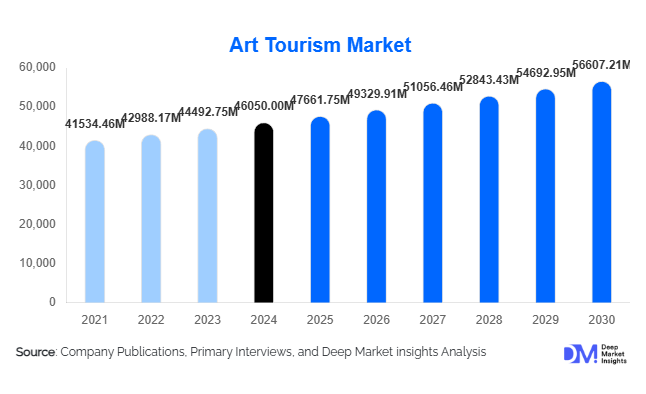
According to Deep Market Insights, the global art tourism market size was valued at USD 46,050.00 million in 2025 and is projected to grow from USD 47,661.75 million in 2026 to reach USD 56,607.21 million by 2031, expanding at a CAGR of 3.5% during the forecast period (2026–2031). The art tourism market growth is primarily driven by the increasing demand for immersive cultural experiences, rising interest in digital and interactive art formats, and the expansion of premium and experiential art travel offerings catering to global travelers.
Key Market Insights
- Art tourism is increasingly integrating digital and immersive experiences, attracting travelers seeking interactive and VR/AR-based engagement with art beyond traditional museum visits.
- Premium and experiential art travel packages are expanding globally, offering curated studio visits, VIP museum access, and luxury art-focused itineraries for high-value travelers.
- Europe dominates the art tourism market, driven by its rich cultural heritage, concentration of world-renowned museums, and well-established art festivals.
- Asia-Pacific is the fastest-growing region, fueled by rising middle-class income, government investments in cultural infrastructure, and increasing outbound tourism from China, India, and Japan.
- North America remains a key source market, with the U.S. and Canada leading demand for both domestic and international art tourism destinations.
- Technological adoption, including AR/VR tours, mobile app-guided experiences, and virtual gallery platforms, is reshaping traveler engagement and expanding market reach.
Art Tourism Market Trends
Immersive Digital and Interactive Art Experiences
Art tourism providers are increasingly adopting immersive digital technologies to enhance visitor engagement. Museums and galleries are implementing AR-guided tours, VR exhibitions, and interactive installations that allow visitors to explore art in innovative ways. These experiences attract younger, tech-savvy audiences and offer remote access options for global travelers. Additionally, mobile apps enable personalized tours, educational content, and real-time interaction, making art tourism more accessible and appealing to a broader demographic.
Premium and Experiential Art Travel
High-value travelers are seeking curated art experiences, such as private studio visits, exclusive exhibitions, and luxury art festivals. Operators are combining art travel with premium accommodations, fine dining, and personalized itineraries, increasing per-visitor revenue and market differentiation. This trend reflects a shift toward experiential tourism, where meaningful engagement with art and culture takes precedence over traditional sightseeing.
Art Tourism Market Drivers
Rising Demand for Experiential Travel
Global travelers increasingly prioritize meaningful and immersive experiences, boosting the popularity of art tourism. This trend has led to higher visitation rates to museums, galleries, art festivals, and interactive art destinations. Travelers are seeking authentic engagement with culture and creativity, which is driving demand for curated and premium art tourism experiences.
Government and Institutional Investment
Public and private investment in art and cultural infrastructure is a major growth driver. Governments worldwide are funding museum expansions, art districts, biennales, and public art projects, enhancing destination appeal. Institutional support not only improves visitor experiences but also stimulates local economies, further expanding the art tourism market.
Technology Integration
Digital innovations such as VR/AR experiences, mobile-guided tours, and virtual exhibitions are expanding the reach of art tourism. These technologies allow visitors to interact with art in new ways, increase engagement, and provide opportunities for monetization through virtual ticketing. Technology adoption also attracts younger travelers and remote audiences, contributing to market growth.
Art Tourism Market Restraints
High Travel and Operational Costs
Art tourism often involves travel, foreign exchange, and fees for specialized experiences, limiting access for price-sensitive travelers. Operational costs such as maintenance of venues, security, and digital infrastructure also pose challenges for providers, affecting scalability and profitability.
Geopolitical and Health-Related Risks
Travel disruptions due to pandemics, political instability, and visa restrictions can constrain international art tourism. Additionally, sustainability concerns and environmental regulations may affect large-scale events and public installations, posing a risk to consistent growth.
Art Tourism Market Opportunities
Technology-Enabled Immersive Tourism
Integration of AR, VR, and digital experiences provides opportunities to attract tech-savvy travelers and broaden geographic reach. Virtual tours, interactive installations, and app-based engagement allow destinations to expand market share beyond physical visitors and tap into new revenue streams.
Emerging Markets and Regional Diversification
Asia-Pacific, Latin America, and the Middle East present underserved opportunities for art tourism. Investment in museums, art districts, and festivals, along with rising disposable income, offers growth potential. Partnerships with local operators can help new entrants capture market share in these regions while reducing dependency on mature markets.
Premium and Experiential Travel Packages
Affluent travelers increasingly demand bespoke art experiences, such as exclusive gallery access, artist-led workshops, and curated art tours. Operators can capitalize on higher per-visitor spend by offering premium services, creating loyalty programs, and combining art travel with luxury accommodations and cultural immersion.
Report Scope
| Report Metric | Details |
|---|---|
| Market Size in 2025 | USD 46050 Million |
| Market Size in 2026 | USD 47661.75 Million |
| Market Size in 2031 | USD 56607.21 Million |
| CAGR | 3.5% (2026-2031) |
| Base Year for Estimation | 2025 |
| Historical Data | 2022-2024 |
| Forecast Period | 2026-2031 |
| Report Coverage | Revenue Forecast, Competitive Landscape, Supply Chain Disruption, Growth Factors, Environment & Regulatory Landscape and Trends |
| Geographies Covered | North America, Europe, APAC, Middle East and Africa, LATAM |
| Countries Covered | U.S., Canada, U.K., Germany, France, Spain, Italy, Russia, Nordic, Benelux, Rest of Europe, China, Korea, Japan, India, Australia, Singapore, Taiwan, South East Asia, Rest of Asia-Pacific, UAE, Turky, Saudi Arabia, South Africa, Egypt, Nigeria, Rest of MEA, Brazil, Mexico, Argentina, Chile, Colombia, Rest of LATAM |
Explore more data points, trends and opportunities Download Free Sample Report
Product Type Insights
Museums and galleries continue to dominate the art tourism market, accounting for 42% of the 2025 market. This segment benefits from a strong concentration of world-class institutions, established infrastructure, and consistent visitor footfall. A key driver for this segment is the proliferation of blockbuster and touring exhibitions combined with enhanced visitor experiences, including digital guides, timed ticketing, and immersive audio-visual installations, which increase travelers’ willingness to plan international art trips.
Art events and festivals are emerging as a high-impact segment, drawing concentrated inbound flows around marquee fairs, biennales, and city-wide art programs. The calendarized nature of these events spikes local hospitality revenues and enhances city branding, appealing to both domestic and international tourists. Creative participation experiences, such as hands-on workshops, skill-based travel programs, and community-led art tours, are gaining traction, particularly among younger demographics seeking authenticity.
Art heritage and architecture benefit from UNESCO listings and conservation-driven investments, positioning destinations as anchor points for longer stays and high-value visits. Urban and public art trails leverage low-barrier, visually engaging, and “Instagrammable” outdoor installations, encouraging city exploration with low marginal cost. Meanwhile, art-integrated hospitality and themed experiences are benefiting from premiumization, where guests pay higher average daily rates (ADRs) for curated art stays often combined with local culinary, wine, or cultural programming. Finally, B2B and professional art travel are largely driven by the health of the global art market, with auction cycles, dealer networks, and trade fairs shaping professional trip flows.
Application Insights
International art tourists account for 58% of the market, reflecting their higher spending capacity and extended dwell times. Applications such as educational trips, corporate cultural programs, and premium individualized travel are driving steady demand. Emerging applications include immersive workshops, artist residencies, and interactive experiences that combine leisure with skill acquisition, thereby increasing visitor engagement, loyalty, and overall market value. These experiential formats particularly appeal to Millennials and Gen Z travelers, who prioritize active participation over passive observation.
Distribution Channel Insights
Online platforms, including OTAs and venue websites, dominate art tourism bookings, capturing 55% of transactions. These platforms provide convenient price comparison, real-time reviews, and dynamic ticketing options. Traditional travel agents and packaged tours remain relevant for group and educational travel, while mobile apps facilitate self-guided experiences with augmented reality or interactive city trails. Subscription-based platforms, influencer-driven content, and social media marketing are emerging as influential distribution channels, particularly among younger travelers seeking inspiration and peer-validated experiences.
Traveler Type Insights
Individual travelers represent the largest end-user segment (51% share), driven by a preference for personalized, immersive, and flexible itineraries. Group tours, educational programs, and corporate cultural trips constitute significant secondary segments, benefiting from curated, high-value itineraries. Young, affluent, and digitally connected travelers are increasingly shaping market trends, favoring participatory and interactive experiences, premium art stays, and immersive festival attendance.
Explore more data points, trends and opportunities Download Free Sample Report
Art Tourism Market Segmentations
By Product Type
- Museums & Galleries
- Art Events & Festivals
- Creative Participation & Workshops
- Art Heritage & Architecture
- Urban & Public Art Trails
- Art-Integrated Hospitality & Themed Experiences
- B2B / Professional Art Travel
By Application
- International Cultural Travel
- Educational Trips & Academic Tours
- Corporate Cultural Programs
- Individual Premium Travel
- Workshops, Residencies, & Immersive Experiences
By Distribution Channel
- Online Travel Agencies & Venue Websites
- Traditional Travel Agents / Tour Operators
- Mobile App-Based Self-Guided Tours
- Subscription-Based & Membership Platforms
- Influencer-Driven & Social Media Marketing Channels
Regional Insights
North America
The U.S. and Canada dominate outbound art tourism demand, fueled by high disposable incomes, a strong domestic cultural travel appetite, and vibrant private museum and collection activity. Festivals, city art programs, and marquee exhibitions act as regional demand drivers, attracting domestic and international visitors. Customized packages and immersive museum experiences remain popular, particularly in cities with dense cultural infrastructure such as New York, Washington D.C., and Montreal. Investment in digital guides and timed ticketing enhances visitor experiences, further supporting regional growth.
Europe
Europe accounts for 38% of the global market (USD 17.1 billion in 2025), led by France, Italy, Germany, Spain, and the U.K. The region benefits from a strong concentration of world-class museums, UNESCO heritage sites, and cultural circuits. Policy pushes toward sustainable cultural tourism, combined with blockbuster exhibitions and festival circuits, remain key drivers of inbound demand. Immersive and digital experiences are increasingly popular, attracting younger demographics and international travelers. Heritage preservation and conservation investments further enhance destination attractiveness, supporting longer stays and high-value travel.
Asia-Pacific
Asia-Pacific is the fastest-growing region, driven by rapidly recovering outbound tourism and expanding middle-class affluence, particularly in China, Japan, South Korea, and Southeast Asia. Major events, such as Art Basel Hong Kong, alongside growing domestic creative tourism initiatives, are key growth drivers. Government investment in cultural infrastructure, museums, and public art districts is expanding destination appeal. Immersive exhibitions, curated gallery tours, and interactive art experiences are increasingly popular, capturing both domestic and international visitor interest.
Latin America & Caribbean
Latin America, led by Brazil, Argentina, and Mexico, is emerging as a market for outbound and domestic art tourism. Rising recognition of cultural festivals, street art murals, and local creative communities is stimulating experiential, community-led tourism opportunities. Niche creative tourism, including artisan workshops and craft trails, is attracting younger and international travelers. These trends are complemented by increasing investments in city-based art infrastructure and festival programming, enhancing the region’s attractiveness for both cultural and leisure-focused travel.
Middle East & Africa
Africa hosts iconic art and cultural heritage sites, while the Middle East, particularly the UAE and Saudi Arabia, is an emerging source market. High-value inbound art tourism is supported by heavy investment in flagship cultural infrastructure, including mega-museums, biennales, and art districts. Seasonal constraints remain a challenge, but government-led initiatives and mega-events act as strong regional drivers. Enhanced air connectivity, luxury hospitality offerings, and cultural branding initiatives are expanding market reach and attracting high-spending tourists from around the world.
Oceania
Oceania, led by Australia and New Zealand, benefits from strong domestic creative tourism and a vibrant festival culture. The region’s proximity to Asia markets provides growth potential as regional travel normalizes. Cultural events, art fairs, and interactive exhibitions are driving domestic engagement, while inbound interest from Asian travelers is increasing, fueled by accessibility and shared cultural appreciation for art and design. Digital experiences and curated cultural itineraries are emerging as key growth enablers in the region.
Key Players in the Art Tourism Market
- Abercrombie & Kent
- Viator, Inc.
- Context Travel
- Trafalgar Tours
- Artisans of Leisure
- Martin Randall Travel
- G Adventures
- Intrepid Travel
- Exodus Travels
- The Metropolitan Museum of Art
- Louvre Museum
- Tate Modern
- Art Basel
- TeamLab
- Klook