Art and Craft Market Size
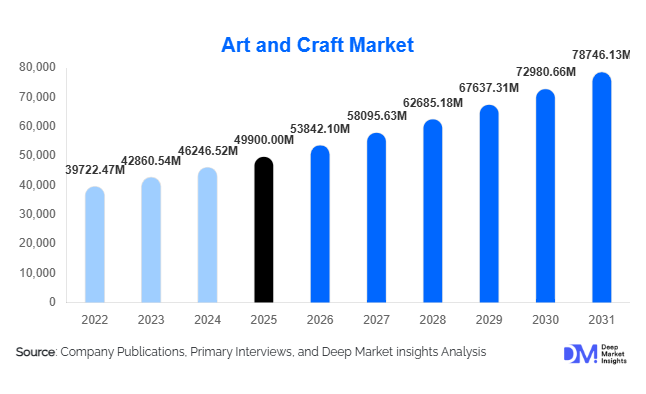
According to Deep Market Insights, the global art and craft market size was valued at USD 49,900 million in 2025 and is projected to grow from USD 53,842.10 million in 2026 to reach USD 78,746.13 million by 2031, expanding at a CAGR of 7.9% during the forecast period (2026–2031). The art and craft market growth is primarily driven by rising participation in DIY hobbies, expanding creative education programs worldwide, and increasing consumer demand for personalized and handmade products. Growing awareness of art as a tool for mental wellness, coupled with the rapid expansion of e-commerce distribution channels, has transformed crafting from a niche hobby into a mainstream global consumer industry.
Key Market Insights
- DIY culture and creative hobbies are becoming lifestyle trends, particularly among millennials and Gen Z consumers seeking stress relief and self-expression.
- Educational institutions remain major buyers, driven by STEAM-based learning initiatives and increased investment in creative development programs.
- Asia-Pacific dominates global consumption due to population scale, expanding middle-class income, and strong school-level art adoption.
- E-commerce platforms are reshaping distribution, enabling niche craft brands to access global audiences directly.
- Sustainable and non-toxic materials are gaining popularity, especially across Europe and North America amid regulatory and environmental awareness.
- Digital creator economy growth is increasing demand for specialized craft supplies used in handmade businesses and online marketplaces.
What are the latest trends in the art and craft market?
Rise of DIY and Creator Economy
The global shift toward handmade and personalized products has significantly increased demand for craft supplies. Social media platforms and online marketplaces have enabled hobbyists to monetize creativity through handmade jewelry, décor, and customized products. This trend has boosted recurring purchases of paints, beads, textile materials, and resin supplies. Subscription-based craft kits and tutorial-driven product ecosystems are becoming popular, helping brands build long-term customer engagement while lowering entry barriers for beginners.
Sustainable Crafting and Eco-Friendly Materials
Consumers are increasingly prioritizing environmentally responsible products, encouraging manufacturers to introduce biodegradable glitter, recycled paper, plant-based dyes, and non-toxic paints. Regulatory pressure in Europe and North America is accelerating innovation toward sustainable materials. Eco-friendly product lines command premium pricing and are becoming a key differentiator among established brands. Manufacturers are also redesigning packaging using recyclable materials, aligning sustainability goals with brand positioning and compliance standards.
What are the key drivers in the art and craft market?
Expansion of Creative Education
Governments and educational institutions worldwide are integrating art into STEAM learning frameworks, recognizing creativity as essential for cognitive development. Schools represent recurring institutional buyers, ensuring stable demand cycles for drawing supplies, paper crafts, and DIY kits. Increased investments in early childhood education and experiential learning programs continue to expand procurement volumes globally.
Growth of Wellness-Oriented Hobbies
Crafting is increasingly associated with mental health benefits such as stress reduction and mindfulness. Consumers are adopting art activities as therapeutic practices, particularly in urban environments. Wellness centers, therapy programs, and rehabilitation facilities are incorporating art-based activities, creating new commercial demand segments beyond traditional hobbyists.
What are the restraints for the global market?
Raw Material Price Volatility
Fluctuations in paper pulp, polymers, pigments, and chemical adhesives affect production costs across the industry. Manufacturers often face margin pressure when passing costs to price-sensitive consumers, especially in entry-level product categories.
Competition from Digital Entertainment
The increasing dominance of gaming, streaming platforms, and digital media competes for consumer leisure time. Younger demographics may allocate less time to physical hobbies, creating a structural challenge for sustained engagement growth in some markets.
What are the key opportunities in the art and craft industry?
Institutional and Educational Procurement Expansion
Large-scale adoption of creative learning programs offers significant growth opportunities. Companies developing curriculum-aligned craft kits and bulk educational supply packages can secure long-term contracts with schools, training institutes, and government education programs.
Premium and Specialized Craft Segments
Demand for advanced materials such as resin art supplies, professional-grade paints, and niche DIY kits is expanding rapidly. Enthusiast consumers and small craft entrepreneurs are willing to pay higher prices for quality materials, enabling brands to improve margins through premiumization strategies.
Report Scope
| Report Metric | Details |
|---|---|
| Market Size in 2025 | USD 49900 Million |
| Market Size in 2026 | USD 53842.10 Million |
| Market Size in 2031 | USD 78746.13 Million |
| CAGR | 7.9% (2026-2031) |
| Base Year for Estimation | 2025 |
| Historical Data | 2022-2024 |
| Forecast Period | 2026-2031 |
| Report Coverage | Revenue Forecast, Competitive Landscape, Supply Chain Disruption, Growth Factors, Environment & Regulatory Landscape and Trends |
| Geographies Covered | North America, Europe, APAC, Middle East and Africa, LATAM |
| Countries Covered | U.S., Canada, U.K., Germany, France, Spain, Italy, Russia, Nordic, Benelux, Rest of Europe, China, Korea, Japan, India, Australia, Singapore, Taiwan, South East Asia, Rest of Asia-Pacific, UAE, Turky, Saudi Arabia, South Africa, Egypt, Nigeria, Rest of MEA, Brazil, Mexico, Argentina, Chile, Colombia, Rest of LATAM |
Explore more data points, trends and opportunities Download Free Sample Report
Product Type Insights
Drawing and painting supplies continue to dominate the global art and craft market, accounting for nearly 32% of global demand in 2025. The leadership of this segment is primarily driven by its universal applicability across multiple consumer groups, including educational institutions, hobbyists, professional artists, and commercial design users. Continuous innovation in pigments, eco-friendly paints, digital-compatible sketching tools, and premium-grade materials has strengthened adoption across both developed and emerging markets. Increasing integration of art education into school curricula and the growing popularity of creative self-expression further reinforce sustained demand for drawing and painting products. Additionally, the expansion of online tutorials and social media-based art communities has lowered entry barriers for beginners, significantly expanding the consumer base.DIY craft kits represent one of the fastest-growing product categories, capturing approximately 18% market share. Growth in this segment is largely supported by convenience-driven consumption patterns, as ready-to-use kits simplify crafting processes for beginners and casual users. The rising popularity of experiential gifting, family-oriented activities, and wellness-focused hobbies has accelerated demand globally. Subscription-based craft kits and themed activity boxes have also contributed to recurring purchases, particularly among younger consumers and urban households seeking screen-free recreational options. Brands increasingly focus on curated kits aligned with seasonal trends, sustainability themes, and educational learning outcomes, strengthening long-term segment expansion.Textile and needle crafts account for nearly 14% of the market, benefiting from the resurgence of handmade fashion, customization trends, and sustainability-driven consumer behavior. Growing awareness of slow fashion and repair culture has encouraged consumers to engage in embroidery, knitting, crocheting, and fabric customization.
Social media platforms showcasing handmade apparel and personalized décor products have significantly influenced adoption, while small-scale craft entrepreneurs increasingly rely on textile crafts for income generation. The availability of organic yarns, recycled fabrics, and eco-conscious materials further supports segment growth across environmentally aware markets.Paper crafts hold approximately 12% market share, supported by strong participation in educational activities, scrapbooking, journaling, and event decoration applications. Continued demand from schools and early childhood learning programs sustains baseline consumption, while adult consumers contribute through creative journaling and personalized stationery trends. The growing popularity of handmade greeting cards and customized celebration décor has expanded commercial usage beyond traditional hobby applications.Jewelry-making supplies contribute around 10% of total demand, supported by the rapid expansion of online handmade marketplaces and independent creator economies. Consumers increasingly pursue small-scale creative entrepreneurship, producing personalized accessories for online sales channels. Advancements in resin art, polymer clay designs, and affordable crafting tools have enabled entry-level creators to participate in the market with minimal investment. Modeling and sculpting materials, along with decorative accessories, collectively represent the remaining market share, driven by the rising popularity of resin art, home décor customization, and creative interior styling projects.
Application Insights
Educational applications remain the largest use case for art and craft products, accounting for nearly 28% of total market demand. The segment’s leadership is primarily driven by increasing global investment in creativity-based learning methodologies, early childhood development programs, and skill-based education initiatives. Governments and private institutions are emphasizing creative thinking and experiential learning, leading to sustained procurement of art materials in bulk volumes. Integration of art into STEM education frameworks and therapeutic learning environments further strengthens long-term demand stability.Hobby and personal crafting applications represent the fastest-growing application segment, supported by rising awareness of mental wellness, stress reduction, and mindful leisure activities. Consumers increasingly adopt crafting as a form of relaxation and self-expression, particularly among urban populations experiencing digital fatigue. Social media inspiration, influencer-led tutorials, and online crafting communities have accelerated participation, transforming crafting from a niche hobby into a mainstream lifestyle activity.
Professional artist applications continue to expand steadily, driven by increasing demand for premium-quality materials, specialized tools, and archival-grade supplies. Growth in freelance creative professions, digital content creation, and commissioned artwork markets has supported consistent product consumption. Professional artists increasingly seek sustainable and high-performance materials, encouraging manufacturers to innovate across durability, color quality, and environmental impact.Commercial applications are emerging as an important growth avenue, including event decoration, handmade product businesses, retail display design, and customized interior décor solutions. Small creative enterprises and home-based businesses are leveraging art and craft materials to produce marketable goods, expanding revenue opportunities beyond traditional consumer segments and contributing to market diversification.
Distribution Channel Insights
Offline retail stores and specialty art supply shops continue to play a critical role in product discovery, experiential purchasing, and professional-grade material selection. Consumers often prefer physical stores for evaluating texture, color accuracy, and material quality before purchase, particularly for high-value art supplies. Workshops, demonstrations, and in-store community engagement initiatives further strengthen customer loyalty within offline channels.E-commerce channels now account for nearly 35% of global sales, reflecting a structural shift toward digital retail ecosystems. The growth of online platforms is driven by convenience, broader product assortment, competitive pricing, and access to global brands. Tutorial-driven marketing strategies and influencer collaborations significantly influence purchasing decisions, enabling consumers to directly purchase materials featured in online content. Subscription-based craft boxes and personalized product recommendations are enhancing customer retention and recurring revenue streams.Direct-to-consumer online platforms allow manufacturers and emerging brands to introduce niche product lines, test innovations quickly, and build dedicated creative communities. Institutional procurement channels remain essential, particularly for educational institutions, corporate creativity programs, and training centers that purchase supplies in large quantities, ensuring stable baseline demand across economic cycles.
Consumer Type Insights
Adults aged 20–45 years represent the largest consumer segment, supported by strong participation in DIY hobbies, creative entrepreneurship, and home décor customization activities. This demographic demonstrates higher purchasing power and willingness to experiment with new crafting trends, making them a primary target audience for premium and subscription-based offerings. Remote work culture and flexible lifestyles have further encouraged engagement in creative pursuits.Children remain a significant demand driver through school procurement programs and parental investment in developmental learning tools. Art and craft activities are widely recognized for improving cognitive development, creativity, and motor skills, ensuring consistent product consumption across educational environments and households.
Teenagers are emerging as an influential growth segment, largely driven by social media trends and digital content creation. Platforms promoting aesthetic crafts, DIY fashion, and personalized accessories inspire frequent experimentation, resulting in shorter product replacement cycles and higher engagement levels.Senior hobbyists represent a smaller yet stable consumer base, increasingly adopting crafting activities for leisure, social interaction, and therapeutic benefits. Crafting is widely associated with stress relief and cognitive engagement among older populations, contributing to steady long-term demand within mature markets.
Explore more data points, trends and opportunities Download Free Sample Report
Art and Craft Market Segmentations
By Product Type
- Drawing & Painting Supplies
- Paper Crafts & Scrapbooking
- DIY Craft Kits
- Textile & Needle Crafts
- Modeling & Sculpting Materials
- Jewelry Making Supplies
- Decorative Craft Materials
By Application
- Educational Use
- Hobby & Personal Crafting
- Professional Artistic Applications
- Commercial & Decorative Applications
By Distribution Channel
- Offline Retail Stores
- Specialty Art Stores
- E-commerce Platforms
- Institutional Procurement
Regional Insights
Asia-Pacific
Asia-Pacific holds the largest market share at approximately 38% in 2025, led by China, India, Japan, and South Korea. Regional growth is driven by rapid urbanization, expanding middle-class populations, and strong education-sector demand for creative learning materials. Rising disposable incomes enable higher spending on recreational hobbies, while government initiatives promoting skill development and creative education further accelerate adoption. India is among the fastest-growing markets due to increasing DIY awareness, expanding school enrollment, and growing participation in home-based creative businesses. China benefits from its large-scale manufacturing ecosystem, cost-efficient production capabilities, and expanding domestic hobby culture supported by digital commerce platforms. Additionally, the region’s strong e-commerce infrastructure and mobile-first consumer behavior significantly enhance product accessibility, driving sustained market expansion.
North America
North America accounts for nearly 27% of global market share, with the United States leading regional consumption. Growth is supported by a deeply rooted DIY culture, high per-capita spending on hobby products, and strong consumer interest in personalized creative experiences. The increasing popularity of wellness-oriented hobbies and home-based creative activities has boosted demand across adult consumers. Advanced retail infrastructure and widespread adoption of subscription craft services further strengthen market penetration. Additionally, strong presence of premium brands, continuous product innovation, and widespread digital content creation ecosystems encourage consistent product upgrades and repeat purchases across the region.
Europe
Europe represents approximately 22% of global demand, with Germany, the United Kingdom, France, and Italy serving as major markets. Regional growth is strongly influenced by sustainability regulations and environmentally conscious consumer behavior. Demand for recycled paper products, biodegradable crafting materials, and ethically sourced supplies continues to increase as consumers prioritize eco-friendly purchasing decisions. Europe’s strong artistic heritage and cultural emphasis on handmade craftsmanship also support sustained participation in traditional crafts such as knitting, embroidery, and paper arts. Government-backed cultural initiatives and creative workshops further stimulate participation across diverse age groups.
Latin America
Latin America holds roughly 6% market share, led by Brazil and Mexico. Regional growth is supported by expanding creative entrepreneurship and rising participation in handmade product businesses, particularly through online marketplaces and social commerce platforms. Increasing internet penetration and improved logistics infrastructure are enabling broader access to art and craft supplies. Cultural traditions emphasizing handmade crafts and festive decorations further contribute to steady demand growth, while rising youth populations support long-term market expansion potential.
Middle East & Africa
The Middle East and Africa region accounts for approximately 7% of global demand. Market growth is supported by increasing investments in education infrastructure, particularly across Gulf Cooperation Council countries, where creative learning programs are gaining prominence. Urbanization and rising disposable incomes in key metropolitan areas are encouraging adoption of hobby-based leisure activities. Government initiatives promoting cultural industries, tourism-related handicrafts, and artisan entrepreneurship are also supporting market development. In Africa, growing youth demographics and expanding access to digital commerce platforms are gradually improving product availability, contributing to long-term growth opportunities across the region.
Key Players in the Art and Craft Market
- Crayola LLC
- Newell Brands Inc.
- Faber-Castell AG
- Staedtler Mars GmbH
- Pilot Corporation
- Kokuyo Co., Ltd.
- Pentel Co., Ltd.
- Sakura Color Products Corporation
- Royal Talens
- Liquitex (ColArt Group)
- Winsor & Newton (ColArt Group)
- Maped Group
- Tombow Pencil Co., Ltd.
- Arteza LLC
- Fiskars Group