Arcade Games Machine Market Size
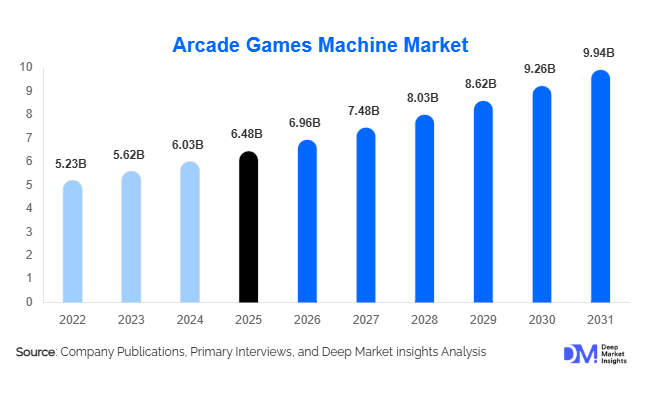
According to Deep Market Insights, the global arcade games machine market size was valued at USD 6.48 billion in 2025 and is projected to grow from USD 6.96 billion in 2026 to reach USD 9.94 billion by 2031, expanding at a CAGR of 7.4% during the forecast period (2026–2031). The arcade games machine market growth is primarily driven by the increasing popularity of location-based entertainment, rising investments in family entertainment centers (FECs), and the growing adoption of immersive gaming technologies such as virtual reality (VR), augmented reality (AR), AI-enabled gameplay systems, and motion simulators.
Arcade gaming has evolved significantly from traditional coin-operated gaming cabinets into highly immersive, digitally connected entertainment ecosystems. The market is increasingly benefiting from demand for experiential entertainment across malls, theme parks, hospitality venues, multiplexes, gaming lounges, and tourism destinations. Consumers, particularly Gen Z and millennials, are increasingly seeking social and multiplayer gaming experiences that provide engagement beyond home-based gaming platforms. In response, arcade operators are modernizing facilities with cloud-connected machines, cashless payment systems, esports-inspired gaming zones, and VR-based attractions.
Key Market Insights
- Immersive VR and AR arcade systems are rapidly transforming the market, allowing operators to deliver premium experiential gaming environments that cannot be replicated through home gaming systems.
- Family entertainment centers (FECs) remain the largest end-use segment, accounting for nearly 35% of global market demand in 2025 due to increasing investments in mall-based entertainment infrastructure.
- Asia-Pacific dominates the global arcade games machine market, led by Japan, China, and South Korea, due to strong gaming culture, manufacturing leadership, and rapid technology adoption.
- North America is witnessing strong demand for premium multiplayer and VR-enabled arcade systems, particularly across experiential retail and entertainment chains.
- Cashless arcade ecosystems are becoming mainstream, with operators increasingly integrating mobile wallets, card-based systems, and cloud-connected analytics platforms.
- AI, IoT, and cloud-based machine management technologies are improving operational efficiency, predictive maintenance, and customer engagement within arcade facilities.
What are the latest trends in the arcade games machine market?
Rise of Immersive VR and Multiplayer Arcade Experiences
The arcade games machine market is witnessing strong growth in immersive gaming technologies, particularly VR-based simulators, multiplayer interactive arenas, and motion-enabled gaming systems. Consumers increasingly prefer social gaming experiences that combine physical interaction with digital immersion, driving demand for premium arcade installations across malls, family entertainment centers, resorts, and tourism destinations. Advanced VR racing simulators, shooting games, motion theater systems, and esports-inspired gaming zones are becoming major revenue generators for operators. Multiplayer competitive gaming experiences are particularly popular among younger demographics seeking experiential entertainment outside traditional home gaming ecosystems.
Arcade manufacturers are also integrating haptic feedback systems, motion platforms, and AI-powered gameplay personalization to improve user engagement. These technologies enable operators to command premium pricing while increasing customer dwell time and repeat visitation. The growing popularity of destination entertainment centers is further accelerating investments in immersive arcade infrastructures globally.
Digitalization and Cashless Arcade Ecosystems
Cashless payment systems and cloud-connected arcade infrastructures are becoming increasingly common across the global market. Operators are shifting away from traditional coin-operated systems toward mobile wallet integrations, RFID cards, app-based gameplay systems, and centralized digital management platforms. These technologies improve operational efficiency by reducing cash handling costs, enabling real-time analytics, and supporting dynamic pricing strategies.
IoT-enabled arcade systems are also gaining traction as operators seek predictive maintenance capabilities, remote diagnostics, and gameplay performance tracking. Cloud-based systems allow arcade owners to update game content remotely, monitor machine utilization, and improve customer retention through loyalty programs and player data analytics. This digital transformation is significantly improving profitability while modernizing the consumer gaming experience.
What are the key drivers in the arcade games machine market?
Growing Demand for Location-Based Entertainment
The rapid expansion of location-based entertainment (LBE) venues is one of the major drivers accelerating arcade games machine market growth. Consumers increasingly prefer social and experiential entertainment activities that offer immersive interaction and multiplayer engagement. Family entertainment centers, mall gaming zones, amusement parks, and gaming lounges are investing heavily in advanced arcade systems to improve footfall and customer retention.
Retail developers and hospitality operators are also using arcade gaming attractions as anchor experiences to increase visitor engagement and improve non-core revenue streams. The trend is especially strong across Asia-Pacific and the Middle East, where large-scale entertainment infrastructure projects are driving sustained demand for arcade gaming equipment.
Technological Innovation in Arcade Gaming Systems
Continuous innovation in arcade technologies is significantly expanding market potential. The integration of VR, AR, AI, motion simulation, and IoT-enabled systems has transformed arcade gaming into a highly immersive entertainment category. Advanced gaming environments featuring multiplayer interaction, real-time analytics, and cinematic experiences are enabling operators to differentiate themselves from home gaming ecosystems.
Manufacturers are increasingly focusing on AI-based gameplay adaptation, interactive storytelling, and cloud-connected ecosystems to enhance customer engagement. These innovations are also improving machine monetization by enabling software updates, recurring content subscriptions, and personalized gaming experiences.
What are the restraints for the global market?
High Capital Investment Requirements
One of the major restraints within the arcade games machine market is the high capital expenditure associated with advanced gaming installations. Premium VR simulators, immersive motion systems, and multiplayer gaming environments require significant upfront investment and ongoing maintenance costs. Smaller arcade operators and entertainment centers in developing markets may face financial limitations in adopting next-generation systems.
Additionally, the cost of electronic components, semiconductors, display systems, and motion technologies continues to impact manufacturing expenses. Supply-chain disruptions and rising import costs further contribute to elevated equipment pricing globally.
Competition from Home Gaming Ecosystems
The increasing popularity of high-performance gaming consoles, cloud gaming services, and mobile gaming platforms remains a key challenge for arcade operators. Consumers now have access to sophisticated gaming experiences at home through affordable gaming subscriptions and connected multiplayer ecosystems. This trend has intensified competition for consumer entertainment spending.
To remain competitive, arcade operators must continuously invest in differentiated experiences that cannot be replicated through home gaming platforms. Failure to innovate could reduce customer traffic and weaken long-term profitability for conventional arcade businesses.
What are the key opportunities in the arcade games machine industry?
Expansion of Family Entertainment Centers in Emerging Markets
The rapid growth of family entertainment centers across emerging economies presents substantial opportunities for arcade gaming machine manufacturers. Countries such as India, Saudi Arabia, Indonesia, Vietnam, and Brazil are witnessing strong urbanization, rising disposable incomes, and large-scale retail infrastructure expansion. Shopping malls and mixed-use developments increasingly incorporate gaming and entertainment zones to attract consumers and improve visitor dwell time.
This trend is creating sustained procurement demand for redemption games, simulation systems, multiplayer arcade cabinets, and immersive VR attractions. Revenue-sharing deployment models and leasing-based arcade solutions are also lowering market entry barriers for operators and expanding equipment deployment opportunities.
Growth of Connected and Smart Arcade Ecosystems
IoT-enabled and cloud-connected arcade systems represent another major opportunity for the industry. Smart arcade machines capable of predictive maintenance, remote diagnostics, gameplay analytics, and mobile-wallet integration are becoming highly attractive to operators seeking operational efficiency and improved monetization.
Manufacturers that offer recurring software services, player engagement platforms, AI-driven personalization, and loyalty ecosystem integration are expected to outperform traditional hardware-centric competitors. The shift toward digitally connected entertainment ecosystems is likely to create long-term recurring revenue opportunities across the global market.
Report Scope
| Report Metric | Details |
|---|---|
| Market Size in 2025 | USD 6.48 Billion |
| Market Size in 2026 | USD 6.96 Billion |
| Market Size in 2031 | USD 9.94 Billion |
| CAGR | 7.4% (2026-2031) |
| Base Year for Estimation | 2025 |
| Historical Data | 2022-2024 |
| Forecast Period | 2026-2031 |
| Report Coverage | Revenue Forecast, Competitive Landscape, Supply Chain Disruption, Growth Factors, Environment & Regulatory Landscape and Trends |
| Geographies Covered | North America, Europe, APAC, Middle East and Africa, LATAM |
| Countries Covered | U.S., Canada, U.K., Germany, France, Spain, Italy, Russia, Nordic, Benelux, Rest of Europe, China, Korea, Japan, India, Australia, Singapore, Taiwan, South East Asia, Rest of Asia-Pacific, UAE, Turky, Saudi Arabia, South Africa, Egypt, Nigeria, Rest of MEA, Brazil, Mexico, Argentina, Chile, Colombia, Rest of LATAM |
Explore more data points, trends and opportunities Download Free Sample Report
Machine Type Insights
Video arcade machines remain the dominant segment within the arcade games machine market, accounting for approximately 31% of global market share in 2025. The popularity of multiplayer competitive gaming, retro arcade revival trends, and immersive VR-based video systems continues to support segment growth. Simulation and motion arcade machines are also witnessing rapid expansion, particularly across premium entertainment venues and tourism-driven gaming centers. Redemption arcade systems continue to generate stable demand due to their strong performance within family entertainment centers and mall gaming zones. Electromechanical arcade machines, including air hockey, basketball systems, and pinball machines, remain popular due to their broad demographic appeal and relatively low operating costs.
Technology Insights
IoT-enabled smart arcade machines are among the fastest-growing technology segments globally, accounting for nearly 24% of market demand in 2025. Operators increasingly prefer cloud-connected systems that support predictive maintenance, player analytics, and remote game updates. VR and AR-enabled arcade systems are also experiencing significant growth as immersive entertainment demand rises globally. AI-driven gameplay systems are improving personalization, customer engagement, and machine monetization. Conventional arcade machines continue to hold relevance in price-sensitive markets; however, digital transformation is rapidly reshaping the competitive landscape.
Revenue Model Insights
Cashless and card-based arcade systems dominate the market, representing approximately 38% of global revenue in 2025. Operators increasingly prefer digital payment ecosystems because they improve convenience, reduce cash handling risks, and enable integrated loyalty programs. Coin-operated systems continue to remain relevant in developing markets and small-scale entertainment venues, although their market share is gradually declining. Subscription-based and hybrid monetization models are emerging across premium gaming centers, enabling operators to increase customer retention and diversify revenue streams.
End-Use Insights
Family entertainment centers (FECs) represent the largest end-use segment in the arcade games machine market, contributing nearly 35% of global demand in 2025. FEC operators continue to aggressively invest in immersive simulators, redemption systems, and multiplayer arcade attractions to increase visitor engagement and repeat traffic. Shopping malls and retail entertainment centers are also major demand generators as experiential retail becomes increasingly important for attracting consumers. Theme parks, multiplex chains, resorts, and cruise operators are expanding arcade gaming infrastructure to diversify entertainment offerings and improve customer retention. Emerging applications are also being observed in corporate recreation spaces, edutainment centers, and military simulation training facilities.
Distribution Channel Insights
Direct sales to entertainment operators remain the leading distribution channel globally, particularly for premium arcade systems and large-scale immersive gaming installations. Specialized arcade equipment distributors continue to play a critical role in regional deployment and after-sales support. Leasing and revenue-sharing deployment models are gaining popularity among smaller operators seeking lower upfront investment requirements. Online B2B commercial equipment platforms are also emerging as important sales channels for mid-range and modular arcade systems. Franchise-based arcade deployment models are expanding rapidly across Asia-Pacific and the Middle East.
Explore more data points, trends and opportunities Download Free Sample Report
Arcade Games Machine Market Segmentations
By Machine Type
- Video Arcade Machines
- Redemption Arcade Machines
- Electromechanical Arcade Machines
- Simulation & Motion Arcade Machines
- Shooting & Action Arcade Machines
- Kiddie Ride & Family Arcade Machines
By Technology Integration
- Conventional Arcade Machines
- IoT-Enabled Smart Arcade Machines
- Cloud-Connected Arcade Systems
- AI-Based Interactive Arcade Machines
- VR/AR Immersive Arcade Systems
By Revenue Model
- Coin-Operated Machines
- Card-Based/Cashless Arcade Systems
- Subscription/Pay-by-Time Arcade Systems
- Hybrid Monetization Arcade Systems
By End User
- Family Entertainment Centers (FECs)
- Commercial Arcades & Gaming Zones
- Shopping Malls & Retail Entertainment Centers
- Theme Parks & Amusement Parks
- Hospitality & Resorts
- Cinema & Multiplex Chains
By Distribution Channel
- Direct Sales to Entertainment Operators
- Arcade Equipment Distributors
- Online Commercial Equipment Platforms
- Leasing & Rental Providers
- Franchise Arcade Solution Providers
Regional Insights
Asia-Pacific
Asia-Pacific dominates the global arcade games machine market with approximately 43% market share in 2025. Japan remains the technological innovation center of the global arcade industry due to its strong gaming culture and leadership in immersive entertainment systems. China is emerging as both a major consumption and manufacturing hub, supported by mall expansion, rising urban leisure spending, and strong electronics manufacturing infrastructure. South Korea continues to witness strong demand for esports-integrated arcade systems and VR-based gaming centers. India is rapidly emerging as a high-growth market due to increasing investments in family entertainment centers and experiential retail infrastructure.
North America
North America accounted for nearly 26% of global market demand in 2025, led by the United States. Strong consumer spending on experiential entertainment, rapid expansion of family entertainment chains, and high adoption of premium VR gaming systems continue to support market growth. Cashless arcade ecosystems and multiplayer simulation systems are increasingly popular across gaming lounges, malls, and tourism venues. Canada is also witnessing steady growth driven by resort-based entertainment investments and modernized gaming centers.
Europe
Europe remains a significant market led by Germany, the United Kingdom, France, and Italy. The region is benefiting from retro arcade gaming trends, tourism-driven entertainment demand, and investments in competitive social gaming venues. The United Kingdom has emerged as a strong market for arcade bars and esports-inspired gaming lounges. Germany and France continue to invest in amusement infrastructure and immersive entertainment systems across retail and hospitality environments.
Latin America
Latin America is gradually emerging as a promising market for arcade gaming machines, particularly in Brazil and Mexico. Growing mall infrastructure, increasing youth gaming participation, and expanding entertainment center investments are supporting regional growth. Economic volatility remains a challenge; however, demand for affordable multiplayer and redemption-based arcade systems continues to rise.
Middle East & Africa
The Middle East is one of the fastest-growing regions within the arcade games machine market, particularly across Saudi Arabia and the UAE. Government-backed tourism diversification strategies and large-scale entertainment infrastructure investments are accelerating demand for immersive arcade systems. Saudi Arabia is expected to register one of the highest regional growth rates globally through 2031 due to aggressive investments under Vision 2031 initiatives. Africa remains a smaller but gradually expanding market supported by tourism-linked entertainment infrastructure and growing urban retail development.
Key Players in the Arcade Games Machine Market
- Sega Sammy Holdings
- Bandai Namco Holdings
- Raw Thrills
- UNIS Technology
- Taito Corporation
- Konami Group
- Adrenaline Amusements
- Andamiro
- LAI Games
- Elaut Group
- Bay Tek Entertainment
- Stern Pinball
- Wahlap Technology
- Incredible Technologies
- ICE (Innovative Concepts in Entertainment)