Apparel Market Size
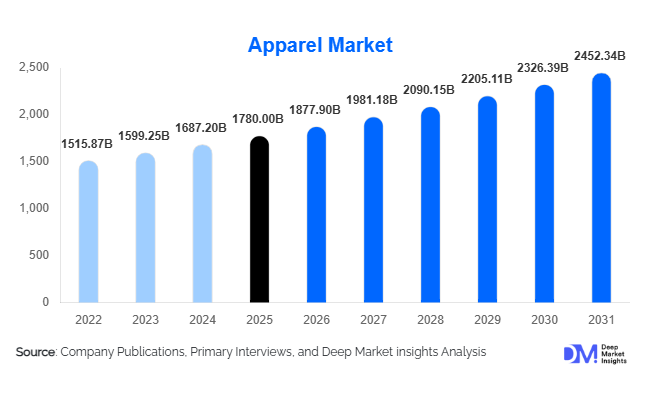
According to Deep Market Insights, the global apparel market size was valued at USD 1,780 billion in 2025 and is projected to grow from USD 1,877.90 billion in 2026 to reach USD 2,454.34 billion by 2031, expanding at a CAGR of 5.5% during the forecast period (2026–2031). The apparel market growth is primarily driven by rising disposable incomes, rapid expansion of e-commerce platforms, and evolving consumer preferences toward fast fashion and sustainable clothing. Increasing urbanization and global exposure to fashion trends through digital media are further accelerating demand across both developed and emerging economies.
Key Market Insights
- Casual and athleisure wear dominate global demand, driven by comfort-focused lifestyles and hybrid work environments.
- E-commerce is rapidly transforming apparel retail, with online channels expected to account for over one-third of global sales by 2031.
- Asia-Pacific leads the global market, supported by strong manufacturing capabilities and growing domestic consumption in China and India.
- Sustainability is becoming a critical differentiator, with increasing adoption of eco-friendly materials and circular fashion models.
- Mid-range apparel dominates pricing segments, balancing affordability with quality for mass consumers.
- Technological adoption, including AI-driven personalization and virtual try-ons, is reshaping consumer engagement and purchase behavior.
What are the latest trends in the apparel market?
Rise of Sustainable and Circular Fashion
The apparel industry is witnessing a strong shift toward sustainability, with brands increasingly adopting eco-friendly materials such as organic cotton, recycled polyester, and biodegradable fabrics. Circular fashion models, including resale platforms, rental services, and recycling initiatives, are gaining traction. Consumers are becoming more conscious of environmental impacts, prompting companies to invest in transparent supply chains and ethical sourcing practices. Governments and regulatory bodies are also introducing stricter environmental guidelines, further accelerating the transition toward sustainable apparel production.
Digitalization and Omnichannel Retail Expansion
Digital transformation is reshaping the apparel market, with online retail emerging as a dominant distribution channel. Brands are leveraging advanced technologies such as artificial intelligence, augmented reality, and big data analytics to enhance customer experiences. Virtual fitting rooms, personalized recommendations, and seamless integration of online and offline channels are improving conversion rates and customer retention. Social commerce and influencer marketing are also playing a crucial role in driving brand visibility and sales, particularly among younger consumers.
What are the key drivers in the apparel market?
Rising Disposable Income and Urbanization
Increasing disposable income levels, particularly in emerging economies, are significantly boosting apparel consumption. Rapid urbanization is leading to lifestyle changes, with consumers placing greater emphasis on fashion and personal appearance. The expanding middle-class population in countries such as India, China, and Brazil is driving demand for both affordable and premium clothing, contributing to overall market growth.
Growth of E-commerce and Direct-to-Consumer Models
The proliferation of e-commerce platforms has revolutionized the apparel industry by enabling brands to reach a global audience. Direct-to-consumer (DTC) models allow companies to maintain better control over pricing, branding, and customer relationships. Features such as easy returns, fast delivery, and personalized shopping experiences are encouraging online purchases, further accelerating market expansion.
What are the restraints for the global market?
Supply Chain Volatility and Raw Material Price Fluctuations
The apparel industry is highly sensitive to fluctuations in raw material prices, particularly cotton and synthetic fibers. Supply chain disruptions, geopolitical tensions, and logistics challenges can significantly impact production costs and lead times. These factors pose challenges for manufacturers in maintaining stable pricing and profit margins.
Environmental Regulations and Sustainability Pressures
Increasing environmental concerns and regulatory pressures are compelling apparel companies to adopt sustainable practices. While this shift is essential for long-term growth, it often involves higher production costs and operational complexities. Smaller players may find it challenging to comply with stringent regulations, potentially limiting their competitiveness in the market.
What are the key opportunities in the apparel industry?
Expansion in Emerging Markets
Emerging economies present significant growth opportunities for apparel companies. Rising incomes, urbanization, and increasing fashion awareness are driving demand in regions such as Asia-Pacific, Latin America, and Africa. Companies can capitalize on these opportunities by offering affordable and culturally relevant products tailored to local preferences.
Growth of Athleisure and Functional Apparel
The increasing focus on health and fitness is driving demand for athleisure and functional apparel. Consumers are seeking versatile clothing that can be worn for both casual and active purposes. This trend is creating opportunities for brands to innovate and expand their product portfolios in high-growth segments.
Report Scope
| Report Metric | Details |
|---|---|
| Market Size in 2025 | USD 1780 Billion |
| Market Size in 2026 | USD 1877.90 Billion |
| Market Size in 2031 | USD 2452.34 Billion |
| CAGR | 5.5% (2026-2031) |
| Base Year for Estimation | 2025 |
| Historical Data | 2022-2024 |
| Forecast Period | 2026-2031 |
| Report Coverage | Revenue Forecast, Competitive Landscape, Supply Chain Disruption, Growth Factors, Environment & Regulatory Landscape and Trends |
| Geographies Covered | North America, Europe, APAC, Middle East and Africa, LATAM |
| Countries Covered | U.S., Canada, U.K., Germany, France, Spain, Italy, Russia, Nordic, Benelux, Rest of Europe, China, Korea, Japan, India, Australia, Singapore, Taiwan, South East Asia, Rest of Asia-Pacific, UAE, Turky, Saudi Arabia, South Africa, Egypt, Nigeria, Rest of MEA, Brazil, Mexico, Argentina, Chile, Colombia, Rest of LATAM |
Explore more data points, trends and opportunities Download Free Sample Report
Product Type Insights
Topwear remains the leading product category, accounting for approximately 32% of the global market in 2025, primarily driven by its high purchase frequency, seasonless demand, and versatility across both casual and formal settings. Consumers tend to refresh topwear collections more frequently than other apparel categories due to changing fashion trends, social media influence, and relatively lower price points compared to outerwear. Bottomwear and outerwear segments also contribute significantly, supported by seasonal demand patterns and evolving fashion cycles, particularly in colder regions. Innerwear and loungewear are experiencing steady growth due to increasing consumer preference for comfort, work-from-home culture, and the premiumization of intimate wear. Sportswear and activewear represent one of the fastest-growing segments globally, driven by rising health consciousness, fitness trends, and the mainstream adoption of athleisure as everyday wear. Meanwhile, ethnic and traditional wear continues to hold strong demand, especially in culturally diverse and festival-driven markets across Asia-Pacific and the Middle East, where traditional attire remains an integral part of social and ceremonial occasions.
Application Insights
Casual wear dominates the apparel market, accounting for nearly 50% of total demand, supported by a global shift toward comfort-driven clothing and relaxed dress codes across workplaces and social settings. The increasing influence of hybrid work models and lifestyle changes has further strengthened this segment, making casual apparel the most frequently purchased category. Formal wear maintains steady demand, particularly in corporate and professional environments, although growth remains moderate compared to casual segments. Sportswear is witnessing rapid expansion, driven by increasing participation in fitness activities, wellness trends, and the blending of activewear into daily wardrobes. Occasion wear, while comparatively smaller in volume, represents a high-value segment due to premium pricing associated with weddings, festivals, and social events. Additionally, the rising popularity of multifunctional clothing, garments that combine comfort, style, and performance, is shaping application trends, enabling consumers to use a single apparel item across multiple use cases, thereby driving innovation in fabric technology and design.
Distribution Channel Insights
Offline retail continues to dominate with approximately 58% market share in 2025, primarily due to the tactile shopping experience, immediate product availability, and consumer preference for trial and fit assurance, particularly in premium and luxury segments. Department stores, specialty outlets, and branded retail chains continue to attract significant footfall, especially in urban centers. However, online retail is the fastest-growing distribution channel, driven by increasing internet penetration, smartphone usage, and convenience-oriented shopping behavior. E-commerce platforms offer competitive pricing, wider product assortments, and seamless return policies, which have significantly boosted adoption. Brand-owned websites are gaining traction as companies increasingly shift toward direct-to-consumer (DTC) strategies to improve margins and customer engagement. Omnichannel retailing has become a key focus area, with retailers integrating online and offline touchpoints through click-and-collect services, real-time inventory visibility, and personalized marketing, thereby enhancing the overall customer experience.
End-User Insights
Women’s apparel leads the market with a share of approximately 52%, driven by a broader product portfolio, higher fashion sensitivity, and faster trend adoption compared to other segments. Frequent product launches, seasonal collections, and the strong influence of social media and celebrity endorsements further contribute to the dominance of this segment. Men’s apparel accounts for a significant share, supported by increasing awareness of fashion, grooming, and professional appearance, particularly in urban populations. The segment is also benefiting from the growing popularity of casual and athleisure wear among male consumers. The kids’ segment is expanding steadily, fueled by rising disposable incomes, increasing spending on children’s lifestyle products, and the influence of branded and licensed apparel. Additionally, rapid growth in organized retail and e-commerce platforms is making children’s apparel more accessible, further supporting segment expansion.
Explore more data points, trends and opportunities Download Free Sample Report
Apparel Market Segmentations
By Product Type
- Topwear
- Bottomwear
- Outerwear
- Innerwear & Loungewear
- Sportswear / Activewear
- Ethnic & Traditional Wear
By Application
- Casual Wear
- Formal Wear
- Sportswear
- Occasion Wear
By Distribution Channel
- Offline Retail
- Online Retail
By End User
- Men
- Women
- Kids
By Material Type
- Natural Fibers
- Synthetic Fibers
- Blended Fabrics
Regional Insights
Asia-Pacific
Asia-Pacific dominates the global apparel market with a share of approximately 38% in 2025, driven by a combination of strong manufacturing capabilities and rising domestic consumption. China leads both production and consumption, supported by its large-scale textile industry and growing middle-class population. India is emerging as one of the fastest-growing markets, driven by favorable demographics, increasing urbanization, and government initiatives such as “Make in India,” which promote domestic manufacturing and exports. Key growth drivers in the region include rising disposable incomes, expanding retail infrastructure, rapid digital adoption, and strong demand for both affordable and premium apparel. Additionally, the presence of low-cost manufacturing hubs such as Bangladesh and Vietnam strengthens the region’s position in global supply chains.
North America
North America accounts for around 22% of the global market, with the United States being the largest contributor. The region’s growth is primarily driven by high consumer spending power, strong brand consciousness, and a well-established retail ecosystem. Increasing demand for sustainable and ethically produced apparel is a major growth driver, with consumers actively seeking eco-friendly products. The rapid adoption of e-commerce and advanced technologies such as AI-driven personalization and virtual fitting rooms further supports market expansion. Additionally, the growing popularity of athleisure and premium apparel segments is contributing to sustained demand across the region.
Europe
Europe holds approximately 20% market share, led by key countries such as Germany, France, Italy, and the UK. The region is characterized by strong demand for luxury and high-quality apparel, supported by established fashion houses and global brands. Sustainability is a major driver of growth in Europe, with stringent environmental regulations and high consumer awareness encouraging the adoption of eco-friendly materials and ethical production practices. Additionally, the region benefits from a well-developed retail infrastructure and a strong cultural inclination toward fashion, which continues to drive demand for both premium and fast-fashion products.
Latin America
Latin America contributes around 10% of the market, with Brazil and Mexico as the leading countries. Growth in the region is driven by increasing urbanization, expanding middle-class populations, and rising fashion awareness among younger consumers. The growing penetration of e-commerce platforms is also playing a significant role in improving product accessibility and boosting sales. Additionally, local manufacturing capabilities and government initiatives to support the textile industry are contributing to regional growth. However, economic volatility remains a key challenge that may impact long-term expansion.
Middle East & Africa
The Middle East and Africa region accounts for approximately 10% market share, with the UAE and South Africa being major contributors. Growth in this region is driven by rising disposable incomes, increasing urbanization, and a strong demand for luxury and premium apparel, particularly in the Gulf countries. The expanding retail sector, including the development of shopping malls and international brand presence, is further supporting market growth. Additionally, the demand for modest fashion is a key regional driver, with increasing global recognition of this segment. In Africa, improving economic conditions, population growth, and rising consumer awareness are gradually boosting apparel demand, making it one of the emerging growth regions globally.