Global Anti-Chafing Cream Market Size
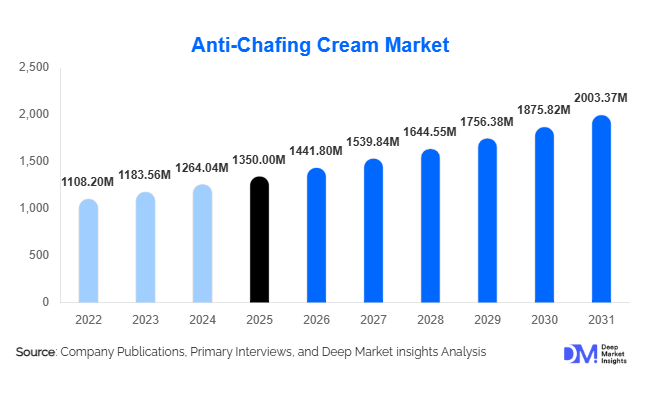
According to Deep Market Insights, the global anti-chafing cream market size was valued at USD 1,350 million in 2025 and is projected to grow from USD 1,441.80 million in 2026 to reach USD 2,003.37 million by 2031, expanding at a CAGR of 6.8% during the forecast period (2026–2031). The market growth is primarily driven by rising participation in sports and fitness activities, increasing awareness of skin irritation prevention, expanding elderly care applications, and growing adoption of dermatologically tested personal care products across both developed and emerging economies.
Anti-chafing creams are increasingly being recognized as essential skincare solutions that reduce friction-induced irritation in sports, healthcare, occupational, and daily-use applications. The market is transitioning from a niche athletic product category into a mainstream personal care and therapeutic skincare segment. Growth is further supported by innovation in long-lasting, sweat-resistant, and organic formulations, along with rising e-commerce penetration that improves accessibility across global markets. Increasing disposable incomes, urbanization, and lifestyle changes are also contributing to stronger demand, particularly in Asia-Pacific and North America. The market remains moderately fragmented, with global FMCG leaders and specialized dermatological brands competing through product differentiation, pricing strategies, and distribution expansion.
Key Market Insights
- Sports and fitness applications dominate demand, with growing global participation in endurance sports, gym training, and outdoor activities.
- Healthcare usage is expanding rapidly, particularly in elderly care and bedridden patient management across hospitals and homecare settings.
- North America leads the global market due to high consumer awareness, strong healthcare infrastructure, and premium product adoption.
- Asia-Pacific is the fastest-growing region, supported by rising disposable incomes, urbanization, and expanding fitness culture.
- Organic and natural formulations are gaining traction as consumers shift toward clean-label and dermatologically safe personal care products.
- E-commerce is transforming distribution, enabling wider access to niche skincare products and boosting brand visibility globally.
Anti-Chafing Cream Market Trends
Shift Toward Organic and Dermatology-Driven Formulations
Consumers are increasingly preferring chemical-free, hypoallergenic, and plant-based anti-chafing solutions. This trend is driving manufacturers to invest in dermatologically tested formulations that reduce skin sensitivity risks while improving performance durability. Brands are focusing on premiumization through natural ingredients such as aloe vera, coconut oil derivatives, and shea butter-based emulsions. Regulatory pressure for ingredient transparency is also pushing innovation toward cleaner formulations, particularly in Europe and North America.
E-Commerce Expansion and Digital Personalization
The rapid growth of online retail channels is reshaping how anti-chafing creams are marketed and sold. Direct-to-consumer platforms and e-pharmacies are enabling personalized product recommendations based on skin type, activity level, and usage environment. Subscription-based skincare models and influencer-led marketing campaigns are also increasing adoption among younger consumers. AI-driven skincare diagnostics and digital consultations are further enhancing customer engagement and boosting repeat purchases.
Anti-Chafing Cream Market Drivers
Rising Global Sports and Fitness Participation
The expansion of global fitness culture is a major driver of the anti-chafing cream market. Increasing participation in marathons, cycling events, gym workouts, and adventure sports has significantly boosted demand for friction-reducing skincare products. Athletes and fitness enthusiasts increasingly rely on long-duration protective creams, driving consistent repeat purchases and expanding product penetration across both professional and recreational user bases.
Growing Elderly and Healthcare Population
The rising aging population worldwide is significantly increasing demand in healthcare applications. Bedridden patients and elderly individuals frequently experience skin irritation due to prolonged immobility, creating strong demand in hospitals, nursing homes, and homecare settings. This segment is becoming a stable institutional revenue source for manufacturers, particularly in developed economies.
Product Innovation and Premiumization
Continuous advancements in formulation technology, including sweat-resistant textures, fast-absorbing creams, and multi-functional skincare benefits, are strengthening market growth. Premium anti-chafing creams that combine moisturizing, healing, and protective properties are gaining traction, enabling higher profit margins for manufacturers.
Anti-Chafing Cream Market Restraints
Limited Awareness in Developing Regions
In many developing economies, consumer awareness regarding specialized anti-chafing products remains relatively low. Traditional substitutes such as talcum powder and petroleum jelly are still widely used, limiting adoption of premium skincare alternatives.
Availability of Low-Cost Substitutes
The presence of inexpensive alternatives significantly restricts market penetration, especially in price-sensitive regions. Consumers often prefer multipurpose or generic skincare products instead of specialized anti-chafing solutions, affecting premium product adoption rates.
Anti-Chafing Cream Market Opportunities
Expansion in Institutional Healthcare and Occupational Safety
Increasing demand from hospitals, elder care facilities, military organizations, and industrial workplaces presents strong growth opportunities. Governments and private institutions are investing in preventive skincare and occupational safety products, creating stable bulk procurement channels for manufacturers.
Growth of Natural and Clean-Label Skincare Products
The rising preference for organic, chemical-free skincare products offers significant opportunities for product differentiation. Brands focusing on sustainable sourcing, eco-friendly packaging, and dermatological safety are likely to gain strong competitive advantage in premium segments.
Digital Commerce and Personalized Skincare Solutions
The expansion of e-commerce platforms and AI-driven skincare personalization is opening new growth avenues. Subscription models and digital skincare diagnostics are enabling brands to build long-term customer engagement and recurring revenue streams.
Report Scope
| Report Metric | Details |
|---|---|
| Market Size in 2025 | USD 1350 Million |
| Market Size in 2026 | USD 1441.80 Million |
| Market Size in 2031 | USD 2003.37 Million |
| CAGR | 6.8% (2026-2031) |
| Base Year for Estimation | 2025 |
| Historical Data | 2022-2024 |
| Forecast Period | 2026-2031 |
| Report Coverage | Revenue Forecast, Competitive Landscape, Supply Chain Disruption, Growth Factors, Environment & Regulatory Landscape and Trends |
| Geographies Covered | North America, Europe, APAC, Middle East and Africa, LATAM |
| Countries Covered | U.S., Canada, U.K., Germany, France, Spain, Italy, Russia, Nordic, Benelux, Rest of Europe, China, Korea, Japan, India, Australia, Singapore, Taiwan, South East Asia, Rest of Asia-Pacific, UAE, Turky, Saudi Arabia, South Africa, Egypt, Nigeria, Rest of MEA, Brazil, Mexico, Argentina, Chile, Colombia, Rest of LATAM |
Explore more data points, trends and opportunities Download Free Sample Report
Product Type Insights
Cream-based anti-chafing products dominate the global market due to their superior ease of application, extended skin protection duration, and high compatibility with sensitive skin types. Their ability to provide uniform coverage and hydration makes them the preferred choice across sports, healthcare, and daily personal care applications. Additionally, creams are widely recommended in dermatological and preventive skincare routines, further reinforcing their dominance in both consumer and institutional channels.
Gels and sticks are witnessing strong adoption among athletes and fitness enthusiasts due to their lightweight, non-greasy texture and portability, making them suitable for on-the-go application during endurance sports and outdoor activities. Powders continue to maintain relevance in price-sensitive and emerging markets where cost-effective friction control solutions are preferred. Sprays and aerosols are emerging as innovative alternatives, particularly in industrial and large-area application scenarios where quick coverage and convenience are essential. The dominance of creams is primarily driven by rising demand for multifunctional skincare solutions that combine friction reduction, moisturization, and skin healing benefits. Growing consumer preference for dermatologically tested and long-duration protection products further strengthens cream-based product leadership globally.
Application Insights
Sports and athletics represent the leading application segment in the global anti-chafing cream market, driven by increasing participation in fitness activities, endurance sports, marathons, cycling, and gym training. Athletes and active consumers require consistent friction protection, making anti-chafing creams an essential part of sports skincare routines.
Healthcare applications are expanding rapidly, particularly in elderly care, bedridden patients, and post-surgical recovery cases where prolonged immobility leads to skin irritation. Industrial applications such as construction, mining, and logistics are emerging as high-growth segments due to prolonged physical movement, heat exposure, and friction-related skin conditions. Daily personal care usage is also increasing as consumers adopt preventive skincare routines for comfort, hygiene, and lifestyle wellness. Growth in sports applications is primarily driven by rising global fitness awareness, expansion of organized sports events, and increasing consumer willingness to invest in performance-enhancing personal care products. Simultaneously, aging population growth is accelerating healthcare-based demand globally.
Distribution Channel Insights
Pharmacies and drug stores remain the most trusted distribution channel due to strong association with dermatological recommendations and healthcare credibility. Consumers prefer these outlets for clinically validated and physician-recommended skincare products, especially in medical and sensitive-use cases.
Online retail is the fastest-growing channel, supported by increasing digital penetration, e-commerce convenience, product variety, and AI-driven personalized skincare recommendations. Supermarkets and hypermarkets continue to serve mass-market consumers seeking easy accessibility and affordable options. Specialty sports stores cater specifically to athletes and fitness enthusiasts, offering performance-focused product assortments. Medical supply stores play a critical role in institutional procurement for hospitals, elder care facilities, and rehabilitation centers. The rapid expansion of online retail is driven by rising smartphone usage, increasing consumer preference for doorstep delivery, availability of niche skincare brands, and strong digital marketing strategies adopted by personal care companies.
Explore more data points, trends and opportunities Download Free Sample Report
Anti-Chafing Cream Market Segmentations
By Product Type
- Creams
- Gels
- Sticks & Balms
- Powders
- Sprays & Aerosols
By Application
- Sports & Athletics
- Healthcare
- Industrial Workers
- Daily Personal Care
By Distribution Channel
- Pharmacies & Drug Stores
- Online Retail / E-commerce
- Supermarkets & Hypermarkets
- Specialty Sports Stores
- Medical Supply Stores
By Formulation Type
- Synthetic-Based Formulations
- Natural / Organic Formulations
- Hybrid Formulations
Regional Insights
North America
North America holds approximately 32% market share in 2025, making it the leading regional market. The region benefits from a highly developed healthcare system, strong fitness and sports culture, and high consumer awareness of advanced skincare solutions. The United States remains the dominant contributor, supported by strong penetration of premium personal care brands and high per-capita healthcare spending. Growth in North America is driven by increasing participation in fitness and outdoor activities, rising demand for premium dermatological products, and strong institutional adoption in healthcare and elderly care facilities. Additionally, high disposable income levels support premium product penetration.
Europe
Europe accounts for approximately 27% of global market share, supported by strong demand for dermatologically tested and organic skincare products. Major contributors include Germany, the United Kingdom, and France, where consumers increasingly prefer clean-label, sustainable, and clinically validated personal care solutions. Market growth in Europe is driven by an aging population requiring healthcare-based skincare solutions, increasing preference for organic and eco-friendly formulations, and strong regulatory frameworks that encourage product quality and safety standards.
Asia-Pacific
Asia-Pacific is the fastest-growing regional market, led by China and India, with significant contributions from Japan and South Korea. Rising disposable incomes, rapid urbanization, and increasing adoption of Western fitness and wellness lifestyles are fueling strong demand across the region. Growth is driven by expanding middle-class populations, rising fitness and gym culture, increasing awareness of skincare hygiene, and strong growth of e-commerce platforms enabling product accessibility in both urban and semi-urban areas.
Latin America
Latin America is witnessing steady growth, particularly in Brazil, Mexico, and Argentina, where sports participation and wellness awareness are gradually increasing. Demand is concentrated in urban regions with higher income levels and better retail infrastructure. Regional growth is supported by increasing sports participation, expansion of retail and pharmacy networks, and growing exposure to international skincare brands through digital channels and cross-border e-commerce.
Middle East & Africa
The Middle East & Africa region is emerging as a developing market, with key growth centered in the UAE, Saudi Arabia, and South Africa. Rising investment in healthcare infrastructure and increasing participation in sports and wellness activities are supporting gradual market expansion. Growth is driven by increasing healthcare investments, rising disposable incomes in Gulf countries, expansion of sports tourism, and growing awareness of personal hygiene and skincare in hot climatic conditions that increase skin friction risks.
Key Players in the Anti-Chafing Cream Market
- Johnson & Johnson
- Beiersdorf AG
- Procter & Gamble
- Unilever
- 3M Company
- Reckitt Benckiser
- Kimberly-Clark
- L’Oréal Group
- Himalaya Wellness
- Church & Dwight
- The Honest Company
- Coloplast
- Bayer Consumer Health
- Scapa Healthcare
- Avon Products