Anti-acne Cosmetics Market Size
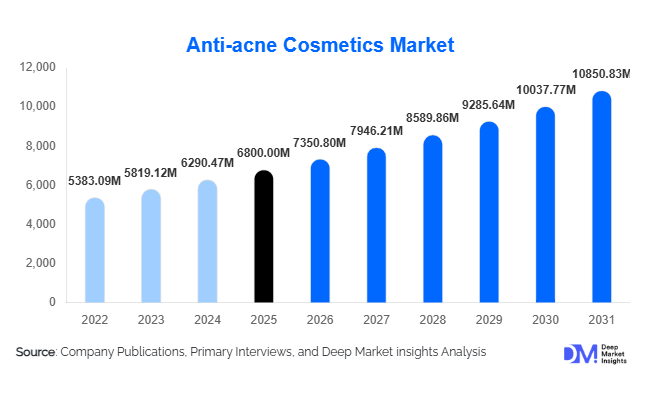
According to Deep Market Insights, the global antiacne cosmetics market size was valued at USD 6,800 million in 2025 and is projected to grow from USD 7,350.80 million in 2026 to reach USD 10,850.83 million by 2031, expanding at a CAGR of 8.1% during the forecast period (2026–2031). The market growth is primarily driven by the increasing prevalence of acne across age groups, rising consumer awareness regarding skincare routines, and the growing demand for targeted dermatological solutions. Additionally, the integration of active ingredients such as salicylic acid and retinoids, along with the surge in demand for clean-label and personalized skincare products, is significantly contributing to market expansion globally.
Key Market Insights
- The rising incidence of adult acne is expanding the consumer base, particularly among individuals aged 20–35 years with higher purchasing power.
- Online retail channels are rapidly gaining dominance, driven by influencer marketing, product accessibility, and direct-to-consumer strategies.
- Asia-Pacific dominates the global market, supported by large populations and increasing skincare awareness in China and India.
- Natural and clean-label products are witnessing strong growth, as consumers shift toward herbal and chemical-free formulations.
- Dermatology-grade and premium products are gaining traction, particularly in developed markets such as North America and Europe.
- Technological advancements in formulation and personalization, including AI-based skin diagnostics, are reshaping product development and consumer engagement.
What are the latest trends in the anti-acne cosmetics market?
Shift Toward Clean and Natural Formulations
Consumers are increasingly prioritizing products with natural and plant-based ingredients, such as tea tree oil, aloe vera, and neem. This shift is driven by growing concerns about the long-term effects of synthetic chemicals like parabens and sulfates. As a result, manufacturers are reformulating products to align with clean beauty standards while maintaining efficacy. Brands are also emphasizing transparency in ingredient sourcing and labeling, which has become a key differentiator in competitive markets. This trend is particularly strong in Europe and North America, where regulatory standards and consumer awareness are high.
Rise of Personalized Skincare Solutions
Personalization is emerging as a transformative trend in the anti-acne cosmetics market. Companies are leveraging AI and digital dermatology tools to analyze individual skin conditions and recommend tailored products. Subscription-based skincare models and customized formulations are gaining popularity, particularly among tech-savvy consumers. This trend not only enhances treatment effectiveness but also strengthens customer loyalty. Integration of data analytics and mobile applications is further enabling brands to deliver personalized experiences at scale.
What are the key drivers in the anti-acne cosmetics market?
Increasing Prevalence of Acne Across Age Groups
Acne is no longer limited to teenagers, with a growing number of adults experiencing persistent skin issues due to stress, hormonal imbalances, and lifestyle factors. This has significantly expanded the target market, driving demand for specialized products tailored to adult skin. The rising incidence of acne in urban populations, coupled with environmental factors such as pollution, is further accelerating product adoption.
Growing Influence of Social Media and Beauty Awareness
Social media platforms have become powerful drivers of consumer behavior in the skincare industry. Influencers, dermatologists, and beauty experts are educating audiences about acne treatment routines, boosting product visibility and demand. The increasing popularity of multi-step skincare regimens is encouraging consumers to invest in multiple antiacne products, thereby increasing overall market value.
What are the restraints for the global market?
Side Effects Associated with Active Ingredients
Despite their effectiveness, ingredients such as benzoyl peroxide and retinoids can cause skin irritation, dryness, and sensitivity. These side effects may discourage consumers, particularly those with sensitive skin, from using certain products. Negative experiences can also impact brand loyalty and hinder market growth.
Intense Competition and Price Sensitivity
The antiacne cosmetics market is highly fragmented, with numerous global and regional players competing across price segments. This intense competition leads to pricing pressure, particularly in emerging markets where consumers are highly price-sensitive. Additionally, the presence of counterfeit products and inconsistent regulatory standards in some regions poses challenges for established brands.
What are the key opportunities in the anti-acne cosmetics industry?
Expansion in Emerging Markets
Emerging economies such as India, Brazil, and Indonesia present significant growth opportunities due to rising disposable incomes, urbanization, and increasing awareness of skincare. Companies can capitalize on these markets by offering affordable and region-specific products tailored to local skin types and climatic conditions. The rapid growth of e-commerce platforms in these regions further facilitates market entry and expansion.
Integration of Advanced Dermatological Technologies
Advancements in dermatology and biotechnology are enabling the development of more effective and targeted antiacne solutions. Innovations such as microbiome-friendly formulations, time-release actives, and AI-driven skin analysis tools are enhancing product efficacy and consumer trust. Companies investing in R&D and technological integration are likely to gain a competitive edge.
Report Scope
| Report Metric | Details |
|---|---|
| Market Size in 2025 | USD 6800 Million |
| Market Size in 2026 | USD 7350.80 Million |
| Market Size in 2031 | USD 10850.83 Million |
| CAGR | 8.1% (2026-2031) |
| Base Year for Estimation | 2025 |
| Historical Data | 2022-2024 |
| Forecast Period | 2026-2031 |
| Report Coverage | Revenue Forecast, Competitive Landscape, Supply Chain Disruption, Growth Factors, Environment & Regulatory Landscape and Trends |
| Geographies Covered | North America, Europe, APAC, Middle East and Africa, LATAM |
| Countries Covered | U.S., Canada, U.K., Germany, France, Spain, Italy, Russia, Nordic, Benelux, Rest of Europe, China, Korea, Japan, India, Australia, Singapore, Taiwan, South East Asia, Rest of Asia-Pacific, UAE, Turky, Saudi Arabia, South Africa, Egypt, Nigeria, Rest of MEA, Brazil, Mexico, Argentina, Chile, Colombia, Rest of LATAM |
Explore more data points, trends and opportunities Download Free Sample Report
Product Type Insights
Cleansers dominate the anti-acne cosmetics market, accounting for approximately 28% of the global market share in 2025, and are expected to maintain their leadership position throughout the forecast period. The primary driver behind this dominance is their essential role as the first step in any skincare routine, ensuring daily and repeated usage across all consumer segments. Increasing concerns regarding excess sebum production, pollution-induced skin damage, and clogged pores, particularly in urban populations, are further reinforcing demand for acne-specific cleansers. Additionally, the availability of advanced formulations incorporating salicylic acid, glycolic acid, and microbiome-friendly ingredients has enhanced their efficacy, making them suitable for both preventive and treatment purposes. While cleansers lead in volume, segments such as serums and spot treatments are witnessing accelerated growth due to their targeted and fast-acting benefits. Combination kits are also gaining traction, especially among young consumers seeking structured, multi-step acne management solutions, reflecting a shift toward holistic skincare regimens.
Ingredient Insights
Salicylic acid-based products lead the ingredient segment with around 26% market share, primarily due to their strong clinical backing and widespread acceptance as an effective over-the-counter acne treatment. The key driver for this segment is the ingredient’s ability to penetrate pores, dissolve excess oil, and exfoliate dead skin cells, making it highly effective for mild to moderate acne conditions. Its compatibility with various product formats, cleansers, toners, serums, and spot treatments further enhances its market penetration. Retinoid-based and benzoyl peroxide products also maintain significant shares, driven by their dermatological efficacy in treating severe acne cases. However, the fastest-growing segment within this category is natural and herbal ingredients, fueled by increasing consumer preference for gentle, non-irritating formulations. The rising demand for clean-label products and concerns over chemical side effects are accelerating the adoption of plant-based alternatives, particularly in Europe and the Asia-Pacific.
Distribution Channel Insights
Online retail channels account for approximately 32% of the market share and represent the fastest-growing distribution segment. The primary growth driver is the rapid digitalization of retail ecosystems, combined with the influence of social media, beauty influencers, and direct-to-consumer (D2C) brand strategies. Consumers increasingly prefer online platforms for their convenience, access to a wide product portfolio, competitive pricing, and availability of user reviews and dermatologist recommendations. Subscription-based skincare services and personalized product recommendations are further strengthening online channel adoption. Meanwhile, pharmacies and drugstores continue to play a crucial role, particularly for clinically recommended and medicated products, driven by consumer trust in professional advice. Specialty stores remain relevant in the premium segment, offering curated product selections and personalized consultations, especially in developed markets.
Consumer Demographics Insights
Young adults aged 20–35 years represent the largest consumer segment, holding around 38% of the global market share. The leading driver for this segment is the rising prevalence of adult acne, which is increasingly linked to lifestyle factors such as stress, hormonal imbalances, dietary habits, and environmental pollution. This demographic also exhibits higher purchasing power and greater willingness to invest in premium and multi-step skincare routines compared to teenage consumers. The strong influence of social media trends, dermatological awareness campaigns, and the growing focus on appearance and self-care are further driving demand within this group. Additionally, this segment shows a high inclination toward experimenting with new products, including serums, combination kits, and personalized skincare solutions, making it a key target for innovation and product launches.
End-Use Insights
The antiacne cosmetics market is primarily driven by demand from the personal skincare segment, which accounts for the majority of product usage due to its daily and preventive application nature. The key growth driver here is the increasing adoption of structured skincare routines among consumers, particularly in urban areas. Dermatology clinics are emerging as the fastest-growing end-use segment, supported by rising consumer preference for professional consultation and clinically proven treatments. This trend is further amplified by the growing awareness of skin health and the availability of advanced dermatological procedures. Additionally, the medical aesthetics industry is expanding its scope by incorporating antiacne products into broader treatment protocols, including chemical peels and laser therapies. Export-driven demand from major cosmetic-producing countries such as South Korea, France, and the United States is also contributing significantly to global market expansion, supported by strong international brand presence and innovation capabilities.
Explore more data points, trends and opportunities Download Free Sample Report
Anti-acne Cosmetics Market Segmentations
By Product Type
- Cleansers
- Toners
- Moisturizers
- Spot Treatments
- Masks
- Serums
- Sunscreens
- Combination Kits
By Ingredient Type
- Salicylic Acid-based Products
- Benzoyl Peroxide-based Products
- Retinoid-based Products
- Natural/Herbal Ingredients
- Antibiotic-based Products
- Others
By Distribution Channel
- Online Retail
- Pharmacies/Drugstores
- Supermarkets/Hypermarkets
- Specialty Beauty Stores
- Dermatology Clinics
By Consumer Demographics
- Teenagers
- Young Adults
- Adults
- Mature Consumers
Regional Insights
Asia-Pacific
Asia-Pacific dominates the global antiacne cosmetics market with approximately 42% share in 2025, driven by a combination of demographic, economic, and cultural factors. China accounts for nearly 18% of global demand, supported by rapid urbanization, increasing disposable incomes, and a strong beauty and skincare culture. The widespread influence of K-beauty and J-beauty trends is also accelerating product adoption across the region. India is the fastest-growing market, driven by a large young population, rising awareness of skincare, and rapid expansion of e-commerce platforms. Additionally, high pollution levels and humid climatic conditions in many Asian countries contribute to higher acne prevalence, further fueling demand for antiacne products.
North America
North America holds about 25% of the global market share, with the United States contributing nearly 22%. The region’s growth is primarily driven by high consumer awareness, strong purchasing power, and a well-established dermatology ecosystem. The increasing prevalence of adult acne, coupled with a growing preference for premium and dermatologist-recommended products, is significantly boosting market demand. Additionally, the presence of leading global skincare brands and continuous product innovation are supporting market expansion. The rapid adoption of personalized skincare solutions and AI-driven diagnostics is further strengthening North America’s position as a technologically advanced market.
Europe
Europe accounts for approximately 18% of the global market, led by countries such as Germany, France, and the United Kingdom. A key driver in this region is the strong consumer preference for natural, organic, and clean-label products, supported by stringent regulatory standards regarding ingredient safety and transparency. European consumers are highly conscious of product quality and sustainability, which is driving demand for eco-friendly and dermatologically tested formulations. Additionally, the region benefits from a well-established cosmetics industry and strong export capabilities, particularly from France, which is a global hub for premium skincare products.
Latin America
Latin America holds around 8% of the global market, with Brazil and Mexico as the primary contributors. The growth in this region is driven by increasing beauty consciousness, expanding middle-class populations, and rising urbanization. Consumers are becoming more aware of skincare routines, leading to higher adoption of antiacne products. Additionally, the influence of social media and the growing presence of international brands are boosting market penetration. However, price sensitivity remains a key factor, driving demand for affordable mass-market products.
Middle East & Africa
The Middle East & Africa region accounts for approximately 7% of the market and is witnessing steady growth. Key drivers include rising disposable incomes, expanding retail infrastructure, and increasing awareness of personal grooming. Countries such as the UAE and South Africa are leading demand, supported by strong retail expansion and the presence of international beauty brands. Additionally, harsh climatic conditions, including high temperatures and humidity, contribute to skin issues such as acne, driving the need for specialized skincare products. The growing influence of social media and beauty trends is further accelerating product adoption in this region.