Alarm Clock Market Size
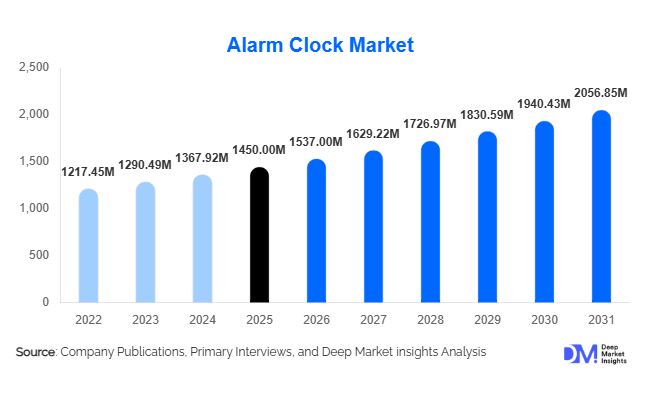
According to Deep Market Insights, the global alarm clock market size was valued at USD 1,450 million in 2025 and is projected to grow from USD 1,537.00 million in 2026 to reach USD 2,050 million by 2031, expanding at a CAGR of 6.0% during the forecast period (2026–2031). The alarm clock market growth is primarily driven by increasing consumer awareness of sleep health, rising adoption of smart home devices, and the growing demand for multifunctional and wellness-oriented bedside electronics.
Key Market Insights
- Smart alarm clocks are gaining strong traction, driven by integration with voice assistants, IoT ecosystems, and personalized wake-up features.
- Digital alarm clocks dominate global demand, accounting for over 40% of total market share due to affordability and ease of use.
- Asia-Pacific leads the global market, supported by strong manufacturing capabilities and rising consumer demand.
- Online retail channels are expanding rapidly, contributing nearly half of global sales due to convenience and product variety.
- Mid-range alarm clocks remain the largest segment, balancing affordability with enhanced features such as Bluetooth and USB charging.
- Wellness-focused devices, including sunrise simulation clocks, are reshaping product innovation and premiumization trends.
What are the latest trends in the alarm clock market?
Rise of Wellness-Oriented Alarm Clocks
Consumers are increasingly prioritizing sleep quality, driving demand for alarm clocks designed to improve wake-up experiences. Products featuring sunrise simulation, natural soundscapes, and circadian rhythm alignment are gaining popularity, particularly in developed markets. These devices are positioned as wellness tools rather than simple timekeeping products, allowing manufacturers to command premium pricing. The integration of light therapy and gradual wake-up technology is also expanding adoption among users seeking stress-free morning routines. As awareness of sleep disorders grows, this trend is expected to accelerate, creating opportunities for innovation in health-focused alarm clock solutions.
Integration with Smart Home Ecosystems
Alarm clocks are increasingly becoming part of the broader smart home ecosystem. Devices integrated with voice assistants and connected home systems allow users to control lighting, temperature, and other devices through a centralized interface. This trend enhances convenience and positions alarm clocks as multifunctional hubs rather than standalone products. Compatibility with major smart platforms is becoming a key differentiator, particularly in premium segments. Additionally, features such as wireless charging, Bluetooth connectivity, and app-based controls are becoming standard, further driving the adoption of smart alarm clocks globally.
What are the key drivers in the alarm clock market?
Growing Awareness of Sleep Health
The increasing focus on mental health and well-being is driving demand for products that enhance sleep quality. Alarm clocks with gentle wake-up features, sleep tracking capabilities, and customizable alarms are gaining traction among health-conscious consumers. This trend is particularly strong in North America and Europe, where consumers are willing to invest in wellness-oriented devices. The rise of remote work and flexible schedules has also contributed to the demand for better sleep management tools, further supporting market growth.
Technological Advancements and Smart Integration
Rapid advancements in IoT and consumer electronics are transforming alarm clocks into multifunctional devices. Features such as voice control, wireless charging, and smartphone connectivity are enhancing user experience and driving adoption. Manufacturers are increasingly focusing on innovation to differentiate their products and capture higher market share. The integration of AI-based personalization and smart home compatibility is expected to remain a key growth driver in the coming years.
What are the restraints for the global market?
Smartphone Substitution
The widespread use of smartphones as alarm devices remains a significant challenge for the alarm clock market. Smartphones offer multifunctionality, reducing the need for standalone devices, particularly in the low-cost segment. This trend has led to declining demand for basic alarm clocks and increased competition for manufacturers.
Price Sensitivity in Emerging Markets
While demand is growing in developing regions, price sensitivity remains a major restraint. Consumers in these markets often prioritize affordability over advanced features, limiting the adoption of premium and smart alarm clocks. Manufacturers must balance cost and innovation to remain competitive in these regions.
What are the key opportunities in the alarm clock industry?
Expansion in Emerging Markets
Rapid urbanization and rising disposable incomes in regions such as Asia-Pacific, Latin America, and Africa present significant growth opportunities. Increasing e-commerce penetration and improved retail infrastructure are making alarm clocks more accessible to a broader consumer base. Companies that focus on localized pricing and product customization can effectively capture demand in these regions.
Integration with Health and Wellness Technologies
The convergence of consumer electronics and health technology offers a major opportunity for market players. Alarm clocks equipped with biometric sensors, sleep tracking, and AI-driven insights can cater to the growing demand for personalized wellness solutions. This trend is expected to drive premiumization and open new revenue streams for manufacturers.
Report Scope
| Report Metric | Details |
|---|---|
| Market Size in 2025 | USD 1450 Million |
| Market Size in 2026 | USD 1537.00 Million |
| Market Size in 2031 | USD 2056.85 Million |
| CAGR | 6% (2026-2031) |
| Base Year for Estimation | 2025 |
| Historical Data | 2022-2024 |
| Forecast Period | 2026-2031 |
| Report Coverage | Revenue Forecast, Competitive Landscape, Supply Chain Disruption, Growth Factors, Environment & Regulatory Landscape and Trends |
| Geographies Covered | North America, Europe, APAC, Middle East and Africa, LATAM |
| Countries Covered | U.S., Canada, U.K., Germany, France, Spain, Italy, Russia, Nordic, Benelux, Rest of Europe, China, Korea, Japan, India, Australia, Singapore, Taiwan, South East Asia, Rest of Asia-Pacific, UAE, Turky, Saudi Arabia, South Africa, Egypt, Nigeria, Rest of MEA, Brazil, Mexico, Argentina, Chile, Colombia, Rest of LATAM |
Explore more data points, trends and opportunities Download Free Sample Report
Product Type Insights
Digital alarm clocks continue to dominate the global alarm clock market, accounting for approximately 42% of the total market share in 2025. This leadership is primarily driven by their affordability, ease of use, and mass-market accessibility across both developed and emerging economies. The widespread availability of LED/LCD-based models, coupled with consistent performance and low maintenance requirements, has made digital alarm clocks the preferred choice for households and institutional buyers alike. Additionally, their compatibility with battery and electric power sources enhances reliability, especially in regions with inconsistent electricity supply.
Smart alarm clocks represent the fastest-growing segment, supported by the rapid expansion of smart home ecosystems and increasing consumer inclination toward connected living. Integration with voice assistants, IoT platforms, and mobile applications allows these devices to function as centralized bedside hubs, offering features such as wireless charging, personalized wake-up routines, and environmental controls. This segment is witnessing strong growth in North America and Europe, where consumers are more receptive to premium and technologically advanced products. Analog alarm clocks, although declining in market share, continue to maintain steady demand among niche consumer groups that value simplicity, durability, and aesthetic appeal. These products are particularly popular in regions with lower technology penetration or among older demographics. Meanwhile, multi-functional alarm clocks, including radio-enabled and charging-integrated devices, are gaining traction due to their enhanced value proposition, catering to consumers seeking convenience and space optimization.
Application Insights
The residential segment dominates the alarm clock market, contributing nearly 65% of total demand in 2025. This dominance is driven by increasing consumer focus on productivity, time management, and sleep quality. The growing awareness of circadian rhythm alignment and the need for distraction-free wake-up solutions, especially as alternatives to smartphones, are key factors supporting demand in this segment. The rise of remote work and flexible schedules has further reinforced the importance of dedicated alarm devices in households. The hospitality sector is one of the fastest-growing end-use segments, fueled by global tourism recovery and hotel modernization initiatives. Hotels are increasingly investing in aesthetically designed and feature-rich alarm clocks that enhance guest experience while aligning with brand identity. The demand for USB charging ports, Bluetooth connectivity, and user-friendly interfaces is particularly high in this segment.
Healthcare applications are also emerging as a significant growth area, especially in elderly care facilities and hospitals. Alarm clocks designed for simplicity, large displays, and easy operability are essential in these environments. Additionally, industrial and institutional applications, including offices, factories, and educational institutions, provide a steady baseline demand for durable and reliable timekeeping devices, ensuring consistent market stability.
Distribution Channel Insights
Online retail channels lead the global alarm clock market, accounting for approximately 48% of total sales in 2025. The rapid growth of e-commerce platforms, coupled with increasing internet penetration and smartphone usage, has significantly influenced purchasing behavior. Consumers benefit from a wide range of product options, competitive pricing, customer reviews, and convenient delivery services, making online channels the preferred choice, particularly for mid-range and premium products. Offline channels, including supermarkets, hypermarkets, and specialty electronics stores, continue to play a crucial role, especially in emerging markets where physical retail infrastructure remains dominant. These channels provide consumers with the opportunity to physically evaluate products before purchase, which is particularly important for first-time buyers.
Direct-to-consumer (D2C) channels are also gaining momentum, as manufacturers increasingly leverage their own websites and digital platforms to engage customers directly. This approach not only enhances brand loyalty but also improves profit margins by eliminating intermediaries. Subscription-based and bundled product offerings are also emerging as innovative distribution strategies.
Price Range Insights
Mid-range alarm clocks (priced between USD 15–50) dominate the market, holding approximately 50% of the total share in 2025. This segment benefits from a strong value proposition, offering a balance between affordability and enhanced functionality, including features such as Bluetooth connectivity, USB charging, and improved display quality. The broad appeal of mid-range products makes them the preferred choice for a wide demographic, particularly in urban households.
Premium alarm clocks are witnessing increasing demand, driven by the growing adoption of smart technologies and wellness-focused features. Products in this category often include advanced functionalities such as voice control, app integration, and sunrise simulation, enabling manufacturers to achieve higher profit margins. This segment is particularly strong in developed markets where consumers prioritize convenience and innovation. Low-cost alarm clocks continue to cater to price-sensitive consumers, particularly in developing regions. While this segment faces competition from smartphones, it remains relevant due to its affordability and simplicity, especially in rural and semi-urban areas.
Explore more data points, trends and opportunities Download Free Sample Report
Alarm Clock Market Segmentations
By Product Type
- Analog Alarm Clocks
- Digital Alarm Clocks
- Smart Alarm Clocks
- Multi-functional Alarm Clocks
By Application
- Residential/Household
- Hospitality
- Healthcare
- Industrial & Institutional
By Distribution Channel
- Online Retail
- Supermarkets & Hypermarkets
- Specialty Electronics Stores
- Department Stores
- Direct-to-Consumer (Brand Websites)
By Price Range
- Low (Below USD 15)
- Mid-Range (USD 15–50)
- Premium (Above USD 50)
Regional Insights
North America
North America accounts for approximately 30% of the global alarm clock market in 2025, making it one of the most significant regional markets. The United States leads demand, driven by high consumer awareness of sleep health, strong adoption of smart home ecosystems, and a preference for premium and multifunctional devices. The presence of leading technology companies and rapid innovation in IoT-enabled consumer electronics further accelerates market growth. Additionally, increasing demand for wellness-oriented products, including sunrise alarm clocks and sleep-enhancing devices, is a key regional driver. Canada complements this growth with steady adoption patterns, supported by similar consumer behavior and high disposable incomes.
Europe
Europe holds approximately 22% of the global market share in 2025, with major contributions from Germany, the United Kingdom, and France. The region’s growth is driven by a strong emphasis on product design, sustainability, and energy efficiency. European consumers are increasingly inclined toward premium and aesthetically appealing alarm clocks, particularly those incorporating eco-friendly materials and energy-saving features. The rising focus on health and well-being is also driving demand for wellness-oriented devices. Additionally, stringent regulatory standards related to electronic safety and energy consumption are encouraging manufacturers to innovate and differentiate their offerings.
Asia-Pacific
Asia-Pacific is the largest regional market, accounting for approximately 35% of global demand in 2025, and is also the fastest-growing region with a CAGR exceeding 7%. China dominates both production and consumption due to its strong manufacturing base, cost advantages, and large domestic market. India and Southeast Asian countries are emerging as high-growth markets, driven by rapid urbanization, rising disposable incomes, and increasing penetration of e-commerce platforms. The expanding middle-class population and growing awareness of modern lifestyle products are key drivers in the region. Furthermore, government initiatives supporting electronics manufacturing and exports are strengthening regional supply chains and boosting market growth.
Latin America
Latin America demonstrates moderate growth, with Brazil and Mexico leading regional demand. Market expansion is driven by improving retail infrastructure, increasing urbanization, and rising consumer awareness of affordable consumer electronics. The growing penetration of online retail platforms is also enhancing product accessibility. Additionally, a young and expanding population is contributing to demand for budget and mid-range alarm clocks. However, economic volatility and price sensitivity remain key challenges in the region.
Middle East & Africa
The Middle East and Africa region is experiencing gradual growth, supported by the expansion of the hospitality and tourism sectors, particularly in countries such as the UAE and Saudi Arabia. Increasing investments in hotels and infrastructure development are driving demand for modern alarm clocks in commercial applications. Rising urbanization, improving living standards, and growing disposable incomes are also contributing to market growth. In Africa, demand is primarily driven by affordable and durable products, with gradual adoption of digital and smart devices as economic conditions improve. The region presents long-term growth potential, especially as retail and distribution networks continue to develop.
Key Players in the Alarm Clock Market
- Sony Corporation
- Philips Electronics
- Panasonic Corporation
- Amazon
- Braun GmbH
- Seiko Holdings Corporation
- Casio Computer Co., Ltd.
- La Crosse Technology
- Emerson Radio Corp.
- iHome (SDI Technologies)
- JBL (Harman International)
- Xiaomi Corporation
- Sharp Corporation
- Lenovo Group