Agro Rural Tourism Market Size
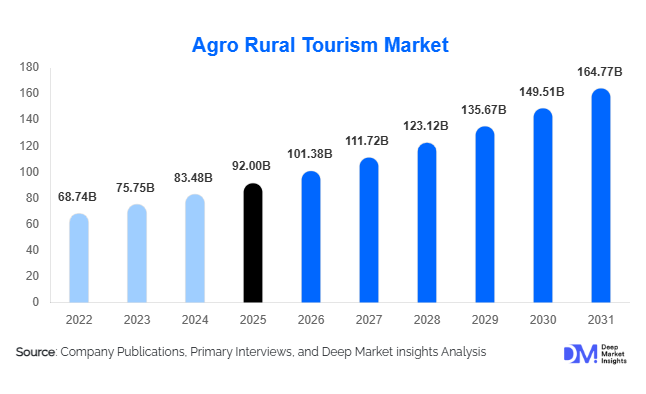
According to Deep Market Insights, the global agro-rural tourism market size was valued at USD 92.0 billion in 2025 and is projected to grow from USD 101.38 billion in 2026 to reach USD 164.77 billion by 2031, expanding at a CAGR of 10.2% during the forecast period (2026–2031). The agro-rural tourism market growth is primarily driven by rising demand for sustainable and experiential travel, increasing diversification of farmer income streams, and strong government support for rural tourism infrastructure. As urban populations seek authentic, nature-based experiences, agro tourism is gaining traction as a mainstream travel segment across both developed and emerging economies.
Key Market Insights
- Agro-rural tourism is rapidly transitioning into a mainstream travel segment, driven by sustainability trends and experiential travel demand.
- Farm stays and immersive agricultural experiences dominate offerings, accounting for a significant share of global bookings.
- Asia-Pacific leads the market, supported by large rural landscapes and strong government initiatives.
- Domestic tourism contributes the majority of demand, particularly from urban populations seeking short rural getaways.
- Digital platforms and OTAs are transforming accessibility, enabling rural operators to reach global audiences.
- Millennials and mid-income travelers are the primary growth drivers, favoring eco-friendly and culturally immersive travel.
What are the latest trends in the agro-rural tourism market?
Shift Toward Sustainable and Regenerative Tourism
Agro-rural tourism is increasingly aligned with sustainability and regenerative tourism practices. Travelers are actively seeking eco-friendly accommodations, organic food experiences, and low-impact travel options. Farm stays are incorporating renewable energy, waste reduction practices, and water conservation systems. Additionally, regenerative agriculture practices such as permaculture and biodiversity conservation are being integrated into tourism experiences. This trend is attracting environmentally conscious travelers while also enhancing the long-term sustainability of rural ecosystems and farming communities.
Digitalization and Platform-Based Booking Growth
The rapid adoption of digital platforms is reshaping the agro-rural tourism landscape. Online travel agencies and niche agro-tourism platforms are enabling seamless discovery and booking of rural experiences. Technologies such as AI-driven recommendations, virtual farm tours, and real-time availability tracking are improving customer engagement. Social media and influencer marketing are further amplifying visibility, particularly among younger travelers. This digital transformation is bridging the gap between fragmented rural operators and global demand, significantly expanding market reach.
What are the key drivers in the agro-rural tourism market?
Rising Demand for Experiential Travel
Modern travelers are prioritizing experiences over traditional sightseeing, driving demand for immersive activities such as farming, cooking, and cultural participation. Agro rural tourism offers unique, hands-on engagement that aligns with these evolving preferences, particularly among millennials and urban populations.
Income Diversification for Farmers
Agro tourism provides farmers with an additional revenue stream, reducing dependence on volatile agricultural income. Governments and development organizations are promoting agro tourism as a tool for rural economic development, encouraging widespread adoption.
Expansion of Rural Infrastructure and Connectivity
Improved road networks, digital connectivity, and tourism infrastructure are enabling easier access to rural destinations. Enhanced connectivity allows operators to market their offerings globally and manage bookings efficiently, supporting market growth.
What are the restraints for the global market?
Inconsistent Infrastructure and Service Quality
Many rural destinations lack standardized infrastructure, including quality accommodations, sanitation, and transportation facilities. This inconsistency can negatively impact visitor experiences and limit repeat tourism, particularly among international travelers.
Limited Awareness and Marketing Capabilities
Agro-rural tourism remains under-promoted compared to mainstream tourism segments. Small-scale operators often lack marketing expertise and resources, restricting their ability to attract a broader customer base and fully utilize capacity.
What are the key opportunities in the agro-rural tourism industry?
Government-Led Rural Tourism Development
Governments across regions are investing in rural tourism as part of economic development strategies. Subsidies, infrastructure development, and policy support are creating favorable conditions for market expansion. Public-private partnerships are further enabling large-scale agro tourism projects.
Technology Integration and Smart Tourism
The integration of digital tools such as AI, IoT, and augmented reality presents significant opportunities. Smart farming demonstrations, interactive tours, and personalized travel planning can enhance visitor experiences and differentiate offerings in a competitive market.
Growing International Demand for Authentic Experiences
International tourists are increasingly seeking authentic cultural and agricultural experiences. Emerging markets in Asia-Pacific and Latin America offer diverse agricultural landscapes and traditions, positioning them as attractive destinations for global travelers.
Report Scope
| Report Metric | Details |
|---|---|
| Market Size in 2025 | USD 92.0 Billion |
| Market Size in 2026 | USD 101.38 Billion |
| Market Size in 2031 | USD 164.77 Billion |
| CAGR | 10.2% (2026-2031) |
| Base Year for Estimation | 2025 |
| Historical Data | 2022-2024 |
| Forecast Period | 2026-2031 |
| Report Coverage | Revenue Forecast, Competitive Landscape, Supply Chain Disruption, Growth Factors, Environment & Regulatory Landscape and Trends |
| Geographies Covered | North America, Europe, APAC, Middle East and Africa, LATAM |
| Countries Covered | U.S., Canada, U.K., Germany, France, Spain, Italy, Russia, Nordic, Benelux, Rest of Europe, China, Korea, Japan, India, Australia, Singapore, Taiwan, South East Asia, Rest of Asia-Pacific, UAE, Turky, Saudi Arabia, South Africa, Egypt, Nigeria, Rest of MEA, Brazil, Mexico, Argentina, Chile, Colombia, Rest of LATAM |
Explore more data points, trends and opportunities Download Free Sample Report
Product Type Insights
Farm-based tourism continues to dominate the agro-rural tourism market, accounting for approximately 32% of the global share in 2025. This segment’s leadership is driven primarily by its direct connection to agricultural activities, offering hands-on experiences such as harvesting, livestock care, organic farming, and interactive workshops that appeal to both domestic and international tourists seeking authenticity. Cultural and heritage tourism is gaining momentum as well, fueled by growing interest in traditional lifestyles, crafts, and rural festivals, particularly in Europe and the Asia-Pacific, where heritage preservation is a key driver. Culinary tourism, including farm-to-table experiences, is emerging as a high-value segment, attracting food-focused travelers who are increasingly seeking organic and locally sourced dining experiences. Adventure and experiential rural tourism, encompassing activities such as trekking, cycling, and agritainment programs, is growing among younger demographics and urban travelers who prioritize active and immersive engagement with nature. Across all product types, sustainability, authenticity, and experiential learning are the principal drivers that make these offerings appealing in global markets.
Accommodation Insights
Farm stays lead the accommodation segment with nearly 38% market share, reflecting their immersive, cost-effective, and authentic rural experiences. Homestays and eco-lodges are gaining traction, offering personalized experiences and environmentally sustainable living, which appeals to the eco-conscious traveler. Rural resorts cater primarily to premium travelers, combining comfort and modern amenities with a connection to rural surroundings. Community-based lodging models are emerging as a sustainable alternative, promoting local participation, equitable revenue distribution, and cultural engagement. The segment’s growth is further supported by government programs providing infrastructure support, rural development subsidies, and incentives for private investment in eco-accommodations, particularly in the Asia-Pacific and Europe.
Distribution Channel Insights
Online travel agencies dominate the booking landscape, accounting for around 35% of total bookings. These platforms provide convenience, transparency, and access to traveler reviews, making them the preferred choice for both domestic and international visitors. Direct bookings through farm owners and cooperatives remain significant, especially for local tourists who seek personalized experiences and lower costs. Government tourism boards and specialized agro-tourism platforms are increasingly promoting rural destinations, providing quality certifications, and standardizing offerings to enhance traveler confidence. The expansion of digital marketing, mobile booking apps, and social media promotions continues to drive accessibility and visibility across global markets.
Traveler Type Insights
Domestic tourists represent the largest segment, contributing approximately 62% of total demand. Urban populations are increasingly opting for short rural getaways, drawn by proximity, affordability, and immersive experiences such as hands-on farming and cultural activities. International tourists, while smaller in share, generate higher revenue per trip and are key drivers for premium offerings. Europe and North America, in particular, have strong international demand due to high disposable incomes and growing interest in sustainable and eco-friendly travel. This dual domestic-international demand mix supports both volume and premium revenue growth globally.
Age Group Insights
Millennials dominate the market with around 40% share, driven by their preference for experiential, eco-conscious, and adventure-oriented travel. Families are another significant segment, seeking educational and recreational experiences for children, including farm-based learning and cultural immersion. Senior travelers contribute to growth in wellness-oriented rural tourism, focusing on relaxed and health-friendly experiences. Educational groups, including schools and universities, are emerging as a niche but rapidly growing segment, particularly in Asia-Pacific and Europe, where experiential learning programs integrate agro tourism into the curriculum and study tours.
Explore more data points, trends and opportunities Download Free Sample Report
Agro Rural Tourism Market Segmentations
By Product Type
- Farm-Based Tourism
- Cultural & Heritage Tourism
- Culinary / Farm-to-Table Tourism
- Adventure & Experiential Rural Tourism
By Accommodation Type
- Farm Stays
- Homestays & Eco-Lodges
- Rural Resorts
- Community-Based Lodging Models
By Distribution Channel
- Online Travel Agencies (OTAs)
- Direct Bookings via Farm Owners / Cooperatives
- Government Tourism Boards
- Specialized Agro-Tourism Platforms
By Traveler Type
- Domestic Tourists
- International Tourists
- Educational Groups
By Age Group
- Millennials
- Families
- Senior Travelers
Regional Insights
Asia-Pacific
Asia-Pacific leads the agro-rural tourism market with approximately 38% share in 2025. Countries such as India, China, Japan, and Thailand are driving growth due to their vast agricultural landscapes, diverse rural cultures, and strong government initiatives supporting rural tourism infrastructure and digital promotion. India alone contributes nearly 12% of the global market, driven by national campaigns promoting rural livelihoods, farm stays, and domestic travel. Rising middle-class income, urbanization, and increasing awareness of sustainable travel are key drivers of regional growth. Additionally, government incentives for private investment in eco-lodges and agritainment experiences further strengthen the region’s market expansion, making Asia-Pacific the fastest-growing market with a CAGR exceeding 11%.
Europe
Europe holds around 30% market share, led by Italy, France, and Spain. Italy alone accounts for approximately 8% of global demand, supported by well-established agro tourism infrastructure, heritage preservation programs, and a strong influx of international tourists seeking authentic rural experiences. Drivers of growth in Europe include strong interest in sustainable and heritage-based tourism, cultural festivals, organic culinary experiences, and government-led rural development programs that promote eco-lodges and farm-based tourism. The availability of short-haul domestic travel within Europe also supports frequent weekend getaways to rural destinations.
North America
North America accounts for nearly 18% of the market, with the United States and Canada leading demand. The growth drivers include high disposable incomes, awareness of eco-tourism, and a strong preference for organic and farm-to-table experiences. The region is witnessing increasing adoption of farm stays and experiential rural tourism by urban populations seeking wellness, relaxation, and hands-on learning. Digital platforms and strong marketing outreach by rural tourism boards further boost accessibility and growth in North America.
Latin America
Latin America is an emerging market, with Brazil, Mexico, and Argentina investing in rural tourism infrastructure and promoting biodiversity-rich destinations. Drivers include rising domestic travel demand, international interest in eco-adventures, and government-led rural development programs. Cultural richness, unique wildlife, and agro-based experiences are attracting international tourists, while domestic tourists are increasingly exploring short rural getaways. Private investments in eco-lodges, community-based stays, and culinary tourism are further strengthening the market.
Middle East & Africa
The Middle East and Africa region accounts for approximately 8% of the global market. South Africa leads in Africa due to its biodiversity, established eco-lodges, and active promotion of farm-based and rural tourism. In the Middle East, the UAE and Saudi Arabia are driving demand through diversification strategies that promote domestic and regional tourism. Key growth drivers include government-led tourism initiatives, high disposable income levels, increasing interest in wellness and luxury rural stays, and infrastructure investments that enhance connectivity to rural areas. Regional growth is also supported by cross-border tourism, with travelers from neighboring countries seeking eco-friendly and culturally immersive experiences.
Key Players in the Agro Rural Tourism Market
- Booking Holdings
- Airbnb Inc.
- Expedia Group
- Agritourism World
- Farm Stay UK
- Agriturismo Italia
- WWOOF Global
- Responsible Travel
- Harvest Hosts
- Rural Tourism International
- Eco Retreats
- Agri Tourism Development Corporation (India)
- Farm Stay USA
- StayBnb Rural
- Green Tortoise Hostel Network