3D Printed Shoes Market Size
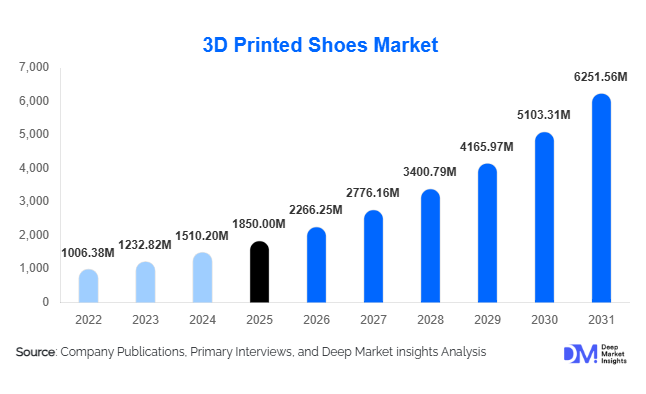
According to Deep Market Insights, the global 3D printed shoes market size was valued at USD 1,850 million in 2025 and is projected to grow from USD 2,266.25 million in 2026 to reach USD 6,251.56 million by 2031, expanding at a CAGR of 22.5% during the forecast period (2026–2031). The market growth is primarily driven by increasing demand for customized footwear, advancements in additive manufacturing technologies, and a rising focus on sustainable production methods. Leading footwear brands are leveraging 3D printing to develop performance-oriented and ergonomically optimized shoes, while reducing material waste and enabling localized production. The convergence of digital design, AI-based customization, and innovative materials is accelerating adoption across sports, lifestyle, and medical applications, positioning 3D printed shoes as a transformative segment within the global footwear industry.
Key Market Insights
- Customization and personalization are key growth drivers, with consumers increasingly demanding footwear tailored to individual foot structure and preferences.
- Sports and performance footwear dominate the market, accounting for nearly 50% of total demand due to enhanced comfort and athletic performance.
- North America leads the global market, supported by strong technological adoption and the presence of major footwear brands.
- Asia-Pacific is the fastest-growing region, driven by expanding manufacturing capabilities and rising consumer demand.
- Sustainability is a major trend, with 3D printing enabling reduced waste and the use of recycled materials.
- Direct-to-consumer (DTC) channels are rapidly expanding, supported by digital customization platforms and online retail growth.
What are the latest trends in the 3D printed shoes market?
Mass Customization and Digital Foot Scanning
The adoption of digital foot scanning and AI-driven design platforms is transforming the footwear industry by enabling mass customization. Consumers can now receive shoes tailored to their exact foot dimensions, improving comfort and performance. Brands are integrating scanning kiosks and mobile-based solutions to collect biomechanical data, which is then used to design customized midsoles and insoles. This trend is particularly prominent in premium athletic and orthopedic segments, where precision fit is critical. The ability to deliver personalized products at scale is redefining consumer expectations and driving competitive differentiation.
Sustainable and On-Demand Manufacturing
Sustainability is emerging as a central theme in the 3D printed shoes market. Additive manufacturing significantly reduces material waste compared to traditional production methods, while enabling the use of recyclable and bio-based materials. On-demand production models are also gaining traction, reducing inventory costs and minimizing overproduction. Brands are increasingly adopting circular economy principles, including recyclable footwear and closed-loop manufacturing systems. This shift is particularly strong in Europe and North America, where regulatory frameworks and consumer preferences favor environmentally responsible products.
What are the key drivers in the 3D printed shoes market?
Rising Demand for Performance-Oriented Footwear
The growing focus on fitness and athletic performance is driving demand for advanced footwear solutions. 3D printed shoes offer superior cushioning, lightweight structures, and enhanced durability through lattice designs that are not achievable with traditional manufacturing. Professional athletes and fitness enthusiasts are increasingly adopting such footwear, boosting market growth.
Advancements in Additive Manufacturing Technologies
Technological innovations such as Selective Laser Sintering (SLS) and Digital Light Synthesis (DLS) have significantly improved production speed, material strength, and design complexity. These advancements have made 3D printing commercially viable for large-scale footwear production, encouraging adoption among major brands.
Shift Toward Sustainable Production
Environmental concerns are pushing manufacturers to adopt sustainable practices. 3D printing reduces waste and energy consumption while enabling localized production, aligning with global sustainability goals. This has become a critical factor influencing purchasing decisions among environmentally conscious consumers.
What are the restraints for the global market?
High Initial Investment Costs
The adoption of 3D printing technology requires significant capital investment in advanced equipment, software, and skilled labor. This creates entry barriers for smaller players and limits widespread adoption in cost-sensitive markets.
Limited Scalability Compared to Traditional Manufacturing
While 3D printing excels in customization, achieving mass production efficiency comparable to conventional manufacturing remains challenging. This can impact cost competitiveness, particularly in high-volume segments such as casual footwear.
What are the key opportunities in the 3D printed shoes industry?
Expansion of Orthopedic and Medical Applications
The medical sector presents significant growth opportunities, particularly in customized orthopedic footwear. Aging populations and increasing prevalence of foot-related disorders are driving demand for personalized solutions, creating a high-margin segment for manufacturers.
Localized Manufacturing and Supply Chain Optimization
3D printing enables decentralized production, allowing manufacturers to establish local production hubs. This reduces logistics costs, shortens delivery times, and enhances responsiveness to market demand. Regions such as North America and Europe are actively promoting reshoring initiatives, further supporting this trend.
Integration with Smart Wearable Technology
The integration of sensors and smart technologies into 3D printed shoes is opening new avenues in performance tracking and healthcare monitoring. Smart footwear capable of analyzing gait, posture, and activity levels is expected to gain traction, particularly among athletes and healthcare providers.
Report Scope
| Report Metric | Details |
|---|---|
| Market Size in 2025 | USD 1850 Million |
| Market Size in 2026 | USD 2266.25 Million |
| Market Size in 2031 | USD 6251.56 Million |
| CAGR | 22.5% (2026-2031) |
| Base Year for Estimation | 2025 |
| Historical Data | 2022-2024 |
| Forecast Period | 2026-2031 |
| Report Coverage | Revenue Forecast, Competitive Landscape, Supply Chain Disruption, Growth Factors, Environment & Regulatory Landscape and Trends |
| Geographies Covered | North America, Europe, APAC, Middle East and Africa, LATAM |
| Countries Covered | U.S., Canada, U.K., Germany, France, Spain, Italy, Russia, Nordic, Benelux, Rest of Europe, China, Korea, Japan, India, Australia, Singapore, Taiwan, South East Asia, Rest of Asia-Pacific, UAE, Turky, Saudi Arabia, South Africa, Egypt, Nigeria, Rest of MEA, Brazil, Mexico, Argentina, Chile, Colombia, Rest of LATAM |
Explore more data points, trends and opportunities Download Free Sample Report
Product Type Insights
Partially 3D printed shoes continue to dominate the global market, accounting for approximately 45% of total market share in 2025. The leadership of this segment is primarily driven by the widespread adoption of 3D printed midsoles, which offer superior cushioning, energy return, and structural optimization through lattice geometries. Major footwear manufacturers are strategically focusing on midsoles as they provide the highest performance differentiation while maintaining cost efficiency compared to fully printed shoes. This hybrid manufacturing approach allows brands to integrate additive manufacturing into existing production lines without completely overhauling traditional processes, making it commercially scalable.
Fully 3D printed shoes, while still niche, are gaining traction in premium and experimental segments, particularly among early adopters and luxury consumers. These products are often positioned as innovation showcases, offering fully customized structures and futuristic aesthetics. Meanwhile, customized orthopedic footwear is emerging as a high-growth sub-segment, supported by rising cases of foot disorders, diabetes-related complications, and increasing demand for medical-grade personalization. Performance athletic footwear remains a key innovation driver across all product types, as brands invest in R&D to enhance athlete performance, reduce injury risks, and deliver biomechanically optimized designs.
Application Insights
Sports and performance footwear remains the largest application segment, contributing nearly 50% of the global market share in 2025. This dominance is driven by the growing global fitness culture, increasing participation in professional and amateur sports, and rising consumer willingness to invest in high-performance footwear. The ability of 3D printing to create customized cushioning systems and lightweight structures gives it a significant competitive advantage in this segment. Additionally, endorsements from professional athletes and collaborations with sports organizations are accelerating adoption.
Casual and lifestyle footwear is witnessing steady growth as consumers increasingly seek unique, design-driven, and personalized products. The influence of fashion trends and social media is encouraging brands to experiment with bold, customizable designs enabled by 3D printing. The medical and orthopedic segment is the fastest-growing application, driven by increasing awareness of foot health, aging populations, and advancements in foot scanning technologies. Industrial and safety footwear is an emerging application area where 3D printing enables ergonomic designs tailored to specific work environments, improving comfort, durability, and worker productivity.
Distribution Channel Insights
Direct-to-consumer (DTC) channels are gaining significant traction, accounting for approximately 30% of the total market share. The growth of this segment is driven by the increasing adoption of digital platforms that allow customers to customize footwear designs, select materials, and place orders online. This model enhances customer engagement, reduces dependency on intermediaries, and improves profit margins for manufacturers. Integration of AI-based recommendation systems and virtual fitting technologies is further strengthening DTC adoption.
Brand retail stores continue to play a crucial role, particularly for premium and high-value products. These stores offer in-person customization services, including foot scanning and personalized consultations, which enhance the customer experience. Specialty stores and third-party retailers continue to play a crucial role in expanding market reach, particularly in developing regions where digital penetration is still in its early stages of development. These channels help bridge the gap between traditional retail and emerging digital models, ensuring broader accessibility of 3D printed footwear.
End-User Insights
The men’s segment holds the largest share of the market, driven by higher participation in sports, fitness activities, and early adoption of performance-oriented footwear technologies. This segment also benefits from strong brand targeting and product availability across athletic and casual categories. The women’s segment is witnessing rapid growth, fueled by increasing demand for customized, stylish, and comfort-focused footwear. Brands are increasingly focusing on women-specific designs, leveraging 3D printing to address fit and aesthetic preferences.
The kids’ segment, although smaller in comparison, is emerging as a niche but promising market, particularly in orthopedic applications. Customized footwear for children with specific medical conditions is gaining importance, supported by growing parental awareness of foot health. Overall, rising awareness regarding comfort, posture, and long-term health benefits is driving demand across all end-user segments, contributing to sustained market expansion.
Explore more data points, trends and opportunities Download Free Sample Report
3D Printed Shoes Market Segmentations
By Product Type
- Fully 3D Printed Shoes
- Partially 3D Printed Shoes
- Customized Orthopedic Footwear
- Performance Athletic Footwear
By Application
- Sports & Performance Footwear
- Casual & Lifestyle Footwear
- Medical & Orthopedic Applications
- Industrial & Safety Footwear
By Distribution Channel
- Direct-to-Consumer (DTC)/Online Platforms
- Brand Retail Stores
- Specialty Stores
- Third-party Retailers
Regional Insights
North America
North America accounts for approximately 35% of the global market share in 2025, with the United States being the primary contributor. The region’s dominance is driven by strong technological infrastructure, early adoption of additive manufacturing, and the presence of leading footwear companies investing heavily in innovation. High consumer awareness regarding customization and premium products further supports demand. Additionally, the growing trend of localized manufacturing and reshoring initiatives is accelerating the adoption of 3D printing technologies. Increasing demand for performance footwear and strong e-commerce penetration are key regional growth drivers.
Europe
Europe holds around 25% of the global market share, led by countries such as Germany, the UK, Italy, and France. The region’s growth is strongly influenced by stringent environmental regulations and a high level of consumer preference for sustainable and eco-friendly products. Government support for circular economy initiatives and sustainable manufacturing practices is encouraging the adoption of 3D printing technologies. Additionally, Europe’s strong fashion industry and emphasis on design innovation are driving demand for customized and premium footwear. The presence of advanced manufacturing hubs further strengthens regional growth.
Asia-Pacific
Asia-Pacific is the fastest-growing region, with a projected CAGR exceeding 25%. China, Japan, South Korea, and India are key markets driving growth. The region benefits from a strong manufacturing base, availability of low-cost labor, and increasing investments in advanced production technologies. Rising disposable incomes, rapid urbanization, and an expanding middle-class population are fueling demand for innovative and customized footwear. In addition, governments in countries like China and India are promoting advanced manufacturing initiatives, which are accelerating the adoption of 3D printing in the footwear industry. The region is also emerging as a major export hub for 3D printed components.
Latin America
Latin America is experiencing moderate growth, with Brazil and Mexico leading regional demand. The market is driven by improving retail infrastructure, growing urban population, and increasing awareness of advanced footwear technologies. Rising participation in sports and fitness activities is also contributing to demand for performance footwear. However, price sensitivity remains a challenge, limiting widespread adoption. Despite this, increasing digital penetration and expansion of e-commerce platforms are expected to support gradual market growth in the region.
Middle East & Africa
The Middle East & Africa region is an emerging market with significant growth potential. Countries such as the UAE, Saudi Arabia, and South Africa are witnessing increasing adoption of innovative footwear technologies. Growth in this region is driven by rising disposable incomes, rapid urbanization, and expanding retail sectors. The Middle East, in particular, is characterized by strong demand for premium and luxury products, which aligns well with the high-value proposition of 3D printed footwear. In Africa, gradual improvements in retail infrastructure and increasing consumer awareness are expected to drive long-term market expansion.