Leading Players in Beauty Supplements Market l Analysis
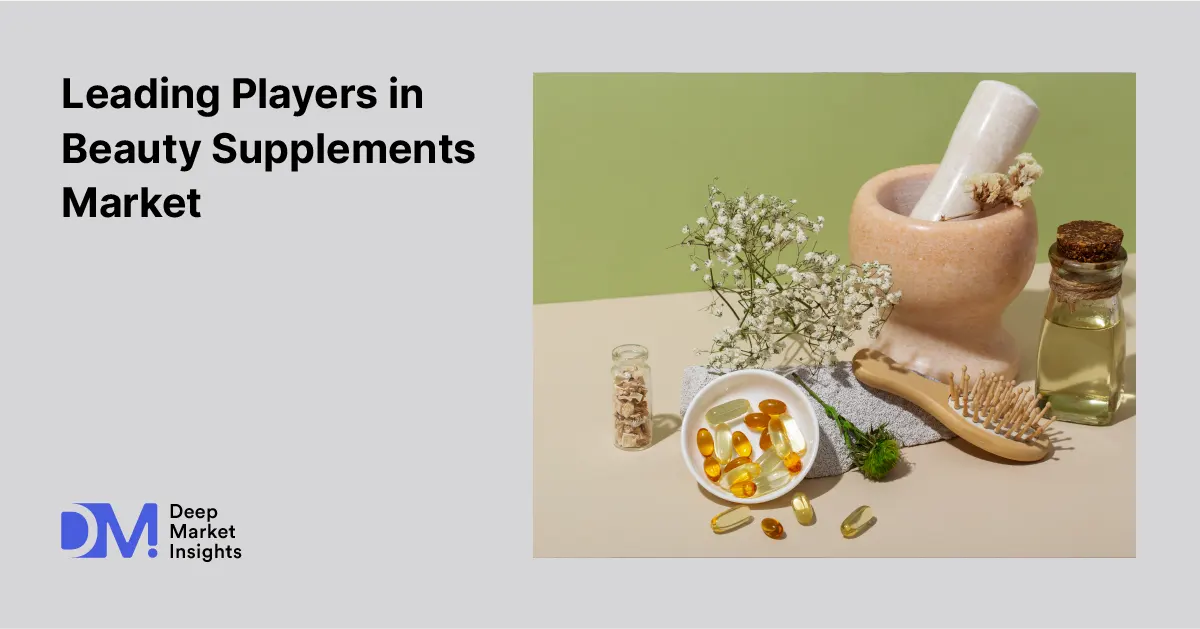
The Leading Players in Beauty Supplements Market are reshaping the global nutraceutical landscape by bridging wellness and aesthetics. Beauty supplements-ranging from collagen powders to biotin capsules-target skin, hair, and nail health through ingestible formats. The market has witnessed strong demand, with global consumption exceeding 3.2 million metric tons annually across formats such as gummies, powders, and capsules. Average product pricing ranges between $15 and $60 per unit, depending on formulation and brand positioning.This segment has gained traction among millennials and aging populations, driving procurement demand across retail, e-commerce, and pharmacy channels. For B2B buyers, understanding supplier capabilities, product portfolios, and pricing benchmarks is critical for strategic sourcing and private-label development.
Leading Players in Beauty Supplements Market Overview with Data
The Leading Players in Beauty Supplements Market operate in a highly fragmented yet rapidly consolidating ecosystem. North America holds approximately 35% market share, followed by Europe at 28%, and Asia-Pacific contributing nearly 30% of total consumption volume.Production capacity across major manufacturers exceeds 500,000 metric tons annually, driven by contract manufacturing and vertically integrated supply chains. Collagen-based supplements account for nearly 40% of total product demand, followed by vitamins and botanical blends.
From a pricing perspective:
-
Mass-market supplements: $15-$25 per unit
-
Premium formulations: $30-$60 per unit
-
Private-label bulk procurement: $8-$18 per unit (wholesale)
E-commerce contributes over 55% of total sales volume, while pharmacy chains and specialty stores account for the remaining distribution. Increasing demand for clean-label and plant-based formulations is influencing procurement strategies globally.
Leading Players in Beauty Supplements Market
Nestlé Health Science

Nestlé Health Science is a dominant force in the beauty supplements sector, leveraging its global nutrition expertise and extensive distribution network. The company generates over $6 billion in annual revenue from its health science division, with a growing share attributed to ingestible beauty products.Its portfolio includes collagen peptides, skin hydration supplements, and vitamin-enriched formulations under premium brands. Nestlé focuses heavily on clinical validation and product efficacy, which strengthens its positioning in pharmaceutical and wellness retail channels.The company operates manufacturing facilities across 20+ countries, enabling high-volume production and consistent supply. Its strategy centers on acquisitions and partnerships, allowing rapid expansion into emerging markets and premium segments. For procurement professionals, Nestlé offers reliability, scalability, and strong regulatory compliance.
Amway Corporation

Amway is a key player in direct-selling beauty supplements, with annual revenues exceeding $8 billion, a significant portion derived from its nutrition and beauty categories. The company’s Nutrilite brand includes supplements targeting skin health, anti-aging, and hair strength.Amway’s vertically integrated supply chain spans farming, ingredient sourcing, and manufacturing, ensuring quality control across 60+ global markets. Its production facilities handle large-scale volumes, supporting both consumer demand and distributor networks.The company positions itself in the premium segment, with products priced between $25 and $50 per unit. Its strategy focuses on personalized nutrition and direct consumer engagement, making it a strong partner for markets with high demand for customized supplement solutions.
Herbalife Nutrition Ltd.

Herbalife Nutrition operates globally with revenues around $5 billion, offering a diversified portfolio that includes beauty-enhancing supplements. The company integrates beauty benefits into its core nutrition products, targeting skin health and anti-aging.Herbalife’s manufacturing capacity exceeds 200,000 metric tons annually, supported by in-house production and third-party partnerships. Its global presence spans over 90 countries, enabling widespread distribution and brand recognition.The company’s pricing strategy falls within the mid-to-premium range, typically $20-$45 per unit, making it competitive across multiple markets. Herbalife emphasizes science-backed formulations and distributor-driven sales, providing scalability for high-volume procurement and regional expansion.
Otsuka Holdings Co., Ltd.

Otsuka Holdings is a Japan-based multinational with strong capabilities in nutraceuticals and functional foods. The company reports revenues exceeding $13 billion, with a growing segment dedicated to health and beauty supplements.Its product portfolio includes collagen drinks, amino acid supplements, and skin-health formulations tailored to Asian consumer preferences. Otsuka’s production infrastructure supports high-quality liquid and capsule formats, with facilities across Asia and North America.The company commands a strong presence in Asia-Pacific, which accounts for nearly 30% of global beauty supplement consumption. Its strategy focuses on innovation and localized product development, making it a preferred supplier for region-specific formulations and premium product lines.
HUM Nutrition Inc.

HUM Nutrition is a fast-growing player specializing in targeted beauty supplements. The company operates primarily in North America and Europe, with estimated revenues in the $100-$200 million range.Its product portfolio includes clinically formulated supplements for skin clarity, anti-aging, and hair growth, often combining vitamins, minerals, and botanical extracts. HUM positions itself in the premium segment, with pricing typically between $25 and $60 per unit.The brand emphasizes transparency, clean-label ingredients, and personalized nutrition through digital platforms. Its direct-to-consumer model contributes to strong margins and customer engagement. For B2B buyers, HUM represents a high-value partner for premium and niche product segments.
Nature’s Bounty (Nestlé-owned)
Nature’s Bounty is a well-established supplement brand with strong retail penetration and a diverse product portfolio. As part of Nestlé Health Science, it benefits from global distribution and advanced manufacturing capabilities.The company produces large volumes of vitamins, biotin supplements, and collagen products, contributing to its estimated annual revenues of over $1 billion. Its manufacturing network supports high-output production, ensuring consistent supply for large-scale procurement.Nature’s Bounty targets the mass and mid-tier segments, with pricing typically ranging from $10 to $30 per unit. Its strategy focuses on accessibility, brand trust, and retail expansion, making it a reliable partner for bulk sourcing and private-label collaborations.
Competitive Landscape Insights
The Leading Players in Beauty Supplements Market exhibit a moderately fragmented structure, with the top five companies accounting for approximately 45%-50% of total market share. Mid-sized and niche brands collectively contribute the remaining share, driving innovation and product differentiation.
Pricing segmentation is clearly defined:
-
Entry-level products: Below $20 (35% market share)
-
Mid-range products: $20-$40 (40% share)
-
Premium products: Above $40 (25% share)
Supply chains are increasingly integrated, with leading players investing in raw material sourcing, contract manufacturing, and digital distribution. Collagen and botanical ingredients dominate procurement volumes, with bulk ingredient costs ranging between $8 and $25 per kilogram.E-commerce-driven demand has shortened supply cycles, requiring manufacturers to maintain flexible production capacities and efficient logistics networks. Private-label manufacturingaccounts for nearly 20% of total production volume, offering opportunities for retailers and distributors to enter the market.The Leading Players in Beauty Supplements Market are driving growth through innovation, scale, and strategic positioning. Companies such as Nestlé Health Science, Amway, and Otsuka Holdings dominate through strong infrastructure and global reach, while emerging brands like HUM Nutrition focus on premium and personalized offerings.For procurement professionals, the market offers diverse sourcing opportunities across pricing tiers and product categories. Understanding supplier capabilities, production capacity, and regional strengths is essential for building resilient supply chains and capturing market demand in this evolving segment.