Protein Hydrolysis Enzymes Market Size
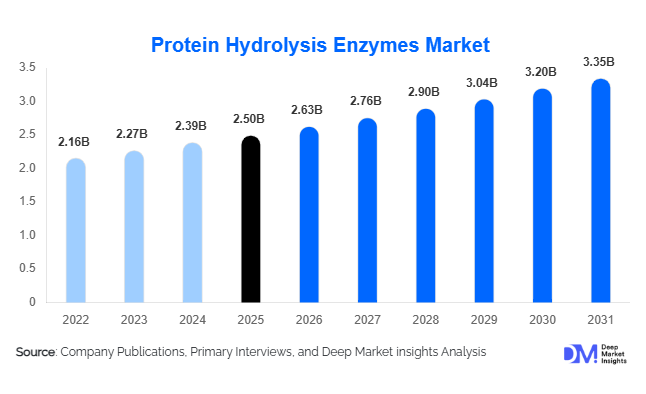
According to Deep Market Insights, the global protein hydrolysis enzymes market size was valued at USD 2.5 billion in 2025 and is projected to grow from USD 2.63 billion in 2026 to reach USD 3.35 billion by 2031, expanding at a CAGR of 5.0% during the forecast period (2026–2031). The market growth is primarily driven by increasing demand for high-quality protein products in food processing, rising adoption of enzymatic solutions in pharmaceuticals and animal nutrition, and technological advancements in enzyme engineering, enabling high-performance and sustainable applications.
Key Market Insights
- Microbial enzymes dominate the market, accounting for around 60% share in 2025, due to cost-effective fermentation production, high catalytic efficiency, and scalability across industrial applications.
- Fermentation-based production methods lead, capturing approximately 65% of market revenue, reflecting broad adoption in food, pharma, and detergent applications.
- Liquid enzyme formulations are preferred, making up 55% of the market, due to ease of dosing and uniform activity in industrial processes.
- Food & beverage applications account for 30% of market revenue, driven by growing demand for protein-rich functional foods, infant nutrition, and sports supplements.
- North America and Europe together represent over 65% of the market, supported by advanced industrial infrastructure and high adoption of enzymatic solutions.
- Asia-Pacific is the fastest-growing region, fueled by increasing industrialization, rising disposable incomes, and government initiatives in biotech and enzyme manufacturing.
What are the latest trends in the protein hydrolysis enzymes market?
Precision Fermentation and Enzyme Engineering
Advances in precision fermentation and enzyme design using AI and metabolic pathway engineering are enabling tailored hydrolysis enzymes for specific applications. These technologies improve enzyme stability, specificity, and yield, while reducing production costs. Companies are leveraging this trend to create application-specific proteases for functional foods, therapeutic peptides, and industrial processes, driving market growth and product differentiation.
Sustainability and Circular Bioeconomy Integration
Protein hydrolysis enzymes are increasingly used in sustainable manufacturing and waste valorization. By converting agro-industrial byproducts, such as brewer’s spent grain or fish waste, into high-value protein hydrolysates, manufacturers reduce environmental impact and create additional revenue streams. Regulatory incentives, particularly in Europe and North America, are encouraging the adoption of environmentally friendly enzymatic solutions, positioning these enzymes as key tools in the circular bioeconomy.
Industrial & Pharmaceutical Applications Expansion
The market is witnessing strong growth from pharmaceutical applications, where hydrolysis enzymes enable the production of bioactive peptides and protein-based therapeutics. Industrial adoption in detergents, textiles, and leather processing continues to expand due to eco-friendly alternatives to chemical catalysts. The growing preference for clean-label, biodegradable solutions is accelerating adoption across multiple sectors.
What are the key drivers in the protein hydrolysis enzymes market?
Increasing Demand in Food Processing & Nutraceuticals
Rising global consumption of protein-rich diets and functional foods is driving the demand for enzymatically hydrolyzed proteins. Enzymatic hydrolysis improves protein digestibility, enhances flavor, and allows for allergen-reduced formulations. Clean-label and health-conscious consumer trends are propelling adoption in dairy, bakery, and sports nutrition sectors worldwide.
Pharmaceutical and Biopharma Integration
Hydrolysis enzymes are essential in producing therapeutic peptides and bioactive compounds, critical for personalized medicine and chronic disease treatments. The growing prevalence of chronic diseases and demand for specialized protein therapeutics are key growth drivers, encouraging pharmaceutical companies to integrate enzymatic solutions in manufacturing pipelines.
Environmental and Industrial Applications
Enzymes are increasingly preferred in detergents, textile processing, and waste treatment due to efficiency and eco-friendliness. Enzymatic detergents reduce chemical load and energy consumption, meeting both regulatory and consumer demands for sustainable solutions, thus driving adoption globally.
What are the restraints for the global market?
Regulatory and Safety Compliance Challenges
Launching new enzyme products requires extensive safety testing and regulatory approval from bodies such as the FDA, EFSA, and CFDA. These compliance requirements increase development costs and timelines, particularly for novel enzyme variants engineered for specific industrial or pharmaceutical applications.
Raw Material and Production Cost Volatility
Fermentation-based enzyme production depends on substrates, growth media, and energy costs, which are subject to fluctuations. Rising input costs can impact profit margins, especially for smaller manufacturers, posing a challenge for market growth.
What are the key opportunities in the protein hydrolysis enzymes market?
Emerging Regional Demand in Asia-Pacific and LATAM
Rapid urbanization, industrial growth, and rising disposable incomes in Asia-Pacific and Latin America are driving enzyme adoption. Governments in China and India support biotech manufacturing and enzyme innovation, creating opportunities for both local and international players to expand market presence.
Sustainable Protein Upcycling and Bioeconomy Integration
Hydrolysis enzymes can convert agro-industrial and fishery byproducts into high-value protein hydrolysates. This approach aligns with circular economy principles and environmental regulations, offering manufacturers opportunities to generate additional revenue streams and enhance sustainability credentials.
Technological Innovation and Customization
Advances in enzyme engineering, AI-assisted design, and precision fermentation allow the creation of highly specific enzymes tailored to industrial needs. Companies investing in these technologies can develop differentiated solutions for functional foods, pharmaceuticals, and industrial applications, gaining a competitive edge in the global market.
Report Scope
| Report Metric | Details |
|---|---|
| Market Size in 2025 | USD 2.5 Billion |
| Market Size in 2026 | USD 2.63 Billion |
| Market Size in 2031 | USD 3.35 Billion |
| CAGR | 5.0% (2026-2031) |
| Base Year for Estimation | 2025 |
| Historical Data | 2022-2024 |
| Forecast Period | 2026-2031 |
| Report Coverage | Revenue Forecast, Competitive Landscape, Supply Chain Disruption, Growth Factors, Environment & Regulatory Landscape and Trends |
| Geographies Covered | North America, Europe, APAC, Middle East and Africa, LATAM |
| Countries Covered | U.S., Canada, U.K., Germany, France, Spain, Italy, Russia, Nordic, Benelux, Rest of Europe, China, Korea, Japan, India, Australia, Singapore, Taiwan, South East Asia, Rest of Asia-Pacific, UAE, Turky, Saudi Arabia, South Africa, Egypt, Nigeria, Rest of MEA, Brazil, Mexico, Argentina, Chile, Colombia, Rest of LATAM |
Explore more data points, trends and opportunities Download Free Sample Report
Product Type Insights
Microbial enzymes dominate the protein hydrolysis enzymes market, accounting for approximately 60% of global revenue in 2025. Their leadership is driven by high production scalability, consistent enzyme activity, cost efficiency, and ease of genetic modification through fermentation technologies. Microbial proteases are extensively used across food processing, detergents, pharmaceuticals, and industrial applications, making them the preferred choice for large-scale commercial deployment. Compared to other sources, microbial enzymes offer superior thermal stability and pH tolerance, which enhances their applicability across diverse processing conditions.
From a production standpoint, fermentation-based enzyme manufacturing accounts for nearly 65% of total market value, driven by its ability to deliver high-purity enzymes at consistent quality while enabling cost optimization at scale. In terms of formulation, liquid enzyme formulations lead with a 55% market share, supported by ease of handling, rapid solubility, and precise dosing in food, detergent, and industrial applications. Powdered enzyme formulations remain critical in pharmaceutical, animal feed, and nutraceutical applications where extended shelf life and formulation flexibility are essential.
Application Insights
The food & beverage segment is the largest application area, accounting for approximately 30% of global market revenue in 2025. Growth in this segment is driven by increasing consumption of functional foods, protein-fortified beverages, infant nutrition products, and sports supplements. Protein hydrolysis enzymes improve digestibility, enhance amino acid availability, reduce allergenicity, and optimize flavor profiles, making them indispensable in modern food formulations. Pharmaceutical and biopharmaceutical applications represent the fastest-growing segment, supported by rising demand for bioactive peptides, therapeutic proteins, and enzyme-assisted drug manufacturing. Protein hydrolysis enzymes are critical in producing peptides with antihypertensive, antimicrobial, and immune-modulating properties, which are increasingly used in precision medicine and chronic disease management.
Detergents, animal feed, and industrial processing applications collectively form a substantial share of the market. In detergents, enzymes enable effective cleaning at lower temperatures, aligning with sustainability and energy-efficiency goals. In animal nutrition, hydrolyzed proteins improve feed conversion ratios and gut health, particularly in aquaculture and poultry feed. Industrial processing applications, including textiles, leather, and waste treatment, are expanding as industries shift away from harsh chemical catalysts toward environmentally friendly enzymatic alternatives.
Distribution Channel Insights
Direct sales to manufacturers dominate the distribution landscape, particularly in food processing, pharmaceuticals, and industrial applications, where enzyme solutions require technical customization, formulation support, and regulatory compliance. Large end users prefer long-term supply agreements with enzyme producers to ensure consistency, traceability, and quality assurance.
Online platforms and B2B digital marketplaces are gaining traction, especially for standardized industrial enzyme products and small-to-mid-scale buyers seeking transparent pricing and faster procurement cycles. However, complex applications continue to rely heavily on direct technical engagement. Strategic partnerships, co-development agreements, and multi-year contracts with major food, pharma, and detergent manufacturers are increasingly common, enabling enzyme suppliers to secure stable demand while offering tailored solutions aligned with customer production requirements.
End-User Insights
Food processing remains the leading end-use segment, accounting for approximately 40% of total market demand. Growth is driven by the global expansion of processed food manufacturing, increasing protein consumption, and rising demand for clean-label and functional ingredients. Protein hydrolysis enzymes play a central role in dairy processing, meat alternatives, infant nutrition, and sports nutrition manufacturing.
Healthcare and therapeutics form the second-largest end-use segment, with strong growth momentum due to expanding pharmaceutical production, biologics manufacturing, and peptide-based drug development. Animal nutrition is another high-growth end-use area, particularly in aquaculture and livestock farming, where enzyme-assisted feeds improve productivity and sustainability. Industrial cleaning, textiles, and leather processing are emerging end-use segments, driven by environmental regulations and cost-efficiency benefits. Export-driven demand is increasing, with enzyme manufacturers in North America and Europe supplying advanced enzyme solutions to fast-growing markets in Asia-Pacific and Latin America, further strengthening global trade flows.
Explore more data points, trends and opportunities Download Free Sample Report
Protein Hydrolysis Enzymes Market Segmentations
By Product Type
- Microbial Enzymes
- Plant-Based Enzymes
- Animal-Based Enzymes
By Production Method
- Fermentation-Based Production
- Extraction-Based Production
By Formulation
- Liquid Enzymes
- Powder Enzymes
- Granular & Encapsulated Enzymes
By Application
- Food & Beverage Processing
- Pharmaceuticals & Biopharmaceuticals
- Animal Feed & Nutrition
- Detergents & Industrial Cleaning
- Textiles & Leather Processing
- Cosmetics & Personal Care
By End-User Industry
- Food Processing & Manufacturing
- Healthcare & Therapeutics
- Animal Nutrition & Aquaculture
- Industrial & Institutional Cleaning
- Textile & Leather Industries
Regional Insights
North America
North America accounted for approximately 35% of the global protein hydrolysis enzymes market in 2025, led primarily by the United States. Regional growth is driven by advanced food processing infrastructure, high adoption of enzyme-based pharmaceutical manufacturing, and strong demand for eco-friendly detergents. High consumer awareness of clean-label foods, coupled with significant investments in biotechnology and precision fermentation, continues to support enzyme adoption. The presence of leading enzyme manufacturers and robust R&D ecosystems further strengthens North America’s market leadership.
Europe
Europe represented around 30% of the global market share in 2025, with Germany, France, and the U.K. as key contributors. Growth in the region is strongly supported by stringent environmental regulations that encourage enzymatic alternatives to chemical processing in detergents, textiles, and leather industries. Europe’s mature food and beverage sector, combined with a strong focus on sustainability, clean-label ingredients, and circular bioeconomy initiatives, continues to drive steady demand for protein hydrolysis enzymes.
Asia-Pacific
Asia-Pacific is the fastest-growing regional market, accounting for approximately 20% share in 2025. Rapid industrialization, expansion of food and beverage manufacturing, and rising pharmaceutical production in China, India, Japan, and Australia are key growth drivers. Government incentives for biotechnology, enzyme manufacturing, and domestic pharma production further accelerate adoption. Additionally, strong growth in animal feed, aquaculture, and functional foods supports sustained demand across the region.
Latin America
Latin America held roughly 10% of the global market, with Brazil and Mexico leading regional demand. Growth is driven by increasing food processing activities, expanding meat and dairy exports, and rising adoption of industrial enzymes in cleaning and textile applications. Export-oriented food manufacturing and gradual modernization of industrial infrastructure are key factors supporting enzyme market expansion in the region.
Middle East & Africa
The Middle East & Africa region accounted for approximately 5% of the global market share. Growth is supported by increasing food processing investments, rising detergent consumption, and expanding pharmaceutical manufacturing capacity. African countries such as South Africa, Kenya, and Nigeria are witnessing growing enzyme adoption in food and animal nutrition, while Middle Eastern economies are increasingly reliant on enzyme imports to support industrial diversification, food security initiatives, and healthcare sector expansion.
Key Players in the Protein Hydrolysis Enzymes Market
- Novozymes A/S
- BASF SE
- DuPont (IFF)
- Royal DSM
- AB Enzymes
- Amano Enzyme Co., Ltd
- Advanced Enzymes Technologies Ltd
- Dyadic International
- Specialty Enzymes & Biotechnologies
- Solvay Enzymes
- Enzyme Development Corporation
- Biocatalysts Ltd
- Kerry Group
- DSM-Firmenich
- Koninklijke DSM N.V.