Pet Educational Toys Market Size
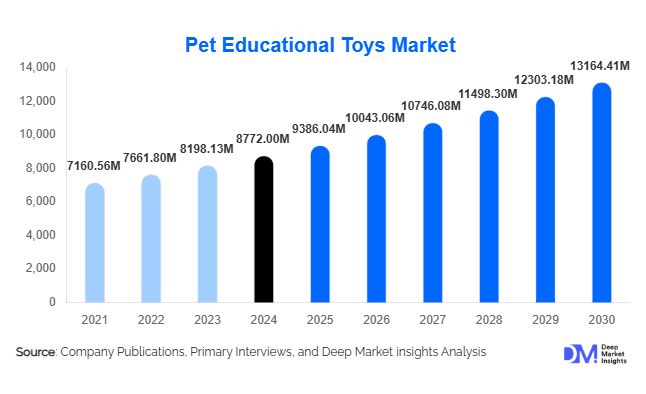
According to Deep Market Insights, the global pet educational toys market size was valued at USD 8,772.00 million in 2025 and is projected to grow from USD 9,386.04 million in 2026 to reach USD 13,164.41 million by 2031, expanding at a CAGR of 7.0% during the forecast period (2026-2031). The market growth is driven by rising pet humanization, increasing awareness of pet mental stimulation and behavioral training, and strong demand for interactive and technology-enabled toys among urban pet owners. Educational toys are increasingly viewed as essential wellness products rather than discretionary accessories, supporting sustained demand globally.
Key Market Insights
- Pet humanization continues to reshape purchasing behavior, with owners prioritizing cognitive development, anxiety reduction, and enrichment-based toys.
- Dogs dominate global demand, accounting for over 60% of total market value due to higher training and engagement requirements.
- Mid-range educational toys (USD 15–40) represent the largest revenue segment, balancing affordability with functionality.
- Online and e-commerce channels lead distribution, driven by subscription models, product variety, and convenience.
- Smart and connected toys are the fastest-growing product category, supported by AI, IoT, and app-based monitoring features.
- Asia-Pacific is the fastest-growing regional market, fueled by rising pet adoption and disposable incomes in China and India.
Pet Educational Toys Market Trends
Smart and Connected Pet Toys Gaining Momentum
The integration of technology into pet educational toys is one of the most prominent trends shaping the market. Smart toys equipped with motion sensors, adaptive learning algorithms, and mobile app connectivity allow pet owners to monitor engagement levels and customize play patterns. These products are particularly popular among tech-savvy millennials and working professionals seeking automated engagement solutions for pets left alone for extended periods. Smart toys currently account for less than one-fifth of total revenue but are expanding at a significantly higher growth rate than traditional toys, driven by premium pricing and repeat purchase potential.
Rising Demand for Sustainable and Non-Toxic Materials
Eco-conscious consumer behavior is influencing material choices across the pet care industry. Pet owners are increasingly seeking educational toys made from recyclable plastics, natural rubber, bamboo fibers, and non-toxic fabrics. Sustainability certifications and transparent sourcing are becoming key differentiators for brands, particularly in North America and Europe. This trend is also supported by tightening regulations on chemical safety and plastic usage, encouraging manufacturers to invest in sustainable product innovation.
Pet Educational Toys Market Drivers
Increasing Pet Humanization and Wellness Awareness
Pets are increasingly treated as family members, leading owners to invest in products that support mental stimulation and emotional well-being. Educational toys are widely recommended to reduce boredom, separation anxiety, and destructive behavior, making them a core component of modern pet care routines. This shift has significantly increased per-pet spending across developed markets.
Growth in Urban Pet Ownership
Urbanization and smaller living spaces have increased demand for toys that provide cognitive engagement indoors. Educational toys enable pets to remain mentally active even in constrained environments, making them highly relevant for apartment-dwelling pet owners. This driver is particularly strong in Asia-Pacific and Europe, where urban pet ownership is rising rapidly.
Pet Educational Toys Market Restraints
Price Sensitivity in Emerging Markets
While demand is growing globally, premium and technology-enabled educational toys remain cost-prohibitive in several developing economies. Limited purchasing power and lower awareness of cognitive pet wellness restrict adoption, particularly in price-sensitive regions.
Product Safety and Durability Concerns
Educational toys must comply with strict safety standards related to choking hazards, toxic materials, and electronic components. Product recalls and durability issues can negatively impact brand trust and increase compliance costs for manufacturers.
Pet Educational Toys Market Opportunities
Expansion in Emerging Economies
Rapid growth in pet adoption across China, India, Brazil, and Southeast Asia presents a major opportunity for market expansion. Localized manufacturing, affordable pricing strategies, and culturally adapted designs can unlock significant untapped demand in these regions.
Integration with Veterinary and Training Services
Educational toys are increasingly being recommended by veterinarians, trainers, and pet wellness centers for behavioral therapy and obesity management. Partnerships with professional pet service providers offer opportunities to expand institutional and B2B sales channels.
Report Scope
| Report Metric | Details |
|---|---|
| Market Size in 2025 | USD 8772 Million |
| Market Size in 2026 | USD 9386.04 Million |
| Market Size in 2031 | USD 13164.41 Million |
| CAGR | 7.0% (2026-2031) |
| Base Year for Estimation | 2025 |
| Historical Data | 2022-2024 |
| Forecast Period | 2026-2031 |
| Report Coverage | Revenue Forecast, Competitive Landscape, Supply Chain Disruption, Growth Factors, Environment & Regulatory Landscape and Trends |
| Geographies Covered | North America, Europe, APAC, Middle East and Africa, LATAM |
| Countries Covered | U.S., Canada, U.K., Germany, France, Spain, Italy, Russia, Nordic, Benelux, Rest of Europe, China, Korea, Japan, India, Australia, Singapore, Taiwan, South East Asia, Rest of Asia-Pacific, UAE, Turky, Saudi Arabia, South Africa, Egypt, Nigeria, Rest of MEA, Brazil, Mexico, Argentina, Chile, Colombia, Rest of LATAM |
Explore more data points, trends and opportunities Download Free Sample Report
Product Type Insights
Puzzle and problem-solving toys dominate the market, accounting for approximately one-third of global revenue in 2025. These toys are widely used for behavioral training and mental stimulation. Interactive and smart toys represent the fastest-growing product category, supported by technological advancements and premiumization trends. Treat-dispensing toys maintain steady demand due to their dual role in engagement and reward-based learning, while sensory and skill-development toys are gaining traction among younger pets and therapy animals.
Material Type Insights
Plastic-based educational toys hold the largest market share due to durability, cost efficiency, and design flexibility. Rubber and elastomer-based toys are widely used for chew-resistant applications, particularly for dogs. Fabric and plush-based toys cater primarily to cats and small mammals, while eco-friendly materials represent a rapidly growing niche driven by sustainability preferences.
Distribution Channel Insights
Online and e-commerce platforms account for the largest share of global sales, supported by subscription models, product reviews, and convenience. Pet specialty stores remain important for premium and trainer-recommended products. Supermarkets and hypermarkets cater to mass-market demand, while veterinary clinics and training centers serve as trusted channels for specialized educational toys.
End-Use Insights
Household pet owners dominate end-use demand, accounting for over 70% of total market value. Professional trainers and pet academies represent the fastest-growing segment, leveraging educational toys for structured training programs. Veterinary and animal wellness centers are emerging as important institutional buyers, particularly for behavioral therapy and rehabilitation applications.
Explore more data points, trends and opportunities Download Free Sample Report
Pet Educational Toys Market Segmentations
By Pet Type
- Dogs
- Cats
- Small Mammals & Birds
By Product Type
- Puzzle & Problem-Solving Toys
- Interactive & Smart Educational Toys
- Treat-Dispensing Educational Toys
- Sensory & Skill-Development Toys
By Material Type
- Plastic-Based Toys
- Rubber & Elastomer-Based Toys
- Fabric & Plush-Based Toys
- Eco-Friendly & Sustainable Materials
By Distribution Channel
- Online & E-Commerce Platforms
- Pet Specialty Stores
- Supermarkets & Hypermarkets
- Veterinary Clinics & Training Centers
By End Use
- Household / Individual Pet Owners
- Professional Trainers & Pet Academies
- Veterinary & Animal Wellness Centers
- Pet Daycare, Boarding & Shelters
Regional Insights
North America
North America accounts for approximately 38% of global market revenue, led by the United States. High disposable income, strong pet humanization trends, and early adoption of smart toys drive demand. Premium and technology-enabled products perform particularly well in this region.
Europe
Europe represents around 27% of the global market, with strong demand from Germany, the U.K., and France. Sustainability and safety standards strongly influence purchasing decisions, supporting the growth of eco-friendly educational toys.
Asia-Pacific
Asia-Pacific is the fastest-growing region, driven by rising pet ownership in China, India, and Japan. Increasing urbanization and growing awareness of pet wellness are accelerating the adoption of educational toys, particularly in mid-range price segments.
Latin America
Latin America shows steady growth, led by Brazil and Mexico. Demand is primarily concentrated in urban centers, with growing interest in affordable educational toys.
Middle East & Africa
The Middle East & Africa remain emerging markets, supported by rising pet ownership in the UAE and South Africa. Premium imports dominate demand, particularly in high-income urban areas.
Leading Players in the Pet Educational Toys Market
- KONG Company
- PetSafe (Radio Systems Corporation)
- Outward Hound
- Nina Ottosson
- West Paw
- Trixie Pet Products
- JW Pet Company
- CleverPet
- Paw5
- Ethical Products
- Petstages
- All For Paws (AFP)
- Hyper Pet
- Company of Animals
- Catit (Hagen Group)