Emulsification of Oil in Water Market Size
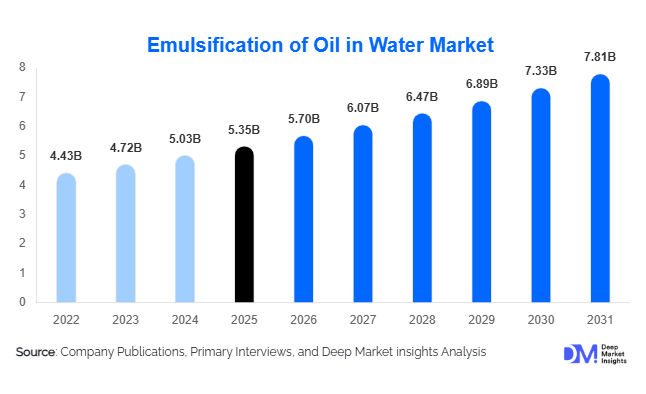
According to Deep Market Insights, the global emulsification of oil in water market size was valued at USD 5.35 billion in 2025 and is projected to grow from USD 5.70 billion in 2026 to reach USD 7.81 billion by 2031, expanding at a CAGR of 6.5% during the forecast period (2026–2031). The market growth is primarily driven by increasing demand for stable water-based formulations across food & beverages, cosmetics & personal care, pharmaceuticals, and industrial applications, along with rising adoption of advanced emulsification technologies such as nano-emulsions and bio-based emulsifiers.
Key Market Insights
- Oil-in-water emulsions dominate modern formulation science, enabling lightweight, stable, and cost-efficient products across consumer and industrial applications.
- Food & beverage applications account for the largest share, supported by rising demand for low-fat, clean-label, and functional food formulations.
- Non-ionic and bio-based emulsifiers are gaining preference due to superior stability, regulatory compliance, and sustainability advantages.
- Asia-Pacific leads market growth, driven by rapid expansion of food processing, cosmetics manufacturing, and pharmaceutical production in China and India.
- Nano-emulsification technologies are reshaping pharmaceutical and cosmetic formulations, enabling improved bioavailability and sensory performance.
- Regulatory pressure on synthetic surfactants is accelerating the shift toward plant-derived and biodegradable emulsification systems.
What are the latest trends in the emulsification of oil in water market?
Shift Toward Bio-Based and Clean-Label Emulsifiers
One of the most prominent trends shaping the emulsification of oil in water market is the rapid shift toward bio-based, plant-derived, and clean-label emulsifiers. Food manufacturers are increasingly replacing synthetic surfactants with natural alternatives such as lecithin, starch derivatives, gums, and protein-based emulsifiers to meet clean-label and regulatory requirements. This trend is particularly strong in Europe and North America, where consumer scrutiny of ingredient transparency is high. Cosmetic and personal care brands are also adopting naturally sourced emulsifiers to align with sustainability commitments and premium positioning. As a result, bio-based emulsification systems are gaining higher market share, commanding premium pricing while improving environmental compliance.
Growth of Nano-Emulsions and Advanced Formulation Technologies
Nano-emulsification is emerging as a transformative trend, particularly in pharmaceuticals and personal care. These ultra-fine emulsions enhance the stability, bioavailability, and controlled release of active ingredients, making them highly valuable for topical drugs, nutraceuticals, sunscreens, and skincare products. Industrial adoption of microfluidization and ultrasonic emulsification technologies is also increasing, allowing manufacturers to achieve consistent droplet sizes and extended shelf life. The integration of digital process control and real-time stability monitoring is further optimizing production efficiency and product performance.
What are the key drivers in the emulsification of oil in water market?
Rising Demand from Food & Beverage Processing
The food and beverage industry remains the largest driver of demand for oil-in-water emulsification systems. Increasing consumption of processed foods, ready-to-eat meals, sauces, dressings, dairy alternatives, and functional beverages is driving consistent demand for stable emulsions. Manufacturers rely on oil-in-water systems to improve texture, mouthfeel, and shelf stability while reducing fat content. The global push toward healthier eating habits and low-calorie formulations has further accelerated the adoption of emulsification technologies.
Expansion of Cosmetics and Personal Care Manufacturing
Cosmetics and personal care formulations extensively use oil-in-water emulsions to deliver lightweight, non-greasy textures in creams, lotions, and sunscreens. Growing demand for skincare products, anti-aging solutions, and sun protection — particularly in Asia-Pacific — is boosting consumption of advanced emulsification systems. The preference for fast-absorbing and sensory-optimized products is reinforcing the dominance of oil-in-water emulsions over water-in-oil alternatives.
Pharmaceutical Innovation and Drug Delivery Applications
In pharmaceuticals, oil-in-water emulsions are increasingly used in topical formulations and advanced drug delivery systems. Nano-emulsions improve the solubility of lipophilic drugs, enhancing therapeutic efficacy. Rising investment in pharmaceutical R&D and growing healthcare demand in emerging economies are strengthening this driver globally.
What are the restraints for the global market?
Volatility in Raw Material Prices
Fluctuations in the prices of key raw materials such as surfactants, specialty chemicals, and natural emulsifiers can impact production costs and profit margins. Bio-based emulsifiers, while in demand, often face supply constraints and price volatility due to agricultural dependencies, which can restrict adoption in price-sensitive markets.
Regulatory Complexity and Compliance Costs
Strict regulatory frameworks governing food additives, cosmetic ingredients, and pharmaceutical excipients pose challenges for manufacturers. Compliance with regional standards increases development timelines and costs, particularly for companies operating across multiple geographies.
What are the key opportunities in the emulsification of oil in water market?
Sustainable and Circular Chemistry Solutions
The transition toward sustainable chemistry presents significant growth opportunities. Companies investing in biodegradable emulsifiers, low-toxicity surfactants, and circular production models can differentiate themselves while meeting evolving regulatory and consumer expectations.
Emerging Market Industrialization
Rapid industrialization across emerging economies—particularly in Asia-Pacific, Latin America, and parts of the Middle East—is significantly accelerating demand for emulsification of oil in water solutions. Expanding food processing infrastructure, rising cosmetics and personal care manufacturing, and growing pharmaceutical production capacities are driving the need for efficient and scalable emulsification technologies. These trends are encouraging multinational manufacturers to establish localized production facilities, enter joint ventures with regional players, and expand emulsifier manufacturing capacity to reduce costs and strengthen supply chain resilience.
Report Scope
| Report Metric | Details |
|---|---|
| Market Size in 2025 | USD 5.35 Billion |
| Market Size in 2026 | USD 5.70 Billion |
| Market Size in 2031 | USD 7.81 Billion |
| CAGR | 6.5% (2026-2031) |
| Base Year for Estimation | 2025 |
| Historical Data | 2022-2024 |
| Forecast Period | 2026-2031 |
| Report Coverage | Revenue Forecast, Competitive Landscape, Supply Chain Disruption, Growth Factors, Environment & Regulatory Landscape and Trends |
| Geographies Covered | North America, Europe, APAC, Middle East and Africa, LATAM |
| Countries Covered | U.S., Canada, U.K., Germany, France, Spain, Italy, Russia, Nordic, Benelux, Rest of Europe, China, Korea, Japan, India, Australia, Singapore, Taiwan, South East Asia, Rest of Asia-Pacific, UAE, Turky, Saudi Arabia, South Africa, Egypt, Nigeria, Rest of MEA, Brazil, Mexico, Argentina, Chile, Colombia, Rest of LATAM |
Explore more data points, trends and opportunities Download Free Sample Report
Technology Insights
Mechanical emulsification remains the dominant technology segment, accounting for the largest share of global adoption due to its cost efficiency, scalability, and widespread use of high-shear mixers and homogenizers across food, cosmetics, and industrial applications. The leading driver for this segment is its ability to support high-volume production while maintaining consistent emulsion stability.
Ultrasonic and microfluidization technologies are witnessing the fastest growth, driven by increasing demand for uniform droplet size, enhanced bioavailability, and improved shelf stability—particularly in pharmaceutical and premium personal care formulations. These technologies are increasingly favored for nano-emulsion and specialty applications where precision and performance are critical.
End-Use Industry Insights
Food & beverages represent the leading end-use segment, accounting for approximately 38% of the global market share in 2025. The primary driver for this segment is rising consumption of processed foods, beverages, sauces, dairy products, and functional nutrition products that require stable oil-in-water emulsions for texture, taste, and shelf life.Cosmetics and personal care follow closely, supported by growing demand for skincare, haircare, and sun care products. The leading growth driver in this segment is the increasing consumer preference for lightweight, fast-absorbing formulations and multifunctional cosmetic products that rely on advanced emulsification systems.
Pharmaceuticals constitute the fastest-growing end-use segment, driven by continuous innovation in nano-emulsion and lipid-based drug delivery systems. Emulsification technologies play a critical role in enhancing drug bioavailability, stability, and patient compliance, particularly for poorly soluble active pharmaceutical ingredients.Industrial applications—including paints and coatings, lubricants, construction chemicals, and agrochemicals—generate steady demand through large-volume usage. Growth in this segment is primarily driven by infrastructure development, agricultural modernization, and rising demand for performance-enhancing industrial formulations.
Explore more data points, trends and opportunities Download Free Sample Report
Emulsification of Oil in Water Market Segmentations
By Emulsification Technology
- Mechanical Emulsification (High-Shear, Homogenization)
- Ultrasonic Emulsification
- Microfluidization
- Chemical / Surfactant-Based Emulsification
- Self-Emulsifying Systems
By Emulsifier Type
- Non-Ionic Emulsifiers
- Anionic Emulsifiers
- Cationic Emulsifiers
- Amphoteric Emulsifiers
- Bio-Based / Natural Emulsifiers
By Droplet Size / Formulation Scale
- Macro-Emulsions
- Mini-Emulsions
- Nano-Emulsions
By End-Use Industry
- Food & Beverages
- Cosmetics & Personal Care
- Pharmaceuticals
- Industrial & Chemical Processing
- Detergents & Cleaning Products
Regional Insights
Asia-Pacific
Asia-Pacific holds the largest share of the emulsification of oil in water market, accounting for nearly 35% of global demand in 2025. China and India dominate regional consumption due to their extensive food processing industries, expanding cosmetics manufacturing base, and rapidly growing pharmaceutical production capabilities.Key growth drivers in the region include rising disposable income, rapid urbanization, increasing consumption of packaged and convenience foods, and growing investments in domestic pharmaceutical manufacturing. Additionally, government initiatives supporting industrial development and foreign direct investment continue to strengthen regional market expansion.
North America
North America represents approximately 27% of the global market, supported by technologically advanced food processing industries, high per-capita consumption of personal care products, and strong pharmaceutical research and development activity. The United States remains the dominant contributor to regional demand.Regional growth is driven by increasing adoption of clean-label, non-GMO, and sustainable emulsification solutions, along with rising demand for functional foods and advanced drug delivery systems. Continuous innovation in formulation technologies and strict quality standards further support market growth.
Europe
Europe accounts for around 24% of the global market share, with Germany, France, and the United Kingdom serving as key demand centers. The region benefits from a well-established cosmetics industry and strong specialty food manufacturing capabilities.Growth in Europe is primarily driven by stringent regulatory frameworks favoring bio-based and environmentally friendly emulsifiers, along with increasing consumer demand for natural and organic products. Ongoing investments in sustainable formulation technologies and premium personal care products further reinforce market expansion.
Latin America & Middle East & Africa
Latin America and the Middle East & Africa collectively account for the remaining market share, with Brazil, Mexico, the UAE, and South Africa emerging as key growth markets. Expanding food and beverage processing, rising cosmetics consumption, and increasing pharmaceutical manufacturing capacity are strengthening regional demand.Growth drivers across these regions include improving industrial infrastructure, rising urban populations, growing middle-class consumer bases, and increasing investments in local manufacturing. Additionally, favorable government policies and trade initiatives are supporting long-term market development.
Key Players in the Emulsification of Oil in Water Market
- BASF SE
- Evonik Industries AG
- DSM-Firmenich
- Croda International Plc
- Clariant AG
- DuPont
- Solvay SA
- Lonza Group
- Akzo Nobel N.V.
- Kerry Group
- Ingredion Incorporated
- Stepan Company
- Huntsman Corporation
- Ashland Global Holdings
- Lubrizol Corporation