Smart Mask Market Size
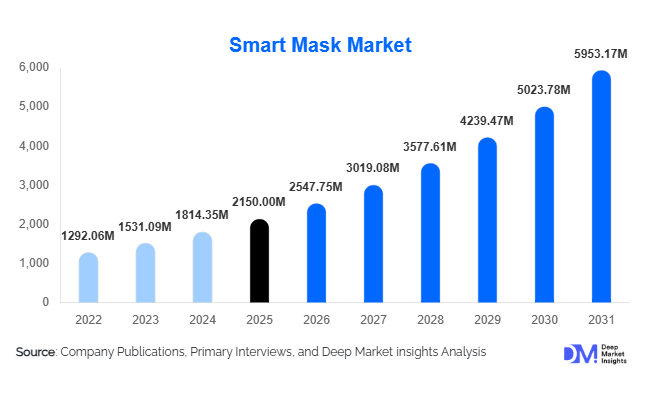
According to Deep Market Insights, the global smart mask market size was valued at USD 2,150 million in 2025 and is projected to grow from USD 2,547.75 million in 2026 to reach USD 5,953.17 million by 2031, expanding at a CAGR of 18.5% during the forecast period (2026–2031). The smart mask market growth is primarily driven by increasing air pollution levels, rising health awareness, and the growing adoption of wearable technology integrated with personal protective equipment.
Key Market Insights
- Air purifying smart masks dominate the market, accounting for over 30% share, driven by urban pollution concerns and daily consumer usage.
- Sensor-enabled and connectivity-integrated masks are gaining traction, enabling real-time monitoring of air quality and respiratory health.
- Asia-Pacific leads the global market, supported by high pollution levels and large urban populations in China and India.
- Online retail channels dominate distribution, contributing nearly half of global sales through direct-to-consumer platforms.
- Mid-range priced smart masks are the most popular, balancing affordability and advanced features, especially in emerging markets.
- Industrial and healthcare sectors are expanding adoption, driven by regulatory compliance and workplace safety requirements.
What are the latest trends in the smart mask market?
Integration with Digital Health Ecosystems
Smart masks are increasingly evolving into connected health devices, integrating with mobile applications and digital health platforms. These masks can track breathing patterns, exposure to pollutants, and even early signs of respiratory distress. The integration with telehealth ecosystems allows users to share real-time data with healthcare providers, enhancing preventive care. This trend is particularly relevant in urban populations where respiratory illnesses are prevalent. Companies are also investing in AI-enabled analytics that provide personalized health insights, transforming smart masks into essential wearable health companions.
Lightweight, Stylish, and Consumer-Centric Designs
Manufacturers are focusing on improving comfort, aesthetics, and usability. Modern smart masks are becoming lighter, quieter, and more ergonomic, addressing earlier concerns related to bulkiness and battery limitations. The fusion of fashion and technology is creating a new category of lifestyle products, appealing to younger consumers. Collaborations with fashion brands and the introduction of customizable designs are further enhancing adoption. Additionally, improvements in battery efficiency and compact components are making smart masks more practical for everyday use.
What are the key drivers in the smart mask market?
Rising Air Pollution and Urban Health Concerns
Increasing air pollution levels across major global cities are a primary driver of smart mask adoption. Urban populations are becoming more aware of the health risks associated with prolonged exposure to pollutants such as PM2.5 and harmful gases. Smart masks provide real-time monitoring and enhanced filtration, making them a preferred choice over traditional masks. Governments and environmental agencies are also raising awareness, further boosting demand.
Growth of Wearable Technology and IoT Integration
The rapid adoption of wearable devices is significantly influencing the smart mask market. Consumers are increasingly seeking connected devices that provide health insights and convenience. Smart masks equipped with Bluetooth, sensors, and app connectivity align with this trend. The ability to monitor air quality, track breathing patterns, and receive alerts enhances user engagement and drives market growth.
What are the restraints for the global market?
High Cost of Advanced Smart Masks
One of the major challenges in the smart mask market is the relatively high cost of technologically advanced products. Premium smart masks with AI capabilities, sensors, and connectivity features are significantly more expensive than conventional masks. This price gap limits adoption in cost-sensitive markets, particularly in developing regions where affordability remains a key concern.
Battery Life and Usability Constraints
Smart masks rely on battery-powered components such as sensors, fans, and connectivity modules. Limited battery life and the need for frequent charging can reduce convenience for users. Additionally, concerns related to weight, noise, and maintenance can impact user experience. Addressing these usability challenges is essential for achieving mass-market adoption.
What are the key opportunities in the smart mask industry?
Expansion in Emerging Markets
Emerging economies, particularly in the Asia-Pacific region, present significant growth opportunities due to rising pollution levels and increasing urbanization. Countries such as India and China are witnessing growing demand for personal air protection solutions. Affordable smart masks tailored to these markets can drive large-scale adoption. Government initiatives supporting local manufacturing further enhance growth potential.
Industrial Safety and Regulatory Compliance
The industrial sector offers a high-value opportunity for smart mask manufacturers. Industries such as mining, construction, and chemicals require advanced safety equipment to comply with regulations. Smart masks with features such as gas detection, fatigue monitoring, and real-time alerts can command premium pricing in B2B markets. Long-term contracts with industrial clients provide stable revenue streams.
Report Scope
| Report Metric | Details |
|---|---|
| Market Size in 2025 | USD 2150 Million |
| Market Size in 2026 | USD 2547.75 Million |
| Market Size in 2031 | USD 5953.17 Million |
| CAGR | 18.5% (2026-2031) |
| Base Year for Estimation | 2025 |
| Historical Data | 2022-2024 |
| Forecast Period | 2026-2031 |
| Report Coverage | Revenue Forecast, Competitive Landscape, Supply Chain Disruption, Growth Factors, Environment & Regulatory Landscape and Trends |
| Geographies Covered | North America, Europe, APAC, Middle East and Africa, LATAM |
| Countries Covered | U.S., Canada, U.K., Germany, France, Spain, Italy, Russia, Nordic, Benelux, Rest of Europe, China, Korea, Japan, India, Australia, Singapore, Taiwan, South East Asia, Rest of Asia-Pacific, UAE, Turky, Saudi Arabia, South Africa, Egypt, Nigeria, Rest of MEA, Brazil, Mexico, Argentina, Chile, Colombia, Rest of LATAM |
Explore more data points, trends and opportunities Download Free Sample Report
Product Type Insights
Air purifying smart masks lead the market with approximately 34% share in 2025, primarily driven by increasing air pollution levels across major urban centers and rising consumer demand for advanced personal protection solutions. These masks integrate high-efficiency filtration systems such as HEPA and activated carbon filters with real-time monitoring capabilities, making them highly suitable for both everyday consumer use and professional environments. The segment’s dominance is further supported by growing awareness around long-term respiratory health and the shift from disposable masks to reusable, technology-enabled solutions.
Fitness and performance smart masks are emerging as a niche but rapidly growing segment, driven by increasing adoption among athletes and fitness enthusiasts seeking respiratory training and performance optimization. Meanwhile, industrial smart masks are witnessing steady growth due to stringent occupational safety regulations and rising investments in worker protection across industries such as construction, mining, and chemicals. These masks offer additional functionalities such as gas detection and fatigue monitoring, making them essential in hazardous work environments.
Technology Insights
Sensor-enabled smart masks dominate the technology segment, accounting for nearly 38% of the global market, as real-time environmental and physiological monitoring remains the core value proposition for users. These masks provide continuous data on air quality parameters such as PM2.5 levels, CO₂ concentration, temperature, and humidity, along with respiratory metrics, enabling informed decision-making and enhanced safety. The growing demand for data-driven health insights is a key driver behind this segment’s leadership.
Connectivity-enabled smart masks are also experiencing rapid growth, supported by increasing smartphone penetration and the expansion of wearable ecosystems. Integration with mobile applications allows users to track exposure history, receive alerts, and analyze health trends over time. Additionally, AI-enabled features are gaining traction, enabling predictive analytics, adaptive filtration, and personalized recommendations. As artificial intelligence and IoT technologies continue to evolve, this segment is expected to witness accelerated innovation and higher adoption rates, particularly in premium product categories.
Distribution Channel Insights
Online retail channels account for approximately 46% of total market share, driven by the rapid expansion of e-commerce platforms and the increasing adoption of direct-to-consumer (D2C) business models. Consumers prefer online channels due to the availability of a wide range of products, transparent pricing, customer reviews, and the convenience of home delivery. The ability of brands to directly engage with customers and offer personalized experiences has further strengthened the dominance of this channel.
Offline retail channels, including pharmacies, electronics stores, and specialty outlets, continue to play a significant role, particularly in regions with lower digital penetration or where consumers prefer physical product evaluation before purchase. Institutional sales are also expanding rapidly, driven by bulk procurement from hospitals, corporate organizations, and industrial players. This segment benefits from long-term contracts and regulatory-driven demand, contributing to stable revenue streams for manufacturers.
End-Use Insights
General consumers represent the largest end-use segment, contributing around 40% of the market, driven by increasing awareness of air pollution, rising health consciousness, and the normalization of mask usage in daily life. Urban populations in highly polluted cities are the primary contributors to this segment, with demand supported by the need for continuous protection during commuting and outdoor activities.
The industrial sector is one of the fastest-growing segments, supported by stringent workplace safety regulations and increasing investments in employee health and safety. Industries such as oil & gas, mining, and manufacturing are adopting smart masks to enhance compliance and reduce occupational health risks. Healthcare institutions continue to adopt smart masks for enhanced protection and monitoring, particularly in high-risk environments such as hospitals and laboratories. Additionally, emerging applications in sports and fitness are expanding the market scope, with growing demand for performance-enhancing wearable solutions.
Explore more data points, trends and opportunities Download Free Sample Report
Smart Mask Market Segmentations
By Product Type
- Air Purifying Smart Masks
- Smart Respiratory Masks
- Fitness & Performance Smart Masks
- Industrial Smart Safety Masks
- Consumer Lifestyle Smart Masks
By Technology Integration
- Sensor-enabled Smart Masks
- Connectivity-enabled Smart Masks
- AI-enabled Smart Masks
- Voice Amplification-enabled Masks
- AR/Display-integrated Smart Masks
By Filtration Mechanism
- Replaceable Filter Systems
- Reusable/Washable Filters
- Self-cleaning (UV-based) Filters
- Electrostatic Filtration Technology
By End-Use
- Healthcare & Medical Institutions
- Industrial & Manufacturing Sector
- Sports & Fitness Users
- General Consumers
- Defense & Emergency Services
By Distribution Channel
- Online Retail
- Pharmacies & Medical Stores
- Electronics & Specialty Stores
- Institutional/B2B Sales
By Price Range
- Premium
- Mid-range
- Budget
Regional Insights
Asia-Pacific
Asia-Pacific dominates the smart mask market with approximately 42% share in 2025, driven by a combination of severe air pollution, high population density, and rapid urbanization. China leads the region with nearly 18% of global demand, supported by strong domestic manufacturing capabilities, government-backed industrial policies, and widespread adoption of wearable technology. India accounts for around 10% share, fueled by rising pollution levels in major cities, increasing consumer awareness, and growing middle-class purchasing power.
Key growth drivers in the region include government initiatives to improve air quality monitoring, increasing penetration of affordable smart devices, and the expansion of local manufacturing under programs such as “Make in India.” Additionally, the cultural normalization of mask usage and the availability of cost-effective products are accelerating adoption across both urban and semi-urban areas.
North America
North America holds about 25% market share, with the United States contributing nearly 20%. The region’s growth is driven by high adoption of wearable technology, strong consumer purchasing power, and increasing focus on preventive healthcare. The presence of leading technology companies and continuous innovation in smart wearable devices further strengthens market growth. Additionally, stringent industrial safety regulations and occupational health standards are driving demand for smart masks in industrial applications. The growing trend of integrating health monitoring devices into daily life, coupled with rising concerns over air quality in urban areas and wildfire-prone regions, is further supporting market expansion in North America.
Europe
Europe accounts for approximately 18% of the market, with Germany, the UK, and France as key contributors. The region’s growth is driven by strong environmental awareness, strict regulatory frameworks, and increasing demand for sustainable and reusable products. Consumers in Europe are highly inclined toward eco-friendly solutions, which is encouraging the adoption of reusable smart masks with advanced filtration technologies. Government regulations related to workplace safety and environmental standards are also playing a critical role in driving demand. Additionally, increasing investments in smart healthcare technologies and the growing popularity of connected devices are contributing to steady market growth across the region.
Latin America
Latin America holds around 8% market share, led by Brazil and Mexico. The market in this region is driven by increasing urbanization, rising pollution levels in major cities, and gradual improvement in healthcare awareness. Growing middle-class populations and expanding access to consumer electronics are supporting the adoption of smart masks. However, price sensitivity remains a key challenge, leading to higher demand for mid-range and budget products. The expansion of e-commerce platforms and the increasing availability of affordable smart masks are expected to drive future growth in the region.
Middle East & Africa
The Middle East & Africa region accounts for approximately 7% of the market, with demand concentrated in urban and industrial sectors. Countries such as the UAE and Saudi Arabia are key contributors, supported by rapid infrastructure development, industrial expansion, and increasing investments in worker safety. Key growth drivers include harsh climatic conditions, such as dust and sandstorms, which necessitate advanced respiratory protection solutions. Additionally, government investments in healthcare infrastructure and rising awareness of occupational safety are supporting market growth. In Africa, adoption is gradually increasing, driven by urbanization and improving access to healthcare and consumer products.
Key Players in the Smart Mask Market
- LG Electronics
- Xiaomi Corporation
- Honeywell International Inc.
- Dyson Ltd.
- Philips NV
- 3M Company
- Samsung Electronics
- AirPop
- Razer Inc.
- Cambridge Mask Co.
- AO Air
- Vogmask
- Respro
- O2O Smart Mask
- MaskFone