Far UVC Lamp Market Size
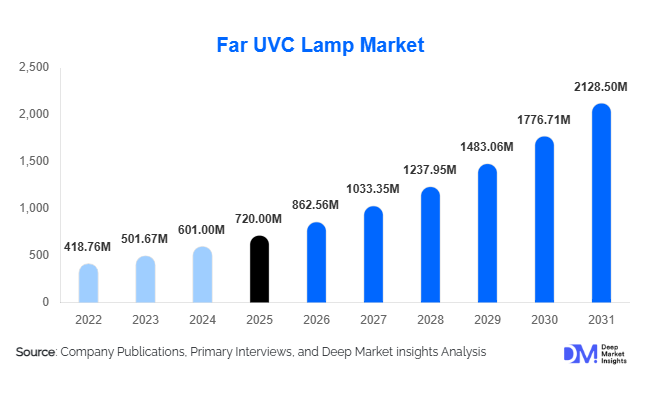
According to Deep Market Insights, the global Far UVC lamp market size was valued at USD 720 million in 2025 and is projected to grow from USD 862.56 million in 2026 to reach USD 2,128.50 million by 2031, expanding at a CAGR of 19.8% during the forecast period (2026–2031). The Far UVC lamp market growth is primarily driven by the increasing demand for continuous air and surface disinfection, rising awareness regarding airborne infection control, and growing adoption of safe UV technologies across healthcare and commercial infrastructure.
Key Market Insights
- Far UVC technology is gaining rapid adoption for occupied space disinfection, particularly in hospitals, airports, and commercial buildings.
- 222 nm wavelength systems dominate the market, owing to their proven safety and effectiveness against pathogens.
- North America leads the global market, supported by regulatory clarity and advanced healthcare infrastructure.
- Asia-Pacific is the fastest-growing region, driven by infrastructure development and government initiatives in China and India.
- Excimer lamps remain the dominant product type, although Far UVC LEDs are emerging as a disruptive technology.
- Integration with HVAC and smart building systems is reshaping demand patterns across commercial real estate.
What are the latest trends in the Far UVC lamp market?
Integration with Smart Buildings and HVAC Systems
Far UVC lamps are increasingly being integrated into HVAC systems and smart building infrastructure to enable continuous air disinfection. This trend is driven by the need for automated, low-maintenance solutions that improve indoor air quality in real time. Commercial real estate developers and facility managers are adopting these systems as part of broader building automation strategies. Integration with IoT-enabled sensors allows monitoring of air quality and dynamic adjustment of UV intensity, enhancing operational efficiency and safety. This trend is particularly strong in office spaces, airports, and educational institutions, where continuous occupancy requires non-intrusive disinfection technologies.
Emergence of Far UVC LED Technology
Technological advancements in Far UVC LEDs are transforming the market by enabling compact, energy-efficient, and longer-lasting solutions. While excimer lamps currently dominate, LED-based systems are expected to gain traction due to their scalability and suitability for consumer applications. These LEDs are being explored for use in portable devices, wearable sterilization solutions, and residential air purifiers. As production costs decline and efficiency improves, Far UVC LEDs are likely to open new application areas and expand the market beyond institutional buyers.
What are the key drivers in the Far UVC lamp market?
Growing Demand for Airborne Infection Control
The increasing focus on mitigating airborne diseases has significantly boosted demand for Far UVC lamps. Healthcare facilities are adopting these systems to reduce hospital-acquired infections, while commercial spaces are deploying them to ensure safer environments for occupants. The ability of Far UVC light to inactivate pathogens without harming human tissue makes it a preferred solution for continuous disinfection.
Regulatory Support and Safety Validation
Regulatory bodies across North America and Europe are establishing safety guidelines for Far UVC exposure, providing clarity for manufacturers and end-users. This has accelerated adoption by reducing uncertainty and enabling large-scale deployment in public spaces. Safety validation studies have further strengthened confidence in the technology, driving investment and commercialization.
What are the restraints for the global market?
High Initial Installation Costs
The upfront cost of Far UVC systems remains a significant barrier, particularly for small and medium enterprises. While long-term operational benefits are substantial, initial investments in equipment and integration can limit adoption in cost-sensitive markets.
Limited Long-Term Safety Data
Despite promising short-term results, the lack of extensive long-term studies on human exposure to Far UVC radiation creates hesitation among regulators and end-users. This uncertainty can slow down adoption, especially in highly regulated industries.
What are the key opportunities in the Far UVC lamp industry?
Expansion in Emerging Markets
Rapid urbanization and increasing healthcare investments in Asia-Pacific, Latin America, and the Middle East present significant growth opportunities. Countries such as India and China are investing heavily in public infrastructure and sanitation, creating strong demand for advanced disinfection technologies. Government initiatives supporting domestic manufacturing are further accelerating market penetration in these regions.
OEM Partnerships and System Integration
Collaborations with HVAC manufacturers and building automation companies are opening new revenue streams for Far UVC lamp providers. OEM integration allows seamless incorporation of disinfection systems into existing infrastructure, enabling large-scale adoption across commercial and industrial sectors. This approach also supports recurring revenue through maintenance and service contracts.
Report Scope
| Report Metric | Details |
|---|---|
| Market Size in 2025 | USD 720 Million |
| Market Size in 2026 | USD 862.56 Million |
| Market Size in 2031 | USD 2128.50 Million |
| CAGR | 19.8% (2026-2031) |
| Base Year for Estimation | 2025 |
| Historical Data | 2022-2024 |
| Forecast Period | 2026-2031 |
| Report Coverage | Revenue Forecast, Competitive Landscape, Supply Chain Disruption, Growth Factors, Environment & Regulatory Landscape and Trends |
| Geographies Covered | North America, Europe, APAC, Middle East and Africa, LATAM |
| Countries Covered | U.S., Canada, U.K., Germany, France, Spain, Italy, Russia, Nordic, Benelux, Rest of Europe, China, Korea, Japan, India, Australia, Singapore, Taiwan, South East Asia, Rest of Asia-Pacific, UAE, Turky, Saudi Arabia, South Africa, Egypt, Nigeria, Rest of MEA, Brazil, Mexico, Argentina, Chile, Colombia, Rest of LATAM |
Explore more data points, trends and opportunities Download Free Sample Report
Product Type Insights
Excimer lamps dominate the Far UVC lamp market, accounting for approximately 68% of the total market share in 2025. This leadership is primarily driven by their proven efficacy at the 222 nm wavelength, which has been extensively validated for safe use in occupied environments while maintaining high germicidal performance. Excimer technology benefits from a relatively mature manufacturing ecosystem, established supplier networks, and strong clinical backing, making it the preferred choice for large-scale institutional deployments such as hospitals, airports, and commercial buildings. Additionally, their ability to deliver consistent output and compatibility with fixed installation systems further strengthens their dominance.
LED-based Far UVC lamps, although currently accounting for a smaller share, are expected to witness the fastest growth rate globally. Their key growth drivers include compact form factor, low power consumption, and potential for integration into consumer electronics and portable disinfection devices. As semiconductor advancements improve efficiency and reduce costs, LED-based solutions are anticipated to disrupt the market, particularly in residential and small-scale commercial applications. Meanwhile, mercury-free plasma lamps are emerging as niche alternatives, driven by environmental sustainability regulations and the global shift toward mercury-free technologies, especially in Europe and developed markets.
Application Insights
Air disinfection is the leading application segment, holding nearly 48% of the global market share in 2025. This dominance is largely attributed to the rising focus on airborne infection control in enclosed and high-traffic environments such as hospitals, offices, airports, and public transportation systems. The COVID-19 pandemic has permanently shifted priorities toward continuous air purification, making Far UVC lamps an essential component of modern indoor air quality management systems. Integration with HVAC infrastructure further amplifies demand in this segment.
Surface disinfection and medical equipment sterilization remain critical secondary applications, particularly in healthcare and pharmaceutical industries where stringent hygiene standards are mandatory. These segments are driven by regulatory compliance and the need to minimize cross-contamination. Emerging applications in food processing and water treatment are expanding the market scope, supported by increasing global food safety standards, export compliance requirements, and growing concerns over microbial contamination in water systems. These new use cases are expected to contribute significantly to incremental market growth over the forecast period.
Distribution Channel Insights
Direct B2B sales dominate the distribution landscape, accounting for around 60% of the market, driven by the need for customized, large-scale disinfection solutions across healthcare institutions, commercial buildings, and industrial facilities. Buyers in these segments typically require tailored system designs, integration with existing infrastructure, and long-term service agreements, making direct engagement with manufacturers the preferred route.
OEM partnerships are gaining strong momentum, particularly in HVAC and smart building ecosystems. These collaborations enable seamless integration of Far UVC technology into ventilation systems, creating a scalable and recurring revenue model for manufacturers. Distributor networks and channel partners play an important role in regional market penetration, especially in emerging economies where localized support is critical. Meanwhile, e-commerce channels are gradually expanding, primarily for portable and residential units, supported by increasing consumer awareness and demand for personal disinfection solutions.
End-Use Industry Insights
The healthcare sector leads the Far UVC lamp market, contributing approximately 40% of total demand in 2025. This dominance is driven by stringent infection prevention protocols, rising incidence of hospital-acquired infections (HAIs), and continuous investments in advanced sterilization technologies. Hospitals, clinics, and diagnostic centers are early adopters, leveraging Far UVC systems for both air and surface disinfection in occupied environments.
The commercial segment, including offices, retail spaces, airports, and educational institutions, is the fastest-growing end-use industry, expanding at a CAGR exceeding 22%. Growth in this segment is fueled by increasing emphasis on employee and customer safety, corporate ESG commitments, and the adoption of smart building technologies. Industrial applications in food processing, pharmaceuticals, and manufacturing are also witnessing steady growth, driven by export-oriented compliance requirements, stringent hygiene standards, and the need to maintain contamination-free production environments. Emerging demand from the hospitality and transportation sectors is further broadening the end-use landscape.
Explore more data points, trends and opportunities Download Free Sample Report
Far UVC Lamp Market Segmentations
By Product Type
- Excimer Lamps
- LED-based Far UVC Lamps
- Mercury-Free Plasma Lamps
By Application
- Air Disinfection
- Surface Disinfection
- Water Disinfection
- Medical Equipment Sterilization
- Food & Beverage Sterilization
By Distribution Channel
- Direct B2B Sales
- OEM Partnerships
- Distributor/Channel Partners
- E-commerce
By End-Use Industry
- Healthcare Facilities
- Commercial Spaces
- Industrial & Manufacturing
- Residential
- Hospitality & Transportation
Regional Insights
North America
North America accounts for approximately 38% of the global market share in 2025, with the United States representing the largest contributor. The region’s dominance is driven by advanced healthcare infrastructure, strong regulatory frameworks, and early adoption of innovative disinfection technologies. Regulatory clarity regarding Far UVC exposure limits has accelerated commercialization and large-scale deployments. Additionally, high investments in public health infrastructure, smart buildings, and airport modernization projects are fueling demand. The presence of leading market players and strong R&D capabilities further strengthens the region’s leadership position.
Asia-Pacific
Asia-Pacific holds around 32% market share and is the fastest-growing region globally, with a projected CAGR exceeding 22%. Growth is primarily driven by rapid urbanization, increasing healthcare investments, and government-led infrastructure development. China leads the region due to its large-scale manufacturing capabilities, favorable industrial policies, and strong domestic demand. Japan remains a technology pioneer, contributing significantly to innovation in Far UVC systems. India is emerging as a high-growth market, supported by initiatives such as “Make in India,” expanding healthcare infrastructure, and rising awareness of infection control in densely populated urban centers. Increasing adoption in commercial real estate and public transportation is further accelerating regional growth.
Europe
Europe represents approximately 20% of the global market, with Germany, the UK, and France as key contributors. The region’s growth is driven by stringent environmental and health regulations, a strong focus on sustainability, and widespread adoption of mercury-free technologies. European countries are actively investing in smart infrastructure and public transport systems, where Far UVC lamps are being integrated for continuous disinfection. Additionally, strict compliance requirements in the food processing and pharmaceutical industries are boosting demand. Government support for energy-efficient and eco-friendly technologies further enhances market expansion.
Latin America
Latin America accounts for approximately 5% of the global market, with Brazil and Mexico leading demand. Growth in this region is supported by improving healthcare infrastructure, rising awareness of infection control, and increasing investments in hospital modernization. Although adoption is relatively slower compared to developed regions, expanding urban populations and growing middle-class demand for safer public environments are driving market penetration. Government initiatives aimed at strengthening public health systems are expected to create new opportunities in the coming years.
Middle East & Africa
The Middle East & Africa region is witnessing steady growth, led by the UAE and Saudi Arabia. Key growth drivers include large-scale investments in smart city projects, healthcare infrastructure expansion, and increasing focus on hygiene in the hospitality and transportation sectors. Countries in the Gulf region are rapidly adopting advanced technologies as part of diversification strategies and global tourism ambitions. In Africa, adoption is gradually increasing in urban healthcare facilities, supported by international funding and public health initiatives. The region’s long-term growth potential remains strong, particularly as awareness and infrastructure continue to improve.
Key Players in the Far UVC Lamp Market
- Ushio Inc.
- Signify N.V.
- Koninklijke Philips N.V.
- Heraeus Holding
- Stanley Electric Co., Ltd.
- Seoul Viosys
- Nikkiso Co., Ltd.
- Halma plc
- Atlantic Ultraviolet Corporation
- American Ultraviolet
- Xenex Disinfection Services
- UV Resources
- Lumalier Corporation
- Crystal IS Inc.
- LG Electronics