Tumbler Market Size
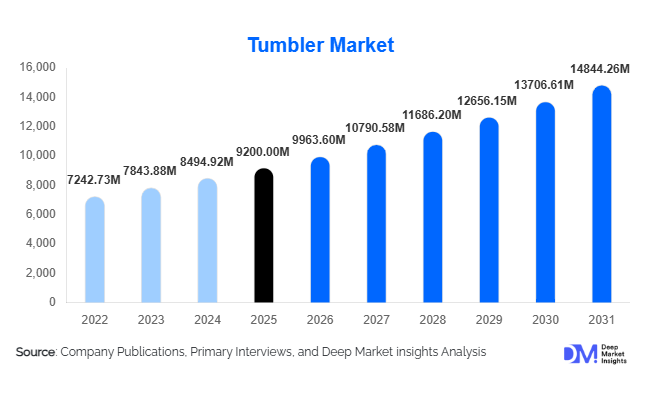
According to Deep Market Insights, the global tumbler market was valued at USD 9,200 million in 2025 and is projected to grow from USD 9,963.60 million in 2026 to reach USD 14,844.26 million by 2031, expanding at a CAGR of 8.3% during the forecast period (2026–2031). The market growth is primarily driven by rising demand for sustainable reusable drinkware, increasing adoption of insulated stainless steel tumblers, and the growing global shift toward eco-conscious consumer lifestyles. Additional momentum is supported by rapid urbanization, expansion of e-commerce distribution channels, and increasing product premiumization across both developed and emerging economies.
Key Market Insights
- Stainless steel insulated tumblers dominate global demand due to superior temperature retention, durability, and premium consumer perception.
- Sustainability regulations and plastic reduction policies are significantly accelerating the shift toward reusable drinkware across major economies.
- Asia-Pacific leads production and consumption growth, driven by rising middle-class incomes in India, China, and Southeast Asia.
- E-commerce and direct-to-consumer (DTC) brands are reshaping distribution, enabling strong customization and global accessibility.
- Corporate gifting and promotional merchandise demand is expanding rapidly, particularly in emerging startup ecosystems and SMEs.
- Premium lifestyle branding is transforming tumblers from utility products into fashion-oriented consumer accessories.
Tumbler Market Trends
Shift Toward Sustainable and Reusable Drinkware
The most significant trend shaping the tumbler market is the global shift away from single-use plastics toward reusable alternatives. Governments across Europe, North America, and parts of Asia are enforcing strict regulations on disposable plastic cups and bottles, directly boosting tumbler adoption. Consumers are increasingly selecting stainless steel and BPA-free plastic tumblers as part of environmentally responsible consumption behavior. Brands are responding by launching recyclable, reusable, and long-life products aligned with circular economy principles, strengthening long-term market penetration.
Premiumization and Lifestyle Branding of Tumblers
Tumblers are increasingly being positioned as lifestyle and fashion accessories rather than basic drinkware. Premium brands are focusing on aesthetics, color variants, ergonomic designs, and collaborations with lifestyle influencers. This trend is especially strong among millennials and Gen Z consumers, who prioritize personalization and brand identity. As a result, tumblers are now frequently used as corporate gifts, influencer merchandise, and fitness accessories, significantly expanding their value proposition beyond traditional utility.
Tumbler Market Drivers
Rising Environmental Awareness and Regulatory Push
Growing environmental concerns and government bans on single-use plastics are key drivers of tumbler adoption. Many countries are encouraging reusable drinkware through policies, taxes on plastic products, and sustainability campaigns. This structural shift is creating long-term demand for durable, reusable tumblers across residential and commercial applications.
Expansion of On-the-Go Urban Lifestyle
Urbanization and fast-paced lifestyles are increasing demand for portable beverage solutions. Office workers, students, and travelers are increasingly using insulated tumblers for coffee, tea, and cold beverages. The convenience of spill-proof, temperature-retaining designs is making tumblers a daily essential product in urban households.
Product Innovation and Material Advancements
Continuous innovation in vacuum insulation technology, stainless steel processing, and smart tumblers with temperature indicators is enhancing product appeal. Manufacturers are investing in advanced manufacturing processes to improve durability, insulation efficiency, and aesthetic customization, thereby driving premium product adoption globally.
Tumbler Market Restraints
High Cost of Premium Products
Premium stainless steel and smart tumblers remain relatively expensive compared to plastic alternatives. This limits adoption in price-sensitive regions, particularly in low-income and rural markets across developing economies, slowing down overall penetration.
Raw Material Price Volatility
Fluctuations in stainless steel, aluminum, and polymer prices directly impact production costs. Manufacturers without strong supply chain integration face margin pressure, making pricing stability a key challenge in competitive markets.
Tumbler Market Opportunities
Expansion into Emerging Economies
Rapid urbanization, rising disposable incomes, and growing café culture in countries such as India, Indonesia, Vietnam, and Brazil are creating strong new demand centers. E-commerce penetration is further accelerating product accessibility, offering significant expansion opportunities for global and regional brands.
Smart and Connected Tumbler Innovation
The integration of smart technologies such as temperature display lids, hydration tracking, and IoT-enabled features presents a high-growth niche. These innovations are particularly appealing to fitness-focused and tech-savvy consumers, creating a premium sub-segment within the broader tumbler market.
Corporate Gifting and Customization Growth
Corporate branding and promotional merchandise demand is rapidly increasing. Custom-printed tumblers are widely used in corporate events, employee gifting, and marketing campaigns, creating a stable and recurring demand stream for manufacturers.
Report Scope
| Report Metric | Details |
|---|---|
| Market Size in 2025 | USD 9200 Million |
| Market Size in 2026 | USD 9963.60 Million |
| Market Size in 2031 | USD 14844.26 Million |
| CAGR | 8.3% (2026-2031) |
| Base Year for Estimation | 2025 |
| Historical Data | 2022-2024 |
| Forecast Period | 2026-2031 |
| Report Coverage | Revenue Forecast, Competitive Landscape, Supply Chain Disruption, Growth Factors, Environment & Regulatory Landscape and Trends |
| Geographies Covered | North America, Europe, APAC, Middle East and Africa, LATAM |
| Countries Covered | U.S., Canada, U.K., Germany, France, Spain, Italy, Russia, Nordic, Benelux, Rest of Europe, China, Korea, Japan, India, Australia, Singapore, Taiwan, South East Asia, Rest of Asia-Pacific, UAE, Turky, Saudi Arabia, South Africa, Egypt, Nigeria, Rest of MEA, Brazil, Mexico, Argentina, Chile, Colombia, Rest of LATAM |
Explore more data points, trends and opportunities Download Free Sample Report
Product Type Insights
Insulated tumblers continue to dominate the global market, accounting for approximately 58% share in 2025. Their leadership is primarily driven by rising consumer demand for temperature-retention beverages, increasing adoption of premium stainless steel drinkware, and strong replacement of single-use plastic bottles. The growth is further supported by lifestyle shifts toward commuting, office mobility, and outdoor recreation, where thermal efficiency becomes a key purchasing factor.
Within material categories, stainless steel tumblers hold nearly 46% market share, driven by superior durability, corrosion resistance, long lifecycle value, and alignment with global sustainability mandates. Plastic tumblers are witnessing gradual decline in developed markets due to environmental restrictions, though they remain relevant in price-sensitive economies and institutional bulk procurement. Glass and hybrid tumblers are emerging niche categories, primarily driven by aesthetic appeal and premium positioning in home and hospitality usage.
Travel mugs and smart tumblers represent the fastest-growing sub-segments, fueled by innovation in spill-proof technology, IoT-enabled temperature display features, and rising consumer preference for multifunctional drinkware. In capacity segmentation, medium-sized tumblers (300–500 ml) dominate due to their universal usability, while large-capacity variants (>500 ml) are gaining traction in fitness, sports hydration, and outdoor adventure applications.
Application Insights
Residential consumption remains the largest application segment, accounting for over 60% of global demand. This dominance is driven by increasing household adoption of reusable drinkware, rising health consciousness, and the normalization of at-home and on-the-go beverage consumption habits. Urbanization and growth of nuclear households further strengthen this demand base.
Commercial foodservice applications, including cafés, quick-service restaurants, and hospitality chains, are expanding steadily due to sustainability mandates and growing adoption of reusable serving solutions. Corporate and promotional gifting is emerging as one of the fastest-growing applications, supported by increasing corporate branding investments, startup ecosystem expansion, and personalized merchandise demand.
Outdoor, travel, and fitness-related usage is also growing rapidly, driven by rising participation in wellness activities, gym culture, hiking, and adventure tourism. These applications are increasingly influencing premium and insulated product demand, particularly in urban consumer markets.
Distribution Channel Insights
Offline retail continues to dominate global distribution, accounting for approximately 52% of total market share, supported by strong presence in supermarkets, specialty stores, and lifestyle retail outlets. Physical retail remains important for tactile product evaluation, especially in premium drinkware categories where design and build quality are key purchase factors.
Online retail, however, is the fastest-growing channel, driven by rapid e-commerce penetration, DTC brand expansion, and increasing consumer preference for product customization and price comparison. Social commerce and influencer-driven sales are significantly shaping purchasing behavior among younger demographics.
Institutional and bulk procurement channels are expanding in corporate, hospitality, and educational sectors, where tumblers are increasingly used for branding and sustainability compliance. Subscription-based gifting platforms and corporate merchandise vendors are also contributing to channel diversification.
End-Use Insights
The residential segment remains the dominant end-use category, supported by daily hydration needs, rising health awareness, and increasing penetration of reusable lifestyle products. However, commercial and corporate segments are expanding at a faster rate due to sustainability initiatives and branding-driven consumption.
Foodservice operators are increasingly adopting branded tumblers to align with plastic reduction policies and enhance customer experience. Corporate gifting is witnessing strong growth due to increased marketing budgets and rising demand for personalized, eco-friendly promotional merchandise.
The outdoor and fitness industry is another key growth contributor, driven by rising wellness awareness, gym participation, and adventure tourism. Additionally, export-driven demand from manufacturing hubs such as China, India, and Vietnam continues to supply global markets, particularly North America and Europe, where premiumization trends are strongest.
Explore more data points, trends and opportunities Download Free Sample Report
Tumbler Market Segmentations
By Material Type
- Stainless Steel Tumblers
- Plastic Tumblers (BPA-Free Reusable)
- Glass Tumblers (Borosilicate & Decorative)
- Silicone & Hybrid Material Tumblers
By Product Type
- Insulated Tumblers
- Non-Insulated Tumblers
- Travel Mugs with Lids
- Smart & Temperature Display Tumblers
- Specialty & Collapsible Tumblers
By Capacity
- Small (≤300 ml)
- Medium (300–500 ml)
- Large (>500 ml)
By Application
- Residential Use
- Commercial Foodservice (Cafés, QSRs, Hospitality)
- Corporate & Promotional Gifting
- Outdoor, Travel & Fitness Use
By Distribution Channel
- Online Retail (E-commerce & DTC Brands)
- Offline Retail (Supermarkets, Specialty Stores, Department Stores)
- Institutional & Bulk Procurement
- Corporate Merchandise & Gifting Platforms
Regional Insights
Asia-Pacific
Asia-Pacific leads the global tumbler market with approximately 38% share in 2025. The region’s dominance is driven by large-scale manufacturing capabilities, rapid urbanization, and rising middle-class consumption. China serves as both the largest producer and domestic consumer, while India represents the fastest-growing market due to expanding e-commerce penetration, café culture growth, and increasing disposable income. Japan and Southeast Asia contribute significantly to premium and mid-range tumbler demand, supported by strong retail ecosystems and innovation in compact, high-quality drinkware.
Growth in Asia-Pacific is further supported by government-led manufacturing initiatives, expansion of export-oriented production hubs, and increasing sustainability awareness among urban consumers. Rising fitness culture and workplace hydration trends are also accelerating demand for insulated tumblers across metropolitan regions.
North America
North America holds around 29% global market share, led by the United States and Canada. The region is characterized by strong demand for premium and branded tumblers, driven by high disposable income, lifestyle-oriented consumption, and advanced retail penetration.
Growth is primarily driven by increasing preference for insulated and smart tumblers, strong outdoor recreation culture (camping, hiking, sports), and widespread adoption of sustainability-driven consumer behavior. Corporate branding and merchandise culture are also key demand drivers, with tumblers widely used in promotional campaigns and employee gifting programs. Additionally, strong influence of DTC brands and influencer-led marketing continues to reshape consumer preferences.
Europe
Europe accounts for nearly 22% of global demand, with Germany, the UK, and France representing key consumption markets. The region’s growth is strongly supported by stringent environmental regulations, plastic reduction policies, and high consumer awareness of sustainability issues.
Key growth drivers include increasing adoption of eco-friendly reusable drinkware, strong demand for premium lifestyle products, and rising preference for minimalist and design-focused tumblers. Younger consumers are particularly driving demand for sustainable and aesthetically designed drinkware, while corporate adoption is increasing due to ESG compliance initiatives across organizations.
Latin America
Latin America is an emerging tumbler market, with growing adoption in Brazil, Mexico, and Argentina. The region’s growth is driven by urbanization, expanding retail infrastructure, and rising consumer awareness of reusable products.
Key drivers include increasing penetration of global retail brands, expansion of e-commerce platforms, and rising interest in fitness and outdoor lifestyles. Corporate gifting and promotional merchandise demand is also gradually increasing as multinational companies expand operations in the region. While price sensitivity remains a challenge, mid-range stainless steel tumblers are gaining traction among urban consumers.
Middle East & Africa
The Middle East & Africa region is witnessing steady growth, led by the UAE, Saudi Arabia, and South Africa. Demand is primarily driven by high-income consumers, tourism expansion, and increasing adoption of premium lifestyle products.
Growth drivers include strong hospitality sector expansion, rising fitness and wellness awareness, and increasing import of branded premium drinkware. The UAE and Saudi Arabia are particularly important luxury consumption hubs, where tumblers are increasingly positioned as lifestyle and gifting products. In Africa, urbanization and retail modernization are gradually expanding access to mid-range and affordable tumbler products, supporting long-term market development.
Key Players in the Tumbler Market
- Thermos LLC
- Stanley (PMI)
- YETI Holdings
- Hydro Flask
- CamelBak
- Contigo
- Zojirushi Corporation
- Tiger Corporation
- Tupperware Brands
- Klean Kanteen
- S’well
- Simple Modern
- Bubba Brands
- Owala
- LocknLock