Toothbrush Market Size
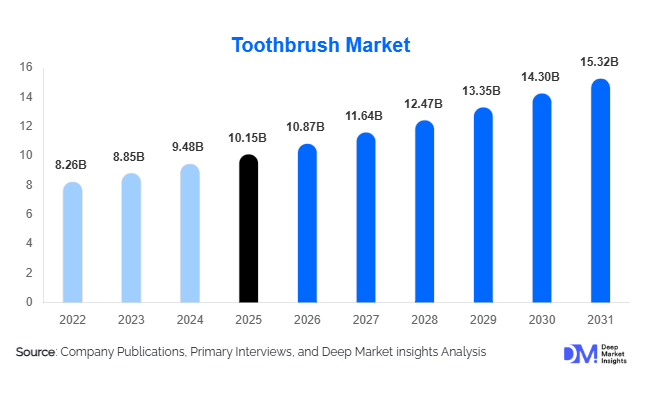
According to Deep Market Insights, the global toothbrush market size was valued at USD 10.15 billion in 2025 and is projected to grow from USD 10.87 billion in 2026 to reach USD 15.32 billion by 2031, expanding at a CAGR of 7.1% during the forecast period (2026–2031). The toothbrush market growth is primarily driven by rising oral hygiene awareness, increasing adoption of electric and smart toothbrushes, growing preventive healthcare spending, and expanding demand for sustainable oral care products across both developed and emerging economies.
Key Market Insights
- Electric and smart toothbrush adoption is accelerating globally, supported by rising consumer preference for premium oral care technologies and dentist-recommended products.
- Sustainable toothbrush solutions are gaining momentum, with bamboo, biodegradable, and recyclable toothbrushes witnessing strong demand in Europe and North America.
- Asia-Pacific dominates manufacturing and consumption growth, led by China, India, Japan, and South Korea, due to urbanization and rising disposable incomes.
- North America remains the leading premium toothbrush market, supported by high consumer healthcare expenditure and strong penetration of smart oral care devices.
- E-commerce and subscription-based oral care models are transforming distribution channels, enabling direct-to-consumer brands to expand rapidly.
- Technological innovation, including AI-enabled brushing analytics, Bluetooth connectivity, sonic cleaning systems, and app-based monitoring, is reshaping consumer engagement and product differentiation.
What are the latest trends in the toothbrush market?
Growing Adoption of Smart and Connected Toothbrushes
The toothbrush market is witnessing rapid growth in smart toothbrush adoption as consumers increasingly prioritize personalized oral healthcare. Manufacturers are integrating Bluetooth connectivity, mobile applications, AI-based brushing feedback, pressure sensors, and real-time brushing analytics into premium electric toothbrushes. These technologies help consumers improve brushing habits while enhancing product engagement and long-term customer retention. Smart toothbrushes are particularly popular among younger urban consumers and health-conscious households seeking preventive healthcare solutions. Subscription-based replacement brush head services are also expanding alongside connected devices, creating recurring revenue opportunities for manufacturers while improving customer convenience and brand loyalty.
Sustainability and Eco-Friendly Toothbrush Innovation
Sustainability has emerged as one of the most influential trends within the global toothbrush industry. Growing environmental awareness and increasing regulations targeting single-use plastics are driving demand for bamboo toothbrushes, biodegradable handles, recyclable packaging, and reusable brush-head systems. Consumers are increasingly favoring brands that emphasize environmentally responsible manufacturing and sustainable sourcing practices. Europe and North America currently lead the adoption of eco-friendly toothbrush products, while emerging markets are gradually increasing demand for affordable, sustainable oral care solutions. Companies are also investing in carbon-neutral manufacturing, plant-based materials, and minimal plastic packaging to strengthen their sustainability positioning and comply with evolving environmental regulations globally.
What are the key drivers in the toothbrush market?
Rising Awareness of Preventive Oral Healthcare
Increasing awareness regarding oral hygiene and preventive dental care is one of the primary growth drivers for the toothbrush market. Rising prevalence of gum disease, cavities, plaque accumulation, and periodontal disorders has encouraged consumers to adopt regular brushing habits and replace toothbrushes more frequently. Governments, healthcare organizations, and dental associations across major economies are promoting preventive oral care through awareness campaigns, school dental programs, and public healthcare initiatives. Growing consumer focus on cosmetic dentistry, whitening treatments, and gum-care solutions is also supporting demand for premium toothbrush products globally.
Technological Advancements in Electric Toothbrushes
Continuous innovation in electric toothbrush technologies is significantly accelerating market growth. Manufacturers are introducing advanced sonic vibration systems, oscillating brush heads, pressure sensors, AI-assisted brushing guidance, and mobile app integration to enhance cleaning efficiency and user engagement. Premium electric toothbrushes are increasingly recommended by dental professionals due to their superior plaque-removal capabilities and gum-protection features. Rising disposable incomes, urbanization, and growing willingness among consumers to invest in technologically advanced healthcare products are further driving electric toothbrush adoption globally. Technological differentiation has also enabled manufacturers to expand premium pricing opportunities and strengthen profitability.
What are the restraints for the global market?
High Costs of Premium Electric Toothbrushes
Despite strong growth potential, the adoption of premium electric and smart toothbrushes remains limited among price-sensitive consumers in emerging economies. Advanced electric toothbrushes often carry significantly higher upfront costs compared with manual toothbrushes, while replacement brush heads and charging accessories add to long-term ownership expenses. This pricing gap restricts mass-market penetration and slows adoption rates in developing regions where manual toothbrushes continue to dominate due to affordability.
Environmental Concerns Related to Plastic Waste
Traditional plastic toothbrushes contribute significantly to global plastic waste generation, creating increasing regulatory and environmental challenges for the industry. Governments across Europe and other developed regions are implementing stricter sustainability regulations targeting disposable plastics and non-recyclable packaging materials. Manufacturers that fail to transition toward sustainable materials may face rising compliance costs, reputational challenges, and reduced consumer preference. Additionally, fragmented local manufacturing and counterfeit products continue to create quality-control and brand-protection concerns within several emerging markets.
What are the key opportunities in the toothbrush industry?
Expansion of Affordable Smart Toothbrushes in Emerging Markets
Emerging economies such as India, China, Brazil, Indonesia, and Vietnam present substantial growth opportunities for electric and smart toothbrush manufacturers. Penetration rates for electric toothbrushes remain significantly lower in these markets compared with North America and Europe, creating strong long-term expansion potential. Rising middle-class income levels, increasing urbanization, and growing oral hygiene awareness are enabling consumers to shift from manual toothbrushes toward technologically advanced oral care devices. Companies introducing affordable smart toothbrush models tailored to local price sensitivities are expected to gain significant market share over the forecast period.
Growth of Sustainable and Subscription-Based Oral Care Models
The growing consumer preference for sustainable personal care products is creating opportunities for manufacturers offering bamboo toothbrushes, biodegradable materials, and recyclable packaging solutions. Eco-conscious consumers are increasingly willing to pay premium prices for environmentally responsible oral care products. At the same time, subscription-based replacement head delivery services and direct-to-consumer oral care platforms are reshaping purchasing behavior. These models improve customer retention, stabilize recurring revenue streams, and provide opportunities for personalized product recommendations and long-term consumer engagement.
Report Scope
| Report Metric | Details |
|---|---|
| Market Size in 2025 | USD 10.15 Billion |
| Market Size in 2026 | USD 10.87 Billion |
| Market Size in 2031 | USD 15.32 Billion |
| CAGR | 7.1% (2026-2031) |
| Base Year for Estimation | 2025 |
| Historical Data | 2022-2024 |
| Forecast Period | 2026-2031 |
| Report Coverage | Revenue Forecast, Competitive Landscape, Supply Chain Disruption, Growth Factors, Environment & Regulatory Landscape and Trends |
| Geographies Covered | North America, Europe, APAC, Middle East and Africa, LATAM |
| Countries Covered | U.S., Canada, U.K., Germany, France, Spain, Italy, Russia, Nordic, Benelux, Rest of Europe, China, Korea, Japan, India, Australia, Singapore, Taiwan, South East Asia, Rest of Asia-Pacific, UAE, Turky, Saudi Arabia, South Africa, Egypt, Nigeria, Rest of MEA, Brazil, Mexico, Argentina, Chile, Colombia, Rest of LATAM |
Explore more data points, trends and opportunities Download Free Sample Report
Product Type Insights
Manual toothbrushes continue to dominate the global toothbrush market, accounting for the largest share of overall volume consumption due to affordability, accessibility, and widespread retail penetration across developing economies. Soft-bristle toothbrushes remain the leading manual category as dental professionals increasingly recommend softer bristles for gum protection and enamel preservation. Electric toothbrushes represent the fastest-growing product category, driven by rising adoption of sonic and oscillating technologies among urban consumers seeking premium oral care solutions. Smart toothbrushes integrated with AI-based brushing analytics, Bluetooth connectivity, and mobile applications are gaining significant traction in developed markets such as the United States, Germany, Japan, and South Korea. Sustainable toothbrush products, including bamboo and biodegradable variants, are also witnessing double-digit growth rates as environmental awareness continues to influence purchasing decisions globally.
Application Insights
Household and personal-use applications account for the majority of global toothbrush demand, supported by rising awareness regarding preventive oral healthcare and increasing replacement frequency among consumers. Dental clinics and orthodontic centers represent important premium-growth applications as dentists increasingly recommend electric toothbrushes and specialized gum-care products for patients undergoing cosmetic or orthodontic treatments. Pediatric oral care applications are expanding rapidly due to growing parental focus on preventive dental hygiene for children. Hospitality and travel-related applications, including hotels, airlines, and travel kits, continue to generate stable institutional demand for disposable and travel toothbrushes. Additionally, hospitals, military organizations, schools, and correctional institutions are increasing bulk procurement of oral care products through public healthcare and institutional hygiene programs.
Distribution Channel Insights
Offline retail channels continue to dominate toothbrush sales globally, particularly supermarkets, hypermarkets, pharmacies, convenience stores, and specialty oral care retailers. Pharmacies remain especially important for premium toothbrush products due to strong consumer trust in pharmacist and dentist recommendations. However, online distribution channels are expanding rapidly as e-commerce platforms enable consumers to compare features, access premium imported brands, and subscribe to automatic replacement head deliveries. Direct-to-consumer oral care brands are leveraging digital marketing, influencer partnerships, and subscription commerce models to compete effectively with multinational incumbents. Mobile commerce and online healthcare marketplaces are further accelerating digital toothbrush sales, particularly among younger consumers and urban households.
User Group Insights
Adult consumers represent the largest segment within the toothbrush market, accounting for the majority of global toothbrush consumption due to higher replacement frequency and increasing focus on oral aesthetics and preventive healthcare. Children's toothbrushes are among the fastest-growing segments as parents increasingly invest in age-specific oral care products featuring soft bristles, cartoon designs, and gamified brushing experiences. Elderly consumers are also emerging as an important demand segment due to increasing prevalence of gum disease, tooth sensitivity, and dental disorders associated with aging populations. Orthodontic patients and sensitive-gum users are driving growing demand for specialized toothbrush designs tailored for braces, implants, and periodontal care.
Technology Insights
Oscillating and rotational technologies currently dominate the electric toothbrush segment due to strong clinical positioning and widespread dentist recommendations. Sonic toothbrushes are witnessing rapid adoption as consumers increasingly prefer quieter operation, enhanced gum-care performance, and premium brushing experiences. Ultrasonic toothbrushes remain a niche but growing segment focused on advanced plaque-removal capabilities. AI-enabled toothbrushes featuring brushing analytics, pressure monitoring, and mobile connectivity are transforming oral healthcare personalization. Companies are increasingly integrating smart sensors, brushing timers, and app-based coaching features to improve user engagement and differentiate premium product offerings in a highly competitive market.
Explore more data points, trends and opportunities Download Free Sample Report
Toothbrush Market Segmentations
By Product Type
- Manual Toothbrushes
- Electric Toothbrushes
- Smart Connected Toothbrushes
- Bamboo & Eco-Friendly Toothbrushes
- Kids Toothbrushes
- Travel Toothbrushes
By Bristle Type
- Ultra-Soft Bristles
- Soft Bristles
- Medium Bristles
- Hard Bristles
- Charcoal & Nano Bristles
By User Group
- Adults
- Children
- Infants & Toddlers
- Elderly Users
- Orthodontic Patients
By Technology
- Oscillating Toothbrushes
- Sonic Toothbrushes
- Ultrasonic Toothbrushes
- Bluetooth-Enabled Smart Toothbrushes
- AI-Integrated Toothbrushes
By Distribution Channel
- Supermarkets & Hypermarkets
- Pharmacies & Drug Stores
- Convenience Stores
- Specialty Oral Care Stores
- Online Retail & E-Commerce
- Direct-to-Consumer Platforms
By End Use
- Household & Personal Use
- Dental Clinics
- Hospitals
- Hotels & Hospitality
- Institutional Procurement
Regional Insights
North America
North America accounted for approximately 29% of the global toothbrush market revenue in 2025, led primarily by the United States. High oral healthcare expenditure, strong electric toothbrush penetration, and widespread adoption of premium oral care technologies continue to drive regional demand. Consumers in the United States and Canada increasingly prefer smart toothbrushes equipped with app connectivity, AI-based brushing guidance, and subscription replacement services. Sustainability trends are also supporting growth in bamboo and biodegradable toothbrush products across the region.
Europe
Europe remains one of the most mature toothbrush markets globally, supported by high oral hygiene awareness and increasing consumer preference for sustainable oral care products. Germany, the United Kingdom, France, Italy, and Spain represent major regional markets. Eco-friendly toothbrush adoption is particularly strong across Northern and Western Europe due to stringent environmental regulations and rising consumer sustainability consciousness. Electric toothbrush penetration remains high throughout the region, particularly in Germany and Scandinavian countries.
Asia-Pacific
Asia-Pacific is the fastest-growing regional market and accounts for the largest share of global toothbrush manufacturing capacity. China dominates toothbrush production and export activity due to large-scale manufacturing infrastructure and cost advantages. India is emerging as one of the fastest-growing toothbrush consumption markets globally, supported by rising disposable incomes, urbanization, and increasing oral healthcare awareness. Japan and South Korea continue to lead premium electric toothbrush adoption due to technologically advanced consumer preferences and strong preventive healthcare spending. Expanding middle-class populations across Southeast Asia are also accelerating demand for both manual and electric toothbrushes.
Latin America
Latin America is witnessing stable growth in toothbrush demand, led by Brazil and Mexico. Rising retail penetration, improving healthcare awareness, and expanding middle-class spending are supporting market expansion throughout the region. Manual toothbrushes continue to dominate due to affordability, although premium electric toothbrush demand is gradually increasing among urban consumers. International oral care brands are expanding regional distribution networks through supermarkets, pharmacies, and e-commerce platforms.
Middle East & Africa
The Middle East & Africa toothbrush market is experiencing moderate growth supported by expanding healthcare infrastructure, rising urbanization, and increasing consumer awareness regarding oral hygiene. Saudi Arabia, the UAE, and South Africa represent major regional demand centers. Growing tourism, hospitality expansion, and institutional procurement are contributing to increased toothbrush consumption across the region. Rising healthcare investments and premium personal care spending among high-income consumers are also supporting electric toothbrush adoption in Gulf Cooperation Council countries.
Key Players in the Toothbrush Market
- Colgate-Palmolive Company
- Procter & Gamble
- Koninklijke Philips N.V.
- Unilever
- Lion Corporation
- Church & Dwight Co., Inc.
- Panasonic Corporation
- Curaden AG
- Sunstar Group
- FOREO