Sink Caddy Market Size
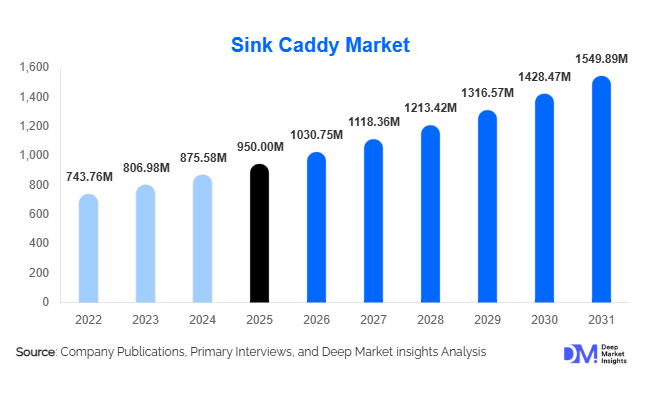
According to Deep Market Insights, the global sink caddy market size was valued at USD 950 million in 2025 and is projected to grow from USD 1,030.75 million in 2026 to reach USD 1,549.89 million by 2031, expanding at a CAGR of 8.5% during the forecast period (2026–2031). The sink caddy market growth is primarily driven by increasing consumer focus on kitchen hygiene, rising demand for space-saving organization solutions, and the growing popularity of modular kitchen setups across urban households. Additionally, the expansion of e-commerce platforms and the availability of innovative, aesthetically appealing designs are further accelerating market adoption globally.
Key Market Insights
- Demand for multifunctional and space-efficient sink caddies is rising, particularly in urban households with compact kitchen spaces.
- Plastic-based sink caddies dominate the market, driven by affordability and mass availability, while premium metal variants are gaining traction.
- North America leads the global market, supported by high consumer spending and strong adoption of kitchen organization products.
- Asia-Pacific is the fastest-growing region, driven by urbanization and rising disposable incomes in countries such as China and India.
- Online retail channels are expanding rapidly, enabling broader product access and boosting global sales penetration.
- Sustainability trends are influencing product innovation, with growing demand for eco-friendly materials such as bamboo and recyclable plastics.
What are the latest trends in the sink caddy market?
Shift Toward Hygienic and Smart Designs
Consumers are increasingly prioritizing hygiene in kitchen environments, driving demand for sink caddies with advanced drainage systems, antimicrobial coatings, and detachable components for easy cleaning. Modern designs focus on preventing water accumulation and bacterial growth, making them more suitable for long-term use. Manufacturers are introducing innovative features such as rust-resistant finishes, odor-control materials, and modular compartments that enhance usability. This trend is particularly strong in developed markets where hygiene standards are high, but it is also gaining momentum in emerging economies due to increased health awareness.
Growth of Eco-Friendly and Aesthetic Products
Sustainability is becoming a major trend, with consumers shifting toward eco-friendly sink caddies made from bamboo, recycled plastics, and biodegradable materials. At the same time, aesthetics are playing a crucial role in purchase decisions, as consumers seek products that complement modern kitchen interiors. Minimalist designs, neutral color palettes, and premium finishes are increasingly popular. Brands are focusing on combining functionality with visual appeal, transforming sink caddies from purely utilitarian products into design-oriented kitchen accessories.
What are the key drivers in the sink caddy market?
Rising Focus on Kitchen Hygiene and Organization
Growing awareness regarding cleanliness and hygiene, especially post-pandemic, has significantly increased demand for organized kitchen spaces. Sink caddies help prevent clutter and reduce bacterial growth by providing structured storage for cleaning tools. This has made them an essential component in modern households, particularly in urban regions where cleanliness standards are continuously improving.
Urbanization and Compact Living Spaces
The global trend of urbanization has led to smaller living spaces, particularly in metropolitan cities. As kitchens become more compact, the need for efficient space utilization has increased. Sink caddies offer a practical solution by optimizing sink areas and reducing clutter, making them highly popular among apartment dwellers and renters.
Expansion of E-Commerce and Product Accessibility
The rapid growth of online retail platforms has significantly improved product accessibility, allowing consumers to explore a wide range of sink caddy designs, materials, and price points. E-commerce platforms also facilitate product comparison, reviews, and competitive pricing, encouraging higher adoption rates globally.
What are the restraints for the global market?
Low Product Differentiation in Economy Segment
A large portion of the sink caddy market, particularly in the low-cost segment, is highly commoditized. Products often compete on price rather than features, leading to intense competition and limited profit margins for manufacturers. This makes it challenging for companies to build brand differentiation and customer loyalty.
Durability and Material Limitations
Durability remains a concern, especially for plastic-based sink caddies that may degrade over time due to constant exposure to moisture. Metal variants can also face issues such as corrosion if not properly treated. These limitations can negatively impact consumer satisfaction and hinder repeat purchases.
What are the key opportunities in the sink caddy industry?
Emerging Market Expansion
Rapid urbanization and rising disposable incomes in emerging economies such as India, Brazil, and Indonesia present significant growth opportunities. Increasing adoption of modular kitchens and improved access to organized retail channels are driving demand for kitchen accessories, including sink caddies. Manufacturers can tap into these markets by offering affordable yet durable products tailored to local preferences.
Innovation in Sustainable Materials
The growing emphasis on environmental sustainability is creating opportunities for eco-friendly sink caddies. Products made from bamboo, recycled plastics, and biodegradable materials are gaining popularity among environmentally conscious consumers. Companies investing in sustainable production processes and materials are likely to capture premium market segments and build long-term brand loyalty.
Report Scope
| Report Metric | Details |
|---|---|
| Market Size in 2025 | USD 950 Million |
| Market Size in 2026 | USD 1030.75 Million |
| Market Size in 2031 | USD 1549.89 Million |
| CAGR | 8.5% (2026-2031) |
| Base Year for Estimation | 2025 |
| Historical Data | 2022-2024 |
| Forecast Period | 2026-2031 |
| Report Coverage | Revenue Forecast, Competitive Landscape, Supply Chain Disruption, Growth Factors, Environment & Regulatory Landscape and Trends |
| Geographies Covered | North America, Europe, APAC, Middle East and Africa, LATAM |
| Countries Covered | U.S., Canada, U.K., Germany, France, Spain, Italy, Russia, Nordic, Benelux, Rest of Europe, China, Korea, Japan, India, Australia, Singapore, Taiwan, South East Asia, Rest of Asia-Pacific, UAE, Turky, Saudi Arabia, South Africa, Egypt, Nigeria, Rest of MEA, Brazil, Mexico, Argentina, Chile, Colombia, Rest of LATAM |
Explore more data points, trends and opportunities Download Free Sample Report
Product Type Insights
Multi-compartment sink caddies dominate the global market, accounting for approximately 34% of the total market share in 2025. The leadership of this segment is primarily driven by the strong and sustained consumer preference for multifunctional, space-efficient, and ergonomically designed kitchen accessories that streamline everyday cleaning activities. These caddies provide a consolidated storage solution for sponges, scrubbers, brushes, and liquid soap dispensers, thereby reducing countertop clutter while improving overall kitchen organization and hygiene standards. The leading segment driver is the rising demand for integrated storage solutions that maximize utility within limited kitchen spaces, particularly in urban households where space optimization is a critical consideration.As modern kitchens continue to evolve toward modular, minimalistic, and efficiency-oriented designs, multi-compartment configurations are increasingly favored for their practicality and aesthetic alignment. The growing prevalence of compact apartments, especially in metropolitan regions, further reinforces the adoption of these products. Additionally, continuous product innovation is playing a vital role in sustaining segment growth, with manufacturers introducing advanced features such as smart drainage systems, anti-bacterial coatings, anti-slip bases, detachable trays, and customizable compartments. These innovations not only enhance user convenience but also address hygiene concerns, which have become more prominent in the post-pandemic landscape. Consequently, multi-compartment sink caddies are expected to maintain their leadership position as consumers increasingly prioritize convenience, cleanliness, and efficient space utilization in kitchen environments.
Material Type Insights
Plastic-based sink caddies hold the largest market share of around 45% in 2025, primarily driven by their affordability, lightweight nature, and widespread accessibility across mass-market retail channels. The leading segment driver is the strong demand from cost-conscious consumers seeking durable yet economical kitchen organization solutions. Plastic materials offer versatility in design, enabling manufacturers to produce a wide variety of shapes, sizes, and colors that cater to diverse consumer preferences and kitchen aesthetics. This flexibility, combined with ease of manufacturing and distribution, has significantly contributed to the dominance of plastic sink caddies globally.Advancements in polymer technologies have further enhanced the durability, water resistance, and structural strength of plastic-based products, extending their lifecycle and improving overall value for money. However, evolving consumer preferences are gradually shifting the market landscape toward premium and sustainable alternatives. Stainless steel sink caddies are gaining significant traction due to their superior corrosion resistance, durability, and modern visual appeal, particularly in high-end and contemporary kitchen setups. Simultaneously, increasing environmental awareness and regulatory pressures are encouraging the adoption of eco-friendly materials such as bamboo, biodegradable composites, and recycled plastics. Manufacturers are responding by diversifying their material portfolios and investing in sustainable product development, thereby creating a balanced market dynamic between affordability, durability, and environmental responsibility.
Installation Type Insights
Freestanding sink caddies lead the market with nearly 40% share in 2025, supported by their unmatched convenience, portability, and ease of use. The leading segment driver is the growing consumer preference for flexible and non-permanent kitchen solutions that do not require installation, drilling, or structural modifications. Freestanding designs allow users to easily place, move, and clean the caddy as needed, making them highly suitable for a wide range of consumers, including renters and individuals living in temporary or shared accommodations.The adaptability of freestanding caddies to different sink sizes, countertop layouts, and kitchen configurations further strengthens their market appeal. In addition, the increasing prevalence of compact urban housing and dynamic living arrangements has amplified the demand for portable and space-efficient kitchen accessories. Manufacturers are continuously enhancing product functionality by integrating features such as anti-slip grips, efficient water drainage systems, compact footprints, and modular designs. These innovations improve usability while maintaining aesthetic appeal, thereby reinforcing the segment’s dominance. As consumers continue to prioritize convenience, flexibility, and ease of maintenance, freestanding sink caddies are expected to remain the preferred choice across both developed and emerging markets.
Distribution Channel Insights
Online retail accounts for approximately 42% of total sales in 2025, making it the leading distribution channel in the sink caddy market. The leading segment driver is the rapid expansion of digital commerce ecosystems, supported by increasing internet penetration, widespread smartphone usage, and evolving consumer purchasing behavior. E-commerce platforms provide consumers with unparalleled convenience, enabling them to browse extensive product ассортимент, compare prices, evaluate features, and access user reviews, all of which significantly influence buying decisions and enhance purchase confidence.The growth of direct-to-consumer brands, coupled with advancements in logistics and last-mile delivery infrastructure, has further strengthened the online retail landscape. Consumers are increasingly drawn to the availability of exclusive online product variants, competitive pricing, and promotional strategies such as discounts, bundled offerings, and subscription models. Additionally, the integration of advanced technologies such as AI-driven recommendations and personalized marketing is improving customer engagement and conversion rates. As digital adoption continues to accelerate globally, online retail is expected to remain a critical driver of market expansion, reshaping traditional distribution models and enhancing overall market accessibility.
End-Use Insights
The residential segment dominates the sink caddy market, contributing over 70% of the total market share in 2025. The leading segment driver is the increasing emphasis on household hygiene, organization, and modern kitchen aesthetics, particularly in the post-pandemic environment. Consumers are becoming more conscious of maintaining clean and व्यवस्थित kitchen spaces, which has significantly boosted the demand for practical storage solutions such as sink caddies. The growing adoption of modular kitchens and space-efficient layouts is further reinforcing the need for organized storage systems in residential settings.The expansion of urban populations, rising disposable incomes, and the proliferation of nuclear families are also contributing to sustained demand in this segment. At the same time, the commercial segment, including hospitality, foodservice, and institutional kitchens, is experiencing faster growth due to stringent hygiene regulations and the need for efficient workflow management. The rapid expansion of the global hospitality industry, coupled with increasing investments in foodservice infrastructure, is driving demand for durable, high-capacity, and easy-to-maintain sink caddies. As both residential and commercial users continue to prioritize cleanliness and operational efficiency, the end-use landscape is expected to witness steady and balanced growth.
Explore more data points, trends and opportunities Download Free Sample Report
Sink Caddy Market Segmentations
By Product Type
- Sponge Holders
- Soap Dispensing Caddies
- Multi-Compartment Sink Caddies
- Over-the-Faucet Caddies
- Corner Sink Caddies
- Hanging/Clip-On Sink Caddies
- Magnetic Sink Caddies
By Material Type
- Plastic
- Stainless Steel
- Aluminum
- Silicone/Rubber
- Ceramic/Stoneware
- Bamboo/Wood-Based
By Installation Type
- Freestanding
- Suction-Based
- Adhesive-Mounted
- Over-the-Sink Hanging
- Magnetic Mount
By Distribution Channel
- Online Retail
- Hypermarkets & Supermarkets
- Home Improvement Stores
- Specialty Kitchenware Stores
By End-Use
- Residential
- Commercial
Regional Insights
North America
North America holds approximately 32% of the global market share in 2025, led by the United States. The region’s growth is driven by high disposable income levels, strong consumer awareness regarding kitchen hygiene, and the widespread adoption of advanced kitchen organization solutions. A key regional growth driver is the robust culture of home improvement and renovation, particularly kitchen remodeling projects, which consistently generate demand for aesthetically appealing and functional accessories such as sink caddies. The presence of a well-established retail and e-commerce ecosystem further ensures seamless product availability and accessibility across urban and suburban areas.Additionally, consumers in North America demonstrate a strong preference for premium, durable, and design-oriented products, driving demand for materials such as stainless steel and high-quality polymers. The increasing inclination toward convenience-driven lifestyles and time-saving household solutions is also accelerating product adoption. Technological integration in retail, including omnichannel strategies and personalized marketing, further enhances consumer engagement and supports sustained market growth in the region.
Europe
Europe accounts for around 27% of the global market share, with key contributions from Germany, the United Kingdom, and France. The regional market is strongly influenced by sustainability initiatives and stringent environmental regulations. A major regional growth driver is the increasing emphasis on eco-friendly consumption, which is encouraging the adoption of recyclable, biodegradable, and sustainably sourced sink caddies. Consumers in Europe exhibit a high preference for minimalist, functional, and aesthetically refined kitchen products, prompting manufacturers to focus on design innovation and material sustainability.The rising prevalence of compact urban living spaces, particularly in major European cities, is further driving demand for space-saving and multifunctional kitchen accessories. In addition, the strong presence of organized retail networks and the rapid expansion of e-commerce platforms are enhancing product reach and availability. Government policies supporting sustainable manufacturing practices and increasing consumer awareness of environmental impact are expected to continue shaping the market dynamics in Europe.
Asia-Pacific
Asia-Pacific is the fastest-growing region, with a CAGR exceeding 10%. China dominates both production and consumption due to its extensive manufacturing base and strong domestic demand. A primary regional growth driver is rapid urbanization, coupled with the expansion of the middle-class population and rising disposable incomes across emerging economies such as India and Southeast Asian countries. These factors are significantly increasing the adoption of modern kitchen appliances and accessories, including sink caddies.In India, the growing penetration of modular kitchens, increasing real estate development, and rising consumer awareness regarding hygiene and organization are fueling market growth. The rapid expansion of e-commerce platforms and improvements in logistics infrastructure are making products more accessible across urban and semi-urban areas. Additionally, the growing influence of Western lifestyle trends and the shift toward convenience-oriented living are further accelerating demand. As the region continues to experience economic growth and lifestyle transformation, Asia-Pacific is expected to remain a key growth engine for the global market.
Latin America
Latin America is experiencing steady growth, particularly in countries such as Brazil and Mexico. A significant regional growth driver is the ongoing process of urbanization, which is transforming consumer lifestyles and increasing the demand for modern kitchen solutions. Rising disposable incomes and the expansion of the middle-class population are enabling greater spending on household organization products, including sink caddies.The increasing penetration of organized retail and e-commerce platforms is enhancing product visibility and accessibility, while also improving consumer awareness. Cultural shifts toward improved household hygiene and cleanliness are further supporting product adoption. Additionally, the gradual development of residential infrastructure and the influence of global consumer trends are contributing to the steady expansion of the sink caddy market across the region.
Middle East & Africa
The Middle East & Africa region is gradually expanding, supported by growth in the hospitality sector and increasing infrastructure development. A key regional growth driver is the rapid expansion of tourism and hospitality industries, particularly in countries such as the UAE and Saudi Arabia, which is generating substantial demand for efficient and hygienic kitchen organization solutions in hotels, restaurants, and institutional kitchens.Rising investments in residential and commercial construction projects, along with increasing urbanization and improving living standards, are encouraging the adoption of modern kitchen accessories among consumers. The growing influence of global lifestyle trends and the expansion of organized retail networks are further enhancing market penetration. As economic diversification efforts continue and infrastructure development progresses, the region is expected to witness gradual yet consistent growth in demand for sink caddies.
Key Players in the Sink Caddy Market
- Simplehuman LLC
- OXO International Ltd.
- InterDesign (iDesign)
- Joseph Joseph Ltd.
- Umbra Ltd.
- Rubbermaid Inc.
- IKEA
- Yamazaki Home
- Spectrum Diversified Designs
- Brabantia
- Tescoma
- mDesign
- Neat-O LLC
- KitchenCraft
- Better Houseware