Hosiery Market Size
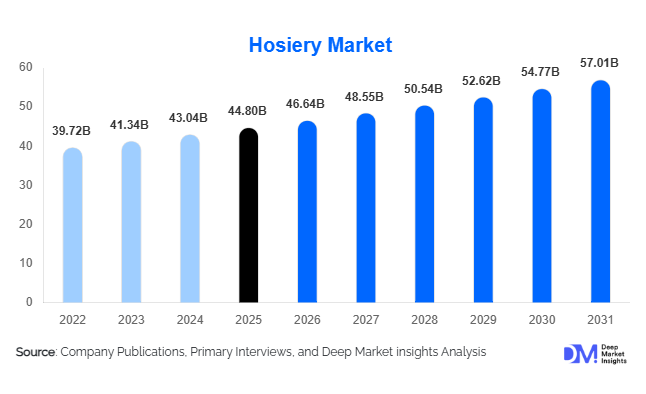
According to Deep Market Insights, the global hosiery market size was valued at USD 44.8 billion in 2025 and is projected to grow from USD 46.64 billion in 2026 to reach USD 57.01 billion by 2031, expanding at a CAGR of 4.1% during the forecast period (2026–2031). The hosiery market growth is primarily driven by rising demand for fashion-oriented apparel, increasing athleisure adoption, expansion of e-commerce retail, and growing awareness regarding comfort-focused and performance-based clothing products.
Hosiery products have evolved beyond basic apparel essentials into fashion, healthcare, and sports-performance products catering to diverse consumer demographics globally. Increasing female workforce participation, changing fashion trends, and rising disposable income in emerging economies continue to support market expansion. Moreover, technological advancements in seamless knitting, moisture management, compression fabrics, and sustainable textile manufacturing are accelerating premium product demand across developed and emerging markets.
The growth of active lifestyles and fitness culture has significantly boosted demand for sports socks, leggings, compression hosiery, and thermal products. In parallel, rising healthcare awareness and aging populations are expanding the medical compression hosiery segment, particularly in North America, Europe, and Japan. Digital transformation across apparel retail has also reshaped hosiery distribution, with online channels enabling direct-to-consumer business models, personalized product offerings, and rapid market penetration for new brands.
Key Market Insights
- Performance and compression hosiery segments are witnessing rapid global growth, supported by increasing sports participation and healthcare awareness.
- Sustainable hosiery products made from recycled fibers and organic materials are gaining traction, particularly across Europe and North America.
- Asia-Pacific is emerging as the fastest-growing regional market, led by China and India due to urbanization, rising disposable income, and expanding apparel retail.
- Women account for the largest consumer segment, driven by strong demand for leggings, tights, stockings, and fashion hosiery products.
- E-commerce channels are reshaping hosiery retail distribution, enabling rapid expansion of direct-to-consumer brands globally.
- Technological advancements in seamless knitting and smart textile integration are improving product comfort, durability, and performance features.
Hosiery Market Trends
Sustainable and Eco-Friendly Hosiery Gaining Momentum
The global hosiery industry is increasingly shifting toward sustainable manufacturing practices and environmentally friendly materials. Consumers are becoming more conscious regarding textile waste, ethical sourcing, and carbon emissions associated with apparel production. As a result, manufacturers are investing heavily in recycled polyester, organic cotton, bamboo fibers, and biodegradable yarns to develop eco-friendly hosiery collections. European apparel regulations and ESG commitments from global fashion brands are accelerating the transition toward sustainable textile ecosystems. Several premium brands are also adopting low-water dyeing technologies, recyclable packaging solutions, and circular manufacturing models to reduce environmental impact. Sustainability certifications and transparent sourcing practices are increasingly influencing consumer purchasing decisions, particularly among younger demographics.
Rise of Athleisure and Performance Hosiery
The rapid expansion of the global athleisure market is significantly influencing hosiery demand worldwide. Consumers increasingly prefer multifunctional apparel products suitable for fitness activities, casual wear, and workplace usage. Compression leggings, moisture-wicking socks, thermal hosiery, and seamless activewear products are witnessing strong growth among urban consumers. Fitness participation, yoga adoption, running culture, and wellness trends are supporting the expansion of performance-based hosiery categories. Advanced fabric technologies including anti-odor materials, temperature regulation, moisture management, and graduated compression systems are becoming major differentiators among leading brands. Social media influencers and celebrity-backed athleisure trends continue accelerating consumer adoption globally.
Hosiery Market Drivers
Growing Demand for Athleisure and Functional Apparel
The increasing global popularity of athleisure and active lifestyles remains one of the primary growth drivers for the hosiery market. Consumers are demanding apparel products that combine comfort, flexibility, and performance functionality for daily wear and fitness applications. Sports socks, compression hosiery, seamless leggings, and thermal products are increasingly integrated into mainstream fashion and sportswear categories. Rising gym memberships, fitness awareness, and outdoor recreational activities are further supporting demand for performance-oriented hosiery products. Manufacturers are continuously innovating with stretchable fabrics, moisture-control systems, and lightweight knitting technologies to improve product functionality and consumer comfort.
Expansion of E-commerce and Digital Apparel Retail
The rapid growth of e-commerce platforms and direct-to-consumer retail models is transforming the global hosiery industry. Online retail channels provide consumers with broader product selection, personalized recommendations, subscription-based purchasing options, and transparent pricing. Digital marketing, influencer collaborations, and social media promotions are accelerating hosiery brand visibility and customer engagement globally. Emerging hosiery brands are increasingly leveraging online channels to expand internationally without extensive physical retail infrastructure. Improvements in logistics, digital payment systems, and mobile commerce adoption are further supporting online hosiery sales growth.
Hosiery Market Restraints
Volatility in Raw Material Prices
Fluctuating prices of cotton, nylon, polyester, elastane, and synthetic yarns continue posing significant challenges for hosiery manufacturers globally. Cotton prices are highly dependent on agricultural output and climate conditions, while synthetic fiber costs are influenced by crude oil prices and petrochemical market volatility. Rising input costs often compress profit margins and create pricing pressure for both manufacturers and retailers. Smaller market participants face additional operational challenges due to limited procurement bargaining power and supply chain flexibility.
Intense Competition and Market Fragmentation
The global hosiery market remains highly fragmented with the presence of multinational apparel companies, regional manufacturers, private-label producers, and low-cost exporters. Intense pricing competition, particularly in economy and mass-market product categories, creates margin pressure for established brands. Counterfeit products and unorganized retail participants in developing economies also negatively impact branded product sales. Maintaining product differentiation through innovation, sustainability, and premium branding remains a critical challenge for manufacturers operating in competitive global markets.
Hosiery Market Opportunities
Expansion of Medical and Compression Hosiery
The growing prevalence of diabetes, obesity, circulatory disorders, and aging populations globally is creating substantial opportunities for medical and therapeutic hosiery products. Compression stockings, diabetic socks, and support leggings are increasingly used for circulation improvement, recovery support, and preventive healthcare applications. Hospitals, rehabilitation centers, pharmacies, and elderly care institutions are becoming important distribution channels for medical hosiery products. Technological advancements in compression engineering and breathable fabrics are further enhancing consumer adoption in both healthcare and sports recovery applications.
Growth of Sustainable Premium Hosiery
Rising consumer preference for eco-friendly and ethically manufactured apparel products presents major growth opportunities for premium hosiery brands. Sustainable hosiery products made from organic cotton, bamboo fibers, recycled polyester, and biodegradable materials are commanding premium pricing in developed markets. Fashion brands investing in transparent sourcing, low-emission manufacturing, and recyclable packaging are gaining stronger consumer loyalty. The growing influence of ESG regulations and sustainable fashion trends is expected to accelerate investments in green textile technologies over the forecast period.
Report Scope
| Report Metric | Details |
|---|---|
| Market Size in 2025 | USD 44.8 Billion |
| Market Size in 2026 | USD 46.64 Billion |
| Market Size in 2031 | USD 57.01 Billion |
| CAGR | 4.1% (2026-2031) |
| Base Year for Estimation | 2025 |
| Historical Data | 2022-2024 |
| Forecast Period | 2026-2031 |
| Report Coverage | Revenue Forecast, Competitive Landscape, Supply Chain Disruption, Growth Factors, Environment & Regulatory Landscape and Trends |
| Geographies Covered | North America, Europe, APAC, Middle East and Africa, LATAM |
| Countries Covered | U.S., Canada, U.K., Germany, France, Spain, Italy, Russia, Nordic, Benelux, Rest of Europe, China, Korea, Japan, India, Australia, Singapore, Taiwan, South East Asia, Rest of Asia-Pacific, UAE, Turky, Saudi Arabia, South Africa, Egypt, Nigeria, Rest of MEA, Brazil, Mexico, Argentina, Chile, Colombia, Rest of LATAM |
Explore more data points, trends and opportunities Download Free Sample Report
Product Type Insights
Socks dominate the global hosiery market, accounting for the largest share due to universal consumer usage and high replacement frequency. Athletic socks and performance-oriented products are witnessing rapid growth supported by increasing sports participation and athleisure adoption. Leggings represent another high-growth category driven by rising female workforce participation, yoga culture, and casual fashion trends. Compression stockings and medical hosiery products are expanding steadily owing to increasing healthcare awareness and aging demographics. Fashion tights and stockings continue maintaining strong demand across premium fashion markets in Europe and North America, while thermal hosiery products are gaining traction in colder regions due to rising outdoor activity participation.
Material Type Insights
Cotton-based hosiery products account for the largest market share due to superior comfort, breathability, and affordability. Cotton remains widely preferred for daily wear socks, leggings, and casual hosiery products across both developed and emerging markets. However, blended fabrics integrating elastane, polyester, and nylon are witnessing stronger growth due to enhanced elasticity, moisture management, and durability. Sustainable materials including bamboo fiber, recycled polyester, and bio-based textiles are gaining traction among environmentally conscious consumers, particularly in Europe and North America. Premium brands are increasingly adopting advanced fabric blends to improve performance and product longevity.
Distribution Channel Insights
Supermarkets and hypermarkets remain leading distribution channels for hosiery products due to mass-market accessibility and bundled product offerings. However, online retail is emerging as the fastest-growing channel globally, driven by increasing smartphone penetration, digital payment adoption, and direct-to-consumer apparel brands. E-commerce platforms allow consumers to compare products, access customer reviews, and purchase personalized hosiery products conveniently. Specialty apparel stores continue maintaining strong presence in premium and fashion-oriented categories, while pharmacies and medical stores play an important role in compression hosiery and therapeutic product distribution.
End-User Insights
Women represent the largest end-user segment within the hosiery market, supported by strong demand for leggings, tights, stockings, fashion socks, and shapewear products. Increasing female workforce participation, fashion consciousness, and athleisure adoption continue driving segment dominance globally. Men’s hosiery demand is also expanding steadily due to rising interest in athletic socks, compression products, and formal dress socks. Children’s hosiery remains an important segment supported by growing population and increasing spending on kids’ apparel products. Unisex and gender-neutral hosiery products are gradually emerging as niche categories influenced by evolving fashion preferences and inclusivity trends.
Explore more data points, trends and opportunities Download Free Sample Report
Hosiery Market Segmentations
By Product Type
- Socks
- Stockings
- Tights
- Leggings
- Pantyhose
- Compression Hosiery
- Thermal Hosiery
- Sports & Performance Hosiery
- Medical & Therapeutic Hosiery
- Sustainable Hosiery
By Material Type
- Cotton
- Nylon
- Polyester
- Wool
- Spandex/Elastane
- Bamboo Fiber
- Blended Fabrics
- Recycled Fibers
By End User
- Men
- Women
- Children
- Unisex
By Distribution Channel
- Supermarkets & Hypermarkets
- Specialty Apparel Stores
- Department Stores
- Online Retail/E-commerce
- Brand-Owned Stores
- Pharmacies & Medical Stores
- Wholesale & Distributor Networks
By Functionality
- Fashion & Aesthetic Hosiery
- Medical & Therapeutic Hosiery
- Sports & Performance Hosiery
- Comfort & Daily Wear Hosiery
- Occupational Hosiery
- Seasonal & Thermal Hosiery
Regional Insights
North America
North America accounted for approximately 36% of the global hosiery market in 2025, supported by strong consumer spending on apparel and premium fashion products. The United States dominates regional demand due to high adoption of athleisure wear, established retail infrastructure, and increasing healthcare awareness supporting compression hosiery sales. Canada also demonstrates stable demand growth driven by winter apparel consumption and premium hosiery purchases. The region continues witnessing strong growth in sustainable hosiery adoption and direct-to-consumer apparel brands.
Europe
Europe remains one of the most mature hosiery markets globally, led by Germany, Italy, France, and the United Kingdom. Italy maintains strong leadership in luxury and designer hosiery products, while Germany represents a major market for medical compression hosiery. Sustainability and eco-friendly apparel trends are particularly influential across European markets, encouraging manufacturers to adopt recycled materials and low-emission production technologies. Premium fashion-oriented hosiery consumption remains strong throughout Western Europe.
Asia-Pacific
Asia-Pacific is the fastest-growing regional market and accounted for nearly 35% of global revenue in 2025. China dominates both production and consumption due to its large textile manufacturing ecosystem and growing domestic fashion demand. India is emerging as a major growth market supported by rising urbanization, expanding middle-class populations, and increasing e-commerce penetration. Japan and South Korea continue generating demand for premium technologically advanced hosiery products. Southeast Asia is also witnessing rapid retail expansion and rising sportswear adoption.
Latin America
Latin America is witnessing moderate hosiery market growth led by Brazil and Mexico. Rising disposable income, increasing fashion awareness, and growing international apparel brand presence are contributing to regional market development. Brazilian consumers continue driving strong demand for leggings, sportswear hosiery, and fashion socks. Expanding online retail penetration is further improving product accessibility throughout the region.
Middle East & Africa
The Middle East and Africa region is gradually emerging as a promising hosiery market supported by urbanization, retail infrastructure development, and increasing fashion consciousness. Gulf countries including the UAE and Saudi Arabia are witnessing rising demand for premium imported hosiery brands. South Africa remains one of the leading African hosiery markets due to relatively advanced retail networks and increasing consumer spending on apparel products. Rising tourism and hospitality sectors are also supporting fashion retail expansion across several Middle Eastern economies.
Key Players in the Hosiery Market
- Hanesbrands Inc.
- Gildan Activewear Inc.
- Jockey International Inc.
- Adidas AG
- Nike Inc.
- Puma SE
- Wolford AG
- Spanx LLC
- Falke KGaA
- Golden Lady Company S.p.A.
- CSP International Fashion Group S.p.A.
- Under Armour Inc.
- Sigvaris Group
- Medi GmbH & Co. KG
- Carolina Hosiery Inc.