Fanny Packs Market Size
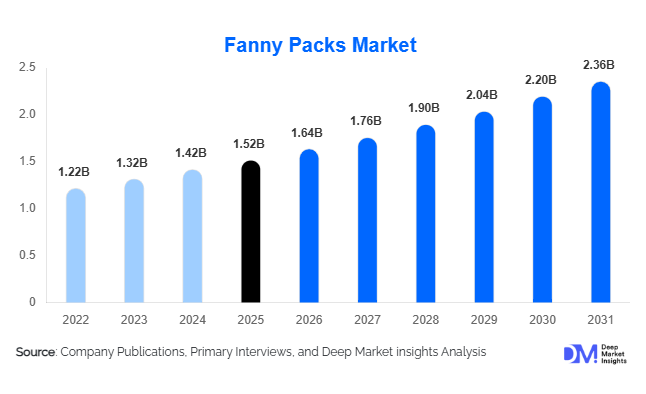
According to Deep Market Insights, the global fanny packs market size was valued at USD 1.52 billion in 2025 and is projected to grow from USD 1.64 billion in 2026 to reach USD 2.36 billion by 2031, expanding at a CAGR of 7.6% during the forecast period (2026–2031). The fanny packs market growth is primarily driven by the increasing adoption of athleisure fashion, rising demand for compact hands-free accessories, rapid urban mobility trends, and growing consumer preference for functional yet stylish lifestyle products. The market has evolved significantly from being a travel utility segment into a mainstream fashion category embraced by luxury brands, sportswear companies, outdoor gear manufacturers, and direct-to-consumer accessory labels.
Growing participation in outdoor recreation, fitness activities, music festivals, and global tourism is creating sustained demand for waist bags, belt bags, and crossbody sling packs. Consumers increasingly seek lightweight accessories that offer convenience, security, and ergonomic comfort without compromising aesthetics. The rising influence of celebrity culture, social media trends, and streetwear fashion has accelerated product adoption among millennials and Gen Z consumers worldwide.
The market is also benefiting from the expansion of e-commerce and social commerce platforms, which enable brands to launch customized collections, influencer collaborations, and direct-to-consumer sales models. Sustainability is emerging as a critical purchasing factor, with consumers favoring products manufactured using recycled polyester, vegan leather, and eco-friendly materials. Technological innovation, including RFID-blocking compartments, waterproof materials, anti-theft systems, and smart wearable integrations, is further enhancing product value propositions. Asia-Pacific remains the fastest-growing regional market, while North America continues to dominate premium and sports-oriented demand globally.
Key Market Insights
- Fashion-oriented belt bags and crossbody waist packs are increasingly replacing traditional handbags, particularly among younger urban consumers seeking compact and versatile accessories.
- Athleisure and streetwear trends are driving global demand, with sportswear and luxury brands actively expanding premium waist bag collections.
- North America dominates the global market, supported by strong outdoor recreation participation, high disposable income, and established fashion accessory demand.
- Asia-Pacific is the fastest-growing region, fueled by rising middle-class spending, digital retail expansion, and increasing fashion consciousness.
- Sustainable materials and eco-friendly manufacturing practices are becoming critical purchasing factors, particularly among Gen Z and millennial consumers.
- Technology-enabled features, including RFID protection, anti-theft designs, waterproof materials, and Bluetooth tracking integrations, are reshaping product innovation.
Fanny Packs Market Trends
Crossbody Belt Bags Becoming Mainstream Fashion Accessories
Fanny packs have transitioned from utility-focused travel accessories into mainstream fashion products integrated into streetwear, athleisure, and luxury collections. Crossbody belt bag styling has become especially popular among millennials and Gen Z consumers, driven by celebrity endorsements, influencer marketing, and social media-driven fashion trends. Luxury fashion houses and sportswear companies are increasingly launching seasonal belt bag collections featuring premium materials, minimalist aesthetics, and multi-functional designs. This transformation has significantly expanded consumer demographics and improved average selling prices within premium categories. Fashion collaborations and limited-edition product launches are also strengthening brand differentiation while accelerating repeat purchases across urban fashion markets globally.
Sustainable and Functional Product Innovation Accelerating
Manufacturers are increasingly focusing on sustainable materials and advanced functionality to differentiate products in a highly competitive market. Recycled polyester, vegan leather, organic cotton blends, and biodegradable fabrics are gaining traction across premium and mid-range segments. Consumers are also demanding features such as RFID-blocking compartments, waterproof coatings, anti-theft zippers, hidden pockets, and modular storage systems. Sportswear brands are integrating ergonomic support systems and lightweight performance fabrics to target fitness and outdoor recreation users. Direct-to-consumer brands are particularly aggressive in launching eco-conscious collections with transparent sourcing practices and recyclable packaging, aligning with growing environmental awareness among younger buyers.
Fanny Packs Market Drivers
Growing Adoption of Athleisure and Streetwear Fashion
The rapid expansion of athleisure and streetwear culture globally is one of the strongest drivers supporting fanny packs market growth. Consumers increasingly prioritize products that combine style, convenience, and mobility, making waist bags and belt bags highly attractive lifestyle accessories. Sportswear brands, luxury fashion companies, and celebrity-led collaborations have significantly elevated product visibility and desirability. Urban consumers are increasingly using fanny packs for daily commuting, travel, and casual wear, contributing to strong demand across premium and mid-range categories. The growing popularity of gender-neutral fashion is also supporting wider product adoption, particularly in unisex collections.
Expansion of Outdoor Recreation and Travel Activities
Rising participation in outdoor recreation, fitness activities, music festivals, hiking, cycling, and international tourism is significantly driving product demand. Consumers prefer compact hands-free accessories that provide secure storage for smartphones, wallets, hydration supplies, and travel essentials. Sports-oriented and travel-oriented fanny packs equipped with water-resistant materials, ergonomic straps, reflective elements, and anti-theft technologies are witnessing particularly strong demand in North America and Europe. The recovery of global tourism and increasing adventure travel participation are further accelerating the adoption of utility-focused waist packs.
Fanny Packs Market Restraints
Intense Pricing Pressure and Product Commoditization
The global fanny packs market faces significant pricing pressure due to the presence of numerous low-cost regional manufacturers and private-label sellers. Economy and mid-range categories are highly competitive, making it difficult for established brands to maintain strong profit margins. Online marketplaces have intensified price competition by increasing transparency and enabling rapid product comparisons. Counterfeit products and imitation designs also create additional challenges for premium and luxury brands seeking to protect brand equity and pricing power.
Raw Material Cost Volatility and Supply Chain Risks
Manufacturers are exposed to fluctuations in the prices of nylon, polyester, leather, zippers, and synthetic fabrics, many of which are linked to petrochemical markets and global logistics costs. Supply chain disruptions, trade restrictions, container shortages, and geopolitical tensions can significantly increase production and transportation expenses. Smaller manufacturers with limited sourcing flexibility are particularly vulnerable to procurement instability and inventory challenges. Rising sustainability compliance costs are also adding operational complexity for companies transitioning toward eco-friendly manufacturing practices.
Fanny Packs Market Opportunities
Growth of Sustainable and Eco-Friendly Fashion Accessories
The increasing global emphasis on sustainability presents substantial opportunities for manufacturers investing in eco-friendly materials and ethical production processes. Consumers are increasingly willing to pay premium prices for products made from recycled polyester, vegan leather, and biodegradable fabrics. Sustainability certifications, low-impact dyeing technologies, and transparent sourcing practices are becoming important differentiators, particularly in North America and Europe. Companies adopting circular manufacturing models and recyclable packaging solutions are expected to strengthen brand loyalty and capture growing demand among environmentally conscious consumers.
Smart and Technology-Integrated Fanny Packs
The integration of smart technologies into wearable accessories is creating new growth opportunities within the market. Advanced products equipped with USB charging ports, Bluetooth tracking systems, anti-theft alarms, RFID protection, and modular storage features are gaining traction among urban commuters and frequent travelers. Smart fanny packs designed for cyclists, runners, and travelers are expected to witness increasing adoption as consumers prioritize convenience, security, and digital connectivity. Technology-focused product innovation remains relatively underpenetrated globally, providing strong opportunities for new entrants and premium brands.
Report Scope
| Report Metric | Details |
|---|---|
| Market Size in 2025 | USD 1.52 Billion |
| Market Size in 2026 | USD 1.64 Billion |
| Market Size in 2031 | USD 2.36 Billion |
| CAGR | 7.6% (2026-2031) |
| Base Year for Estimation | 2025 |
| Historical Data | 2022-2024 |
| Forecast Period | 2026-2031 |
| Report Coverage | Revenue Forecast, Competitive Landscape, Supply Chain Disruption, Growth Factors, Environment & Regulatory Landscape and Trends |
| Geographies Covered | North America, Europe, APAC, Middle East and Africa, LATAM |
| Countries Covered | U.S., Canada, U.K., Germany, France, Spain, Italy, Russia, Nordic, Benelux, Rest of Europe, China, Korea, Japan, India, Australia, Singapore, Taiwan, South East Asia, Rest of Asia-Pacific, UAE, Turky, Saudi Arabia, South Africa, Egypt, Nigeria, Rest of MEA, Brazil, Mexico, Argentina, Chile, Colombia, Rest of LATAM |
Explore more data points, trends and opportunities Download Free Sample Report
Product Type Insights
Fashion fanny packs dominate the market, accounting for nearly 34% of global revenue in 2025. The segment benefits from the growing influence of luxury streetwear, celebrity endorsements, and premium fashion collaborations. Designer belt bags and crossbody waist packs are increasingly positioned as everyday lifestyle accessories rather than purely functional travel products. Sports and outdoor fanny packs represent one of the fastest-growing categories, supported by increasing participation in fitness, hiking, running, and cycling activities. Travel utility packs featuring RFID protection, anti-theft zippers, and waterproof materials continue gaining popularity among international travelers and urban commuters. Tactical and utility waist packs are also witnessing gradual adoption among industrial workers, event personnel, and delivery professionals seeking practical hands-free storage solutions.
Material Insights
Nylon-based fanny packs hold the largest market share, representing approximately 31% of total revenue globally due to their lightweight structure, durability, affordability, and water resistance. Nylon remains the preferred material for sports, travel, and outdoor recreation applications because it provides high durability while maintaining low manufacturing costs. Polyester-based products are widely adopted within economy and mass-market categories because of their cost-effectiveness and design flexibility. Leather and vegan leather products dominate premium and luxury segments, particularly among fashion-conscious consumers seeking high-end aesthetics and premium craftsmanship. Sustainable materials such as recycled polyester and organic cotton blends are witnessing the fastest growth rates as environmental awareness increasingly influences consumer purchasing behavior.
Distribution Channel Insights
Online retail channels dominate global fanny pack sales, accounting for nearly 39% of market revenue in 2025. E-commerce marketplaces, brand-owned websites, and social commerce platforms enable consumers to access broader product selections, customized collections, and influencer-driven promotions. Digital retail channels are particularly important among younger demographics that prioritize convenience, product comparisons, and trend-driven purchasing decisions. Offline retail remains important for premium and luxury segments, with specialty fashion stores, sports retailers, department stores, and airport retail outlets continuing to generate significant sales volumes. Direct-to-consumer strategies are becoming increasingly popular among emerging brands seeking to reduce distribution costs and strengthen customer engagement through personalized digital marketing campaigns.
Consumer Group Insights
Unisex fanny packs represent the largest consumer category, accounting for approximately 42% of global demand in 2025. The popularity of gender-neutral fashion and minimalist accessories has significantly expanded adoption across diverse consumer demographics. Women’s fanny packs continue witnessing strong growth due to rising demand for compact crossbody bags that combine style and functionality. Men’s waist bags are increasingly popular within sportswear, travel, and streetwear applications. Kids’ and teenagers’ products are emerging as a growing niche segment, particularly through cartoon-themed designs, school travel accessories, and youth-oriented fashion collaborations.
End-Use Insights
Fashion and lifestyle applications remain the largest end-use segment globally, accounting for nearly 36% of market demand in 2025. Celebrity endorsements, streetwear culture, and social media-driven fashion trends continue supporting product penetration in this segment. Sports and fitness applications are among the fastest-growing categories due to increasing gym memberships, outdoor recreation participation, and active lifestyle adoption. Travel and tourism remain important contributors to demand growth, particularly for anti-theft and RFID-enabled waist packs designed for international travelers. Music festivals, concerts, and large-scale entertainment events are also creating seasonal spikes in product demand, especially among younger consumers seeking secure and lightweight accessories.
Explore more data points, trends and opportunities Download Free Sample Report
Fanny Packs Market Segmentations
By Product Type
- Classic Waist Packs
- Fashion Fanny Packs
- Sports & Outdoor Fanny Packs
- Travel Utility Packs
- Tactical & Utility Packs
- Kids’ Fanny Packs
By Material
- Nylon
- Polyester
- Leather
- Canvas
- Polyurethane (PU)
- Recycled & Sustainable Fabrics
By Consumer Group
- Men
- Women
- Unisex
- Kids & Teenagers
By Distribution Channel
- Online Retail
- Brand-Owned Stores
- Specialty Fashion Stores
- Sports & Outdoor Retailers
- Department Stores
- Airport & Travel Retail Stores
By End Use Application
- Fashion & Lifestyle
- Sports & Fitness
- Travel & Tourism
- Outdoor Recreation
- Daily Urban Commuting
- Music Festivals & Events
- Workwear & Industrial Utility
Regional Insights
North America
North America accounted for approximately 32% of the global fanny packs market in 2025, making it the leading regional market. The United States dominates regional demand due to strong athleisure adoption, high outdoor recreation participation, and premium consumer spending on fashion accessories. Crossbody belt bags and sports-oriented waist packs are particularly popular among urban consumers and fitness enthusiasts. Canada contributes steadily through strong travel demand and outdoor sports participation. The region benefits from advanced e-commerce infrastructure, strong brand presence, and widespread influencer-driven marketing campaigns.
Europe
Europe represents nearly 24% of the global market, led by Germany, the United Kingdom, France, and Italy. European consumers increasingly prioritize sustainable materials, ethical sourcing, and premium product quality, encouraging manufacturers to invest in eco-friendly collections. Luxury fashion brands headquartered in Europe continue shaping global belt bag trends through premium designer launches and seasonal collaborations. Tourism growth, outdoor recreation participation, and widespread acceptance of waist bags within urban fashion are supporting steady regional demand expansion.
Asia-Pacific
Asia-Pacific is the fastest-growing regional market and accounted for approximately 29% of global revenue in 2025. China dominates regional demand due to strong domestic manufacturing capabilities, expanding middle-class consumption, and rapid growth in digital retail. Japan and South Korea continue driving premium and fashion-forward demand, particularly within luxury and streetwear categories. India is emerging as a high-growth market due to urbanization, rising disposable incomes, and increasing adoption of global fashion trends among younger consumers. Southeast Asia is also witnessing rising demand through expanding e-commerce penetration and growing tourism activity.
Latin America
Latin America is experiencing moderate but consistent market growth led by Brazil and Mexico. Expanding urban populations, increasing fashion awareness, and growing adoption of affordable sports accessories are contributing to rising regional demand. E-commerce expansion is improving accessibility to international sportswear and fashion brands, while younger consumers increasingly adopt crossbody waist bags as everyday lifestyle accessories.
Middle East & Africa
The Middle East & Africa market remains comparatively smaller but is witnessing steady growth due to increasing luxury retail expansion and tourism activity. UAE and Saudi Arabia are major regional demand centers driven by high disposable income and premium fashion spending. South Africa contributes through outdoor recreation and sports-oriented demand. The region is also benefiting from increasing investments in luxury shopping infrastructure and international fashion retail expansion.
Key Players in the Fanny Packs Market
- Nike
- Adidas
- The North Face
- Patagonia
- Puma
- Herschel Supply Co.
- Lululemon Athletica
- Gucci
- Louis Vuitton
- JanSport
- Dakine
- Under Armour
- Supreme
- Kipling
- Travelon