Eco-Friendly Cleaning Products Market Size
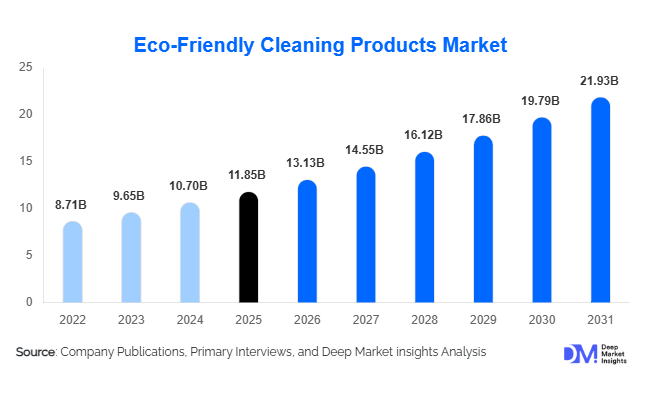
According to Deep Market Insights, the global eco-friendly cleaning products market size was valued at USD 11.85 billion in 2025 and is projected to grow from USD 13.13 billion in 2026 to reach USD 21.93 billion by 2031, expanding at a CAGR of 10.8% during the forecast period (2026–2031). The eco-friendly cleaning products market growth is primarily driven by rising consumer awareness regarding health and environmental sustainability, increasing adoption of biodegradable and plant-based formulations, growing government regulations on hazardous chemicals, and expanding demand for sustainable household and institutional cleaning solutions. The transition toward refillable packaging, low-toxicity ingredients, and circular economy initiatives is further accelerating market expansion across residential, commercial, and industrial applications.
Key Market Insights
- Plant-based and biodegradable formulations are becoming mainstream, driven by consumer concerns regarding chemical exposure, indoor air quality, and environmental impact.
- Refillable and zero-waste packaging solutions are witnessing rapid adoption, helping manufacturers reduce plastic consumption and improve sustainability credentials.
- North America dominates the global market, accounting for approximately 34% of total revenue in 2025, supported by strong consumer awareness and green procurement programs.
- Asia-Pacific is the fastest-growing regional market, fueled by rising middle-class income, urbanization, and increasing demand for sustainable consumer products.
- Institutional demand is accelerating, particularly from healthcare facilities, hospitality operators, educational institutions, and government organizations implementing green procurement standards.
- Technology-driven innovation in bio-enzymes, concentrated formulations, and sustainable packaging is improving product performance while reducing environmental footprints.
Eco-Friendly Cleaning Products Market Trends
Refillable and Zero-Waste Cleaning Systems Gaining Momentum
One of the most transformative trends in the eco-friendly cleaning products market is the rapid shift toward refillable packaging and zero-waste cleaning systems. Consumers are increasingly adopting reusable spray bottles, concentrated cleaning tablets, dissolvable strips, and refill pouches that significantly reduce single-use plastic waste. Major retailers and consumer goods companies are expanding refill stations and subscription-based refill models to strengthen sustainability commitments. The trend is particularly strong in North America and Europe, where environmental regulations and consumer expectations are driving investments in circular packaging ecosystems. Beyond sustainability benefits, refillable systems lower transportation costs, reduce packaging material requirements, and improve long-term customer retention through recurring purchases.
Bio-Enzyme and Biotechnology-Based Cleaning Solutions Expanding
Manufacturers are increasingly investing in bio-enzyme technologies that offer superior cleaning performance without relying on harsh synthetic chemicals. Bio-based formulations use naturally occurring enzymes and microorganisms to break down grease, stains, organic matter, and odors. These products are gaining acceptance across both residential and commercial applications because they combine environmental sustainability with high cleaning efficacy. Continuous advancements in biotechnology are enabling companies to develop multi-functional enzyme formulations capable of replacing conventional cleaning chemicals. Growing consumer trust in scientifically validated green cleaning technologies is expected to support strong market growth throughout the forecast period.
Eco-Friendly Cleaning Products Market Drivers
Growing Consumer Focus on Health and Wellness
Consumers are becoming increasingly aware of the potential health risks associated with conventional cleaning products containing ammonia, chlorine, phosphates, synthetic fragrances, and volatile organic compounds (VOCs). Rising concerns regarding respiratory illnesses, allergies, skin irritation, and indoor air pollution are encouraging households to adopt safer alternatives. Families with children, elderly individuals, and pets are among the most active purchasers of eco-friendly cleaning products. This growing preference for non-toxic and naturally derived solutions is creating sustained demand across multiple product categories including surface cleaners, laundry detergents, and dishwashing products.
Regulatory Support for Sustainable Cleaning Products
Governments and regulatory bodies worldwide are implementing stricter environmental regulations governing chemical ingredients used in cleaning formulations. Restrictions on phosphates, chlorine compounds, and non-biodegradable surfactants are encouraging manufacturers to develop environmentally responsible alternatives. Sustainability-focused regulations in Europe, North America, and selected Asia-Pacific markets are creating favorable conditions for eco-friendly cleaning product adoption. Green certifications and procurement guidelines are further strengthening demand across institutional and commercial sectors.
Eco-Friendly Cleaning Products Market Restraints
Premium Product Pricing Compared to Conventional Alternatives
Despite growing adoption, eco-friendly cleaning products continue to face challenges associated with higher retail pricing. Sustainable raw materials, specialized certifications, environmentally friendly packaging, and lower production scale contribute to elevated costs compared to conventional cleaning products. Price-sensitive consumers, particularly in emerging economies, may continue to favor traditional cleaning solutions, limiting market penetration in certain regions.
Consumer Skepticism and Greenwashing Concerns
The growing popularity of sustainable products has resulted in an increase in environmental marketing claims that are sometimes difficult for consumers to verify. Greenwashing practices and inconsistent sustainability labeling can create confusion and reduce trust. Companies must invest in transparent communication, third-party certifications, and verifiable sustainability metrics to overcome consumer skepticism and maintain brand credibility.
Eco-Friendly Cleaning Products Market Opportunities
Expansion of Institutional Green Procurement Programs
Government agencies, hospitals, schools, airports, and corporate facilities are increasingly implementing green procurement standards that prioritize environmentally certified cleaning products. These initiatives create significant opportunities for manufacturers capable of meeting stringent sustainability requirements. Long-term procurement contracts offer stable revenue streams while supporting broader adoption of eco-friendly cleaning solutions across institutional environments.
Emerging Market Growth Across Asia-Pacific and Latin America
Rapid urbanization, expanding middle-class populations, and rising environmental awareness are creating substantial growth opportunities in developing economies. Countries such as China, India, Indonesia, Brazil, and Mexico are witnessing increased demand for sustainable household products. Local manufacturers are introducing affordable eco-friendly cleaning solutions tailored to regional consumer preferences, while international brands continue expanding their presence through e-commerce and modern retail channels.
Report Scope
| Report Metric | Details |
|---|---|
| Market Size in 2025 | USD 11.85 Billion |
| Market Size in 2026 | USD 13.13 Billion |
| Market Size in 2031 | USD 21.93 Billion |
| CAGR | 10.8% (2026-2031) |
| Base Year for Estimation | 2025 |
| Historical Data | 2022-2024 |
| Forecast Period | 2026-2031 |
| Report Coverage | Revenue Forecast, Competitive Landscape, Supply Chain Disruption, Growth Factors, Environment & Regulatory Landscape and Trends |
| Geographies Covered | North America, Europe, APAC, Middle East and Africa, LATAM |
| Countries Covered | U.S., Canada, U.K., Germany, France, Spain, Italy, Russia, Nordic, Benelux, Rest of Europe, China, Korea, Japan, India, Australia, Singapore, Taiwan, South East Asia, Rest of Asia-Pacific, UAE, Turky, Saudi Arabia, South Africa, Egypt, Nigeria, Rest of MEA, Brazil, Mexico, Argentina, Chile, Colombia, Rest of LATAM |
Explore more data points, trends and opportunities Download Free Sample Report
Product Type Insights
Surface cleaners dominated the eco-friendly cleaning products market, accounting for approximately 31.5% of global revenue in 2025. The segment's leadership is primarily driven by the high frequency of cleaning activities across residential households, commercial buildings, healthcare facilities, educational institutions, and hospitality establishments. Within this category, multi-surface cleaners represent the largest sub-segment due to their versatility, convenience, and ability to clean multiple surfaces using a single formulation. Growing consumer preference for non-toxic household cleaning solutions, coupled with increasing awareness regarding indoor air quality, has accelerated adoption of plant-based surface cleaners. The segment has further benefited from innovations in concentrated formulations, refillable packaging formats, and biodegradable surfactants that reduce environmental impact while maintaining cleaning performance.
Laundry care products constitute the second-largest product segment, supported by rising demand for plant-derived detergents, phosphate-free formulations, and low-allergen fabric care products. Consumers are increasingly replacing traditional detergents with eco-certified alternatives that minimize water pollution and chemical residues. Meanwhile, dishwashing products are experiencing robust growth due to the increasing penetration of biodegradable dishwasher tablets and naturally derived dishwashing liquids. Specialty cleaners, disinfectants, sanitizers, and air-care products continue to gain market share as consumers seek comprehensive environmentally responsible cleaning solutions capable of addressing specific cleaning applications while complying with sustainability objectives.
Ingredient Source Insights
Plant-based formulations accounted for approximately 46% of total market revenue in 2025, making them the leading ingredient category globally. Their dominance is supported by widespread consumer acceptance, regulatory compliance advantages, renewable sourcing, and superior biodegradability compared to conventional chemical-based formulations. Natural surfactants derived from coconut oil, corn, citrus extracts, and vegetable oils have become increasingly popular among manufacturers seeking to reduce environmental footprints while maintaining product efficacy. The strong growth of certified natural and organic cleaning products has further reinforced the position of plant-based ingredients across household and institutional cleaning applications.
Bio-enzyme-based cleaning products represent the fastest-growing ingredient segment due to advancements in biotechnology and increasing demand for highly effective, environmentally responsible cleaning solutions. Enzyme technologies improve stain removal, grease breakdown, and odor control without relying on harsh chemicals. Mineral-based formulations are increasingly utilized in specialty cleaning applications due to their low toxicity profiles, while microbial cleaning technologies are gaining traction in commercial and industrial environments where long-term odor control and waste reduction are priorities. Hybrid formulations combining plant extracts, enzymes, and naturally derived surfactants are emerging as premium offerings that deliver enhanced cleaning performance while meeting sustainability expectations.
Packaging Type Insights
Refillable packaging systems emerged as one of the most influential segments within the eco-friendly cleaning products market, accounting for approximately 24% of global revenue in 2025. The segment's growth is being driven by increasing consumer efforts to reduce plastic waste, growing retailer support for refill programs, and corporate sustainability commitments aimed at minimizing packaging-related carbon emissions. Cleaning tablets, concentrated liquid refills, reusable spray bottles, and subscription-based refill systems have become particularly popular among environmentally conscious consumers. Refillable solutions also offer manufacturers opportunities to strengthen customer retention through recurring purchases while reducing logistics and packaging costs.
Recycled plastic packaging continues to represent a substantial share of the market due to its scalability, affordability, and compatibility with existing manufacturing infrastructure. Compostable and paper-based packaging formats are witnessing accelerated adoption among premium brands seeking to differentiate themselves through sustainability credentials. In the institutional sector, bulk packaging solutions remain highly attractive due to their ability to reduce packaging waste while generating operational cost savings for large-scale users such as hospitals, hotels, and educational institutions.
Distribution Channel Insights
Supermarkets and hypermarkets remained the dominant distribution channel in 2025, accounting for approximately 38% of global market sales. Their leadership position is supported by extensive product visibility, broad geographic coverage, competitive pricing strategies, and the ability to educate consumers through in-store promotions and sustainability-focused product displays. Major retail chains have increasingly expanded shelf space dedicated to environmentally friendly cleaning products, making sustainable alternatives more accessible to mainstream consumers.
E-commerce represents the fastest-growing distribution channel, driven by rising consumer preference for online purchasing, subscription-based refill services, and direct-to-consumer business models. Digital channels enable manufacturers to communicate sustainability benefits more effectively while offering personalized product recommendations and recurring delivery services. Specialty eco-focused retailers continue to play an important role in attracting environmentally conscious consumers seeking premium and niche sustainable cleaning products. Institutional distribution channels are also expanding rapidly as corporations, healthcare providers, educational institutions, and government agencies implement green procurement standards and sustainability-focused purchasing policies.
End User Insights
Residential consumers accounted for approximately 58% of global market demand in 2025, making households the largest end-user segment. The segment's dominance is primarily driven by growing awareness of chemical exposure risks, increasing interest in sustainable lifestyles, and rising demand for safer cleaning products for children, pets, and sensitive individuals. Social media influence, environmental education campaigns, and expanding availability of eco-certified products have further accelerated residential adoption worldwide.
Commercial facilities represent the fastest-growing end-user segment, supported by corporate sustainability initiatives, ESG commitments, and increasing adoption of green building certifications such as LEED and BREEAM. Hotels, office buildings, retail facilities, and educational institutions are increasingly transitioning toward environmentally friendly cleaning programs to improve sustainability performance and meet stakeholder expectations. Healthcare facilities are also emerging as a significant growth area, driven by demand for eco-friendly disinfectants that reduce chemical exposure while maintaining infection-control effectiveness. Industrial users and government organizations continue to integrate sustainable cleaning products into broader environmental management and workplace safety programs.
Explore more data points, trends and opportunities Download Free Sample Report
Eco-Friendly Cleaning Products Market Segmentations
By Product Type
- Surface Cleaners
- Laundry Care Products
- Dishwashing Products
- Disinfectants & Sanitizers
- Specialty Cleaners
- Toilet & Drain Cleaning Products
- Air & Odor Control Products
By Ingredient Source
- Plant-Based Formulations
- Bio-Enzyme-Based Formulations
- Mineral-Based Formulations
- Microbial/Biotechnology-Based Formulations
- Hybrid Natural Formulations
By Packaging Type
- Refillable Packaging
- Recycled Plastic Packaging
- Compostable Packaging
- Paper-Based Packaging
- Bulk Institutional Packaging
By Distribution Channel
- Supermarkets & Hypermarkets
- Convenience Stores
- Specialty Eco Stores
- E-Commerce
- Direct-to-Consumer (DTC)
- Institutional/B2B Distribution
By End User
- Residential Consumers
- Commercial Facilities
- Healthcare Facilities
- Industrial Facilities
- Government & Public Infrastructure
Regional Insights
North America
North America accounted for approximately 34% of global market revenue in 2025, making it the largest regional market for eco-friendly cleaning products. The United States alone represented nearly 28% of global demand, supported by high levels of consumer awareness regarding environmental sustainability, widespread adoption of green procurement standards, and strong penetration of premium household cleaning brands. A key growth driver in the region is the increasing emphasis on indoor air quality and chemical safety, particularly among households with children and pets. The expansion of sustainability-focused retail programs, corporate ESG initiatives, and environmentally responsible procurement policies across government agencies and institutions continues to strengthen market demand. Canada is experiencing robust growth due to supportive environmental regulations, strong recycling infrastructure, and increasing consumer preference for biodegradable household products.
Europe
Europe accounted for approximately 31% of global market revenue in 2025, making it the second-largest regional market. Germany, the United Kingdom, France, Italy, and the Netherlands represent the primary demand centers. The region's growth is heavily supported by stringent environmental regulations governing chemical ingredients, ambitious circular economy targets, and strong consumer commitment to sustainable consumption. European Union initiatives focused on reducing plastic waste, improving product sustainability, and promoting environmentally responsible manufacturing practices have accelerated market penetration. Consumers in the region demonstrate a higher willingness to pay premium prices for certified eco-friendly products, supporting innovation and product differentiation. The expansion of refill systems, plastic-free packaging formats, and bio-based cleaning formulations continues to drive regional growth.
Asia-Pacific
Asia-Pacific accounted for approximately 24% of global market revenue in 2025 and is projected to be the fastest-growing regional market through 2031, with growth exceeding the global average. China leads regional demand due to rapid urbanization, rising disposable income, and increasing environmental awareness among consumers. India is expected to register the fastest growth rate globally, driven by expanding middle-class populations, government sustainability initiatives, rising health consciousness, and increasing adoption of premium household care products. Japan and South Korea continue to benefit from strong consumer demand for technologically advanced, high-performance cleaning solutions, while Australia remains a mature market characterized by high environmental awareness and strong demand for natural products. The rapid expansion of e-commerce channels across the region is further accelerating market penetration and product accessibility.
Latin America
Brazil and Mexico account for the majority of eco-friendly cleaning product demand within Latin America. Regional growth is being driven by increasing urbanization, improving consumer purchasing power, and growing awareness regarding environmental sustainability. Expansion of modern retail infrastructure and digital commerce platforms has significantly improved product availability across major metropolitan areas. Rising interest in natural and health-focused consumer products is encouraging greater adoption of eco-friendly cleaning solutions among middle-income households. Additionally, multinational consumer goods manufacturers are increasing investments in localized production and product development to better address regional consumer preferences and affordability requirements.
Middle East & Africa
The Middle East and Africa region represents an emerging growth market for eco-friendly cleaning products, with demand concentrated in the UAE, Saudi Arabia, and South Africa. Growth is being supported by government sustainability initiatives, green building regulations, and increasing investment in tourism and hospitality infrastructure. The UAE and Saudi Arabia are witnessing rising demand from commercial facilities, hotels, airports, and public infrastructure projects that are incorporating environmentally responsible cleaning programs into broader sustainability strategies. South Africa continues to lead demand within Sub-Saharan Africa due to increasing consumer awareness, expanding retail distribution networks, and growing adoption of environmentally friendly household products. Rising investments in smart cities, sustainable construction projects, and institutional cleaning programs are expected to support long-term regional growth.
Key Players in the Eco-Friendly Cleaning Products Market
- Unilever
- Procter & Gamble
- Henkel AG & Co. KGaA
- SC Johnson
- Reckitt
- Seventh Generation
- Ecover
- Method Products
- The Clorox Company
- Better Life
- Blueland
- Grove Collaborative
- Earth Friendly Products
- Bio-D
- Frosch