Cowboy Hats Market Size
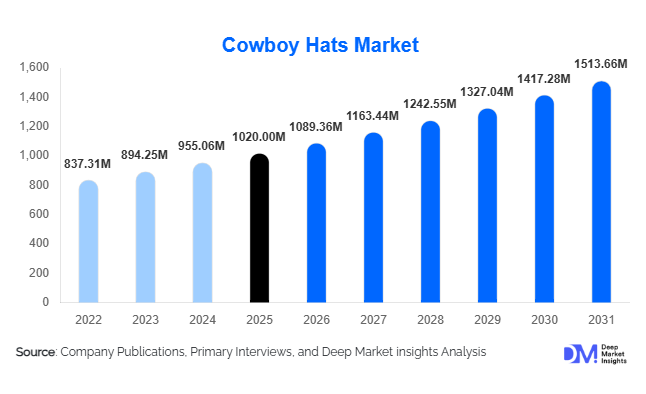
According to Deep Market Insights, the global cowboy hats market size was valued at USD 1,020 million in 2025 and is projected to grow from USD 1,089.36 million in 2026 to reach USD 1,513.66 million by 2031, expanding at a CAGR of 6.8% during the forecast period (2026–2031). The cowboy hats market growth is primarily driven by the increasing global adoption of western fashion, rising demand for premium handcrafted hats, and the expanding influence of entertainment, rodeo culture, and outdoor lifestyle activities across both developed and emerging markets.
Key Market Insights
- Fashion-driven demand is accelerating global adoption, with cowboy hats evolving beyond functional use into mainstream lifestyle accessories.
- Premium and luxury segments are expanding rapidly, driven by consumer preference for handcrafted, high-quality felt and leather hats.
- North America dominates the market, supported by strong cultural roots and consistent demand from the ranching and outdoor industries.
- Asia-Pacific is the fastest-growing region, fueled by rising disposable incomes and increasing exposure to Western fashion trends.
- Offline retail remains dominant, though online sales channels are expanding rapidly through e-commerce penetration.
- Sustainability and material innovation are emerging as key differentiators, with eco-friendly materials gaining traction among consumers.
What are the latest trends in the cowboy hats market?
Premiumization and Craftsmanship Revival
The market is witnessing a strong shift toward premium and luxury cowboy hats, particularly those made from high-quality fur felt and leather. Consumers are increasingly valuing durability, heritage craftsmanship, and exclusivity, driving demand for handmade products. This trend is especially prominent in North America and Europe, where consumers are willing to pay premium prices for authenticity and brand legacy. Limited-edition collections and custom-fit offerings are gaining traction, allowing manufacturers to enhance margins and brand differentiation.
Fashion Integration and Global Lifestyle Appeal
Cowboy hats are becoming integral to global fashion, appearing in music festivals, fashion weeks, and influencer-driven social media content. This trend is expanding demand beyond traditional markets into urban populations worldwide. Designers are incorporating modern aesthetics, vibrant colors, and hybrid materials to appeal to younger consumers. As a result, cowboy hats are increasingly positioned as versatile accessories rather than niche western wear products.
What are the key drivers in the cowboy hats market?
Growth of Western Culture and Entertainment Influence
The global popularity of country music, western films, and rodeo events has significantly increased awareness and demand for cowboy hats. These cultural influences are expanding the market beyond traditional geographies, making cowboy hats a symbol of lifestyle and identity across diverse consumer groups.
Rising Demand for Outdoor and Functional Apparel
Cowboy hats continue to serve practical purposes such as sun protection and durability in outdoor environments. Growth in agriculture, ranching, and outdoor recreation industries is sustaining consistent demand, particularly in North America and Latin America.
What are the restraints for the global market?
Fluctuating Raw Material Costs
The prices of key raw materials such as fur felt, leather, and straw are subject to volatility, impacting production costs and profit margins. Premium segments are particularly sensitive to these fluctuations, as they rely on high-quality inputs.
Limited Cultural Penetration in Certain Regions
Despite growing global awareness, cowboy hats still face cultural limitations in regions where Western fashion is not widely adopted. This restricts mass-market expansion and requires targeted marketing strategies to drive adoption.
What are the key opportunities in the cowboy hats industry?
Expansion in Emerging Markets
Asia-Pacific and Latin America present significant growth opportunities due to rising disposable incomes and increasing exposure to Western culture. Countries such as China, India, and Brazil are witnessing growing demand, particularly in fashion-oriented segments. Localized marketing and product customization can help brands capture these emerging markets effectively.
Technological and Material Innovation
Advancements in materials, such as water-resistant felt and UV-protective straw, are creating opportunities for product differentiation. Additionally, sustainable sourcing and eco-friendly production processes are becoming critical for attracting environmentally conscious consumers. Companies investing in innovation can gain a competitive edge and command premium pricing.
Report Scope
| Report Metric | Details |
|---|---|
| Market Size in 2025 | USD 1020 Million |
| Market Size in 2026 | USD 1089.36 Million |
| Market Size in 2031 | USD 1513.66 Million |
| CAGR | 6.8% (2026-2031) |
| Base Year for Estimation | 2025 |
| Historical Data | 2022-2024 |
| Forecast Period | 2026-2031 |
| Report Coverage | Revenue Forecast, Competitive Landscape, Supply Chain Disruption, Growth Factors, Environment & Regulatory Landscape and Trends |
| Geographies Covered | North America, Europe, APAC, Middle East and Africa, LATAM |
| Countries Covered | U.S., Canada, U.K., Germany, France, Spain, Italy, Russia, Nordic, Benelux, Rest of Europe, China, Korea, Japan, India, Australia, Singapore, Taiwan, South East Asia, Rest of Asia-Pacific, UAE, Turky, Saudi Arabia, South Africa, Egypt, Nigeria, Rest of MEA, Brazil, Mexico, Argentina, Chile, Colombia, Rest of LATAM |
Explore more data points, trends and opportunities Download Free Sample Report
Product Type Insights
Felt cowboy hats continue to dominate the global market, accounting for approximately 45% of total revenue in 2025, primarily driven by their superior durability, weather resistance, and strong association with premium craftsmanship. The leading position of this segment is further supported by increasing consumer preference for high-quality, long-lasting products, particularly in North America and Europe, where heritage and authenticity play a critical role in purchasing decisions. Felt hats, especially those made from fur blends such as beaver and rabbit, are widely perceived as status symbols, enabling manufacturers to command higher margins.
Straw cowboy hats represent the second-largest segment, driven by strong demand in warmer climates such as Latin America, the southern United States, and parts of the Asia-Pacific. Their lightweight, breathable construction and affordability make them highly attractive in the mid-range segment, particularly for outdoor and agricultural use. Leather cowboy hats, while niche, cater to premium consumers seeking rugged aesthetics and enhanced durability, often used in outdoor sports and adventure activities. Meanwhile, hybrid materials are emerging as a fast-growing category, as manufacturers innovate with blended fabrics to offer improved comfort, flexibility, and weather adaptability, appealing to younger and fashion-conscious consumers.
Application Insights
Fashion and lifestyle applications lead the cowboy hats market with approximately 40% share in 2025, driven by the increasing global influence of western-inspired fashion and celebrity endorsements. The leading position of this segment is attributed to the shift in consumer perception, where cowboy hats are no longer limited to functional use but are widely adopted as statement accessories across urban markets. Social media platforms and fashion events have significantly amplified this trend, particularly among younger demographics.
Functional applications in agriculture, ranching, and outdoor labor continue to provide a stable demand base, especially in North America and Latin America. These applications are driven by the practical benefits of cowboy hats, including sun protection and durability. The entertainment and events segment, including rodeos, country music festivals, and film productions, is experiencing rapid growth and contributes to seasonal demand spikes. Additionally, outdoor sports and recreational activities such as horseback riding and adventure tourism are further supporting market expansion, particularly in regions with strong equestrian traditions.
Distribution Channel Insights
Offline retail channels dominate the cowboy hats market, accounting for nearly 60% of total sales in 2025. The leading position of this segment is driven by the importance of physical fit, comfort, and style evaluation, as consumers prefer trying hats before purchase. Specialty western wear stores, department stores, and branded outlets play a crucial role in influencing buying decisions, particularly in premium and mid-range segments where tactile experience is critical.
However, online retail is rapidly gaining momentum, supported by the expansion of e-commerce platforms and direct-to-consumer (D2C) strategies adopted by leading brands. Digital channels are enabling global market penetration, especially in regions where physical retail presence is limited. Innovations such as virtual try-on tools, AI-driven size recommendations, and personalized customization options are enhancing the online shopping experience. As a result, online channels are expected to witness the fastest growth during the forecast period, particularly in Asia-Pacific and Europe.
End-User Insights
The men’s segment dominates the cowboy hats market, contributing approximately 55% of total demand in 2025. This leadership is primarily driven by traditional usage in ranching, agriculture, and outdoor activities, particularly in North America and Latin America. The segment also benefits from strong cultural associations with Western heritage, reinforcing consistent demand. The women’s segment is emerging as the fastest-growing category, fueled by increasing participation in fashion, music festivals, and outdoor events. Changing fashion dynamics and the growing popularity of gender-inclusive styles are further accelerating growth. The unisex segment is gaining traction among younger consumers, driven by the rising demand for versatile and gender-neutral fashion accessories. Meanwhile, the children’s segment remains relatively niche but is supported by family-oriented events, cultural festivals, and increasing participation in western-themed activities, contributing to steady incremental growth.
Explore more data points, trends and opportunities Download Free Sample Report
Cowboy Hats Market Segmentations
By Product Type
- Felt Cowboy Hats
- Straw Cowboy Hats
- Leather Cowboy Hats
- Hybrid/Blended Material Hats
By Application
- Fashion & Lifestyle
- Functional/Workwear
- Entertainment & Events
- Outdoor & Sports Activities
By Distribution Channel
- Offline Retail
- Online Retail
By End-User
- Men
- Women
- Unisex Consumers
- Children/Youth
Regional Insights
North America
North America remains the largest market, accounting for approximately 45% of global revenue in 2025, with the United States representing the dominant share. The region’s leadership is driven by deep-rooted cowboy culture, a well-established ranching and agriculture industry, and strong consumer spending on premium western wear. Rodeo events, country music festivals, and western-themed entertainment significantly contribute to sustained demand. Additionally, the presence of leading manufacturers and strong retail infrastructure further supports market growth. Canada complements regional demand through outdoor recreation and equestrian activities, while increasing interest in premium lifestyle products is driving higher-value sales.
Europe
Europe holds around 20% market share, with key countries including the UK, Germany, France, Italy, and Spain. Regional growth is primarily driven by the rising popularity of western-inspired fashion and increasing participation in music festivals and themed events. Consumers in Europe are particularly inclined toward premium and sustainably sourced products, which is encouraging manufacturers to adopt eco-friendly materials and ethical production practices. The expansion of online retail channels and the influence of global fashion trends are further accelerating market penetration. Additionally, growing demand for niche and customized fashion accessories is supporting higher-margin product segments.
Asia-Pacific
Asia-Pacific accounts for approximately 18% of the global market and is the fastest-growing region, with a CAGR exceeding 8% during the forecast period. Growth is primarily driven by rising disposable incomes, rapid urbanization, and increasing exposure to Western fashion through digital media and entertainment. China and India are key growth engines, supported by expanding middle-class populations and strong e-commerce ecosystems. Japan and South Korea contribute through fashion-forward consumers and niche demand for premium accessories, while Australia shows steady demand linked to outdoor and equestrian activities. The rapid expansion of online retail platforms and the increasing adoption of global fashion trends are key drivers of regional growth.
Latin America
Latin America represents approximately 12% of the global market, with Mexico and Brazil as the leading contributors. The region’s growth is strongly driven by deeply ingrained cowboy culture, rodeo traditions, and widespread use of cowboy hats in daily life. Agricultural and ranching activities continue to support consistent demand, while increasing urbanization and rising disposable incomes are driving growth in fashion-oriented segments. Additionally, cultural festivals and tourism are contributing to increased product visibility and consumption, particularly in Mexico.
Middle East & Africa
The Middle East & Africa region accounts for approximately 5% of the global market, with growth driven by tourism, luxury retail expansion, and increasing adoption of Western fashion. The United Arab Emirates and Saudi Arabia are key markets, supported by high disposable incomes and strong demand for premium lifestyle products. In Africa, South Africa leads demand due to its established retail sector and growing interest in outdoor and equestrian activities. The expansion of international brands and the increasing presence of luxury shopping destinations are further supporting market growth in this region.