Convertible Fashion Market Size
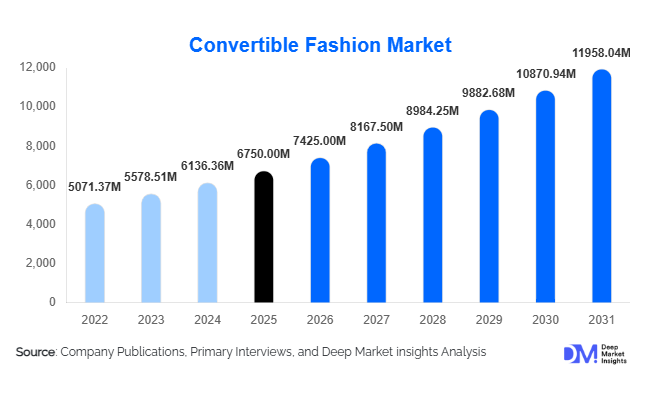
According to Deep Market Insights, the global convertible fashion market size was valued at USD 6,750 million in 2025 and is projected to grow from USD 7,425.00 million in 2026 to reach USD 11,958.04 million by 2031, expanding at a CAGR of 10.0% during the forecast period (2026–2031). Market growth is primarily driven by increasing consumer demand for multifunctional apparel, growing adoption of sustainable fashion practices, rising travel and hybrid work lifestyles, and the expanding popularity of capsule wardrobes. Convertible fashion products, including transformable apparel, modular accessories, reversible garments, and multi-functional footwear, are increasingly being adopted by consumers seeking versatility, convenience, and value from fewer clothing purchases.
Key Market Insights
- Convertible apparel accounts for nearly 58% of total market revenue, led by multi-way dresses, transformable outerwear, and travel-oriented clothing.
- Sustainability remains a major purchase driver, with consumers increasingly preferring products that reduce wardrobe redundancy and textile waste.
- North America dominates the global market, accounting for approximately 34% of global revenue, supported by strong consumer spending and sustainability awareness.
- Asia-Pacific is the fastest-growing regional market, driven by rising disposable incomes, digital fashion adoption, and increasing awareness of sustainable apparel.
- Online retail channels account for approximately 46% of market sales, benefiting from visual demonstrations of product functionality and direct-to-consumer business models.
- Technological innovation in smart textiles and modular garment engineering is creating new premium product categories and supporting higher profit margins.
Convertible Fashion Market Trends
Rise of Sustainable Capsule Wardrobes
The global shift toward sustainable consumption patterns is significantly influencing purchasing behavior within the convertible fashion market. Consumers are increasingly adopting capsule wardrobe concepts that prioritize fewer but more versatile garments capable of serving multiple functions. Convertible dresses, modular jackets, reversible apparel, and transformable accessories enable consumers to maximize utility while reducing overall clothing consumption. Fashion brands are responding by incorporating recycled materials, organic fibers, and circular-fashion principles into product development. Sustainability certifications, traceability initiatives, and repair-friendly designs are becoming important differentiators among premium and mid-tier brands. As governments strengthen textile waste reduction regulations and consumers become more environmentally conscious, demand for convertible fashion products that support long-term wardrobe optimization continues to accelerate globally.
Technology-Enabled Modular Fashion Designs
Innovation in textile engineering and garment construction is reshaping the convertible fashion industry. Brands are increasingly introducing modular clothing systems that allow consumers to alter silhouettes, lengths, sleeves, and styling configurations through detachable components. Technical fabrics offering moisture management, wrinkle resistance, climate adaptability, and lightweight performance are becoming increasingly common in travel and activewear applications. Smart textile integration, including temperature-regulating materials and wearable technology compatibility, is further expanding the functionality of convertible garments. These innovations are particularly attractive to younger consumers seeking personalization, convenience, and technologically enhanced fashion experiences. Digital visualization tools, virtual fitting technologies, and AI-powered style recommendations are also improving consumer engagement and supporting higher online conversion rates.
Convertible Fashion Market Drivers
Growing Demand for Versatile and Functional Apparel
Consumers increasingly seek products that provide greater functionality and flexibility across multiple occasions. Rising urbanization, changing work patterns, and growing travel frequency are encouraging purchases of garments that transition seamlessly between professional, casual, and leisure environments. Convertible apparel reduces wardrobe complexity while delivering enhanced value, making it particularly attractive to younger consumers and frequent travelers. As consumers prioritize practicality alongside style, multifunctional fashion products continue to gain mainstream acceptance.
Expansion of Sustainable Fashion Consumption
Sustainability has evolved from a niche consideration to a mainstream purchasing criterion within the global fashion industry. Convertible fashion directly supports sustainable consumption by extending product utility and reducing the need for multiple garment purchases. Consumers increasingly recognize the environmental benefits associated with fewer purchases, reduced textile waste, and lower overall wardrobe turnover. Brands emphasizing eco-friendly materials, circular production models, and transparent supply chains are experiencing stronger consumer engagement and premium pricing opportunities.
Convertible Fashion Market Restraints
Higher Product Development and Manufacturing Costs
Convertible garments typically require more sophisticated design engineering, extensive prototyping, premium materials, and specialized manufacturing processes compared to conventional apparel. Multiple functional components such as zippers, modular fasteners, detachable panels, and reversible construction techniques increase production complexity. These factors often result in higher retail prices, potentially limiting adoption among cost-sensitive consumer groups. Manufacturers must continuously balance innovation and affordability to achieve broader market penetration.
Limited Consumer Awareness and Education
Despite growing popularity, many consumers remain unfamiliar with the benefits and functionality of convertible fashion products. Demonstrating product versatility often requires visual content, interactive marketing campaigns, and in-store education. Brands face higher customer acquisition costs as they invest in tutorials, influencer collaborations, and digital demonstrations to communicate product value. Limited awareness in emerging markets continues to constrain adoption, particularly outside premium and urban consumer segments.
Convertible Fashion Market Opportunities
Travel and Hybrid Lifestyle Apparel Expansion
The continued growth of global tourism, remote working, and hybrid employment models presents significant opportunities for convertible fashion manufacturers. Travelers increasingly seek lightweight, multifunctional apparel capable of reducing luggage requirements while supporting diverse activities and climates. Convertible jackets, modular dresses, adaptable footwear, and travel-friendly accessories are gaining popularity among business travelers, digital nomads, and leisure tourists. Brands that successfully integrate comfort, performance, and versatility into travel-focused collections are expected to capture substantial growth opportunities during the forecast period.
Smart Textiles and Technical Fabric Integration
Emerging textile technologies provide opportunities to enhance product functionality beyond traditional convertibility. Temperature-regulating fabrics, moisture-control materials, antimicrobial treatments, and wearable technology compatibility are creating new premium segments within the market. Outdoor, activewear, and travel applications offer particularly attractive opportunities for technology-enhanced convertible products. As manufacturing costs decline and consumer acceptance grows, smart textile integration is expected to become a key source of competitive differentiation and value creation.
Report Scope
| Report Metric | Details |
|---|---|
| Market Size in 2025 | USD 6750 Million |
| Market Size in 2026 | USD 7425.00 Million |
| Market Size in 2031 | USD 11958.04 Million |
| CAGR | 10% (2026-2031) |
| Base Year for Estimation | 2025 |
| Historical Data | 2022-2024 |
| Forecast Period | 2026-2031 |
| Report Coverage | Revenue Forecast, Competitive Landscape, Supply Chain Disruption, Growth Factors, Environment & Regulatory Landscape and Trends |
| Geographies Covered | North America, Europe, APAC, Middle East and Africa, LATAM |
| Countries Covered | U.S., Canada, U.K., Germany, France, Spain, Italy, Russia, Nordic, Benelux, Rest of Europe, China, Korea, Japan, India, Australia, Singapore, Taiwan, South East Asia, Rest of Asia-Pacific, UAE, Turky, Saudi Arabia, South Africa, Egypt, Nigeria, Rest of MEA, Brazil, Mexico, Argentina, Chile, Colombia, Rest of LATAM |
Explore more data points, trends and opportunities Download Free Sample Report
Product Type Insights
Convertible apparel dominates the global convertible fashion market, accounting for approximately 58% of total revenue in 2025, making it the largest product category worldwide. The segment's leadership is primarily driven by growing consumer demand for wardrobe versatility, sustainability, and cost-efficient fashion purchases. Multi-way dresses, transformable outerwear, reversible garments, and modular activewear have gained widespread acceptance among consumers seeking products that can transition seamlessly across professional, casual, travel, and social settings. Convertible dresses represent the leading sub-segment within apparel due to their ability to offer multiple styling configurations from a single garment, making them particularly attractive to female consumers and frequent travelers.
The rapid expansion of hybrid lifestyles, increasing travel frequency, and rising adoption of capsule wardrobes are further supporting demand for convertible apparel. Consumers are increasingly prioritizing functionality alongside aesthetics, encouraging brands to develop garments that provide multiple uses while reducing overall clothing consumption. Additionally, sustainability concerns surrounding fast fashion have strengthened consumer preference for durable, multi-purpose apparel that extends product lifespan and reduces textile waste.
Meanwhile, convertible accessories are emerging as the fastest-growing product category. Products such as backpack-to-tote bags, modular handbags, detachable-heel footwear, multifunctional scarves, and reversible accessories are gaining popularity among urban consumers seeking convenience and adaptability. Growing adoption of sustainable materials, recycled fabrics, and technical textiles is further enhancing product functionality while enabling manufacturers to command premium pricing. As innovation in modular design and smart textile integration continues to advance, both apparel and accessory segments are expected to experience sustained growth throughout the forecast period.
Application Insights
Travel and tourism applications account for approximately 29% of global convertible fashion demand, making this the largest application segment in the market. The segment's dominance is largely driven by growing international tourism, increasing business travel activity, and the expansion of remote and hybrid work lifestyles. Travelers increasingly seek versatile clothing solutions capable of reducing luggage volume while maintaining style and functionality across multiple occasions and climates. Convertible garments provide significant value by enabling consumers to carry fewer items without sacrificing outfit variety.
Travel-focused consumers are particularly attracted to wrinkle-resistant, lightweight, climate-adaptive, and multi-functional garments that support extended trips and changing environments. As global tourism flows continue to recover and expand, demand for travel-oriented convertible fashion is expected to remain a major growth catalyst for the industry.
Everyday casual wear represents the second-largest application segment, supported by increasing consumer adoption of minimalist wardrobes and practical fashion choices. Meanwhile, professional workwear applications are witnessing accelerated growth due to hybrid work models that require apparel capable of transitioning between office, home, and social environments. Outdoor recreation and adventure tourism are also contributing significantly to market expansion, with consumers increasingly purchasing transformable activewear and performance apparel designed for hiking, camping, and outdoor experiences. Furthermore, sustainability-focused consumers continue to drive demand across all application categories as environmental considerations become increasingly integrated into fashion purchasing decisions.
Distribution Channel Insights
Online retail channels account for approximately 46% of global convertible fashion sales, making digital commerce the leading distribution channel worldwide. The segment's leadership is driven by the visual and functional nature of convertible fashion products, which are particularly well-suited to digital marketing formats such as product demonstration videos, interactive styling tutorials, influencer campaigns, and social media content. Consumers often require visual explanations to understand the multiple uses and configurations of convertible garments, making e-commerce platforms highly effective for product education and conversion.
The continued expansion of direct-to-consumer (DTC) business models has further accelerated online channel growth. Emerging convertible fashion brands increasingly rely on DTC strategies to build direct customer relationships, improve margins, gather consumer insights, and rapidly launch new product innovations. Subscription-based fashion programs, personalized shopping experiences, and AI-powered style recommendations are further enhancing online engagement.
Specialty fashion retailers continue to maintain an important position within the market by providing personalized consultations and product demonstrations that help consumers understand garment functionality. Department stores remain influential, particularly within premium and luxury segments where brand visibility and customer experience are critical purchasing factors. Travel retail channels are also becoming increasingly important as brands target business travelers and tourists seeking versatile wardrobe solutions. Additionally, social commerce, live-stream shopping, and influencer-led retail experiences are emerging as high-growth distribution formats that are expected to further strengthen digital sales channels over the coming years.
Consumer Insights
Women represent the largest consumer segment, accounting for approximately 68% of total market demand in 2025. The segment's dominance is driven by higher engagement with fashion trends, greater product availability across women's apparel categories, and strong adoption of convertible dresses, modular clothing, and multifunctional accessories. Female consumers increasingly seek garments capable of supporting multiple styling options, enabling greater wardrobe flexibility while minimizing clothing purchases.
Growing participation of women in professional occupations, increasing travel frequency, and rising sustainability awareness continue to support demand across premium and mid-priced convertible fashion categories. Convertible dresses, reversible jackets, adaptable workwear, and modular accessories remain among the most popular product categories within this consumer group.
Millennials account for approximately 38% of global demand and represent the largest age-based consumer segment. Their strong preference for sustainable consumption, digital shopping, travel experiences, and value-oriented purchasing behavior aligns closely with the core benefits offered by convertible fashion. Gen Z consumers are emerging as the fastest-growing demographic, driven by interest in personalized styling, social media-driven fashion trends, sustainability, and circular fashion concepts.
Meanwhile, men's convertible apparel is gaining traction across travel, outdoor recreation, and activewear applications as consumers increasingly recognize the practical benefits of multifunctional clothing. Unisex fashion categories are also expanding rapidly as brands emphasize inclusivity, minimalist design, and versatile functionality capable of serving diverse consumer needs.
Explore more data points, trends and opportunities Download Free Sample Report
Convertible Fashion Market Segmentations
By Product Type
- Convertible Apparel
- Convertible Accessories
By Application
- Travel & Tourism
- Everyday Casual Wear
- Professional & Workwear
- Outdoor & Adventure Activities
- Occasion & Event Wear
- Maternity & Family Use
- Sustainable Fashion Consumption
By Distribution Channel
- Online Retail
- Brand-Owned E-commerce
- Specialty Fashion Stores
- Department Stores
- Fashion Boutiques
- Direct-to-Consumer (DTC)
- Travel Retail
By Consumer Group
- Women
- Men
- Unisex
Regional Insights
North America
North America accounts for approximately 34% of global convertible fashion market revenue, making it the largest regional market worldwide. The United States alone contributes nearly 27% of total global demand, supported by high disposable incomes, strong consumer willingness to spend on premium apparel, and advanced e-commerce penetration. The region's leadership is further driven by growing adoption of sustainable fashion practices, increasing popularity of capsule wardrobes, and widespread acceptance of multifunctional lifestyle products.
The rapid growth of direct-to-consumer fashion brands, extensive social media influence, and strong demand for travel-oriented apparel continue to support market expansion. Hybrid work arrangements have also accelerated demand for adaptable clothing capable of transitioning between professional and casual environments. In Canada, increasing environmental awareness and growing consumer interest in ethically produced apparel are contributing to rising adoption of premium convertible fashion products.
Europe
Europe represents approximately 28% of global market demand and remains one of the most sustainability-focused regions within the fashion industry. Germany, the United Kingdom, France, Italy, and the Netherlands are the leading markets, collectively accounting for the majority of regional consumption. Demand growth is strongly supported by stringent environmental regulations, circular economy initiatives, and increasing government efforts to reduce textile waste across the European Union.
European consumers demonstrate some of the highest levels of sustainability awareness globally and increasingly prioritize quality, durability, and product longevity when making apparel purchases. Growing adoption of circular fashion models, clothing reuse initiatives, and sustainable manufacturing standards is encouraging consumers to invest in multifunctional garments that maximize wardrobe utility. The region's strong fashion heritage, combined with increasing demand for environmentally responsible products, continues to support expansion of the convertible fashion market.
Asia-Pacific
Asia-Pacific accounts for approximately 26% of global market revenue and is projected to be the fastest-growing regional market through 2031, with growth rates exceeding the global average. China remains the largest regional market, supported by rising middle-class incomes, rapid digital commerce expansion, and increasing demand for premium lifestyle products. The country's growing focus on sustainable consumption and domestic fashion innovation is further supporting market development.
India is expected to emerge as one of the fastest-growing national markets globally, driven by urbanization, increasing fashion awareness among younger consumers, rising disposable incomes, and rapid adoption of online shopping platforms. Japan and South Korea continue to generate strong demand for innovative, technology-driven fashion products, while Australia benefits from growing travel activity and outdoor lifestyle trends. The region's expanding e-commerce infrastructure, growing influence of social commerce, and increasing sustainability awareness are expected to remain major drivers of future growth.
Latin America
Latin America accounts for approximately 6% of global market demand, led primarily by Brazil and Mexico. Market growth is being driven by expanding middle-class populations, increasing urbanization, and rising adoption of online fashion retail platforms. Consumers across major metropolitan areas are increasingly embracing multifunctional apparel and accessories as practical solutions that provide greater value and versatility.
The region is also witnessing growing awareness of sustainable fashion concepts, particularly among younger consumers. Social media influence, increasing international fashion exposure, and rising travel activity are contributing to stronger demand for convertible apparel and accessories. As disposable incomes continue to improve across key markets, premium and mid-tier convertible fashion categories are expected to gain broader consumer acceptance.
Middle East & Africa
The Middle East and Africa account for approximately 6% of global market revenue, with the United Arab Emirates, Saudi Arabia, and South Africa representing the largest regional markets. Growth in the Middle East is primarily supported by high consumer spending on premium fashion, luxury lifestyle preferences, and increasing international tourism activity. Consumers in the Gulf region are increasingly seeking innovative and multifunctional fashion products that combine luxury aesthetics with practical utility.
In Africa, South Africa remains the most developed market due to its established retail infrastructure, expanding middle-class population, and growing adoption of international fashion trends. Rising awareness of sustainability, increasing tourism activity, and improving access to global fashion brands through e-commerce platforms are creating additional growth opportunities across the region. Long-term market expansion is expected to be supported by urbanization, retail modernization, and increasing consumer demand for premium lifestyle products.
Key Players in the Convertible Fashion Market
- Patagonia
- Lululemon Athletica
- Nike
- Adidas
- Uniqlo
- Athleta
- Encircled
- Vetta Capsule
- Ministry of Supply
- PrAna
- Aday
- Eileen Fisher
- M.M.LaFleur
- The North Face
- Columbia Sportswear