Beverage Coaster Market Size
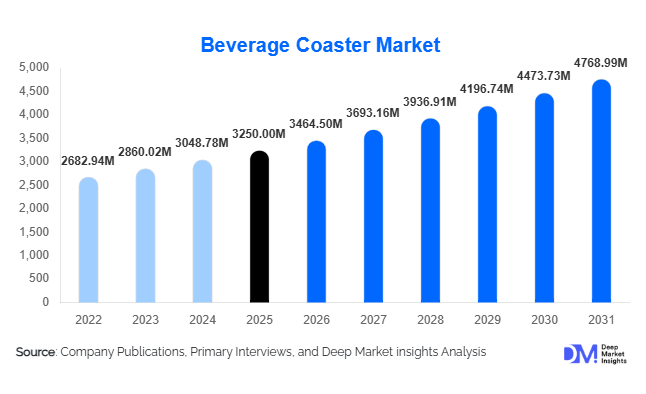
According to Deep Market Insights, the global beverage coaster market size was valued at USD 3,250 million in 2025 and is projected to grow from USD 3,464.50 million in 2026 to reach USD 4,768.99 million by 2031, expanding at a CAGR of 6.6% during the forecast period (2026–2031). The beverage coaster market growth is primarily driven by the rapid expansion of the global hospitality sector, increasing demand for low-cost promotional tools, and rising consumer preference for surface protection and home décor accessories. Additionally, growing awareness around sustainability and eco-friendly materials is reshaping product innovation, with manufacturers increasingly focusing on recyclable and biodegradable coaster solutions.
Key Market Insights
- Paper and pulp-based coasters dominate the market, driven by their cost-effectiveness and high-volume usage in hospitality and events.
- Customization and branding demand is increasing significantly, particularly among bars, breweries, and corporate advertisers.
- North America leads the global market, supported by a mature hospitality industry and strong promotional product usage.
- Asia-Pacific is the fastest-growing region, fueled by urbanization, café culture expansion, and rising disposable incomes.
- Eco-friendly and biodegradable materials are gaining traction, especially in Europe and North America, due to regulatory pressure.
- E-commerce channels are transforming distribution, enabling direct-to-consumer sales of premium and customized coasters.
What are the latest trends in the beverage coaster market?
Sustainability and Eco-Friendly Materials
The beverage coaster market is witnessing a strong shift toward sustainable materials such as recycled paper, cork, and biodegradable composites. Increasing environmental awareness and stricter regulations, particularly in Europe, are pushing manufacturers to adopt eco-friendly production methods. Hospitality chains and corporate buyers are prioritizing sustainable procurement policies, leading to a surge in demand for recyclable and compostable coasters. This trend is also encouraging innovation in material science, including water-resistant biodegradable coatings and plant-based alternatives that maintain durability while reducing environmental impact.
Rise of Customized and Promotional Coasters
Customized coasters are becoming a powerful branding tool across industries. Businesses are leveraging them for advertising, brand recall, and customer engagement in high-traffic environments such as bars, cafés, and events. Advances in digital printing technology have enabled cost-effective short-run production, allowing small and medium enterprises to adopt customized coaster solutions. The growing popularity of craft breweries and themed cafés has further amplified this trend, with unique coaster designs contributing to brand identity and customer experience.
What are the key drivers in the beverage coaster market?
Expansion of the Global Hospitality Industry
The growth of hotels, restaurants, cafés, and bars worldwide is a major driver of the beverage coaster market. These establishments require large volumes of coasters for daily operations, particularly disposable variants for hygiene and convenience. The increasing number of quick-service restaurants and specialty coffee chains is further boosting demand.
Growing Use of Coasters as Promotional Tools
Coasters offer a cost-effective medium for advertising, making them highly attractive for businesses. Companies are increasingly using branded coasters for marketing campaigns, events, and customer engagement. This trend is particularly strong in the beverage and entertainment industries, where brand visibility plays a critical role in consumer retention.
What are the restraints for the global market?
Price Competition in Low-Cost Segments
The beverage coaster market faces intense competition in the mass-produced segment, especially for paper coasters. Limited product differentiation leads to price wars, reducing profit margins for manufacturers and creating challenges for new entrants.
Volatility in Raw Material Prices
Fluctuations in the prices of raw materials such as paper pulp, wood, and cork can significantly impact production costs. Manufacturers must navigate these uncertainties while maintaining competitive pricing, which can constrain profitability.
What are the key opportunities in the beverage coaster industry?
Growth in Eco-Friendly Product Lines
The increasing global focus on sustainability presents a significant opportunity for manufacturers to develop eco-friendly coaster solutions. Companies investing in biodegradable materials and green production processes can gain a competitive edge, particularly in regulated markets.
Premiumization and Home Décor Integration
Rising consumer interest in home aesthetics is driving demand for premium coasters made from materials such as marble, wood, and leather. These products cater to urban households seeking functional yet stylish accessories, opening new revenue streams in the high-margin segment.
Report Scope
| Report Metric | Details |
|---|---|
| Market Size in 2025 | USD 3250 Million |
| Market Size in 2026 | USD 3464.50 Million |
| Market Size in 2031 | USD 4768.99 Million |
| CAGR | 6.6% (2026-2031) |
| Base Year for Estimation | 2025 |
| Historical Data | 2022-2024 |
| Forecast Period | 2026-2031 |
| Report Coverage | Revenue Forecast, Competitive Landscape, Supply Chain Disruption, Growth Factors, Environment & Regulatory Landscape and Trends |
| Geographies Covered | North America, Europe, APAC, Middle East and Africa, LATAM |
| Countries Covered | U.S., Canada, U.K., Germany, France, Spain, Italy, Russia, Nordic, Benelux, Rest of Europe, China, Korea, Japan, India, Australia, Singapore, Taiwan, South East Asia, Rest of Asia-Pacific, UAE, Turky, Saudi Arabia, South Africa, Egypt, Nigeria, Rest of MEA, Brazil, Mexico, Argentina, Chile, Colombia, Rest of LATAM |
Explore more data points, trends and opportunities Download Free Sample Report
Product Type Insights
Disposable coasters dominate the beverage coaster market, accounting for over 55% of total demand in 2025, primarily driven by their extensive usage across high-volume environments such as hotels, bars, restaurants, and large-scale events. The key driver for this segment’s leadership is the cost-efficiency and hygiene advantage, as disposable coasters eliminate the need for cleaning and reuse, aligning with strict sanitation standards in the hospitality industry. Their lightweight nature, ease of bulk procurement, and compatibility with branding further strengthen their position globally. Meanwhile, reusable coasters are gaining traction in residential and premium hospitality settings, supported by increasing consumer inclination toward sustainable and long-lasting products. Materials such as wood, cork, and silicone are witnessing higher adoption due to their durability and visual appeal. Customized coasters represent the fastest-growing segment, fueled by the rising demand for brand visibility and personalized customer experiences, particularly among cafés, breweries, and corporate advertisers leveraging coasters as low-cost marketing tools.
Application Insights
The hospitality sector remains the largest application segment, contributing nearly 48% of total market demand, supported by the continuous expansion of global tourism and foodservice industries. The primary driver for this segment is the consistent and high-frequency consumption of coasters in commercial establishments, where they serve both functional and promotional purposes. Corporate and promotional applications are among the fastest-growing segments, driven by the increasing use of coasters in branding campaigns, trade shows, and corporate events. Businesses are leveraging coasters as a cost-effective medium for targeted advertising, enhancing customer engagement in high-traffic environments. The household segment is expanding steadily, underpinned by rising disposable incomes and growing interest in home aesthetics and lifestyle products. Consumers are increasingly purchasing premium and decorative coasters as part of interior décor, particularly in urban markets where lifestyle upgrades are a key trend.
Distribution Channel Insights
Institutional sales dominate the distribution landscape, accounting for approximately 42% of the global market, primarily driven by bulk procurement from hospitality chains, corporate offices, and event organizers. The leading driver for this segment is the economies of scale and recurring demand cycles, as businesses require continuous replenishment of coasters. Offline retail channels, including supermarkets, hypermarkets, and specialty stores, continue to play a significant role in serving residential consumers, offering a wide range of mid-range and premium products. However, online retail is emerging as the fastest-growing distribution channel, supported by rapid digitalization and the growing penetration of e-commerce platforms. Online channels enable consumers and businesses to access a diverse range of customized, designer, and bulk products, while direct-to-consumer (D2C) models allow manufacturers to improve margins and build brand loyalty. The convenience of online ordering, coupled with customization options and competitive pricing, is significantly reshaping purchasing behavior.
End-Use Industry Insights
The hospitality industry remains the largest end-use segment, driven by the continuous expansion of hotels, restaurants, cafés, and bars worldwide, which require coasters as a standard operational necessity. The segment benefits from high repeat demand and bulk consumption patterns, ensuring stable revenue generation for manufacturers. The corporate sector is witnessing rapid growth, particularly in the use of branded coasters for marketing and promotional activities, supported by the increasing importance of experiential branding and customer engagement strategies. The residential segment is expanding due to the growing popularity of home décor and lifestyle products, with consumers increasingly opting for premium coasters that combine functionality with aesthetics. Additionally, emerging applications in event management and catering services are contributing to market growth, particularly in developing economies where the rise of organized events, weddings, and corporate gatherings is driving incremental demand for disposable and customized coasters.
Explore more data points, trends and opportunities Download Free Sample Report
Beverage Coaster Market Segmentations
By Product Type
- Disposable Coasters
- Reusable Coasters
- Customized/Printed Coasters
- Smart/Functional Coasters
By Application
- Hospitality
- Corporate & Promotional Use
- Household/Residential Use
- Events & Catering
By Distribution Channel
- Institutional Sales
- Online Retail
- Supermarkets/Hypermarkets
- Specialty Stores
By Material Type
- Paper & Pulp-Based
- Wood-Based
- Cork
- Plastic
- Silicone & Rubber
- Metal
- Glass & Stone
- Leather & Fabric
Regional Insights
North America
North America accounts for approximately 30% of the global beverage coaster market, with the United States representing the largest share within the region. The market is primarily driven by the highly developed hospitality and foodservice industry, coupled with a strong culture of branded promotional products. The widespread presence of bars, pubs, and quick-service restaurants ensures consistent high-volume demand for disposable coasters. Additionally, the region exhibits strong adoption of premium and customized coasters, driven by high consumer spending on lifestyle products and advanced marketing practices. The growing trend of craft breweries and specialty cafés further supports demand for customized and branded coaster solutions.
Europe
Europe holds around 28% of the global market share, led by key countries such as Germany, the UK, and France. The primary growth driver in this region is the strong regulatory push toward sustainability and circular economy practices, which is accelerating the adoption of eco-friendly and biodegradable coasters. European consumers and businesses are highly environmentally conscious, leading to increased demand for recycled paper and cork-based products. Additionally, the region’s well-established hospitality industry and cultural inclination toward cafés and social drinking environments contribute to steady demand. Premiumization trends are also prominent, with consumers favoring aesthetically designed and high-quality coasters.
Asia-Pacific
Asia-Pacific is the fastest-growing region, with a CAGR exceeding 8% during the forecast period. China dominates as a global manufacturing hub, benefiting from low production costs and large-scale export capabilities. Meanwhile, countries such as India, Indonesia, and Vietnam are emerging as key consumption markets, driven by rapid urbanization, rising disposable incomes, and the expansion of café culture. The region’s growth is further supported by the proliferation of organized retail and foodservice chains, as well as increasing adoption of Western dining habits. E-commerce growth in the region is also facilitating access to customized and premium coaster products, further accelerating market expansion.
Latin America
Latin America accounts for approximately 6% of the global market, with Brazil and Mexico leading regional demand. The primary driver for growth is the expansion of the foodservice and hospitality sectors, supported by increasing urbanization and rising middle-class populations. The growing popularity of cafés, casual dining establishments, and social events is contributing to higher consumption of beverage coasters. Additionally, improving economic conditions and increasing investments in retail infrastructure are supporting the adoption of both disposable and reusable coasters across the region.
Middle East & Africa
The Middle East & Africa region holds around 7% of the global market, driven largely by the rapid growth of tourism and hospitality infrastructure in countries such as the UAE, Saudi Arabia, and South Africa. Significant investments in luxury hotels, restaurants, and entertainment venues are creating strong demand for both premium and disposable coasters. The region’s growth is also supported by increasing international tourism and government initiatives aimed at diversifying economies through the hospitality sector. In Africa, rising urbanization and the gradual expansion of organized retail and foodservice industries are contributing to steady market growth, although at a relatively moderate pace compared to other regions.
Key Players in the Beverage Coaster Market
- Hoffmaster Group Inc.
- Georgia-Pacific LLC
- International Paper Company
- Graphic Packaging International
- Sappi Limited
- Smurfit Kappa Group
- WestRock Company
- UPM-Kymmene Corporation
- Asia Pulp & Paper
- Metsä Board
- Nippon Paper Industries
- Stora Enso
- Billerud AB
- KapStone Paper
- Twin Rivers Paper Company