Base Layer Market Size
According to Deep Market Insights, the global base layer market size was valued at USD 9,850 million in 2025 and is projected to grow from USD 10,638.00 million in 2026 to reach USD 15,630.71 million by 2031, expanding at a CAGR of 8.0% during the forecast period (2026–2031). The base layer market growth is primarily driven by increasing participation in sports and fitness activities, rising demand for performance-oriented apparel, and the rapid expansion of athleisure trends across both developed and emerging economies.
Key Market Insights
- Base layers are evolving from niche sportswear to mainstream apparel, driven by the global athleisure movement and rising preference for comfort-driven clothing.
- Synthetic fabrics dominate the market, offering superior moisture-wicking, durability, and cost efficiency compared to natural fibers.
- North America leads the global market, supported by high consumer spending, strong sports culture, and widespread adoption of performance apparel.
- Asia-Pacific is the fastest-growing region, fueled by urbanization, rising disposable incomes, and increasing fitness awareness.
- Sustainability trends are reshaping product innovation, with rising demand for recycled fabrics and eco-friendly production processes.
- Technological advancements in textiles, including anti-microbial coatings and compression features, are enhancing product differentiation and performance.
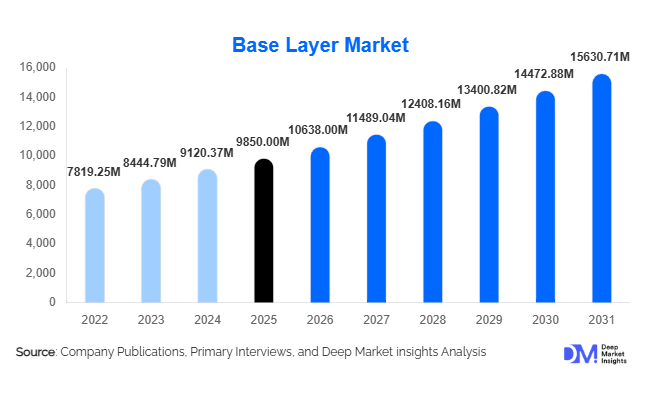
What are the latest trends in the base layer market?
Sustainable and Eco-Friendly Base Layers Gaining Momentum
Environmental sustainability is emerging as a defining trend in the base layer market. Consumers are increasingly seeking apparel made from recycled polyester, organic cotton, and responsibly sourced merino wool. Brands are investing in circular economy initiatives, including recyclable garments and low-impact dyeing processes. Regulatory pressures in regions such as Europe are also accelerating the shift toward eco-friendly production. Companies adopting sustainability not only benefit from premium pricing but also strengthen brand loyalty among environmentally conscious consumers.
Integration of Smart and Functional Textiles
Technological innovation is reshaping base layer functionality. Smart textiles incorporating temperature regulation, moisture sensors, and compression technology are gaining traction among athletes and fitness enthusiasts. Advanced features such as odor resistance, UV protection, and enhanced breathability are becoming standard. The emergence of wearable-integrated base layers with biometric tracking capabilities is also opening new opportunities in sports performance and health monitoring, particularly in professional sports and military applications.
What are the key drivers in the base layer market?
Growing Participation in Sports and Fitness Activities
The global increase in health consciousness has significantly boosted participation in fitness activities such as running, gym training, and outdoor sports. Base layers play a critical role in enhancing comfort and performance, making them essential for both professional athletes and recreational users. This trend is particularly strong in North America and Europe, where structured fitness culture and outdoor recreation drive consistent demand.
Expansion of Athleisure and Everyday Wear
The blending of sportswear with casual fashion has expanded the application of base layers beyond traditional use. Consumers are increasingly adopting base layers as part of their everyday wardrobes due to their comfort, flexibility, and versatility. This shift has significantly broadened the market’s consumer base, driving higher sales volumes across both premium and mass-market segments.
What are the restraints for the global market?
High Cost of Premium Materials
Base layers made from high-quality materials such as merino wool and advanced synthetic blends often come at premium prices. This limits accessibility in price-sensitive markets, particularly in developing regions, and restricts adoption among budget-conscious consumers.
Volatility in Raw Material Prices
Fluctuating prices of key raw materials, including polyester and wool, pose a challenge for manufacturers. Supply chain disruptions and cost variability can impact profit margins and create pricing uncertainties, affecting overall market stability.
What are the key opportunities in the base layer industry?
Expansion in Emerging Markets
Emerging economies such as China, India, and Brazil present significant growth opportunities due to rising disposable incomes and increasing participation in fitness activities. Growing urban populations and exposure to global fashion trends are driving demand for performance apparel, creating a favorable environment for market expansion.
Growth in Industrial and Defense Applications
Base layers designed for extreme environments are gaining traction in industrial sectors such as construction, oil & gas, and mining, as well as in military applications. Demand for temperature-regulating and protective clothing is increasing, supported by government investments and safety regulations. This segment offers stable, long-term growth potential for manufacturers.
Report Scope
| Report Metric | Details |
|---|---|
| Market Size in 2025 | USD 9850 Million |
| Market Size in 2026 | USD 10638 Million |
| Market Size in 2031 | USD 15630.71 Million |
| CAGR | 8.0% (2026-2031) |
| Base Year for Estimation | 2025 |
| Historical Data | 2022-2024 |
| Forecast Period | 2026-2031 |
| Report Coverage | Revenue Forecast, Competitive Landscape, Supply Chain Disruption, Growth Factors, Environment & Regulatory Landscape and Trends |
| Geographies Covered | North America, Europe, APAC, Middle East and Africa, LATAM |
| Countries Covered | U.S., Canada, U.K., Germany, France, Spain, Italy, Russia, Nordic, Benelux, Rest of Europe, China, Korea, Japan, India, Australia, Singapore, Taiwan, South East Asia, Rest of Asia-Pacific, UAE, Turky, Saudi Arabia, South Africa, Egypt, Nigeria, Rest of MEA, Brazil, Mexico, Argentina, Chile, Colombia, Rest of LATAM |
Explore more data points, trends and opportunities Download Free Sample Report
Product Type Insights
Tops continue to dominate the base layer market, accounting for approximately 48% of the global market share in 2025. This leadership is primarily driven by their versatility and year-round usability across multiple applications, including sports, outdoor activities, industrial workwear, and everyday athleisure. Tops are often the first point of purchase for consumers entering the performance apparel category, making them a high-volume segment. Additionally, innovations in lightweight fabrics, seamless construction, and ergonomic design have further strengthened their adoption. Bottoms, including leggings, tights, and compression wear, represent a significant share due to their widespread use in fitness training, running, and winter sports. This segment is particularly benefiting from the rising popularity of gym culture and yoga. Full-body suits, although smaller in market share, are witnessing steady growth in specialized applications such as extreme weather sports, military usage, and industrial environments where full-body thermal regulation is critical.
Material Type Insights
Synthetic materials lead the base layer market with a share of around 55% in 2025, driven by their superior performance characteristics such as moisture-wicking, durability, quick drying, and cost efficiency. Polyester and nylon blends are widely preferred for mass-market products due to their scalability and affordability. Continuous advancements in fiber engineering, including recycled synthetics, are further boosting their dominance. Natural fibers, particularly merino wool, occupy a strong position in the premium segment owing to their excellent thermal insulation, breathability, and odor resistance. These materials are highly favored in cold climates and high-end outdoor sports. Meanwhile, hybrid materials that combine synthetic and natural fibers are emerging as a key growth area, offering an optimal balance of performance, comfort, and sustainability. This segment is gaining traction among consumers seeking multifunctional and eco-conscious apparel.
Functionality Insights
Moisture-wicking base layers hold the largest share at approximately 35% of the market in 2025, as moisture management remains a fundamental requirement across all applications—from high-intensity sports to industrial work environments. This segment’s leadership is driven by increasing consumer awareness regarding performance benefits and comfort. Thermal base layers are particularly dominant in colder regions and winter sports, supported by demand in North America and Europe. Compression base layers are experiencing strong growth, driven by their ability to enhance blood circulation, improve athletic performance, and aid muscle recovery. Additionally, value-added features such as anti-microbial treatments and UV protection are increasingly being integrated into products, reflecting a shift toward multifunctional apparel. These innovations are enabling brands to differentiate their offerings and capture premium pricing.
End-User Insights
Men represent the largest segment in the base layer market, accounting for around 52% of the total market share in 2025. This dominance is largely attributed to higher participation in outdoor sports, fitness activities, and industrial work environments. However, the women’s segment is emerging as the fastest-growing category, driven by increasing health awareness, rising participation in fitness programs, and the growing influence of athleisure fashion. Brands are expanding their product lines with gender-specific designs, improved fit, and aesthetic appeal to capture this segment. The kids segment is also witnessing steady growth, particularly in colder regions where thermal base layers are essential. Increasing parental awareness regarding comfort and protection in outdoor activities further supports demand in this segment.
Distribution Channel Insights
Offline retail channels dominate the base layer market with approximately 60% market share in 2025, as consumers prefer to physically assess fit, comfort, and fabric quality before making a purchase. Specialty sports stores and brand-owned outlets play a critical role in driving sales, particularly for premium and performance-oriented products. These channels also allow brands to offer personalized customer experiences and product demonstrations. However, online retail is rapidly gaining momentum, supported by the expansion of e-commerce platforms, competitive pricing, and increasing smartphone penetration. The availability of detailed product descriptions, customer reviews, and easy return policies is encouraging consumers to shift toward digital channels. Direct-to-consumer (D2C) strategies are also becoming increasingly important for brands seeking to enhance margins and customer engagement.
Application Insights
Sports and outdoor activities remain the largest application segment, accounting for nearly 58% of the global base layer market in 2025. This dominance is driven by the increasing popularity of fitness activities, adventure sports, and organized athletic events worldwide. The segment benefits from continuous innovation in performance apparel, making base layers essential for both professional athletes and recreational users. Industrial and military applications are emerging as high-growth segments, driven by the need for temperature-regulating and protective clothing in extreme working conditions. Governments and organizations are investing in advanced gear, further boosting demand. Additionally, everyday wear and athleisure are rapidly expanding applications, as consumers increasingly adopt base layers for comfort and versatility in daily life. This shift is significantly broadening the market’s consumer base.
Explore more data points, trends and opportunities Download Free Sample Report
Base Layer Market Segmentations
By Product Type
- Tops
- Bottoms
- Full Body Suits / One-piece Base Layers
By Material Type
- Synthetic
- Natural Fibers
- Hybrid / Blended Materials
By Functionality
- Moisture-Wicking Base Layers
- Thermal / Insulating Base Layers
- Compression Base Layers
- Anti-Microbial / Odor-Resistant Base Layers
- UV Protection Base Layers
By End User
- Men
- Women
- Kids
By Distribution Channel
- Online Retail
- Specialty Sports Stores
- Supermarkets/Hypermarkets
- Brand-Owned Stores
By Application
- Sports & Outdoor Activities
- Military & Defense
- Industrial Workwear
- Everyday Wear / Athleisure
Regional Insights
North America
North America holds approximately 32% of the global base layer market share in 2025, making it the leading regional market. The United States dominates demand due to high disposable income levels, a well-established sports culture, and widespread participation in fitness and outdoor activities such as running, hiking, and winter sports. Canada also contributes significantly, driven by cold climatic conditions that necessitate thermal base layers. Key growth drivers in this region include strong brand presence, high consumer awareness regarding performance apparel, and increasing adoption of athleisure trends. Additionally, technological innovation and premium product adoption are more prominent in this market, further supporting growth.
Europe
Europe accounts for around 28% of the global market share, with major demand coming from countries such as Germany, the UK, France, and Nordic nations. The region’s strong inclination toward winter sports, including skiing and snowboarding, significantly drives demand for thermal base layers. Sustainability is a major growth driver in Europe, with consumers actively seeking eco-friendly and ethically produced apparel. Stringent environmental regulations and a strong focus on circular economy practices are encouraging brands to innovate in sustainable materials. Additionally, high participation in outdoor recreational activities and increasing health consciousness are supporting steady market growth.
Asia-Pacific
Asia-Pacific holds approximately 24% of the global market share and is the fastest-growing region, with a projected double-digit growth rate over the forecast period. China leads the region in terms of manufacturing and exports, benefiting from a strong textile industry and cost advantages. India is emerging as a high-growth consumer market due to rapid urbanization, rising disposable incomes, and increasing fitness awareness among the population. Japan and South Korea contribute significantly to their demand for high-performance and technologically advanced apparel. Key growth drivers include expanding middle-class populations, increasing adoption of Western lifestyle trends, and rapid growth in e-commerce platforms, which are making base layer products more accessible.
Latin America
Latin America accounts for approximately 8% of the global market share, with Brazil and Mexico being the primary contributors. The region is witnessing gradual growth driven by increasing sports participation, particularly in football, running, and fitness activities. Rising consumer awareness and improving retail infrastructure are also supporting demand. However, price sensitivity remains a key challenge, limiting the adoption of premium products. Growth in this region is further supported by the expansion of international brands and the increasing penetration of online retail channels.
Middle East & Africa
The Middle East & Africa region holds around 8% of the market share, with growth primarily driven by industrial applications and increasing adoption in sports sectors. Countries such as the UAE and Saudi Arabia are investing heavily in sports infrastructure and fitness initiatives, boosting demand for performance apparel. South Africa is another key market, supported by outdoor recreational activities and a growing sports culture. In addition, demand from the oil & gas and construction industries is driving the adoption of base layers as part of protective workwear. Key growth drivers in this region include rising disposable incomes, government-led sports initiatives, and increasing awareness regarding functional apparel.