Barbecue Grills Market Size
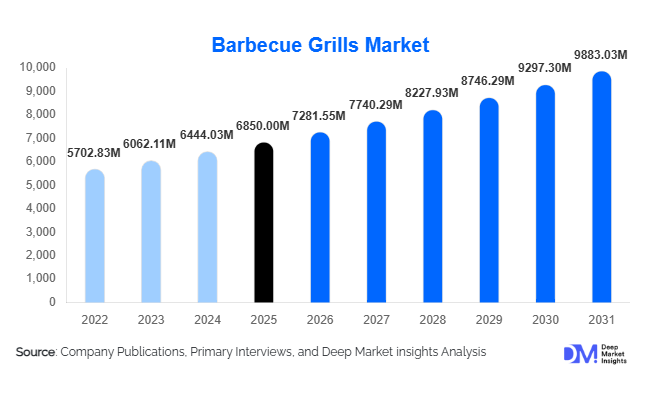
According to Deep Market Insights, the global barbecue grills market size was valued at USD 6,850 million in 2025 and is projected to grow from USD 7,281.55 million in 2026 to reach USD 9,883.03 million by 2031, expanding at a CAGR of 6.3% during the forecast period (2026–2031). The market growth is primarily driven by increasing outdoor cooking culture, rising consumer spending on home improvement, and the growing popularity of social gatherings centered around grilling. Technological advancements such as smart grills with app-based temperature control and automated cooking features are further enhancing product appeal. Additionally, the expansion of the foodservice industry and increasing adoption in emerging economies are contributing to steady demand. The market is also benefiting from premiumization trends, with consumers investing in high-end grills and outdoor kitchen setups. Overall, the barbecue grills market is evolving with a blend of lifestyle changes, innovation, and an expanding global consumer base.
Key Market Insights
- Outdoor cooking culture is expanding globally, driven by lifestyle shifts and increasing interest in home-based entertainment.
- Gas grills dominate the market due to convenience, ease of use, and faster cooking times.
- North America leads the market, supported by strong barbecue traditions and high disposable incomes.
- Asia-Pacific is the fastest-growing region, driven by urbanization and rising middle-class adoption of Western cooking habits.
- Smart grilling technologies, including IoT-enabled devices, are gaining traction among tech-savvy consumers.
- E-commerce channels are expanding rapidly, improving accessibility and product availability across regions.
What are the latest trends in the barbecue grills market?
Smart and Connected Grilling Solutions
The integration of smart technologies is transforming the barbecue grills market. Modern grills equipped with Wi-Fi and Bluetooth connectivity allow users to monitor and control cooking remotely through mobile applications. Features such as automated temperature regulation, cooking alerts, and recipe integration are enhancing convenience and precision. This trend is particularly appealing to younger consumers and first-time grill users, who seek simplified cooking experiences. Manufacturers are increasingly investing in R&D to incorporate AI-driven cooking assistance and predictive maintenance, further elevating the user experience.
Shift Toward Sustainable and Eco-Friendly Grills
Environmental awareness is influencing consumer preferences, leading to increased demand for eco-friendly grilling solutions. Pellet grills and electric grills are gaining popularity due to lower emissions compared to traditional charcoal grills. Manufacturers are also focusing on sustainable materials and energy-efficient designs. Regulatory pressures in regions such as Europe are encouraging the adoption of low-emission grills, while consumers are increasingly prioritizing environmentally responsible products. This shift is expected to shape product innovation and market strategies in the coming years.
What are the key drivers in the barbecue grills market?
Growth in Outdoor Living and Home Improvement Trends
The rising trend of outdoor living spaces has significantly boosted demand for barbecue grills. Consumers are investing in backyard kitchens, patios, and recreational areas, where grills serve as a central feature. This trend is particularly strong in North America and Europe, where outdoor gatherings and social events are common. Increased spending on home improvement projects has further accelerated market growth, especially in the premium segment.
Expansion of the Foodservice Industry
The growth of the global foodservice sector is a major driver for commercial grill demand. Restaurants, hotels, and catering services are increasingly incorporating grilled food offerings, driving the need for high-capacity and durable grills. The global foodservice industry, valued at over USD 3 trillion, continues to expand, creating sustained demand for barbecue grills in commercial applications.
What are the restraints for the global market?
High Cost of Advanced Grills
Premium barbecue grills, particularly pellet and smart models, are relatively expensive, limiting their adoption in price-sensitive markets. The high initial investment required for advanced features can deter consumers, especially in emerging economies. This cost barrier remains a key challenge for manufacturers aiming to expand their customer base.
Environmental and Regulatory Challenges
Charcoal grills face increasing scrutiny due to their environmental impact, including carbon emissions and deforestation concerns. Stringent regulations in regions such as Europe may restrict the use of certain grill types, requiring manufacturers to invest in compliance and innovation. These regulatory pressures can increase production costs and affect market growth.
What are the key opportunities in the barbecue grills industry?
Expansion in Emerging Markets
Emerging economies in the Asia-Pacific and Latin America present significant growth opportunities. Rising disposable incomes, urbanization, and the adoption of Western lifestyles are driving demand for barbecue grills. Manufacturers can capitalize on this opportunity by offering affordable and compact grill solutions tailored to urban consumers with limited outdoor space.
Development of Premium and Smart Grill Segments
The increasing demand for premium products offers opportunities for manufacturers to introduce high-end grills with advanced features. Smart grills with app connectivity, automated cooking systems, and enhanced durability are gaining traction. This segment allows companies to achieve higher profit margins while catering to affluent and tech-savvy consumers.
Report Scope
| Report Metric | Details |
|---|---|
| Market Size in 2025 | USD 6850 Million |
| Market Size in 2026 | USD 7281.55 Million |
| Market Size in 2031 | USD 9883.03 Million |
| CAGR | 6.3% (2026-2031) |
| Base Year for Estimation | 2025 |
| Historical Data | 2022-2024 |
| Forecast Period | 2026-2031 |
| Report Coverage | Revenue Forecast, Competitive Landscape, Supply Chain Disruption, Growth Factors, Environment & Regulatory Landscape and Trends |
| Geographies Covered | North America, Europe, APAC, Middle East and Africa, LATAM |
| Countries Covered | U.S., Canada, U.K., Germany, France, Spain, Italy, Russia, Nordic, Benelux, Rest of Europe, China, Korea, Japan, India, Australia, Singapore, Taiwan, South East Asia, Rest of Asia-Pacific, UAE, Turky, Saudi Arabia, South Africa, Egypt, Nigeria, Rest of MEA, Brazil, Mexico, Argentina, Chile, Colombia, Rest of LATAM |
Explore more data points, trends and opportunities Download Free Sample Report
Product Type Insights
Gas grills continue to dominate the barbecue grills market, accounting for approximately 45% of the total market share in 2025. The leadership of this segment is primarily driven by its convenience, rapid ignition systems, and superior temperature control, which cater to both novice and experienced users. The growing preference for hassle-free cooking solutions, particularly in developed markets such as North America and Europe, has further strengthened demand. Additionally, the increasing adoption of propane and natural gas infrastructure in residential spaces is supporting segment growth. Charcoal grills maintain a strong presence among traditional users and grilling enthusiasts due to their ability to deliver authentic smoky flavors, particularly in regions with established barbecue cultures. Meanwhile, pellet grills are emerging as a high-growth premium segment, driven by their integration of smart technologies, precise temperature management, and enhanced flavor profiles. Electric grills are gaining traction in urban environments, especially in apartments and regions with strict fire safety regulations, as they offer a smoke-free and compact grilling solution. The diversification of product offerings across fuel types is enabling manufacturers to cater to a broader consumer base globally.
Application Insights
The residential segment remains the dominant application area, accounting for nearly 70% of total demand in 2025. This dominance is driven by the rising popularity of home-based leisure activities, backyard gatherings, and outdoor cooking experiences. Increasing investments in home improvement and outdoor living spaces, particularly in developed economies, are significantly boosting residential demand. The commercial segment, including restaurants, hotels, and catering services, is the fastest-growing application area, supported by the rapid expansion of the global foodservice industry and increasing consumer preference for grilled food options. Growth in quick-service restaurants and casual dining establishments is further accelerating demand for high-capacity and durable grills. Emerging applications such as outdoor events, food trucks, and mobile catering services are also contributing to market expansion, creating demand for portable, versatile, and high-performance grilling equipment. These evolving use cases are broadening the application scope of barbecue grills beyond traditional settings.
Distribution Channel Insights
Offline retail channels, including specialty stores, home improvement outlets, and large-format retail chains, account for approximately 60% of the market share. The dominance of this segment is attributed to consumer preference for physically inspecting high-value products such as grills before purchase, as well as the availability of expert guidance and after-sales services. Retailers also benefit from in-store product demonstrations, which play a crucial role in influencing purchasing decisions. However, online distribution channels are witnessing rapid growth, driven by the increasing penetration of e-commerce platforms, competitive pricing, and the availability of a wide range of products. Digital platforms enable consumers to compare features, read reviews, and access promotional offers, making them an increasingly preferred purchasing channel. The online segment is expected to gain significant traction by 2031, supported by advancements in logistics, improved delivery infrastructure, and the growing influence of digital marketing strategies.
End-Use Insights
The residential segment remains the primary driver of the barbecue grills market, valued at approximately USD 4,800 million in 2025. Growth in this segment is fueled by increasing consumer inclination toward experiential cooking and social dining at home. The commercial segment is expanding at a faster pace, with a CAGR exceeding 7%, driven by the proliferation of restaurants, hotels, and catering services globally. The growing trend of outdoor dining and live cooking experiences in the hospitality sector is further boosting demand for advanced grilling equipment. Emerging end-use applications, including outdoor entertainment businesses, event management services, and food festivals, are creating new growth avenues for the market. Additionally, export-driven demand plays a significant role, with major manufacturing hubs such as China and the United States supplying barbecue grills to international markets, thereby supporting global market expansion.
Explore more data points, trends and opportunities Download Free Sample Report
Barbecue Grills Market Segmentations
By Product Type
- Gas Barbecue Grills
- Charcoal Barbecue Grills
- Electric Barbecue Grills
- Pellet Barbecue Grills
- Hybrid/Multi-Fuel Grills
By Application
- Residential
- Commercial
By Distribution Channel
- Online Retail
- Offline Retail
Regional Insights
North America
North America remains the largest market, accounting for approximately 40% of the global share in 2025, with the United States contributing the majority of regional demand. The region’s dominance is driven by a deeply rooted barbecue culture, high disposable incomes, and widespread adoption of outdoor living spaces. The increasing trend of backyard renovations and outdoor kitchens is significantly boosting grill sales. Additionally, the strong presence of leading manufacturers, high product innovation, and early adoption of smart grilling technologies are key growth drivers. Canada also contributes significantly, supported by similar lifestyle patterns and increasing demand for premium and technologically advanced grills.
Europe
Europe accounts for around 25% of the global market, with Germany, the United Kingdom, and France being the major contributors. Regional growth is driven by rising consumer awareness regarding sustainable and eco-friendly products, leading to increased adoption of electric and pellet grills. Stringent environmental regulations are encouraging the shift away from traditional charcoal grills toward cleaner alternatives. Additionally, the growing popularity of outdoor social gatherings, coupled with rising disposable incomes and interest in premium lifestyle products, is supporting market expansion. Technological adoption and demand for compact grills suitable for urban living spaces are also key growth factors in the region.
Asia-Pacific
Asia-Pacific is the fastest-growing region, with a CAGR exceeding 7.5%. China and India are the primary growth engines, driven by rapid urbanization, expanding middle-class populations, and increasing exposure to Western lifestyles. Rising disposable incomes and changing consumer preferences toward outdoor and experiential cooking are fueling demand. China’s strong manufacturing base and export capabilities further strengthen its position in the global market. In India, growth is supported by increasing adoption of modern cooking appliances and the rising popularity of social gatherings. Additionally, improving e-commerce infrastructure and increasing penetration of global brands are accelerating market growth across the region.
Latin America
Latin America holds approximately 8% of the global market, with Brazil and Mexico leading demand. The region’s growth is driven by increasing adoption of Western cooking styles, expanding middle-class populations, and a strong cultural inclination toward grilled food. Brazil, in particular, has a well-established barbecue tradition, which supports consistent demand for grills. Economic development and urbanization are further contributing to market growth, while the expansion of retail and e-commerce channels is improving product accessibility across the region.
Middle East & Africa
The Middle East & Africa region is experiencing steady growth, with demand concentrated in GCC countries such as the UAE and Saudi Arabia. Growth in this region is driven by a strong outdoor dining culture, favorable climatic conditions for outdoor cooking, and increasing investments in tourism and hospitality infrastructure. The rising number of luxury hotels, resorts, and outdoor dining establishments is boosting demand for commercial-grade grills. Additionally, increasing expatriate populations and the influence of Western lifestyles are contributing to higher adoption rates. In Africa, growth is supported by expanding urban centers and gradual improvements in retail and distribution networks.
Key Players in the Barbecue Grills Market
- Weber Inc.
- Traeger Inc.
- Char-Broil LLC
- Napoleon Products
- Broil King
- Landmann
- Coleman Company
- Blackstone Products
- Pit Boss Grills
- Kamado Joe
- Char-Griller
- Dyna-Glo
- Fire Magic
- Lynx Grills
- Kenmore