Asia Pacific Smart Wearables Market Size & Outlook, 2026-2034
Last Updated : 14 July, 2026 |
Study Period : 2022-2034 |
Format : PDF, Excel |
Author : Anna Morgan
Asia Pacific Smart Wearables Market Insights
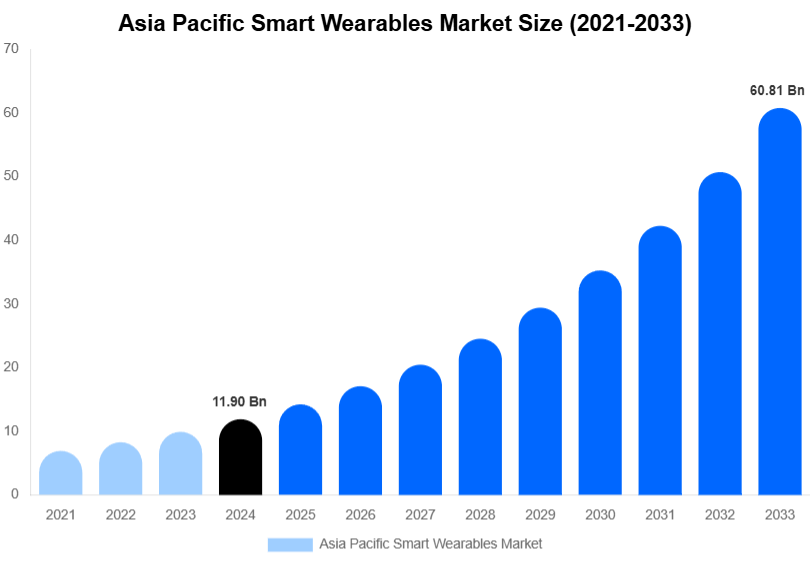
- Based on Deep Market Insights findings, the Asia Pacific Smart Wearables Market size reached USD 19633.17 Billion in 2025 and is expected to grow to USD 107499.29 Billion by 2034.
- During 2026–2034, the market is forecasted to advance at a CAGR of 20.56%.
- Smart Glasses represented the largest share of the Product Type market in terms of size in 2025.
- Among the Product Type segments, Smart Glasses is forecasted to achieve the highest growth and remain the most lucrative through the forecast period.
Source: DMI Analysis Company Publications, Primary Interviews.

Other Key Findings
- In 2025, Asia Pacific accounted for 23.26% of the global Smart Wearables Market size.
- By 2034, United States is projected to lead the global market in terms of market size.
- Taiwan is projected to emerge as the fastest-growing market in Asia Pacific, reaching USD 8268.79 Billion by 2034.
Asia Pacific Smart Wearables Market Dynamics
- Consumers across Asia Pacific increasingly integrate smart wearables into daily routines for health monitoring, fitness tracking, digital payments, and connected lifestyle management. Rapid urbanization, expanding smartphone penetration, and growing digital literacy encourage manufacturers to develop innovative wearable technologies tailored to diverse consumer preferences.
- Retail distribution continues expanding through electronics stores, telecom operators, online marketplaces, brand-exclusive outlets, and emerging social commerce platforms. Omnichannel retail strategies, localized product offerings, and digital marketing campaigns strengthen customer engagement across both developed and emerging economies.
- Technology companies continue investing in artificial intelligence, flexible displays, miniaturized sensors, wearable operating systems, and advanced biometric monitoring. Product innovation emphasizes affordability, personalized wellness features, and seamless integration with broader connected device ecosystems.
- Sustainability initiatives encourage manufacturers to improve energy efficiency, incorporate recycled materials, reduce packaging waste, and strengthen responsible supply chain practices. Companies increasingly prioritize environmentally conscious production while enhancing device durability and software longevity.
Key Industry Insights
- Smartphone integration remains a major purchasing factor.
- Health and fitness applications drive wearable adoption.
- Online retail continues expanding wearable accessibility.
- AI-enabled features strengthen product differentiation.
Asia Pacific Smart Wearables Market Country 2026-2034 (USD Billion)
| Asia Pacific | 2022 | 2023 | 2024 | 2025 | 2026 | 2027 | 2028 | 2029 | 2030 | 2031 | 2032 | 2033 | 2034 |
|---|---|---|---|---|---|---|---|---|---|---|---|---|---|
| China | XX.x | XX.x | XX.x | 7550.91 | XX.x | XX.x | XX.x | XX.x | XX.x | XX.x | XX.x | XX.x | XX.x |
| India | XX.x | XX.x | XX.x | XX.x | XX.x | XX.x | XX.x | XX.x | XX.x | XX.x | XX.x | XX.x | XX.x |
| Japan | XX.x | XX.x | XX.x | XX.x | XX.x | XX.x | XX.x | XX.x | XX.x | XX.x | XX.x | XX.x | XX.x |
| Korea | XX.x | XX.x | XX.x | XX.x | XX.x | XX.x | XX.x | XX.x | XX.x | XX.x | XX.x | XX.x | XX.x |
| Taiwan | XX.x | XX.x | XX.x | XX.x | XX.x | XX.x | XX.x | XX.x | XX.x | XX.x | XX.x | XX.x | XX.x |
| Australia | XX.x | XX.x | XX.x | XX.x | XX.x | XX.x | XX.x | XX.x | XX.x | XX.x | XX.x | XX.x | XX.x |
| Singapore | XX.x | XX.x | XX.x | XX.x | XX.x | XX.x | XX.x | XX.x | XX.x | XX.x | XX.x | XX.x | XX.x |
| South East Asia | XX.x | XX.x | XX.x | XX.x | XX.x | XX.x | XX.x | XX.x | XX.x | XX.x | XX.x | XX.x | XX.x |
| Total | XX.x | XX.x | XX.x | 19,633.15 | XX.x | XX.x | XX.x | XX.x | XX.x | XX.x | XX.x | XX.x | XX.x |
Source: DMI Analysis Company Publications, Primary Interviews.
Asia Pacific Smart Wearables Market Product Type 2026-2034 (USD Billion)
| Product Type | 2022 | 2023 | 2024 | 2025 | 2026 | 2027 | 2028 | 2029 | 2030 | 2031 | 2032 | 2033 | 2034 |
|---|---|---|---|---|---|---|---|---|---|---|---|---|---|
| Smartwatches | XX.x | XX.x | XX.x | 5889.95 | XX.x | XX.x | XX.x | XX.x | XX.x | XX.x | XX.x | XX.x | XX.x |
| Fitness Trackers | XX.x | XX.x | XX.x | XX.x | XX.x | XX.x | XX.x | XX.x | XX.x | XX.x | XX.x | XX.x | XX.x |
| Smart Glasses | XX.x | XX.x | XX.x | XX.x | XX.x | XX.x | XX.x | XX.x | XX.x | XX.x | XX.x | XX.x | XX.x |
| Smart Rings | XX.x | XX.x | XX.x | XX.x | XX.x | XX.x | XX.x | XX.x | XX.x | XX.x | XX.x | XX.x | XX.x |
| Smart Clothing | XX.x | XX.x | XX.x | XX.x | XX.x | XX.x | XX.x | XX.x | XX.x | XX.x | XX.x | XX.x | XX.x |
| Hearables | XX.x | XX.x | XX.x | XX.x | XX.x | XX.x | XX.x | XX.x | XX.x | XX.x | XX.x | XX.x | XX.x |
| Total | XX.x | XX.x | XX.x | 19,633.17 | XX.x | XX.x | XX.x | XX.x | XX.x | XX.x | XX.x | XX.x | XX.x |
Source: DMI Analysis Company Publications, Primary Interviews.
Asia Pacific Smart Wearables Market Application 2026-2034 (USD Billion)
| Application | 2022 | 2023 | 2024 | 2025 | 2026 | 2027 | 2028 | 2029 | 2030 | 2031 | 2032 | 2033 | 2034 |
|---|---|---|---|---|---|---|---|---|---|---|---|---|---|
| Health Monitoring | XX.x | XX.x | XX.x | 7865.04 | XX.x | XX.x | XX.x | XX.x | XX.x | XX.x | XX.x | XX.x | XX.x |
| Fitness Tracking | XX.x | XX.x | XX.x | XX.x | XX.x | XX.x | XX.x | XX.x | XX.x | XX.x | XX.x | XX.x | XX.x |
| Sports Performance | XX.x | XX.x | XX.x | XX.x | XX.x | XX.x | XX.x | XX.x | XX.x | XX.x | XX.x | XX.x | XX.x |
| Consumer Electronics Integration | XX.x | XX.x | XX.x | XX.x | XX.x | XX.x | XX.x | XX.x | XX.x | XX.x | XX.x | XX.x | XX.x |
| Total | XX.x | XX.x | XX.x | 19,633.16 | XX.x | XX.x | XX.x | XX.x | XX.x | XX.x | XX.x | XX.x | XX.x |
Source: DMI Analysis Company Publications, Primary Interviews.
Asia Pacific Smart Wearables Market Connectivity 2026-2034 (USD Billion)
| Connectivity | 2022 | 2023 | 2024 | 2025 | 2026 | 2027 | 2028 | 2029 | 2030 | 2031 | 2032 | 2033 | 2034 |
|---|---|---|---|---|---|---|---|---|---|---|---|---|---|
| Bluetooth | XX.x | XX.x | XX.x | 7458.64 | XX.x | XX.x | XX.x | XX.x | XX.x | XX.x | XX.x | XX.x | XX.x |
| Wi-Fi | XX.x | XX.x | XX.x | XX.x | XX.x | XX.x | XX.x | XX.x | XX.x | XX.x | XX.x | XX.x | XX.x |
| Cellular | XX.x | XX.x | XX.x | XX.x | XX.x | XX.x | XX.x | XX.x | XX.x | XX.x | XX.x | XX.x | XX.x |
| GPS | XX.x | XX.x | XX.x | XX.x | XX.x | XX.x | XX.x | XX.x | XX.x | XX.x | XX.x | XX.x | XX.x |
| 5G | XX.x | XX.x | XX.x | XX.x | XX.x | XX.x | XX.x | XX.x | XX.x | XX.x | XX.x | XX.x | XX.x |
| Total | XX.x | XX.x | XX.x | 19,633.16 | XX.x | XX.x | XX.x | XX.x | XX.x | XX.x | XX.x | XX.x | XX.x |
Source: DMI Analysis Company Publications, Primary Interviews.
Asia Pacific Smart Wearables Market Distribution Channel 2026-2034 (USD Billion)
| Distribution Channel | 2022 | 2023 | 2024 | 2025 | 2026 | 2027 | 2028 | 2029 | 2030 | 2031 | 2032 | 2033 | 2034 |
|---|---|---|---|---|---|---|---|---|---|---|---|---|---|
| Online Retail | XX.x | XX.x | XX.x | 10262.25 | XX.x | XX.x | XX.x | XX.x | XX.x | XX.x | XX.x | XX.x | XX.x |
| Offline Retail | XX.x | XX.x | XX.x | XX.x | XX.x | XX.x | XX.x | XX.x | XX.x | XX.x | XX.x | XX.x | XX.x |
| Direct Sales | XX.x | XX.x | XX.x | XX.x | XX.x | XX.x | XX.x | XX.x | XX.x | XX.x | XX.x | XX.x | XX.x |
| Total | XX.x | XX.x | XX.x | 19,633.15 | XX.x | XX.x | XX.x | XX.x | XX.x | XX.x | XX.x | XX.x | XX.x |
Source: DMI Analysis Company Publications, Primary Interviews.
Asia Pacific Smart Wearables Market End-User 2026-2034 (USD Billion)
| End-User | 2022 | 2023 | 2024 | 2025 | 2026 | 2027 | 2028 | 2029 | 2030 | 2031 | 2032 | 2033 | 2034 |
|---|---|---|---|---|---|---|---|---|---|---|---|---|---|
| Individual Consumers | XX.x | XX.x | XX.x | 10658.84 | XX.x | XX.x | XX.x | XX.x | XX.x | XX.x | XX.x | XX.x | XX.x |
| Healthcare Providers | XX.x | XX.x | XX.x | XX.x | XX.x | XX.x | XX.x | XX.x | XX.x | XX.x | XX.x | XX.x | XX.x |
| Enterprises | XX.x | XX.x | XX.x | XX.x | XX.x | XX.x | XX.x | XX.x | XX.x | XX.x | XX.x | XX.x | XX.x |
| Total | XX.x | XX.x | XX.x | 19,633.16 | XX.x | XX.x | XX.x | XX.x | XX.x | XX.x | XX.x | XX.x | XX.x |
Source: DMI Analysis Company Publications, Primary Interviews.
Inside This Report
This section examines the commercial landscape shaping Asia Pacific's smart wearables industry, highlighting digital lifestyle trends, technological innovation, retail transformation, and sustainability initiatives. It explores how manufacturers strengthen commercial strategies through connected ecosystems, localized product development, and responsible manufacturing practices.
- Regional market landscape: Reviews wearable innovation and digital ecosystem expansion across Asia Pacific.
- Consumer and purchasing trends: Explores connected lifestyles and evolving technology preferences.
- Product innovation and distribution: Covers AI integration, biometric sensors, and omnichannel retail.
- Competitive and industry developments: Highlights sustainability initiatives, manufacturing innovation, and ecosystem partnerships.
Report Summary
| Report Scope | Details |
|---|---|
| Base Year for Study | 2025 |
| Study Period | 2022-2034 |
| Historical Period | 2022-2024 |
| Forecast Period | 2026-2034 |
| Market Size In 2025 | USD 19633.17 Billion |
| Market Size In 2034 | USD 107499.29 Billion |
| Largest segment | Smart Glasses |
| Units | Revenue in USD Billion |
| CAGR | 20.56% (2026-2034) |
| Report Coverage | Revenue Forecast, Competitive Landscape, Growth Factors, Environment & Regulatory Landscape and Trends |