Asia Pacific Online Food Delivery Market Size & Outlook, 2026-2034
Last Updated : 16 July, 2026 |
Study Period : 2022-2034 |
Format : PDF, Excel |
Author : Hannah Blake
Asia Pacific Online Food Delivery Market Insights
- Based on Deep Market Insights findings, the Asia Pacific Online Food Delivery Market size reached USD 39.37 Billion in 2025 and is expected to grow to USD 95.72 Billion by 2034.
- During 2026–2034, the market is forecasted to advance at a CAGR of 10.4%.
- Aggregator Platforms represented the largest share of the Service Model market in terms of size in 2025.
- Among the Service Model segments, Cloud Kitchen Integration is forecasted to achieve the highest growth and remain the most lucrative through the forecast period.
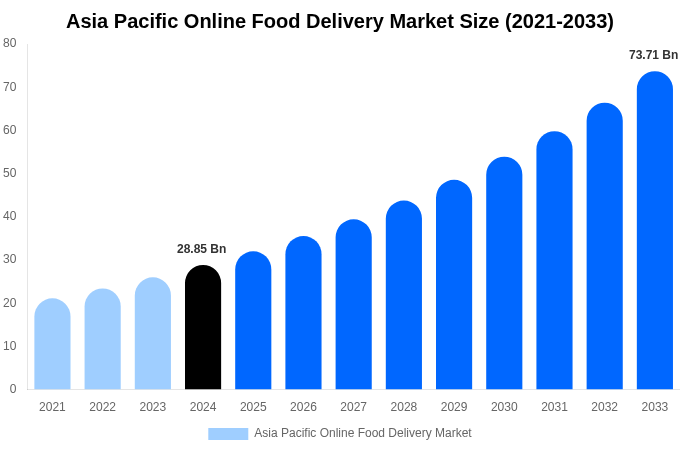
Source: DMI Analysis Company Publications, Primary Interviews.

Other Key Findings
- The global Online Food Delivery Market size saw Asia Pacific holding a share of 20.1% in 2025.
- United States is forecasted to account for the leading share of the global market by 2034.
- In Asia Pacific, Singapore is forecasted to be the fastest-expanding market, projected to reach USD 2.01 Billion by 2034.
Asia Pacific Online Food Delivery Market Dynamics
- The Asia Pacific online food delivery market remains one of the fastest-growing globally, supported by rapid urbanization, rising smartphone penetration, affordable internet access, expanding middle-class populations, and changing consumer lifestyles. Demand continues rising for restaurant meals, groceries, beverages, convenience foods, and quick commerce services.
- Food delivery platforms, restaurant-owned applications, cloud kitchens, supermarkets, convenience retailers, and quick commerce providers continue strengthening market accessibility. Expansion into emerging cities and increasing digital payment adoption continue accelerating market growth.
- Companies invest in AI-powered logistics, route optimization, autonomous delivery technologies, cloud kitchen expansion, predictive analytics, real-time order tracking, and personalized recommendations. Product innovation focuses on delivery speed, operational efficiency, and customer convenience.
- Sustainability initiatives promote recyclable food packaging, electric delivery vehicles, optimized logistics, biodegradable containers, and food waste reduction. Companies increasingly integrate sustainable delivery practices into long-term business strategies.
Key Industry Insights
- Smartphone adoption drives rapid market expansion.
- Quick commerce strengthens digital food delivery.
- AI-powered logistics improve operational efficiency.
- Sustainable packaging gains increasing importance.
Asia Pacific Online Food Delivery Market Country 2026-2034 (USD Billion)
| Asia Pacific | 2022 | 2023 | 2024 | 2025 | 2026 | 2027 | 2028 | 2029 | 2030 | 2031 | 2032 | 2033 | 2034 |
|---|---|---|---|---|---|---|---|---|---|---|---|---|---|
| China | XX.x | XX.x | XX.x | 14.96 | XX.x | XX.x | XX.x | XX.x | XX.x | XX.x | XX.x | XX.x | XX.x |
| India | XX.x | XX.x | XX.x | XX.x | XX.x | XX.x | XX.x | XX.x | XX.x | XX.x | XX.x | XX.x | XX.x |
| Japan | XX.x | XX.x | XX.x | XX.x | XX.x | XX.x | XX.x | XX.x | XX.x | XX.x | XX.x | XX.x | XX.x |
| Korea | XX.x | XX.x | XX.x | XX.x | XX.x | XX.x | XX.x | XX.x | XX.x | XX.x | XX.x | XX.x | XX.x |
| Taiwan | XX.x | XX.x | XX.x | XX.x | XX.x | XX.x | XX.x | XX.x | XX.x | XX.x | XX.x | XX.x | XX.x |
| Australia | XX.x | XX.x | XX.x | XX.x | XX.x | XX.x | XX.x | XX.x | XX.x | XX.x | XX.x | XX.x | XX.x |
| Singapore | XX.x | XX.x | XX.x | XX.x | XX.x | XX.x | XX.x | XX.x | XX.x | XX.x | XX.x | XX.x | XX.x |
| South East Asia | XX.x | XX.x | XX.x | XX.x | XX.x | XX.x | XX.x | XX.x | XX.x | XX.x | XX.x | XX.x | XX.x |
| Total | XX.x | XX.x | XX.x | 39.38 | XX.x | XX.x | XX.x | XX.x | XX.x | XX.x | XX.x | XX.x | XX.x |
Source: DMI Analysis Company Publications, Primary Interviews.
Asia Pacific Online Food Delivery Market Service Model 2026-2034 (USD Billion)
| Service Model | 2022 | 2023 | 2024 | 2025 | 2026 | 2027 | 2028 | 2029 | 2030 | 2031 | 2032 | 2033 | 2034 |
|---|---|---|---|---|---|---|---|---|---|---|---|---|---|
| Aggregator Platforms | XX.x | XX.x | XX.x | 19.11 | XX.x | XX.x | XX.x | XX.x | XX.x | XX.x | XX.x | XX.x | XX.x |
| Platform-To-Consumer | XX.x | XX.x | XX.x | XX.x | XX.x | XX.x | XX.x | XX.x | XX.x | XX.x | XX.x | XX.x | XX.x |
| Cloud Kitchen Integration | XX.x | XX.x | XX.x | XX.x | XX.x | XX.x | XX.x | XX.x | XX.x | XX.x | XX.x | XX.x | XX.x |
| Total | XX.x | XX.x | XX.x | 39.37 | XX.x | XX.x | XX.x | XX.x | XX.x | XX.x | XX.x | XX.x | XX.x |
Source: DMI Analysis Company Publications, Primary Interviews.
Asia Pacific Online Food Delivery Market Order Type 2026-2034 (USD Billion)
| Order Type | 2022 | 2023 | 2024 | 2025 | 2026 | 2027 | 2028 | 2029 | 2030 | 2031 | 2032 | 2033 | 2034 |
|---|---|---|---|---|---|---|---|---|---|---|---|---|---|
| App Orders | XX.x | XX.x | XX.x | XX.x | XX.x | XX.x | XX.x | XX.x | XX.x | XX.x | XX.x | XX.x | XX.x |
| Website Orders | XX.x | XX.x | XX.x | XX.x | XX.x | XX.x | XX.x | XX.x | XX.x | XX.x | XX.x | XX.x | XX.x |
| Total | XX.x | XX.x | XX.x | XX.x | XX.x | XX.x | XX.x | XX.x | XX.x | XX.x | XX.x | XX.x | XX.x |
Source: DMI Analysis Company Publications, Primary Interviews.
Asia Pacific Online Food Delivery Market End User 2026-2034 (USD Billion)
| End User | 2022 | 2023 | 2024 | 2025 | 2026 | 2027 | 2028 | 2029 | 2030 | 2031 | 2032 | 2033 | 2034 |
|---|---|---|---|---|---|---|---|---|---|---|---|---|---|
| Individual Consumers | XX.x | XX.x | XX.x | XX.x | XX.x | XX.x | XX.x | XX.x | XX.x | XX.x | XX.x | XX.x | XX.x |
| Corporate Orders | XX.x | XX.x | XX.x | XX.x | XX.x | XX.x | XX.x | XX.x | XX.x | XX.x | XX.x | XX.x | XX.x |
| Total | XX.x | XX.x | XX.x | XX.x | XX.x | XX.x | XX.x | XX.x | XX.x | XX.x | XX.x | XX.x | XX.x |
Source: DMI Analysis Company Publications, Primary Interviews.
Inside This Report
This section examines Asia Pacific's online food delivery industry through consumer demand, logistics innovation, technology adoption, and sustainability initiatives. It highlights how providers strengthen competitiveness through digital transformation and scalable delivery networks.
- Regional market landscape: Reviews online food delivery developments across Asia Pacific.
- Consumer ordering trends: Explores digital purchasing behavior and convenience preferences.
- Technology and service innovation: Covers logistics technologies, delivery platforms, and payment solutions.
- Competitive and industry developments: Highlights sustainability, innovation, and regional growth.
Report Summary
| Report Scope | Details |
|---|---|
| Base Year for Study | 2025 |
| Study Period | 2022-2034 |
| Historical Period | 2022-2024 |
| Forecast Period | 2026-2034 |
| Market Size In 2025 | USD 39.37 Billion |
| Market Size In 2034 | USD 95.72 Billion |
| Largest segment | Aggregator Platforms |
| Units | Revenue in USD Billion |
| CAGR | 10.4% (2026-2034) |
| Report Coverage | Revenue Forecast, Competitive Landscape, Growth Factors, Environment & Regulatory Landscape and Trends |