Europe Non Alcoholic Beer Market Size & Outlook, 2026-2034
Last Updated : 27 July, 2026 |
Study Period : 2022-2034 |
Format : PDF, Excel |
Author : Hannah Blake
Europe Non Alcoholic Beer Market Insights
- Based on Deep Market Insights findings, the Europe Non Alcoholic Beer Market size reached USD 6387.54 Million in 2025 and is expected to grow to USD 11892.35 Million by 2034.
- During 2026–2034, the market is forecasted to advance at a CAGR of 7.29%.
- Dealcoholized represented the largest share of the Type market in terms of size in 2025.
- Among the Type segments, Malt based is forecasted to achieve the highest growth and remain the most lucrative through the forecast period.
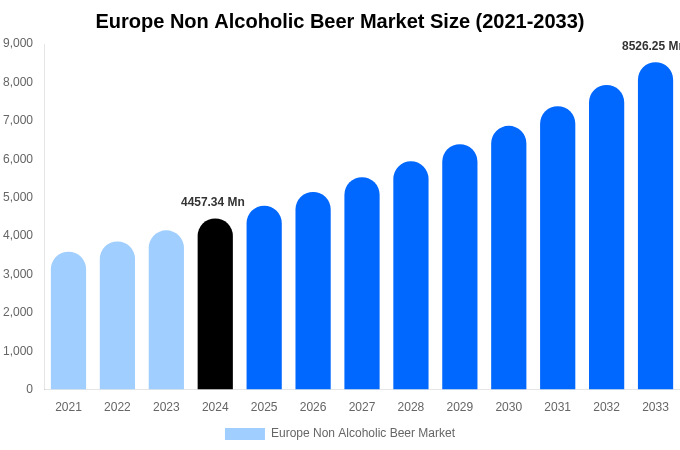
Source: DMI Analysis Company Publications, Primary Interviews.

Other Key Findings
- Europe held 26.73% share of the global Non Alcoholic Beer Market size in 2025.
- United States is expected to remain the largest contributor to the global market size by 2034.
- By 2034, Italy is anticipated to record the highest growth in Europe, with the market size expected to reach USD 1234.3 Million.
Europe Non-Alcoholic Beer Market Dynamics
- Europe's non-alcoholic beer market reflects increasing consumer demand for healthier beverage alternatives, responsible drinking habits, and premium alcohol-free brewing. Buyers increasingly prioritize authentic flavor, traditional brewing quality, low-calorie recipes, and sustainably produced beverages that complement evolving lifestyle preferences.
- Supermarkets, beverage specialty retailers, restaurants, pubs, convenience stores, and e-commerce platforms strengthen accessibility through extensive omnichannel distribution. Brewers increasingly diversify alcohol-free portfolios, improve retail visibility, and introduce premium seasonal offerings that broaden consumer choice across multiple consumption occasions.
- Manufacturers prioritize advanced brewing technologies, precision alcohol removal processes, premium malt selection, flavor preservation techniques, and environmentally responsible packaging to strengthen product differentiation. Innovation also focuses on reduced sugar formulations, isotonic beverages, and authentic brewing experiences that maintain traditional taste characteristics.
- Beverage companies collaborate with retailers, hospitality operators, distributors, sporting events, and promotional partners to strengthen brand visibility and consumer engagement. Continued investment in brewing excellence, sustainable production, and premium alcohol-free innovation reinforces competitiveness across Europe's non-alcoholic beer industry.
Key Industry Insights
- Traditional brewing supports premium positioning.
- Responsible consumption strengthens category demand.
- Sustainable packaging improves brand value.
- Retail diversification expands consumer accessibility.
Europe Non Alcoholic Beer Market Country 2026-2034 (USD Million)
| Europe | 2022 | 2023 | 2024 | 2025 | 2026 | 2027 | 2028 | 2029 | 2030 | 2031 | 2032 | 2033 | 2034 |
|---|---|---|---|---|---|---|---|---|---|---|---|---|---|
| Germany | XX.x | XX.x | XX.x | 1621.8 | XX.x | XX.x | XX.x | XX.x | XX.x | XX.x | XX.x | XX.x | XX.x |
| United Kingdom | XX.x | XX.x | XX.x | XX.x | XX.x | XX.x | XX.x | XX.x | XX.x | XX.x | XX.x | XX.x | XX.x |
| France | XX.x | XX.x | XX.x | XX.x | XX.x | XX.x | XX.x | XX.x | XX.x | XX.x | XX.x | XX.x | XX.x |
| Italy | XX.x | XX.x | XX.x | XX.x | XX.x | XX.x | XX.x | XX.x | XX.x | XX.x | XX.x | XX.x | XX.x |
| Spain | XX.x | XX.x | XX.x | XX.x | XX.x | XX.x | XX.x | XX.x | XX.x | XX.x | XX.x | XX.x | XX.x |
| Russia | XX.x | XX.x | XX.x | XX.x | XX.x | XX.x | XX.x | XX.x | XX.x | XX.x | XX.x | XX.x | XX.x |
| Nordic | XX.x | XX.x | XX.x | XX.x | XX.x | XX.x | XX.x | XX.x | XX.x | XX.x | XX.x | XX.x | XX.x |
| Benelux | XX.x | XX.x | XX.x | XX.x | XX.x | XX.x | XX.x | XX.x | XX.x | XX.x | XX.x | XX.x | XX.x |
| Total | XX.x | XX.x | XX.x | 6,387.54 | XX.x | XX.x | XX.x | XX.x | XX.x | XX.x | XX.x | XX.x | XX.x |
Source: DMI Analysis Company Publications, Primary Interviews.
Europe Non Alcoholic Beer Market Type 2026-2034 (USD Million)
| Type | 2022 | 2023 | 2024 | 2025 | 2026 | 2027 | 2028 | 2029 | 2030 | 2031 | 2032 | 2033 | 2034 |
|---|---|---|---|---|---|---|---|---|---|---|---|---|---|
| Dealcoholized | XX.x | XX.x | XX.x | 3481.21 | XX.x | XX.x | XX.x | XX.x | XX.x | XX.x | XX.x | XX.x | XX.x |
| Low alcohol | XX.x | XX.x | XX.x | XX.x | XX.x | XX.x | XX.x | XX.x | XX.x | XX.x | XX.x | XX.x | XX.x |
| Malt based | XX.x | XX.x | XX.x | XX.x | XX.x | XX.x | XX.x | XX.x | XX.x | XX.x | XX.x | XX.x | XX.x |
| Total | XX.x | XX.x | XX.x | 6,387.54 | XX.x | XX.x | XX.x | XX.x | XX.x | XX.x | XX.x | XX.x | XX.x |
Source: DMI Analysis Company Publications, Primary Interviews.
Europe Non Alcoholic Beer Market Packaging 2026-2034 (USD Million)
| Packaging | 2022 | 2023 | 2024 | 2025 | 2026 | 2027 | 2028 | 2029 | 2030 | 2031 | 2032 | 2033 | 2034 |
|---|---|---|---|---|---|---|---|---|---|---|---|---|---|
| Bottle | XX.x | XX.x | XX.x | 2892.28 | XX.x | XX.x | XX.x | XX.x | XX.x | XX.x | XX.x | XX.x | XX.x |
| Can | XX.x | XX.x | XX.x | XX.x | XX.x | XX.x | XX.x | XX.x | XX.x | XX.x | XX.x | XX.x | XX.x |
| Keg | XX.x | XX.x | XX.x | XX.x | XX.x | XX.x | XX.x | XX.x | XX.x | XX.x | XX.x | XX.x | XX.x |
| Total | XX.x | XX.x | XX.x | 6,387.55 | XX.x | XX.x | XX.x | XX.x | XX.x | XX.x | XX.x | XX.x | XX.x |
Source: DMI Analysis Company Publications, Primary Interviews.
Europe Non Alcoholic Beer Market Channel 2026-2034 (USD Million)
| Channel | 2022 | 2023 | 2024 | 2025 | 2026 | 2027 | 2028 | 2029 | 2030 | 2031 | 2032 | 2033 | 2034 |
|---|---|---|---|---|---|---|---|---|---|---|---|---|---|
| Retail | XX.x | XX.x | XX.x | 3444.81 | XX.x | XX.x | XX.x | XX.x | XX.x | XX.x | XX.x | XX.x | XX.x |
| On trade | XX.x | XX.x | XX.x | XX.x | XX.x | XX.x | XX.x | XX.x | XX.x | XX.x | XX.x | XX.x | XX.x |
| Online | XX.x | XX.x | XX.x | XX.x | XX.x | XX.x | XX.x | XX.x | XX.x | XX.x | XX.x | XX.x | XX.x |
| Total | XX.x | XX.x | XX.x | 6,387.55 | XX.x | XX.x | XX.x | XX.x | XX.x | XX.x | XX.x | XX.x | XX.x |
Source: DMI Analysis Company Publications, Primary Interviews.
Inside This Report
This section explores Europe's non-alcoholic beer market through consumer behavior, brewing innovation, retail transformation, and competitive strategies. It explains how beverage companies strengthen competitiveness by improving product quality, expanding omnichannel distribution, and advancing premium alcohol-free brewing technologies.
- Regional market landscape: Reviews Europe's non-alcoholic beer ecosystem.
- Consumer and purchasing trends: Explores mindful drinking preferences.
- Product innovation and distribution: Covers brewing technologies and retail expansion.
- Competitive and industry developments: Highlights sustainability and premiumization.
Report Summary
| Report Scope | Details |
|---|---|
| Base Year for Study | 2025 |
| Study Period | 2022-2034 |
| Historical Period | 2022-2024 |
| Forecast Period | 2026-2034 |
| Market Size In 2025 | USD 6387.54 Million |
| Market Size In 2034 | USD 11892.35 Million |
| Largest segment | Dealcoholized |
| Units | Revenue in USD Million |
| CAGR | 7.29% (2026-2034) |
| Report Coverage | Revenue Forecast, Competitive Landscape, Growth Factors, Environment & Regulatory Landscape and Trends |