Korea Islamic Clothing Market Size & Outlook, 2026-2034
Last Updated : 27 July, 2026 |
Study Period : 2022-2034 |
Format : PDF, Excel |
Author : Anna Morgan
Korea Islamic Clothing Market Insights
- Based on Deep Market Insights findings, the Korea Islamic Clothing Market reached USD 1709.34 Billion in 2025 and is estimated to attain USD 3071.22 Billion by 2034.
- From 2026 to 2034, the Korea market is expected to grow at a steady CAGR of 6.74%.
- Within the Type category, Hijab dominated in 2025 in terms of market size contribution.
- Over the forecast period, Abaya is forecasted to deliver the fastest growth, positioning it as the most lucrative Type segment.
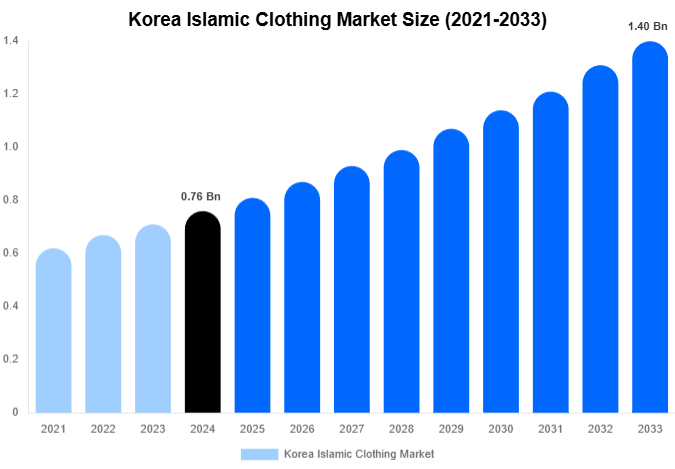
Source: DMI Analysis Company Publications, Primary Interviews.

Other Key Findings
- In 2025, Korea accounted for 1.73% of the global Islamic Clothing Market size.
- By 2034, United States is expected to lead the global Islamic Clothing Market in terms of market size.
- Within Asia Pacific, China is projected to dominate the regional Islamic Clothing Market size by 2034.
- Singapore is identified as the fastest-growing market in Asia Pacific, anticipated to reach USD 1246.09 Billion by 2034.
South Korea Islamic Clothing Market Dynamics
- South Korea's Islamic clothing market reflects increasing demand from Muslim visitors, expatriates, and fashion-conscious consumers seeking contemporary modest apparel. Consumers increasingly prefer stylish garments combining cultural authenticity, premium fabrics, modern silhouettes, and practical functionality suitable for everyday wear and special occasions.
- Fashion retailers, department stores, specialty boutiques, online marketplaces, cross-border e-commerce platforms, and digital fashion channels strengthen accessibility through integrated omnichannel distribution. Brands increasingly improve digital engagement, broaden modest fashion portfolios, and strengthen international partnerships to improve consumer accessibility.
- Companies invest in sustainable textiles, breathable premium fabrics, contemporary modest fashion collections, customization capabilities, and digital shopping technologies to strengthen competitive differentiation. Innovation also focuses on seasonal apparel, luxury modest wear, inclusive fashion, and environmentally responsible manufacturing supporting changing consumer expectations.
- Islamic clothing brands collaborate with designers, textile manufacturers, retailers, logistics providers, fashion influencers, and digital commerce platforms to strengthen operational efficiency and product quality. Continued investment in sustainable fashion, premium apparel, and omnichannel retail reinforces competitiveness across South Korea's Islamic clothing industry.
Key Industry Insights
- Contemporary styling strengthens consumer appeal.
- Sustainable fabrics improve brand positioning.
- Digital commerce enhances accessibility.
- Premium collections support differentiation.
Korea Islamic Clothing Market Type 2026-2034 (USD Billion)
| Type | 2022 | 2023 | 2024 | 2025 | 2026 | 2027 | 2028 | 2029 | 2030 | 2031 | 2032 | 2033 | 2034 |
|---|---|---|---|---|---|---|---|---|---|---|---|---|---|
| Hijab | XX.x | XX.x | XX.x | XX.x | XX.x | XX.x | XX.x | XX.x | XX.x | XX.x | XX.x | XX.x | XX.x |
| Abaya | XX.x | XX.x | XX.x | XX.x | XX.x | XX.x | XX.x | XX.x | XX.x | XX.x | XX.x | XX.x | XX.x |
| Total | XX.x | XX.x | XX.x | XX.x | XX.x | XX.x | XX.x | XX.x | XX.x | XX.x | XX.x | XX.x | XX.x |
Source: DMI Analysis Company Publications, Primary Interviews.
Korea Islamic Clothing Market Distribution 2026-2034 (USD Billion)
| Distribution | 2022 | 2023 | 2024 | 2025 | 2026 | 2027 | 2028 | 2029 | 2030 | 2031 | 2032 | 2033 | 2034 |
|---|---|---|---|---|---|---|---|---|---|---|---|---|---|
| Online | XX.x | XX.x | XX.x | XX.x | XX.x | XX.x | XX.x | XX.x | XX.x | XX.x | XX.x | XX.x | XX.x |
| Offline | XX.x | XX.x | XX.x | XX.x | XX.x | XX.x | XX.x | XX.x | XX.x | XX.x | XX.x | XX.x | XX.x |
| Total | XX.x | XX.x | XX.x | XX.x | XX.x | XX.x | XX.x | XX.x | XX.x | XX.x | XX.x | XX.x | XX.x |
Source: DMI Analysis Company Publications, Primary Interviews.
Inside This Report
This section explores South Korea's Islamic clothing market through changing consumer preferences, product innovation, retail developments, and competitive strategies. It explains how brands strengthen competitiveness by expanding modest fashion portfolios, improving omnichannel retail capabilities, and investing in sustainable apparel innovation.
- Country market landscape: Reviews South Korea's Islamic clothing ecosystem.
- Consumer and purchasing trends: Explores modest fashion preferences.
- Product innovation and distribution: Covers apparel innovation and retail channels.
- Competitive and industry developments: Highlights sustainability and fashion partnerships.
Report Summary
| Report Scope | Details |
|---|---|
| Base Year for Study | 2025 |
| Study Period | 2022-2034 |
| Historical Period | 2022-2024 |
| Forecast Period | 2026-2034 |
| Market Size In 2025 | USD 1709.34 Billion |
| Market Size In 2034 | USD 3071.22 Billion |
| Largest segment | Hijab |
| Units | Revenue in USD Billion |
| CAGR | 6.74% (2026-2034) |
| Report Coverage | Revenue Forecast, Competitive Landscape, Growth Factors, Environment & Regulatory Landscape and Trends |