Asia Pacific Student Accommodation Market Size & Outlook, 2026-2034
Last Updated : 24 July, 2026 |
Study Period : 2022-2034 |
Format : PDF, Excel |
Author : Anna Morgan
Asia Pacific Student Accommodation Market Insights
- Deep Market Insights analysis indicates that the Asia Pacific Student Accommodation Market size, which was USD 20.63 Billion in 2025, is projected to attain USD 32.37 Billion by 2034.
- The market is expected to register a CAGR of 5.13% over the period 2026–2034.
- In 2025, PBSA emerged as the dominant Property Type based on market size.
- PBSA is projected to register the fastest growth, positioning it as the most attractive Property Type segment over the forecast horizon.
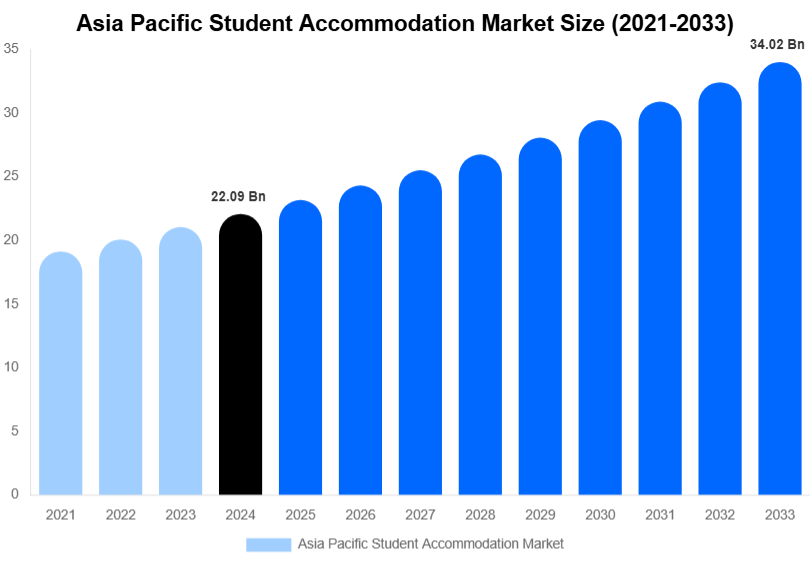
Source: DMI Analysis Company Publications, Primary Interviews.

Other Key Findings
- Asia Pacific represented 15.57% of the global Student Accommodation Market size in 2025.
- By 2034, United States is estimated to hold the largest position in the global market in terms of size.
- Korea is estimated to remain the fastest-growing market in Asia Pacific, advancing to USD 1.75 Billion by 2034.
Asia Pacific Student Accommodation Market Dynamics
- Asia Pacific's student accommodation landscape reflects diverse education systems, urban densities, housing markets, and student mobility patterns. University dormitories, private rentals, shared housing, and purpose-built facilities serve different needs, while students increasingly seek convenient locations, reliable connectivity, security, affordability, and study-friendly environments.
- Major education cities increasingly attract students from domestic regions and overseas, creating demand for accommodation beyond traditional campus housing. Operators increasingly develop furnished rooms, flexible occupancy arrangements, shared facilities, and services designed for students relocating to unfamiliar cities.
- International student mobility influences accommodation design and service delivery across key education markets. Providers increasingly offer simplified applications, multilingual communication, furnished units, flexible onboarding, and community services to support students navigating new housing and cultural environments.
- Digital platforms increasingly transform accommodation discovery, booking, payments, maintenance, and tenant communication. Operators also invest in study lounges, social areas, fitness facilities, smart access systems, and community programming to strengthen the overall student living experience.
Key Industry Insights
- Asia Pacific has diverse student housing systems and education markets.
- Major cities attract significant domestic and international student mobility.
- University dormitories remain important in several regional markets.
- Digital platforms increasingly support student accommodation discovery.
Asia Pacific Student Accommodation Market Country 2026-2034 (USD Billion)
| Asia Pacific | 2022 | 2023 | 2024 | 2025 | 2026 | 2027 | 2028 | 2029 | 2030 | 2031 | 2032 | 2033 | 2034 |
|---|---|---|---|---|---|---|---|---|---|---|---|---|---|
| China | XX.x | XX.x | XX.x | 7.84 | XX.x | XX.x | XX.x | XX.x | XX.x | XX.x | XX.x | XX.x | XX.x |
| India | XX.x | XX.x | XX.x | XX.x | XX.x | XX.x | XX.x | XX.x | XX.x | XX.x | XX.x | XX.x | XX.x |
| Japan | XX.x | XX.x | XX.x | XX.x | XX.x | XX.x | XX.x | XX.x | XX.x | XX.x | XX.x | XX.x | XX.x |
| Korea | XX.x | XX.x | XX.x | XX.x | XX.x | XX.x | XX.x | XX.x | XX.x | XX.x | XX.x | XX.x | XX.x |
| Taiwan | XX.x | XX.x | XX.x | XX.x | XX.x | XX.x | XX.x | XX.x | XX.x | XX.x | XX.x | XX.x | XX.x |
| Australia | XX.x | XX.x | XX.x | XX.x | XX.x | XX.x | XX.x | XX.x | XX.x | XX.x | XX.x | XX.x | XX.x |
| Singapore | XX.x | XX.x | XX.x | XX.x | XX.x | XX.x | XX.x | XX.x | XX.x | XX.x | XX.x | XX.x | XX.x |
| South East Asia | XX.x | XX.x | XX.x | XX.x | XX.x | XX.x | XX.x | XX.x | XX.x | XX.x | XX.x | XX.x | XX.x |
| Total | XX.x | XX.x | XX.x | 20.62 | XX.x | XX.x | XX.x | XX.x | XX.x | XX.x | XX.x | XX.x | XX.x |
Source: DMI Analysis Company Publications, Primary Interviews.
Asia Pacific Student Accommodation Market Property Type 2026-2034 (USD Billion)
| Property Type | 2022 | 2023 | 2024 | 2025 | 2026 | 2027 | 2028 | 2029 | 2030 | 2031 | 2032 | 2033 | 2034 |
|---|---|---|---|---|---|---|---|---|---|---|---|---|---|
| PBSA | XX.x | XX.x | XX.x | XX.x | XX.x | XX.x | XX.x | XX.x | XX.x | XX.x | XX.x | XX.x | XX.x |
| Private Rental | XX.x | XX.x | XX.x | XX.x | XX.x | XX.x | XX.x | XX.x | XX.x | XX.x | XX.x | XX.x | XX.x |
| Total | XX.x | XX.x | XX.x | XX.x | XX.x | XX.x | XX.x | XX.x | XX.x | XX.x | XX.x | XX.x | XX.x |
Source: DMI Analysis Company Publications, Primary Interviews.
Asia Pacific Student Accommodation Market Room Type 2026-2034 (USD Billion)
| Room Type | 2022 | 2023 | 2024 | 2025 | 2026 | 2027 | 2028 | 2029 | 2030 | 2031 | 2032 | 2033 | 2034 |
|---|---|---|---|---|---|---|---|---|---|---|---|---|---|
| Single | XX.x | XX.x | XX.x | XX.x | XX.x | XX.x | XX.x | XX.x | XX.x | XX.x | XX.x | XX.x | XX.x |
| Shared | XX.x | XX.x | XX.x | XX.x | XX.x | XX.x | XX.x | XX.x | XX.x | XX.x | XX.x | XX.x | XX.x |
| Total | XX.x | XX.x | XX.x | XX.x | XX.x | XX.x | XX.x | XX.x | XX.x | XX.x | XX.x | XX.x | XX.x |
Source: DMI Analysis Company Publications, Primary Interviews.
Inside This Report
This section examines Asia Pacific's student accommodation industry through education mobility, urbanization, campus housing, private rentals, purpose-built facilities, and digital transformation. It explores how providers respond to diverse student needs through furnished housing, accessible services, technology, shared amenities, and community-oriented residential environments.
- Regional market landscape: Reviews Asia Pacific's diverse university and accommodation ecosystem.
- Consumer and purchasing trends: Explores affordability, convenience, connectivity, and student mobility.
- Product innovation and distribution: Covers digital booking, furnished rooms, and shared amenities.
- Competitive and industry developments: Highlights international education and specialized housing providers.
Report Summary
| Report Scope | Details |
|---|---|
| Base Year for Study | 2025 |
| Study Period | 2022-2034 |
| Historical Period | 2022-2024 |
| Forecast Period | 2026-2034 |
| Market Size In 2025 | USD 20.63 Billion |
| Market Size In 2034 | USD 32.37 Billion |
| Largest segment | PBSA |
| Units | Revenue in USD Billion |
| CAGR | 5.13% (2026-2034) |
| Report Coverage | Revenue Forecast, Competitive Landscape, Growth Factors, Environment & Regulatory Landscape and Trends |