Europe Residential Real Estate Market Size & Outlook, 2026-2034
Last Updated : 27 July, 2026 |
Study Period : 2022-2034 |
Format : PDF, Excel |
Author : Anna Morgan
Europe Residential Real Estate Market Insights
- Based on Deep Market Insights findings, the Europe Residential Real Estate Market size reached USD 3965.94 Billion in 2025 and is expected to grow to USD 6130.84 Billion by 2034.
- During 2026–2034, the market is forecasted to advance at a CAGR of 5.01%.
- Apartments represented the largest share of the Type market in terms of size in 2025.
- Among the Type segments, Condos is forecasted to achieve the highest growth and remain the most lucrative through the forecast period.
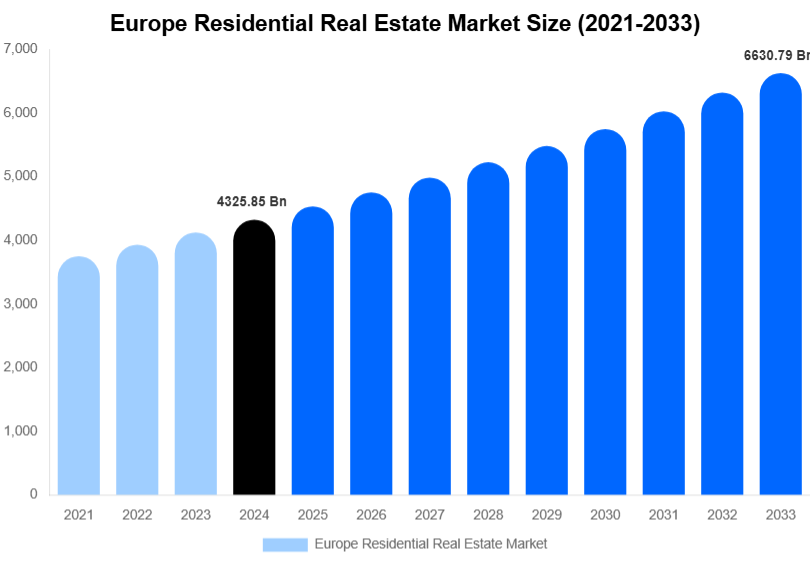
Source: DMI Analysis Company Publications, Primary Interviews.

Other Key Findings
- Europe held 34.39% share of the global Residential Real Estate Market size in 2025.
- United States is expected to remain the largest contributor to the global market size by 2034.
- By 2034, Nordic is anticipated to record the highest growth in Europe, with the market size expected to reach USD 318.42 Billion.
Europe Residential Real Estate Market Dynamics
- Europe's residential real estate market benefits from increasing sustainability initiatives, urban redevelopment, and growing demand for premium energy-efficient housing. Homebuyers increasingly prefer properties featuring smart technologies, environmentally responsible construction, premium amenities, and convenient access to transportation, employment, and public services.
- Property developers, estate agencies, digital property portals, financial institutions, and brokerage firms strengthen accessibility through diversified omnichannel property services. Companies increasingly enhance virtual property experiences, digital documentation capabilities, and customer engagement technologies to improve purchasing efficiency and transaction transparency.
- Developers invest in green construction technologies, smart residential infrastructure, energy-efficient buildings, premium community amenities, sustainable materials, and digital property management systems to strengthen competitive differentiation. Innovation also emphasizes wellness-focused developments, mixed-use communities, and environmentally responsible urban planning supporting evolving consumer expectations.
- Residential developers collaborate with construction companies, municipal authorities, technology providers, financial institutions, and digital property platforms to strengthen operational resilience and project quality. Continued investment in sustainable housing, smart infrastructure, and digital real estate capabilities reinforces competitiveness across Europe's residential real estate industry.
Key Industry Insights
- Sustainable housing drives buyer preference.
- Smart technologies improve residential value.
- Digital transactions enhance convenience.
- Green developments strengthen competitiveness.
Europe Residential Real Estate Market Country 2026-2034 (USD Billion)
| Europe | 2022 | 2023 | 2024 | 2025 | 2026 | 2027 | 2028 | 2029 | 2030 | 2031 | 2032 | 2033 | 2034 |
|---|---|---|---|---|---|---|---|---|---|---|---|---|---|
| Germany | XX.x | XX.x | XX.x | 991.88 | XX.x | XX.x | XX.x | XX.x | XX.x | XX.x | XX.x | XX.x | XX.x |
| United Kingdom | XX.x | XX.x | XX.x | XX.x | XX.x | XX.x | XX.x | XX.x | XX.x | XX.x | XX.x | XX.x | XX.x |
| France | XX.x | XX.x | XX.x | XX.x | XX.x | XX.x | XX.x | XX.x | XX.x | XX.x | XX.x | XX.x | XX.x |
| Italy | XX.x | XX.x | XX.x | XX.x | XX.x | XX.x | XX.x | XX.x | XX.x | XX.x | XX.x | XX.x | XX.x |
| Spain | XX.x | XX.x | XX.x | XX.x | XX.x | XX.x | XX.x | XX.x | XX.x | XX.x | XX.x | XX.x | XX.x |
| Russia | XX.x | XX.x | XX.x | XX.x | XX.x | XX.x | XX.x | XX.x | XX.x | XX.x | XX.x | XX.x | XX.x |
| Nordic | XX.x | XX.x | XX.x | XX.x | XX.x | XX.x | XX.x | XX.x | XX.x | XX.x | XX.x | XX.x | XX.x |
| Benelux | XX.x | XX.x | XX.x | XX.x | XX.x | XX.x | XX.x | XX.x | XX.x | XX.x | XX.x | XX.x | XX.x |
| Total | XX.x | XX.x | XX.x | 3,965.94 | XX.x | XX.x | XX.x | XX.x | XX.x | XX.x | XX.x | XX.x | XX.x |
Source: DMI Analysis Company Publications, Primary Interviews.
Europe Residential Real Estate Market Type 2026-2034 (USD Billion)
| Type | 2022 | 2023 | 2024 | 2025 | 2026 | 2027 | 2028 | 2029 | 2030 | 2031 | 2032 | 2033 | 2034 |
|---|---|---|---|---|---|---|---|---|---|---|---|---|---|
| Apartments | XX.x | XX.x | XX.x | 2142 | XX.x | XX.x | XX.x | XX.x | XX.x | XX.x | XX.x | XX.x | XX.x |
| Villas | XX.x | XX.x | XX.x | XX.x | XX.x | XX.x | XX.x | XX.x | XX.x | XX.x | XX.x | XX.x | XX.x |
| Condos | XX.x | XX.x | XX.x | XX.x | XX.x | XX.x | XX.x | XX.x | XX.x | XX.x | XX.x | XX.x | XX.x |
| Total | XX.x | XX.x | XX.x | 3,965.94 | XX.x | XX.x | XX.x | XX.x | XX.x | XX.x | XX.x | XX.x | XX.x |
Source: DMI Analysis Company Publications, Primary Interviews.
Europe Residential Real Estate Market Transaction 2026-2034 (USD Billion)
| Transaction | 2022 | 2023 | 2024 | 2025 | 2026 | 2027 | 2028 | 2029 | 2030 | 2031 | 2032 | 2033 | 2034 |
|---|---|---|---|---|---|---|---|---|---|---|---|---|---|
| Sale | XX.x | XX.x | XX.x | XX.x | XX.x | XX.x | XX.x | XX.x | XX.x | XX.x | XX.x | XX.x | XX.x |
| Rental | XX.x | XX.x | XX.x | XX.x | XX.x | XX.x | XX.x | XX.x | XX.x | XX.x | XX.x | XX.x | XX.x |
| Total | XX.x | XX.x | XX.x | XX.x | XX.x | XX.x | XX.x | XX.x | XX.x | XX.x | XX.x | XX.x | XX.x |
Source: DMI Analysis Company Publications, Primary Interviews.
Inside This Report
This section explores Europe's residential real estate market through changing housing preferences, development innovation, digital transformation, and competitive strategies. It explains how developers strengthen competitiveness by expanding sustainable residential communities, integrating smart technologies, and enhancing digital property services.
- Regional market landscape: Reviews Europe's residential housing ecosystem.
- Consumer and purchasing trends: Explores evolving homebuyer preferences.
- Product innovation and distribution: Covers smart housing and digital property platforms.
- Competitive and industry developments: Highlights sustainability and residential innovation.
Report Summary
| Report Scope | Details |
|---|---|
| Base Year for Study | 2025 |
| Study Period | 2022-2034 |
| Historical Period | 2022-2024 |
| Forecast Period | 2026-2034 |
| Market Size In 2025 | USD 3965.94 Billion |
| Market Size In 2034 | USD 6130.84 Billion |
| Largest segment | Apartments |
| Units | Revenue in USD Billion |
| CAGR | 5.01% (2026-2034) |
| Report Coverage | Revenue Forecast, Competitive Landscape, Growth Factors, Environment & Regulatory Landscape and Trends |