Asia Pacific Paper Goods Market Size & Outlook, 2026-2034
Last Updated : 27 July, 2026 |
Study Period : 2022-2034 |
Format : PDF, Excel |
Author : Anna Morgan
Asia Pacific Paper Goods Market Insights
- As per Deep Market Insights insights, Asia Pacific’s Paper Goods Market was valued at USD 69.59 Billion in 2025 and is anticipated to expand to USD 89.33 Billion by 2034.
- From 2026 to 2034, the market is anticipated to expand at a CAGR of 2.87%.
- Within Product Type, Tissue & hygiene (toilet tissue, paper towels) accounted for the largest market size in 2025.
- During the forecast period, Disposable tableware (paper plates, cups) is anticipated to remain the highest-growth segment within the Product Type category.
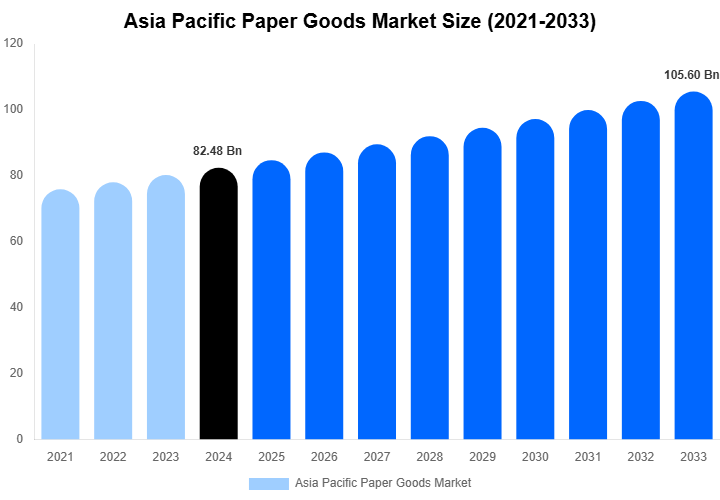
Source: DMI Analysis Company Publications, Primary Interviews.

Other Key Findings
- In 2025, Asia Pacific accounted for 23.16% of the global Paper Goods Market size.
- By 2034, United States is projected to lead the global market in terms of market size.
- Taiwan is projected to emerge as the fastest-growing market in Asia Pacific, reaching USD 4.56 Billion by 2034.
Asia Pacific Paper Goods Market Dynamics
- Asia Pacific's paper goods market is expanding through increasing demand for tissue products, packaging materials, household paper, and commercial paper supported by urbanization, industrial growth, and rising hygiene awareness. Consumers increasingly seek premium paper products, sustainable materials, and improved product quality across diverse applications.
- Supermarkets, convenience stores, wholesalers, office supply retailers, industrial distributors, and e-commerce platforms strengthen accessibility through expanding distribution networks and integrated digital commerce. Retailers increasingly promote environmentally responsible paper goods, premium tissue collections, and innovative packaging materials to meet evolving consumer expectations.
- Manufacturers invest in recycled fiber technologies, biodegradable paper solutions, lightweight packaging materials, and advanced production systems to strengthen product differentiation. Innovation also emphasizes efficient resource utilization, specialty paper development, and sustainable manufacturing practices that align with regional environmental priorities.
- Paper companies collaborate with packaging manufacturers, retailers, commercial users, logistics providers, and sustainability organizations to strengthen supply chain efficiency and product innovation. Continued investment in production modernization, responsible sourcing, and omnichannel distribution reinforces competitiveness across the regional paper goods industry.
Key Industry Insights
- Urbanization supports household paper demand.
- Recycled fibers strengthen sustainable manufacturing.
- Premium tissue products gain wider acceptance.
- E-commerce increases packaging paper consumption.
Asia Pacific Paper Goods Market Country 2026-2034 (USD Billion)
| Asia Pacific | 2022 | 2023 | 2024 | 2025 | 2026 | 2027 | 2028 | 2029 | 2030 | 2031 | 2032 | 2033 | 2034 |
|---|---|---|---|---|---|---|---|---|---|---|---|---|---|
| China | XX.x | XX.x | XX.x | 26.44 | XX.x | XX.x | XX.x | XX.x | XX.x | XX.x | XX.x | XX.x | XX.x |
| India | XX.x | XX.x | XX.x | XX.x | XX.x | XX.x | XX.x | XX.x | XX.x | XX.x | XX.x | XX.x | XX.x |
| Japan | XX.x | XX.x | XX.x | XX.x | XX.x | XX.x | XX.x | XX.x | XX.x | XX.x | XX.x | XX.x | XX.x |
| Korea | XX.x | XX.x | XX.x | XX.x | XX.x | XX.x | XX.x | XX.x | XX.x | XX.x | XX.x | XX.x | XX.x |
| Taiwan | XX.x | XX.x | XX.x | XX.x | XX.x | XX.x | XX.x | XX.x | XX.x | XX.x | XX.x | XX.x | XX.x |
| Australia | XX.x | XX.x | XX.x | XX.x | XX.x | XX.x | XX.x | XX.x | XX.x | XX.x | XX.x | XX.x | XX.x |
| Singapore | XX.x | XX.x | XX.x | XX.x | XX.x | XX.x | XX.x | XX.x | XX.x | XX.x | XX.x | XX.x | XX.x |
| South East Asia | XX.x | XX.x | XX.x | XX.x | XX.x | XX.x | XX.x | XX.x | XX.x | XX.x | XX.x | XX.x | XX.x |
| Total | XX.x | XX.x | XX.x | 69.58 | XX.x | XX.x | XX.x | XX.x | XX.x | XX.x | XX.x | XX.x | XX.x |
Source: DMI Analysis Company Publications, Primary Interviews.
Asia Pacific Paper Goods Market Product Type 2026-2034 (USD Billion)
| Product Type | 2022 | 2023 | 2024 | 2025 | 2026 | 2027 | 2028 | 2029 | 2030 | 2031 | 2032 | 2033 | 2034 |
|---|---|---|---|---|---|---|---|---|---|---|---|---|---|
| Tissue & hygiene (toilet tissue, paper towels) | XX.x | XX.x | XX.x | 28.92 | XX.x | XX.x | XX.x | XX.x | XX.x | XX.x | XX.x | XX.x | XX.x |
| Packaging paper & board | XX.x | XX.x | XX.x | XX.x | XX.x | XX.x | XX.x | XX.x | XX.x | XX.x | XX.x | XX.x | XX.x |
| Printing & writing paper | XX.x | XX.x | XX.x | XX.x | XX.x | XX.x | XX.x | XX.x | XX.x | XX.x | XX.x | XX.x | XX.x |
| Disposable tableware (paper plates, cups) | XX.x | XX.x | XX.x | XX.x | XX.x | XX.x | XX.x | XX.x | XX.x | XX.x | XX.x | XX.x | XX.x |
| Total | XX.x | XX.x | XX.x | 69.59 | XX.x | XX.x | XX.x | XX.x | XX.x | XX.x | XX.x | XX.x | XX.x |
Source: DMI Analysis Company Publications, Primary Interviews.
Asia Pacific Paper Goods Market End Use Industry 2026-2034 (USD Billion)
| End Use Industry | 2022 | 2023 | 2024 | 2025 | 2026 | 2027 | 2028 | 2029 | 2030 | 2031 | 2032 | 2033 | 2034 |
|---|---|---|---|---|---|---|---|---|---|---|---|---|---|
| Food & beverage packaging | XX.x | XX.x | XX.x | 37.32 | XX.x | XX.x | XX.x | XX.x | XX.x | XX.x | XX.x | XX.x | XX.x |
| Consumer hygiene | XX.x | XX.x | XX.x | XX.x | XX.x | XX.x | XX.x | XX.x | XX.x | XX.x | XX.x | XX.x | XX.x |
| Industrial packaging | XX.x | XX.x | XX.x | XX.x | XX.x | XX.x | XX.x | XX.x | XX.x | XX.x | XX.x | XX.x | XX.x |
| Total | XX.x | XX.x | XX.x | 69.59 | XX.x | XX.x | XX.x | XX.x | XX.x | XX.x | XX.x | XX.x | XX.x |
Source: DMI Analysis Company Publications, Primary Interviews.
Asia Pacific Paper Goods Market Distribution Channel 2026-2034 (USD Billion)
| Distribution Channel | 2022 | 2023 | 2024 | 2025 | 2026 | 2027 | 2028 | 2029 | 2030 | 2031 | 2032 | 2033 | 2034 |
|---|---|---|---|---|---|---|---|---|---|---|---|---|---|
| B2B direct | XX.x | XX.x | XX.x | XX.x | XX.x | XX.x | XX.x | XX.x | XX.x | XX.x | XX.x | XX.x | XX.x |
| Retail / wholesale | XX.x | XX.x | XX.x | XX.x | XX.x | XX.x | XX.x | XX.x | XX.x | XX.x | XX.x | XX.x | XX.x |
| Total | XX.x | XX.x | XX.x | XX.x | XX.x | XX.x | XX.x | XX.x | XX.x | XX.x | XX.x | XX.x | XX.x |
Source: DMI Analysis Company Publications, Primary Interviews.
Inside This Report
This section examines Asia Pacific's paper goods market through consumption patterns, retail developments, product innovation, sustainability initiatives, and commercial strategies. It highlights how manufacturers strengthen competitiveness by expanding premium product offerings, improving environmental performance, and enhancing regional distribution capabilities.
- Regional market landscape: Reviews Asia Pacific's paper goods ecosystem.
- Consumer and purchasing trends: Explores hygiene and packaging demand.
- Product innovation and distribution: Covers recycled materials and sustainable production.
- Competitive and industry developments: Highlights manufacturing modernization and responsible sourcing.
Report Summary
| Report Scope | Details |
|---|---|
| Base Year for Study | 2025 |
| Study Period | 2022-2034 |
| Historical Period | 2022-2024 |
| Forecast Period | 2026-2034 |
| Market Size In 2025 | USD 69.59 Billion |
| Market Size In 2034 | USD 89.33 Billion |
| Largest segment | Tissue & hygiene (toilet tissue, paper towels) |
| Units | Revenue in USD Billion |
| CAGR | 2.87% (2026-2034) |
| Report Coverage | Revenue Forecast, Competitive Landscape, Growth Factors, Environment & Regulatory Landscape and Trends |