Japan Luxury Residential Real Estate Market Size & Outlook, 2026-2034
Last Updated : 10 August, 2026 |
Study Period : 2022-2034 |
Format : PDF, Excel |
Author : Anna Morgan
Japan Luxury Residential Real Estate Market Insights
- As highlighted in Deep Market Insights analysis, the Japan Luxury Residential Real Estate Market, worth USD 35.12 Billion in 2025, is forecasted to achieve USD 61.01 Billion by 2034.
- The Japan market is anticipated to grow at a CAGR of 6.36% during the period 2026–2034.
- By 2025, Penthouses represented the largest share of the Property Type market size.
- Waterfront Estates is expected to remain the key growth driver within Property Type, registering the fastest CAGR during the forecast period.
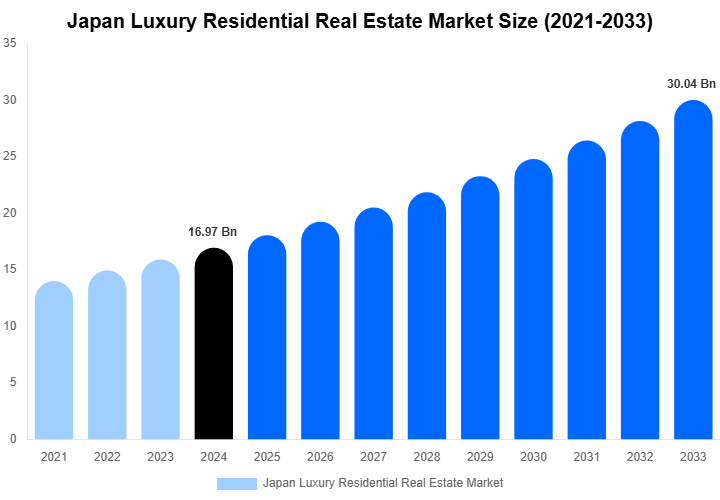
Source: DMI Analysis Company Publications, Primary Interviews.

Other Key Findings
- As of 2025, Japan held 4.61% of the global Luxury Residential Real Estate Market size.
- By 2034, United States is anticipated to capture the largest share of the global Luxury Residential Real Estate Market.
- In Asia Pacific, China is expected to lead the regional Luxury Residential Real Estate Market size by 2034.
- Korea will remain the fastest-growing market in Asia Pacific, reaching USD 23.59 Billion by 2034.
Japan Luxury Residential Real Estate Market Dynamics
- Japan's luxury residential real estate category reflects demand for premium urban living, architectural excellence, privacy, and long-term asset preservation. Affluent domestic buyers and international investors increasingly prioritize prime locations, smart home technologies, security, and high-quality design with convenient access to commercial districts.
- Luxury apartments, branded residences, waterfront developments, and exclusive villas are marketed through specialized real estate agencies, private broker networks, and developer-led sales platforms. Digital property tours and personalized advisory services increasingly support high-value residential transactions.
- Developers increasingly differentiate projects through sustainable architecture, wellness amenities, concierge services, earthquake-resistant construction, energy-efficient technologies, and flexible interior layouts. Premium residences increasingly integrate lifestyle-focused facilities such as fitness centers, private lounges, and landscaped outdoor spaces.
- Urban redevelopment, international investment, and evolving lifestyle preferences continue shaping premium residential development. Developers emphasize exclusive communities, design innovation, premium craftsmanship, and personalized living experiences to strengthen competitiveness within Japan's luxury housing landscape.
Key Industry Insights
- Prime urban districts attract affluent buyers.
- Smart home features enhance premium residences.
- Concierge services strengthen luxury positioning.
- Sustainable architecture supports premium developments.
Japan Luxury Residential Real Estate Market Property Type 2026-2034 (USD Billion)
| Property Type | 2022 | 2023 | 2024 | 2025 | 2026 | 2027 | 2028 | 2029 | 2030 | 2031 | 2032 | 2033 | 2034 |
|---|---|---|---|---|---|---|---|---|---|---|---|---|---|
| Penthouses | XX.x | XX.x | XX.x | 17.17 | XX.x | XX.x | XX.x | XX.x | XX.x | XX.x | XX.x | XX.x | XX.x |
| Villas | XX.x | XX.x | XX.x | XX.x | XX.x | XX.x | XX.x | XX.x | XX.x | XX.x | XX.x | XX.x | XX.x |
| Waterfront Estates | XX.x | XX.x | XX.x | XX.x | XX.x | XX.x | XX.x | XX.x | XX.x | XX.x | XX.x | XX.x | XX.x |
| Total | XX.x | XX.x | XX.x | 35.12 | XX.x | XX.x | XX.x | XX.x | XX.x | XX.x | XX.x | XX.x | XX.x |
Source: DMI Analysis Company Publications, Primary Interviews.
Japan Luxury Residential Real Estate Market Buyer Type 2026-2034 (USD Billion)
| Buyer Type | 2022 | 2023 | 2024 | 2025 | 2026 | 2027 | 2028 | 2029 | 2030 | 2031 | 2032 | 2033 | 2034 |
|---|---|---|---|---|---|---|---|---|---|---|---|---|---|
| Domestic Wealthy | XX.x | XX.x | XX.x | 18.28 | XX.x | XX.x | XX.x | XX.x | XX.x | XX.x | XX.x | XX.x | XX.x |
| UHNWIs | XX.x | XX.x | XX.x | XX.x | XX.x | XX.x | XX.x | XX.x | XX.x | XX.x | XX.x | XX.x | XX.x |
| Foreign Investors | XX.x | XX.x | XX.x | XX.x | XX.x | XX.x | XX.x | XX.x | XX.x | XX.x | XX.x | XX.x | XX.x |
| Total | XX.x | XX.x | XX.x | 35.13 | XX.x | XX.x | XX.x | XX.x | XX.x | XX.x | XX.x | XX.x | XX.x |
Source: DMI Analysis Company Publications, Primary Interviews.
Japan Luxury Residential Real Estate Market Sales Channel 2026-2034 (USD Billion)
| Sales Channel | 2022 | 2023 | 2024 | 2025 | 2026 | 2027 | 2028 | 2029 | 2030 | 2031 | 2032 | 2033 | 2034 |
|---|---|---|---|---|---|---|---|---|---|---|---|---|---|
| Brokers | XX.x | XX.x | XX.x | XX.x | XX.x | XX.x | XX.x | XX.x | XX.x | XX.x | XX.x | XX.x | XX.x |
| Developers | XX.x | XX.x | XX.x | XX.x | XX.x | XX.x | XX.x | XX.x | XX.x | XX.x | XX.x | XX.x | XX.x |
| Total | XX.x | XX.x | XX.x | XX.x | XX.x | XX.x | XX.x | XX.x | XX.x | XX.x | XX.x | XX.x | XX.x |
Source: DMI Analysis Company Publications, Primary Interviews.
Inside This Report
This section examines Japan's luxury residential real estate industry through premium housing demand, urban redevelopment, architectural innovation, sustainability, smart living technologies, and buyer preferences. It explores how developers differentiate projects through exclusive amenities, design quality, and personalized residential experiences.
- Country market landscape: Reviews Japan's luxury residential development ecosystem.
- Consumer and purchasing trends: Explores exclusivity, location, design, and lifestyle preferences.
- Product innovation and distribution: Covers smart homes, wellness amenities, and sustainable architecture.
- Competitive and industry developments: Highlights redevelopment, premium services, and investment trends.
Report Summary
| Report Scope | Details |
|---|---|
| Base Year for Study | 2025 |
| Study Period | 2022-2034 |
| Historical Period | 2022-2024 |
| Forecast Period | 2026-2034 |
| Market Size In 2025 | USD 35.12 Billion |
| Market Size In 2034 | USD 61.01 Billion |
| Largest segment | Penthouses |
| Units | Revenue in USD Billion |
| CAGR | 6.36% (2026-2034) |
| Report Coverage | Revenue Forecast, Competitive Landscape, Growth Factors, Environment & Regulatory Landscape and Trends |