India Luxury Car Market Size & Outlook, 2026-2034
Last Updated : 30 July, 2026 |
Study Period : 2022-2034 |
Format : PDF, Excel |
Author : Anna Morgan
India Luxury Car Market Insights
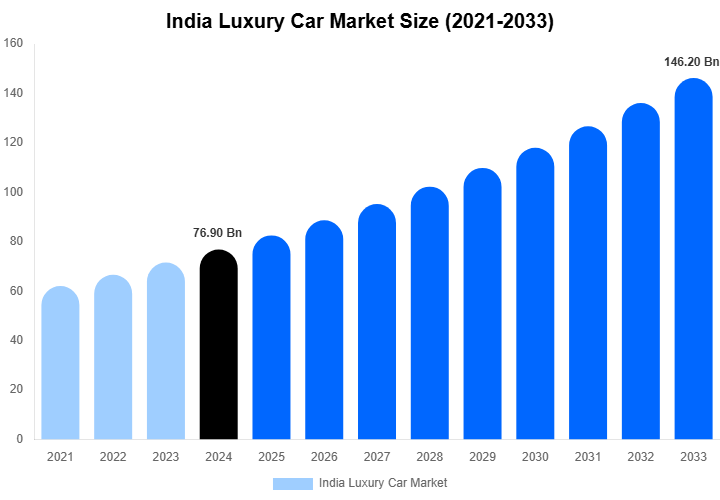
- As per Deep Market Insights insights, the India Luxury Car Market stood at USD 43 Billion in 2025 and is anticipated to grow to USD 82.17 Billion by 2034.
- The India market is expected to advance at a CAGR of 7.4% from 2026 through 2034.
- In 2025, ICE Luxury accounted for the highest share of the Propulsion market size.
- During the forecast period, ICE Luxury is set to register the highest growth, making it the most lucrative Propulsion segment.
Source: DMI Analysis Company Publications, Primary Interviews.

Other Key Findings
- In 2025, India accounted for 2.91% of the global Luxury Car Market size.
- By 2034, United States is expected to lead the global Luxury Car Market in terms of market size.
- Within Asia Pacific, China is projected to dominate the regional Luxury Car Market size by 2034.
- South East Asia is identified as the fastest-growing market in Asia Pacific, anticipated to reach USD 44.1 Billion by 2034.
India Luxury Car Market Dynamics
- India's luxury car market is driven by rising disposable incomes, increasing high-net-worth individuals, growing demand for premium mobility, expanding luxury SUV adoption, and increasing preference for technologically advanced vehicles. Consumers increasingly purchase luxury sedans, premium SUVs, performance vehicles, and luxury electric vehicles that offer superior comfort, safety, connectivity, and brand prestige.
- Luxury automobile manufacturers, authorized dealerships, financial institutions, leasing providers, digital automotive platforms, and premium mobility companies strengthen market accessibility through flexible financing, subscription services, personalized buying experiences, and expanding dealership networks. Companies increasingly improve digital engagement, premium after-sales services, and customer relationship programs.
- Luxury vehicle manufacturers invest in electric mobility, connected vehicle technologies, AI-powered driver assistance systems, premium interiors, lightweight materials, and advanced infotainment platforms to strengthen competitive differentiation. Innovation also emphasizes luxury EVs, intelligent safety systems, personalized digital experiences, and sustainable mobility solutions.
- Market participants collaborate with automotive technology companies, charging infrastructure providers, software developers, financial institutions, and mobility service providers to strengthen product innovation and ecosystem development. Continued investment in electrification, connected mobility, premium ownership experiences, and digital retail reinforces competitiveness across India's luxury car industry.
Key Market Insights
- Premium SUV demand strengthens growth.
- Luxury EV adoption expands opportunities.
- Financing solutions improve accessibility.
- Connected technologies enhance competitiveness.
India Luxury Car Market Propulsion 2026-2034 (USD Billion)
| Propulsion | 2022 | 2023 | 2024 | 2025 | 2026 | 2027 | 2028 | 2029 | 2030 | 2031 | 2032 | 2033 | 2034 |
|---|---|---|---|---|---|---|---|---|---|---|---|---|---|
| ICE Luxury | XX.x | XX.x | XX.x | 20.2 | XX.x | XX.x | XX.x | XX.x | XX.x | XX.x | XX.x | XX.x | XX.x |
| Hybrid | XX.x | XX.x | XX.x | XX.x | XX.x | XX.x | XX.x | XX.x | XX.x | XX.x | XX.x | XX.x | XX.x |
| EV Luxury | XX.x | XX.x | XX.x | XX.x | XX.x | XX.x | XX.x | XX.x | XX.x | XX.x | XX.x | XX.x | XX.x |
| Total | XX.x | XX.x | XX.x | 43.00 | XX.x | XX.x | XX.x | XX.x | XX.x | XX.x | XX.x | XX.x | XX.x |
Source: DMI Analysis Company Publications, Primary Interviews.
India Luxury Car Market Vehicle Type 2026-2034 (USD Billion)
| Vehicle Type | 2022 | 2023 | 2024 | 2025 | 2026 | 2027 | 2028 | 2029 | 2030 | 2031 | 2032 | 2033 | 2034 |
|---|---|---|---|---|---|---|---|---|---|---|---|---|---|
| Sedan | XX.x | XX.x | XX.x | XX.x | XX.x | XX.x | XX.x | XX.x | XX.x | XX.x | XX.x | XX.x | XX.x |
| SUV | XX.x | XX.x | XX.x | XX.x | XX.x | XX.x | XX.x | XX.x | XX.x | XX.x | XX.x | XX.x | XX.x |
| Total | XX.x | XX.x | XX.x | XX.x | XX.x | XX.x | XX.x | XX.x | XX.x | XX.x | XX.x | XX.x | XX.x |
Source: DMI Analysis Company Publications, Primary Interviews.
India Luxury Car Market Price Tier 2026-2034 (USD Billion)
| Price Tier | 2022 | 2023 | 2024 | 2025 | 2026 | 2027 | 2028 | 2029 | 2030 | 2031 | 2032 | 2033 | 2034 |
|---|---|---|---|---|---|---|---|---|---|---|---|---|---|
| Mid | XX.x | XX.x | XX.x | 20.03 | XX.x | XX.x | XX.x | XX.x | XX.x | XX.x | XX.x | XX.x | XX.x |
| Premium | XX.x | XX.x | XX.x | XX.x | XX.x | XX.x | XX.x | XX.x | XX.x | XX.x | XX.x | XX.x | XX.x |
| Ultra | XX.x | XX.x | XX.x | XX.x | XX.x | XX.x | XX.x | XX.x | XX.x | XX.x | XX.x | XX.x | XX.x |
| Total | XX.x | XX.x | XX.x | 43.01 | XX.x | XX.x | XX.x | XX.x | XX.x | XX.x | XX.x | XX.x | XX.x |
Source: DMI Analysis Company Publications, Primary Interviews.
Inside This Report
This section examines India's luxury car market through premium mobility trends, electrification, consumer purchasing behavior, technological innovation, and competitive strategies.
- Country market landscape: Reviews India's luxury car ecosystem.
- Consumer and mobility trends: Explores luxury ownership, premium SUVs, EV adoption, and digital buying preferences.
- Product innovation and applications: Covers luxury sedans, SUVs, EVs, and performance vehicles.
- Competitive and industry developments: Highlights innovation, partnerships, and market expansion.
Report Summary
| Report Scope | Details |
|---|---|
| Base Year for Study | 2025 |
| Study Period | 2022-2034 |
| Historical Period | 2022-2024 |
| Forecast Period | 2026-2034 |
| Market Size In 2025 | USD 43 Billion |
| Market Size In 2034 | USD 82.17 Billion |
| Largest segment | ICE Luxury |
| Units | Revenue in USD Billion |
| CAGR | 7.4% (2026-2034) |
| Report Coverage | Revenue Forecast, Competitive Landscape, Growth Factors, Environment & Regulatory Landscape and Trends |