Asia Pacific Co-Living Market Size & Outlook, 2026-2034
Last Updated : 27 July, 2026 |
Study Period : 2022-2034 |
Format : PDF, Excel |
Author : Abigail Foster
Asia Pacific Co-Living Market Insights
- As per Deep Market Insights insights, Asia Pacific’s Co-Living Market was valued at USD 2884.77 Million in 2025 and is anticipated to expand to USD 9369.26 Million by 2034.
- From 2026 to 2034, the market is anticipated to expand at a CAGR of 13.86%.
- Within Property Type, Managed Co-living accounted for the largest market size in 2025.
- During the forecast period, Managed Co-living is anticipated to remain the highest-growth segment within the Property Type category.
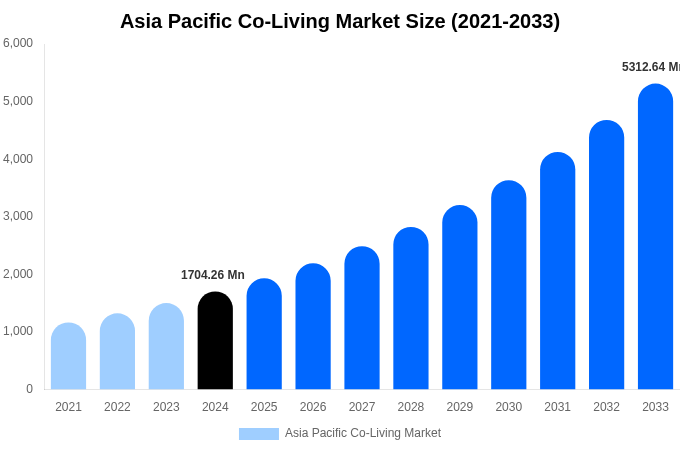
Source: DMI Analysis Company Publications, Primary Interviews.

Other Key Findings
- The global Co-Living Market size saw Asia Pacific holding a share of 30.16% in 2025.
- United States is forecasted to account for the leading share of the global market by 2034.
- In Asia Pacific, Taiwan is forecasted to be the fastest-expanding market, projected to reach USD 487.52 Million by 2034.
Asia Pacific Co-living Market Dynamics
- Asia Pacific's co-living market continues expanding as rapid urbanization, increasing workforce mobility, and rising housing demand encourage adoption of flexible residential solutions. Young professionals, students, and expatriates increasingly prefer furnished accommodations featuring shared amenities, digital leasing, and community-oriented living experiences.
- Managed accommodation operators, property developers, digital rental platforms, institutional investors, and real estate agencies strengthen accessibility through expanding omnichannel leasing services. Operators increasingly broaden managed housing portfolios, improve resident engagement, and optimize digital property management to strengthen occupancy and customer satisfaction.
- Companies invest in smart building technologies, sustainable residential developments, flexible lease structures, premium communal facilities, digital resident platforms, and wellness-focused amenities to strengthen competitive differentiation. Innovation also emphasizes co-working spaces, automated maintenance, energy-efficient infrastructure, and personalized tenant experiences aligned with changing housing preferences.
- Co-living operators collaborate with property owners, employers, universities, technology providers, facility management companies, and relocation partners to strengthen operational efficiency and service quality. Continued investment in digital transformation, sustainable housing, and community-driven living environments reinforces competitiveness across Asia Pacific's co-living industry.
Key Industry Insights
- Urbanization accelerates co-living adoption.
- Smart technologies improve operational efficiency.
- Flexible housing attracts mobile residents.
- Community amenities strengthen resident satisfaction.
Asia Pacific Co-Living Market Country 2026-2034 (USD Million)
| Asia Pacific | 2022 | 2023 | 2024 | 2025 | 2026 | 2027 | 2028 | 2029 | 2030 | 2031 | 2032 | 2033 | 2034 |
|---|---|---|---|---|---|---|---|---|---|---|---|---|---|
| China | XX.x | XX.x | XX.x | 1098.23 | XX.x | XX.x | XX.x | XX.x | XX.x | XX.x | XX.x | XX.x | XX.x |
| India | XX.x | XX.x | XX.x | XX.x | XX.x | XX.x | XX.x | XX.x | XX.x | XX.x | XX.x | XX.x | XX.x |
| Japan | XX.x | XX.x | XX.x | XX.x | XX.x | XX.x | XX.x | XX.x | XX.x | XX.x | XX.x | XX.x | XX.x |
| Korea | XX.x | XX.x | XX.x | XX.x | XX.x | XX.x | XX.x | XX.x | XX.x | XX.x | XX.x | XX.x | XX.x |
| Taiwan | XX.x | XX.x | XX.x | XX.x | XX.x | XX.x | XX.x | XX.x | XX.x | XX.x | XX.x | XX.x | XX.x |
| Australia | XX.x | XX.x | XX.x | XX.x | XX.x | XX.x | XX.x | XX.x | XX.x | XX.x | XX.x | XX.x | XX.x |
| Singapore | XX.x | XX.x | XX.x | XX.x | XX.x | XX.x | XX.x | XX.x | XX.x | XX.x | XX.x | XX.x | XX.x |
| South East Asia | XX.x | XX.x | XX.x | XX.x | XX.x | XX.x | XX.x | XX.x | XX.x | XX.x | XX.x | XX.x | XX.x |
| Total | XX.x | XX.x | XX.x | 2,884.78 | XX.x | XX.x | XX.x | XX.x | XX.x | XX.x | XX.x | XX.x | XX.x |
Source: DMI Analysis Company Publications, Primary Interviews.
Asia Pacific Co-Living Market Property Type 2026-2034 (USD Million)
| Property Type | 2022 | 2023 | 2024 | 2025 | 2026 | 2027 | 2028 | 2029 | 2030 | 2031 | 2032 | 2033 | 2034 |
|---|---|---|---|---|---|---|---|---|---|---|---|---|---|
| Managed Co-living | XX.x | XX.x | XX.x | XX.x | XX.x | XX.x | XX.x | XX.x | XX.x | XX.x | XX.x | XX.x | XX.x |
| Independent Co-living | XX.x | XX.x | XX.x | XX.x | XX.x | XX.x | XX.x | XX.x | XX.x | XX.x | XX.x | XX.x | XX.x |
| Total | XX.x | XX.x | XX.x | XX.x | XX.x | XX.x | XX.x | XX.x | XX.x | XX.x | XX.x | XX.x | XX.x |
Source: DMI Analysis Company Publications, Primary Interviews.
Asia Pacific Co-Living Market Room Type 2026-2034 (USD Million)
| Room Type | 2022 | 2023 | 2024 | 2025 | 2026 | 2027 | 2028 | 2029 | 2030 | 2031 | 2032 | 2033 | 2034 |
|---|---|---|---|---|---|---|---|---|---|---|---|---|---|
| Studio | XX.x | XX.x | XX.x | 1311.13 | XX.x | XX.x | XX.x | XX.x | XX.x | XX.x | XX.x | XX.x | XX.x |
| Shared Room | XX.x | XX.x | XX.x | XX.x | XX.x | XX.x | XX.x | XX.x | XX.x | XX.x | XX.x | XX.x | XX.x |
| Private Room | XX.x | XX.x | XX.x | XX.x | XX.x | XX.x | XX.x | XX.x | XX.x | XX.x | XX.x | XX.x | XX.x |
| Total | XX.x | XX.x | XX.x | 2,884.77 | XX.x | XX.x | XX.x | XX.x | XX.x | XX.x | XX.x | XX.x | XX.x |
Source: DMI Analysis Company Publications, Primary Interviews.
Asia Pacific Co-Living Market End User 2026-2034 (USD Million)
| End User | 2022 | 2023 | 2024 | 2025 | 2026 | 2027 | 2028 | 2029 | 2030 | 2031 | 2032 | 2033 | 2034 |
|---|---|---|---|---|---|---|---|---|---|---|---|---|---|
| Students | XX.x | XX.x | XX.x | 1419.6 | XX.x | XX.x | XX.x | XX.x | XX.x | XX.x | XX.x | XX.x | XX.x |
| Young Professionals | XX.x | XX.x | XX.x | XX.x | XX.x | XX.x | XX.x | XX.x | XX.x | XX.x | XX.x | XX.x | XX.x |
| Digital Nomads | XX.x | XX.x | XX.x | XX.x | XX.x | XX.x | XX.x | XX.x | XX.x | XX.x | XX.x | XX.x | XX.x |
| Total | XX.x | XX.x | XX.x | 2,884.78 | XX.x | XX.x | XX.x | XX.x | XX.x | XX.x | XX.x | XX.x | XX.x |
Source: DMI Analysis Company Publications, Primary Interviews.
Inside This Report
This section examines Asia Pacific's co-living market through changing residential preferences, property innovation, operational developments, and competitive strategies. It highlights how operators strengthen competitiveness by expanding managed accommodation portfolios, improving digital property management, and investing in community-focused residential solutions.
- Regional market landscape: Reviews Asia Pacific's co-living ecosystem.
- Consumer and purchasing trends: Explores tenant lifestyle preferences.
- Product innovation and distribution: Covers property innovation and leasing services.
- Competitive and industry developments: Highlights operator expansion and sustainability initiatives.
Report Summary
| Report Scope | Details |
|---|---|
| Base Year for Study | 2025 |
| Study Period | 2022-2034 |
| Historical Period | 2022-2024 |
| Forecast Period | 2026-2034 |
| Market Size In 2025 | USD 2884.77 Million |
| Market Size In 2034 | USD 9369.26 Million |
| Largest segment | Managed Co-living |
| Units | Revenue in USD Million |
| CAGR | 13.86% (2026-2034) |
| Report Coverage | Revenue Forecast, Competitive Landscape, Growth Factors, Environment & Regulatory Landscape and Trends |