Asia Pacific Books Market Size & Outlook, 2026-2034
Last Updated : 27 July, 2026 |
Study Period : 2022-2034 |
Format : PDF, Excel |
Author : Anna Morgan
Asia Pacific Books Market Insights
- According to Deep Market Insights analysis, the Asia Pacific Books Market size stood at USD 35.81 Billion in 2025 and is forecasted to reach USD 51.24 Billion by 2034.
- The market is projected to grow at a CAGR of 4.03% between 2026 and 2034.
- By segment, Print was the leading Format in terms of market size in 2025.
- Print is expected to be the most lucrative Format segment, exhibiting the fastest growth throughout the forecast period.
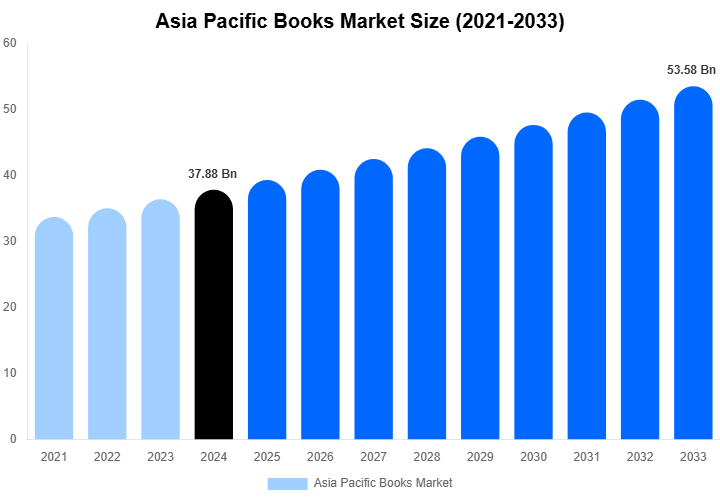
Source: DMI Analysis Company Publications, Primary Interviews.

Other Key Findings
- Asia Pacific held 21.13% share of the global Books Market size in 2025.
- United States is expected to remain the largest contributor to the global market size by 2034.
- By 2034, Taiwan is anticipated to record the highest growth in Asia Pacific, with the market size expected to reach USD 2.61 Billion.
Asia Pacific Books Market Dynamics
- Asia Pacific's books market continues expanding through increasing literacy, educational investments, digital reading adoption, and growing demand for recreational reading. Consumers increasingly purchase print books, e-books, audiobooks, educational publications, and multilingual content supporting academic achievement, entertainment, and lifelong learning.
- Physical bookstores, online retailers, educational publishers, digital reading platforms, subscription services, and direct-to-consumer publishers strengthen accessibility through expanding omnichannel distribution. Publishers increasingly improve personalized recommendations, digital engagement, AI-enabled content discovery, and reader loyalty initiatives to strengthen recurring purchases.
- Publishers invest in premium publishing quality, audiobook production, digital publishing technologies, sustainable paper sourcing, multilingual content development, and interactive educational resources to strengthen competitive differentiation. Innovation also emphasizes enhanced reader experiences, environmentally responsible manufacturing, AI-supported editorial workflows, and seamless digital accessibility.
- Publishers collaborate with authors, bookstores, educational institutions, technology providers, printing companies, literary organizations, and digital distributors to strengthen operational efficiency and market reach. Continued investment in premium publishing, sustainability, multilingual content, and digital transformation reinforces competitiveness across Asia Pacific's books industry.
Key Industry Insights
- Educational publishing supports growth.
- Digital reading improves accessibility.
- Multilingual content expands readership.
- Sustainable publishing enhances competitiveness.
Asia Pacific Books Market Country 2026-2034 (USD Billion)
| Asia Pacific | 2022 | 2023 | 2024 | 2025 | 2026 | 2027 | 2028 | 2029 | 2030 | 2031 | 2032 | 2033 | 2034 |
|---|---|---|---|---|---|---|---|---|---|---|---|---|---|
| China | XX.x | XX.x | XX.x | 13.62 | XX.x | XX.x | XX.x | XX.x | XX.x | XX.x | XX.x | XX.x | XX.x |
| India | XX.x | XX.x | XX.x | XX.x | XX.x | XX.x | XX.x | XX.x | XX.x | XX.x | XX.x | XX.x | XX.x |
| Japan | XX.x | XX.x | XX.x | XX.x | XX.x | XX.x | XX.x | XX.x | XX.x | XX.x | XX.x | XX.x | XX.x |
| Korea | XX.x | XX.x | XX.x | XX.x | XX.x | XX.x | XX.x | XX.x | XX.x | XX.x | XX.x | XX.x | XX.x |
| Taiwan | XX.x | XX.x | XX.x | XX.x | XX.x | XX.x | XX.x | XX.x | XX.x | XX.x | XX.x | XX.x | XX.x |
| Australia | XX.x | XX.x | XX.x | XX.x | XX.x | XX.x | XX.x | XX.x | XX.x | XX.x | XX.x | XX.x | XX.x |
| Singapore | XX.x | XX.x | XX.x | XX.x | XX.x | XX.x | XX.x | XX.x | XX.x | XX.x | XX.x | XX.x | XX.x |
| South East Asia | XX.x | XX.x | XX.x | XX.x | XX.x | XX.x | XX.x | XX.x | XX.x | XX.x | XX.x | XX.x | XX.x |
| Total | XX.x | XX.x | XX.x | 35.80 | XX.x | XX.x | XX.x | XX.x | XX.x | XX.x | XX.x | XX.x | XX.x |
Source: DMI Analysis Company Publications, Primary Interviews.
Asia Pacific Books Market Format 2026-2034 (USD Billion)
| Format | 2022 | 2023 | 2024 | 2025 | 2026 | 2027 | 2028 | 2029 | 2030 | 2031 | 2032 | 2033 | 2034 |
|---|---|---|---|---|---|---|---|---|---|---|---|---|---|
| XX.x | XX.x | XX.x | 17.53 | XX.x | XX.x | XX.x | XX.x | XX.x | XX.x | XX.x | XX.x | XX.x | |
| Ebook | XX.x | XX.x | XX.x | XX.x | XX.x | XX.x | XX.x | XX.x | XX.x | XX.x | XX.x | XX.x | XX.x |
| Audiobook | XX.x | XX.x | XX.x | XX.x | XX.x | XX.x | XX.x | XX.x | XX.x | XX.x | XX.x | XX.x | XX.x |
| Total | XX.x | XX.x | XX.x | 35.81 | XX.x | XX.x | XX.x | XX.x | XX.x | XX.x | XX.x | XX.x | XX.x |
Source: DMI Analysis Company Publications, Primary Interviews.
Asia Pacific Books Market Category 2026-2034 (USD Billion)
| Category | 2022 | 2023 | 2024 | 2025 | 2026 | 2027 | 2028 | 2029 | 2030 | 2031 | 2032 | 2033 | 2034 |
|---|---|---|---|---|---|---|---|---|---|---|---|---|---|
| Educational | XX.x | XX.x | XX.x | 19.5 | XX.x | XX.x | XX.x | XX.x | XX.x | XX.x | XX.x | XX.x | XX.x |
| Trade | XX.x | XX.x | XX.x | XX.x | XX.x | XX.x | XX.x | XX.x | XX.x | XX.x | XX.x | XX.x | XX.x |
| Professional | XX.x | XX.x | XX.x | XX.x | XX.x | XX.x | XX.x | XX.x | XX.x | XX.x | XX.x | XX.x | XX.x |
| Total | XX.x | XX.x | XX.x | 35.81 | XX.x | XX.x | XX.x | XX.x | XX.x | XX.x | XX.x | XX.x | XX.x |
Source: DMI Analysis Company Publications, Primary Interviews.
Asia Pacific Books Market Distribution 2026-2034 (USD Billion)
| Distribution | 2022 | 2023 | 2024 | 2025 | 2026 | 2027 | 2028 | 2029 | 2030 | 2031 | 2032 | 2033 | 2034 |
|---|---|---|---|---|---|---|---|---|---|---|---|---|---|
| Online Retailers | XX.x | XX.x | XX.x | 16.11 | XX.x | XX.x | XX.x | XX.x | XX.x | XX.x | XX.x | XX.x | XX.x |
| Bookstores | XX.x | XX.x | XX.x | XX.x | XX.x | XX.x | XX.x | XX.x | XX.x | XX.x | XX.x | XX.x | XX.x |
| Direct Sales | XX.x | XX.x | XX.x | XX.x | XX.x | XX.x | XX.x | XX.x | XX.x | XX.x | XX.x | XX.x | XX.x |
| Total | XX.x | XX.x | XX.x | 35.80 | XX.x | XX.x | XX.x | XX.x | XX.x | XX.x | XX.x | XX.x | XX.x |
Source: DMI Analysis Company Publications, Primary Interviews.
Inside This Report
This section examines Asia Pacific's books market through evolving reading preferences, educational demand, publishing innovation, and competitive strategies. It highlights how publishers strengthen competitiveness by expanding premium publishing portfolios, improving digital reading experiences, and enhancing omnichannel distribution across diverse reader segments.
- Regional market landscape: Reviews Asia Pacific's books ecosystem.
- Consumer and purchasing trends: Explores print, digital, and audio reading preferences.
- Product innovation and distribution: Covers digital publishing and omnichannel retail.
- Competitive and industry developments: Highlights publishing innovation and sustainability.
Report Summary
| Report Scope | Details |
|---|---|
| Base Year for Study | 2025 |
| Study Period | 2022-2034 |
| Historical Period | 2022-2024 |
| Forecast Period | 2026-2034 |
| Market Size In 2025 | USD 35.81 Billion |
| Market Size In 2034 | USD 51.24 Billion |
| Largest segment | |
| Units | Revenue in USD Billion |
| CAGR | 4.03% (2026-2034) |
| Report Coverage | Revenue Forecast, Competitive Landscape, Growth Factors, Environment & Regulatory Landscape and Trends |